Month: February 2025

The “Red Special” Comes to Grinnell (1908)

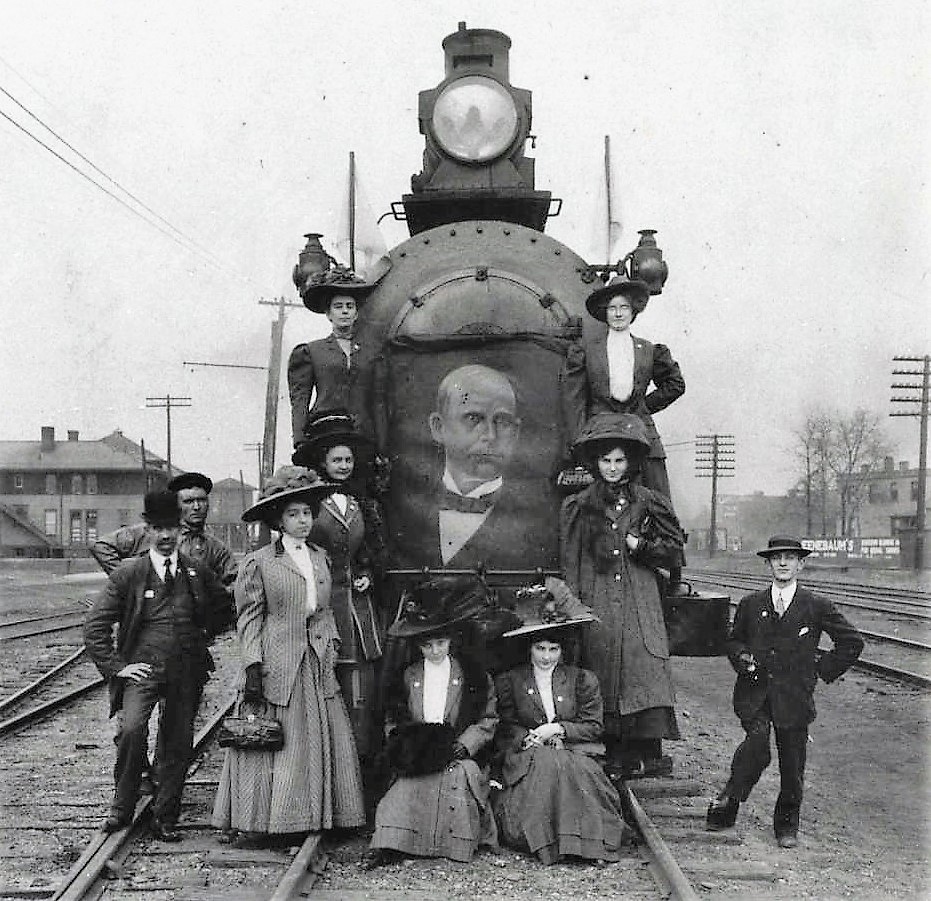
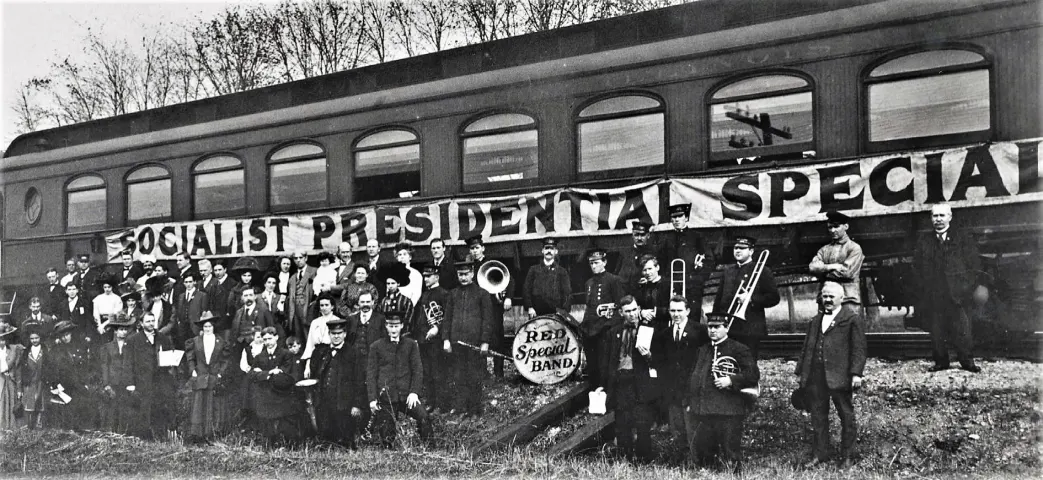
Just after 2pm on the afternoon of September 1st, Eugene Debs’s special train pulled into Grinnell’s Union Station. Debs was running for president on the Socialist party ticket that Fall (1908), and had organized a cross-country campaign in which he and a party of about a hundred supporters, campaign workers, officials, and a musical band, would stop at various cities as their privately rented train made its way from New York to California. Dubbed, the “red special,” Debs’s train (see above and below) stopped at Grinnell for about two hours, giving the band time to play in central park; giving his associates time to distribute campaign flyers, sell party tracts, and solicit donations; and giving Debs time to deliver a speech to students and townspeople who had gathered around the gazebo in the park.
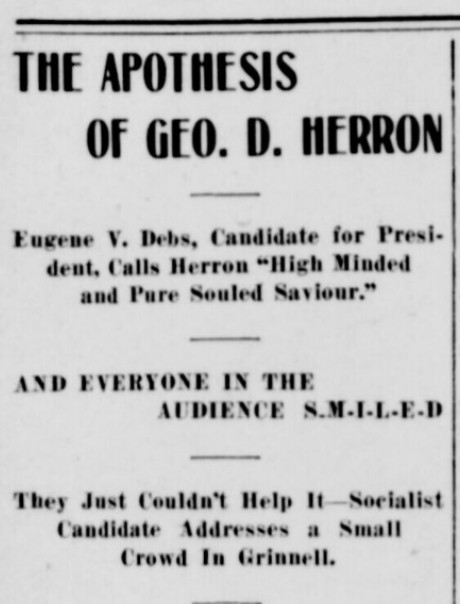
The Grinnell Herald, which was no fan of Debs, noted sarcastically that “Grinnell’s ‘down-trodden’ laboring class was so busy working at from $2 to $5 a day, that they didn’t have time to stop to hear from Mr. Debs how miserable was their condition.” In fact, the paper was less interested in reporting Debs’ political message than in discussing his controversial remarks about ex-Grinnellian, George D. Herron, who had been forced out of his endowed chair in Applied Christianity at the college when he eloped with Carrie Rand, the Dean of Women at the college (and daughter of Elizabeth Rand who had endowed the chair and larger program).  Herron was one of the most prominent spokesmen for the Social Gospel and Christian Socialism, and Debs took this opportunity to chastise Grinnell over its treatment of Herron, saying:

Grinnell had crucified its saviour; that because George D. Herron had been a high-minded, pure-souled man, Grinnell had driven him out and that when all the rest of us are forgotten Mr. Herron will be remembered

In fact, Herron received top-billing in the headline framing the story of Debs’ visit in the Herald:
One person who would have agreed with Debs, however, was Laetitia Moon Conard, who was a personal friend and follower of George Herron; who taught sociology at Grinnell College; and who would eventually run for governor of Iowa on the Socialist party ticket, a few decades later. Sadly, Laetitia never got her own “red special” when she campaigned for the governorship in 1932.


I’ll Take You There: The Staples Singers at Grinnell

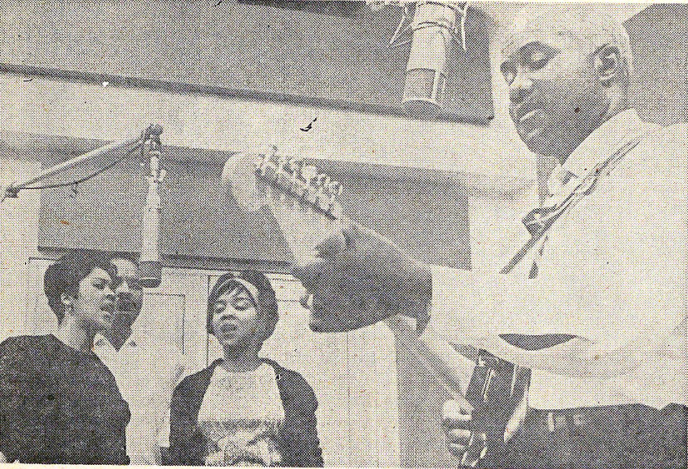
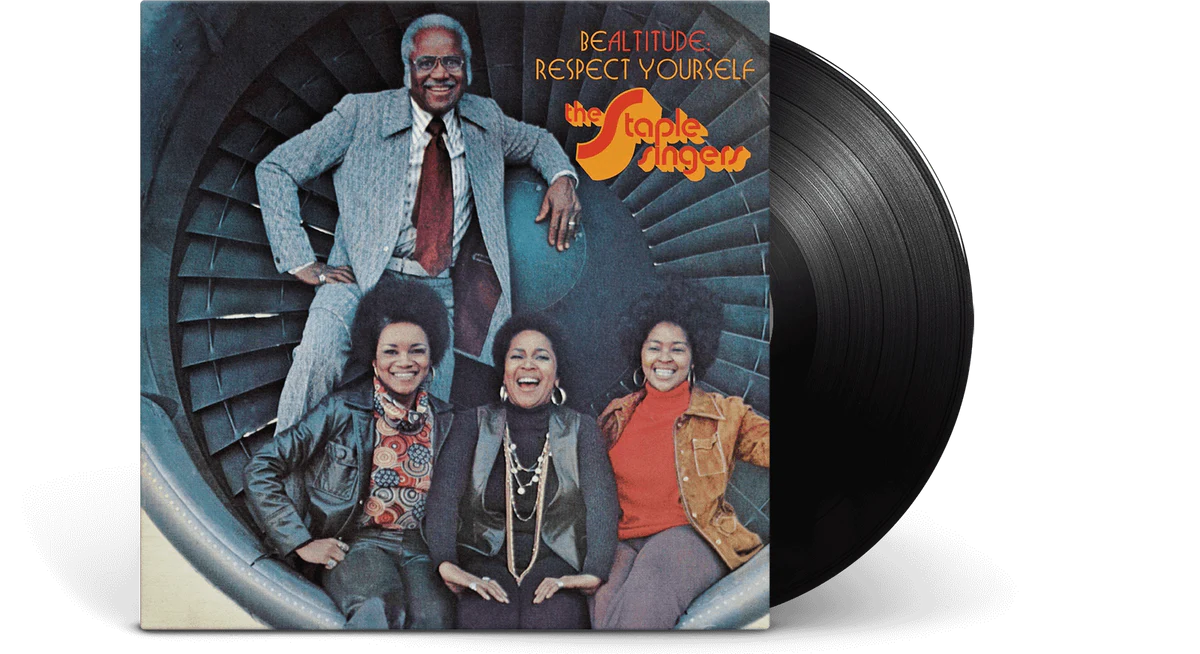
In the 1960s and 1970s, Grinnell had a national reputation for securing some of the best musical acts in the country, by finding talented performers who were on the cusp of breaking through to stardom (due to the legendary work of Georgia Dentel, the “activities counselor” who managed the events programming throughout this period). One  example of this was the Staples Singers, who played Darby Gym on February 17th 1964 (pictured here from the S&B).  In the 1950s and early 60s, this family act had established a name for itself in Gospel circles, but was just beginning to develop cross-over appeal to audiences more attuned to the new sound of “soul” and R&B. In 1965, the group gained more national attention with the release of Freedom Highway (an album that engaged heavily with the events of the civil rights movement) and then signed with Stax Records, in Memphis TN, where they became leaders of the soul movement of the late 1960s and early 1970s (alongside other Stax artists like Isaac Hayes, Sam and Dave, Eddie Floyd, William Bell, and Wilson Pickett).

The Red Cross and the White Lion

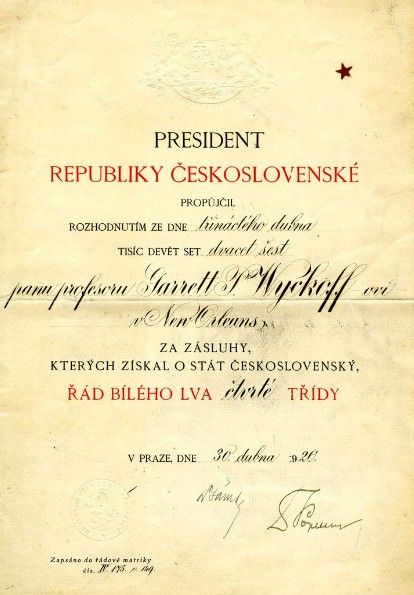
In 1926, Professor Garrett P. Wyckoff (’94) was awarded the Order of the White Lion (čtvrtý třídy, or 4th degree, meaning he was made an “officer” in that order).  The order, which represented Czechoslovakia’s highest civilian honor, was created after World War I to recognize those civilians, particularly foreigners, who had performed extraordinary service to the country. Professor Wyckoff, who taught at Grinnell for a number of years in various departments (including Applied Christianity, Political Science, Economics, and finally, Sociology), had taken leave of teaching duties during World War I to become a field director of the American Red Cross. Wyckoff directed the Gulf division, then moved on to the mid-Atlantic office (not before giving Harry Hopkins, 12′, his first big break by having him appointed as his successor in New Orleans), and then became a commissioner of organization for the League of Red Cross Societies in Geneva, Switzerland. After the war ended, Wyckoff worked for 2 years to establish a branch of the Red Cross in Czechoslovakia, for which he received this honorific award, Řád Bílého lva.


Viewing the Cyclone of 1882

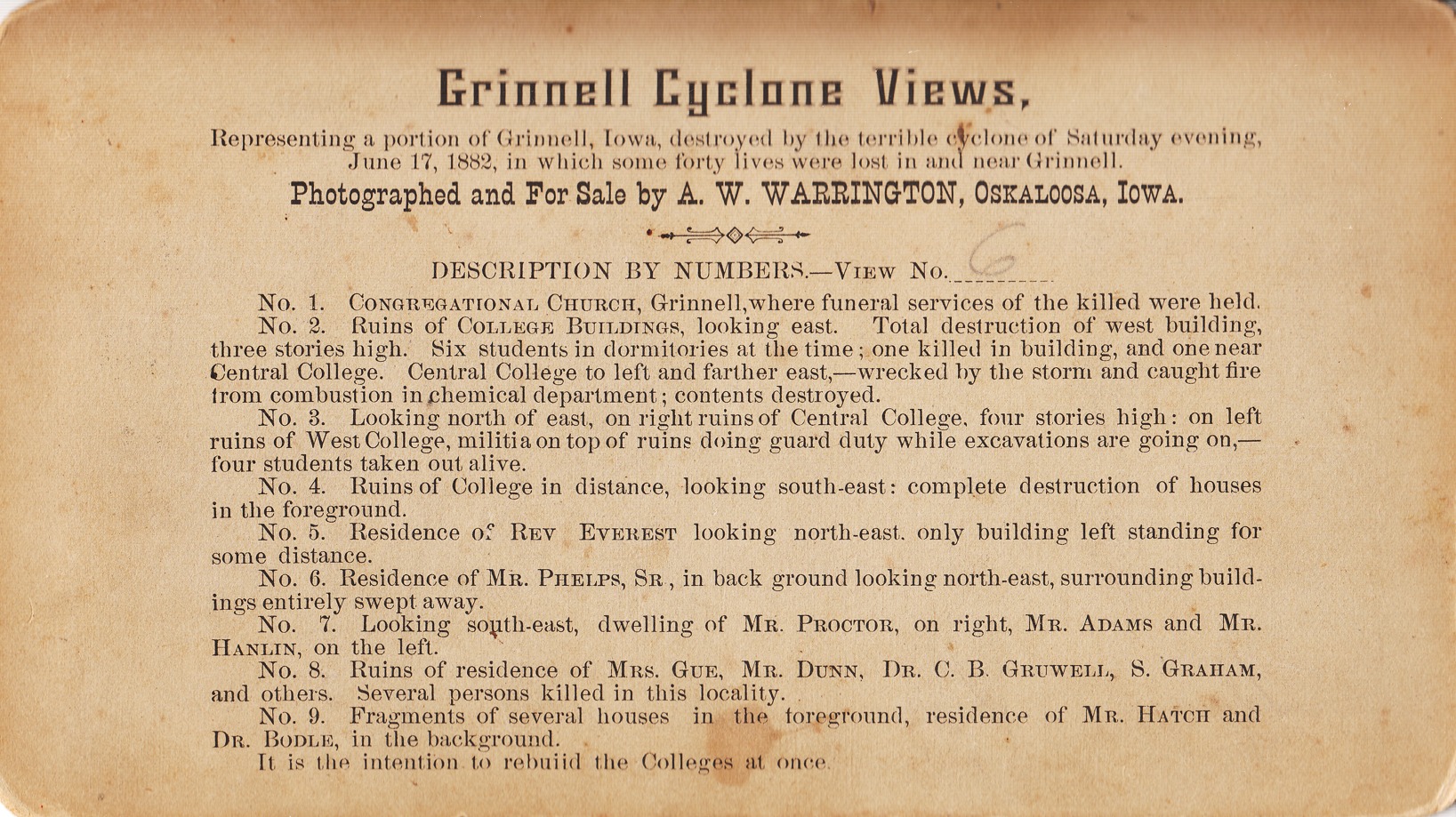
On the evening of June 17, 1882, two tornadoes joined together (near 8th Ave and Broad St.) to form one devastating “cyclone” that destroyed many buildings on campus and in town, killing nearly 40 people (2 of whom were students at the college). This local tragedy received national attention, as various newspapers and magazines reported on the devastation.

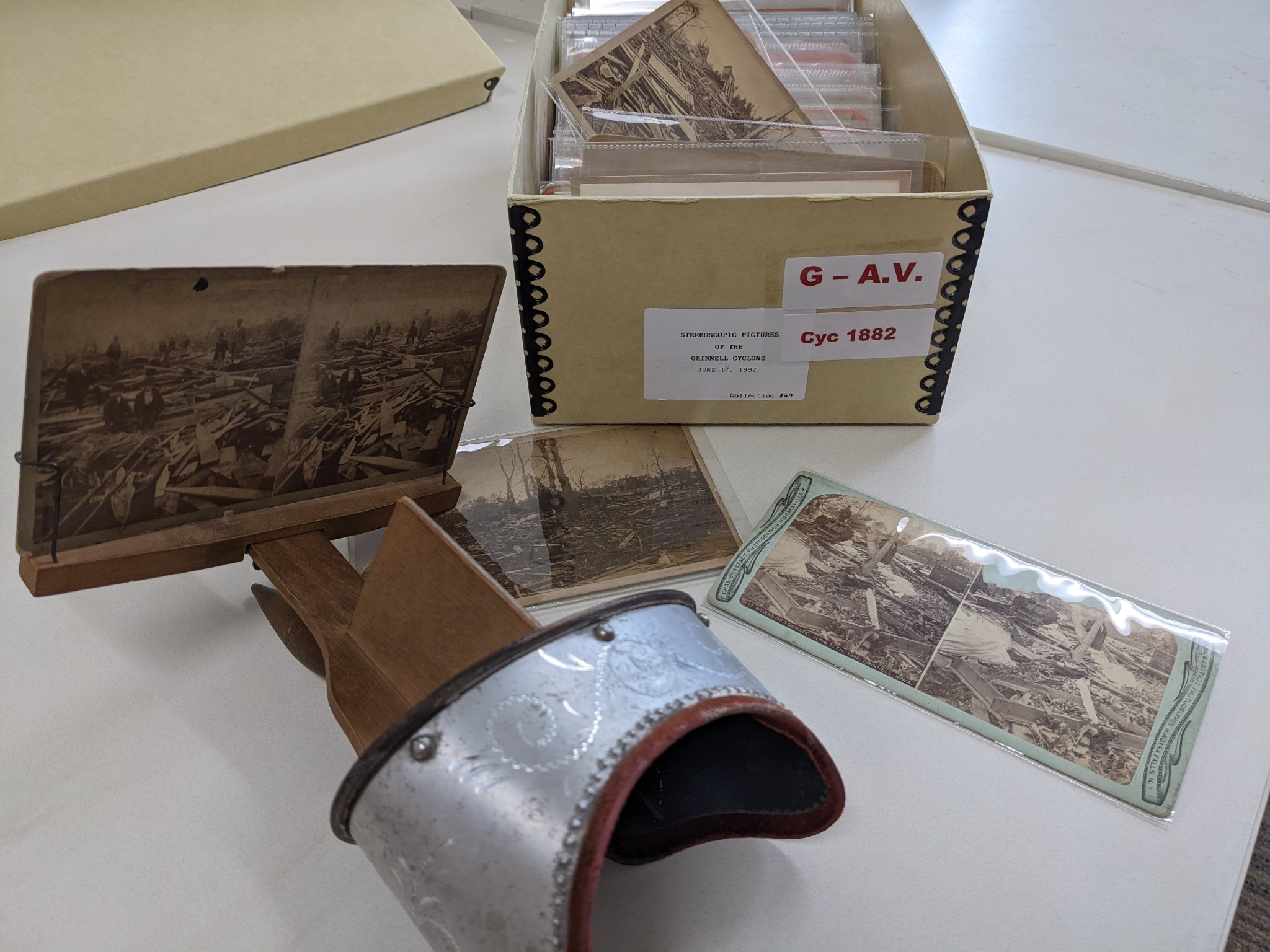
Images of the aftermath were highly sought after, and some companies began to create stereoscopic cards, known as “stereoviews” that allowed for a kind of immersive, 3-D, experience of the scene. Pictured above is one of the popular Holmes stereoscopes, along with a set of stereoviews showing the destruction wrought by the cyclone in Grinnell.

Powered by WordPress & Theme by Anders Norén