Tag: Speakers

Emmeline Pankhurst comes to Grinnell (1916)

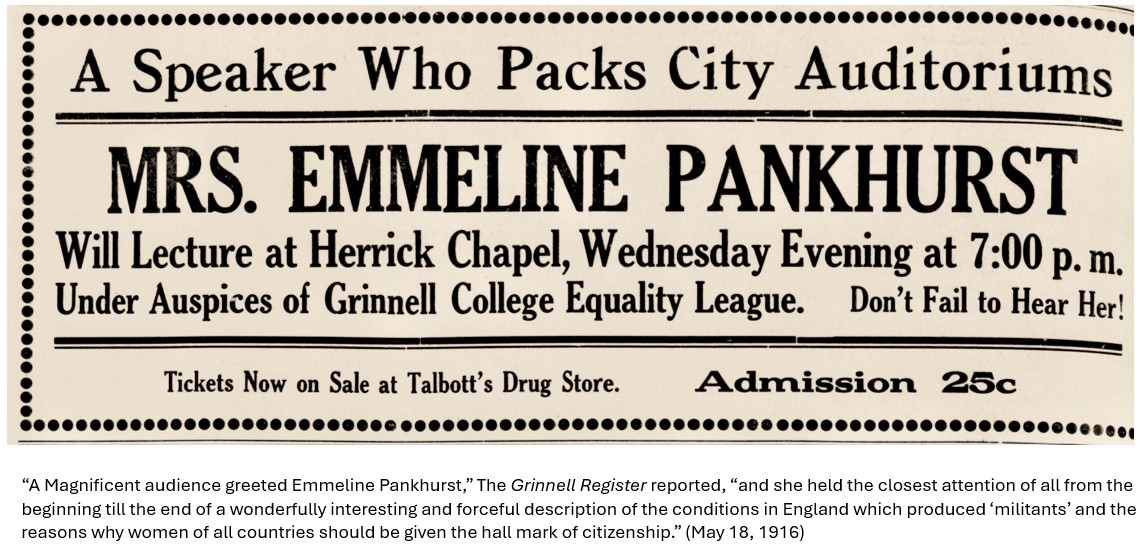
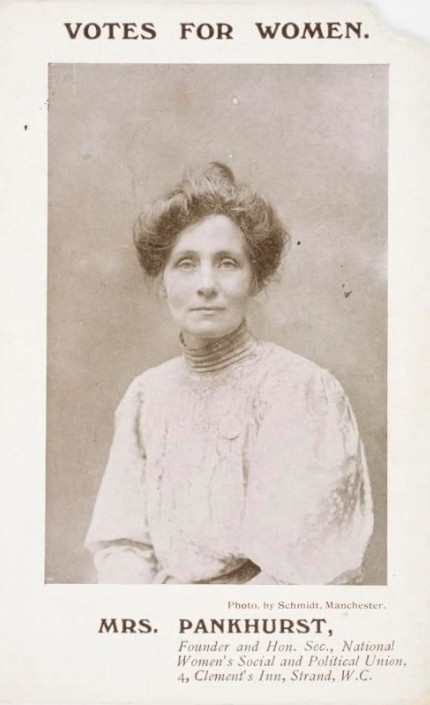
In May of 1916, a group of Grinnell students managed to persuade Emmeline Pankhurst, the famed leader of the radical suffrage movement in Britain, to give a public lecture in Herrick Chapel. Pankhurst had founded the Women’s Social and Political Union in 1903, which organized more confrontational forms of protest and civil disobedience—ranging from blocking roads to disrupting sessions of Parliament to smashing windows and setting fires. Draped in their colors of purple, white, and green, and often brandishing their trademarks signs & badges declaring “votes for women” or “deeds not words,” the members of the WSPU became the iconic face of the suffragette movement (both then and now). Like many of her colleagues, Pankhurst spent considerable time in prison where she engaged in rounds of hunger strikes that attracted even more attention to the cause.
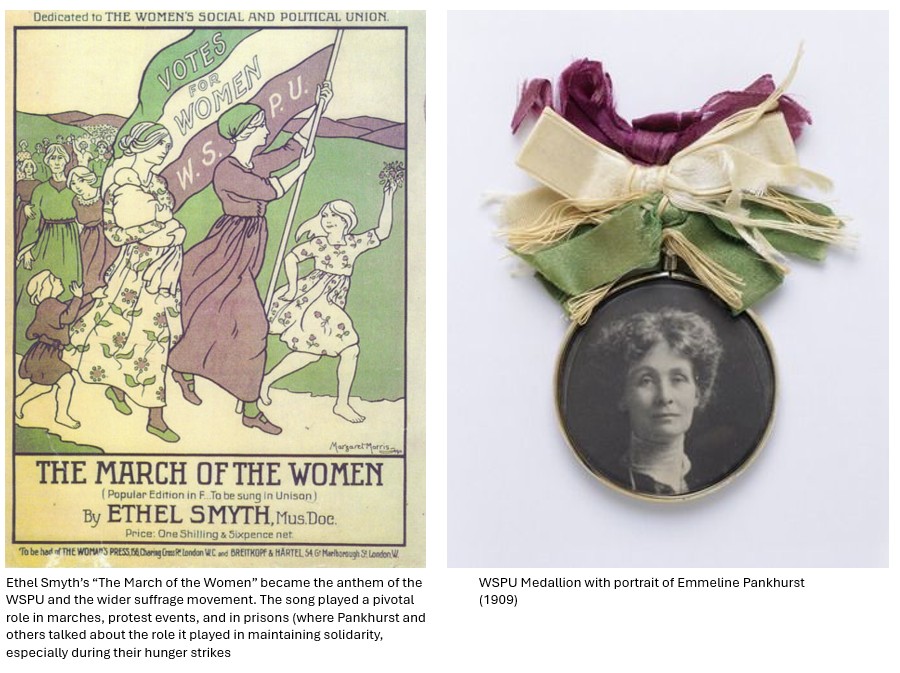
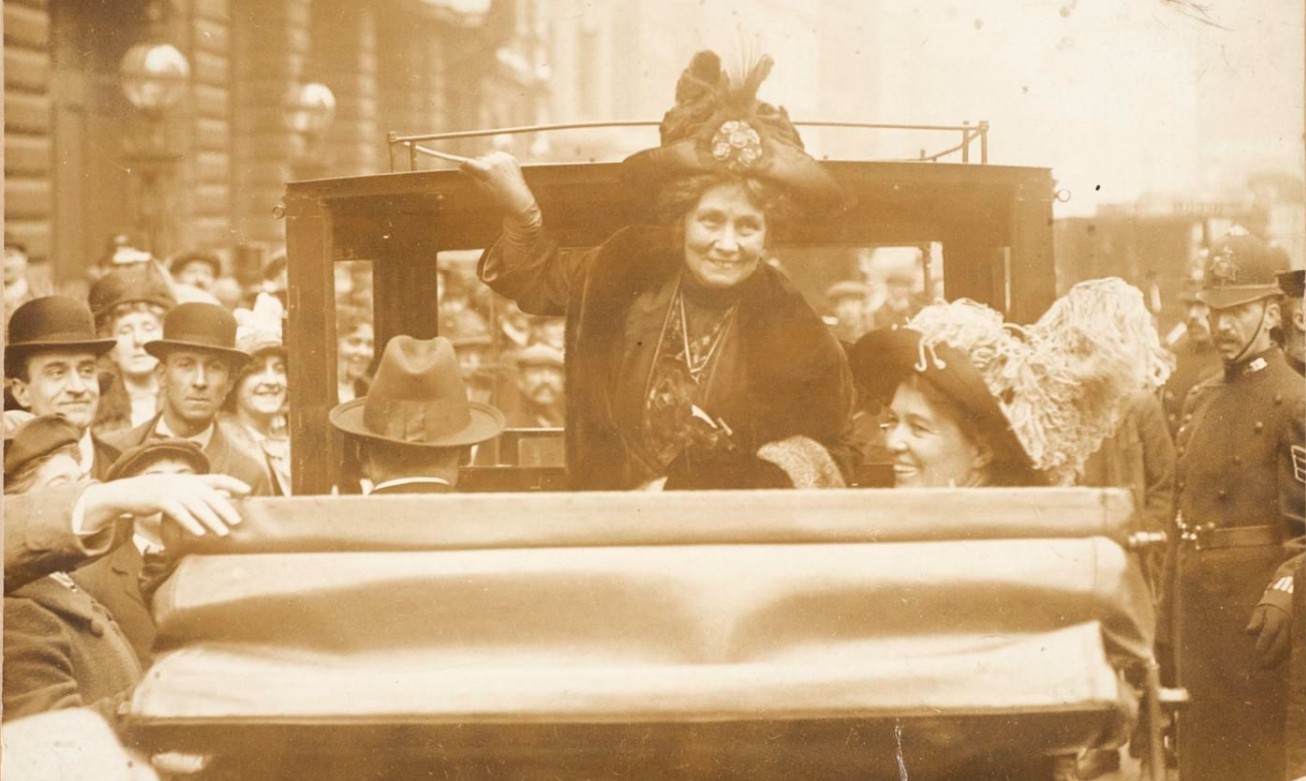
Yet, the beginnings of the First World War brought a temporary truce to these battles, as Pankhurst and the majority of the WSPU agreed to suspend their political protests and support the British government’s war effort. In this spirit, Pankhurst agreed to tour the United States in 1916, giving lectures on the war to raise funds for Britain and its allies.


Given the goals of Pankhurst’s American tour, and her pact with the British government, it is surprising that she agreed to come to Grinnell College to lecture specifically on the suffrage issue. She had been invited to come to Grinnell by the newly formed “Political Equality League,” comprised of female students at the college who were eager to mobilize support for the upcoming vote (in July) on an amendment to the Iowa constitution that would grant equal voting rights to women. That Grinnell would become the main speaking stop between Chicago and Denver on her American tour, and that she would speak explicitly about suffrage here (while avoiding the topic elsewhere), makes her Grinnell lecture all the more intriguing.  Pankhurst might have been swayed by the personal appeal of the Grinnell college students, whose organizing efforts mirrored her own work (in fact, Pankhurst stayed another day in town, so as to attend several meetings and events with college women in their new Quadrangle facilities). Pankhurst might have been equally tempted to speak in Iowa at that particular moment, given the upcoming constitutional referendum that was emerging as a bellwether of the suffrage cause in America. Whatever the precise reasoning, Pankhurst delivered a rousing speech to a packed audience in Herrick Chapel that evening of May 17, 1916.
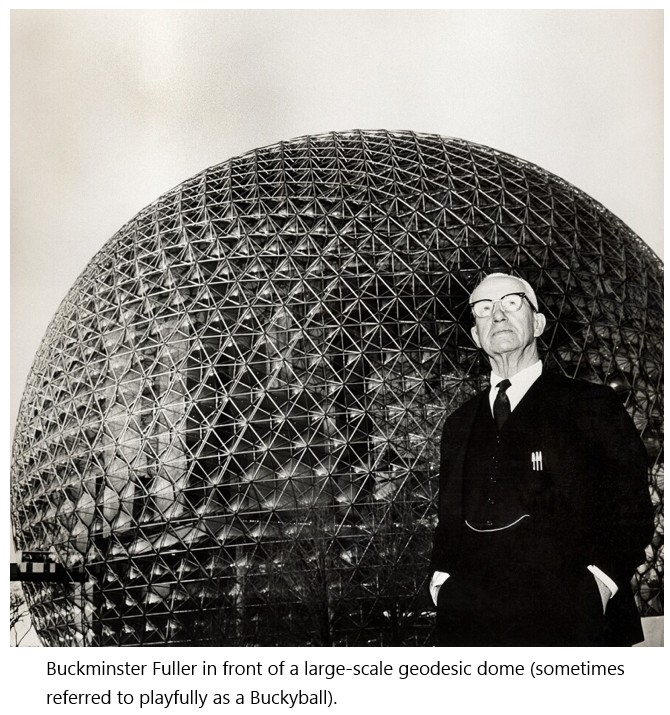
A Dome of One’s Own: Buckminster Fuller Comes to Grinnell (1972)

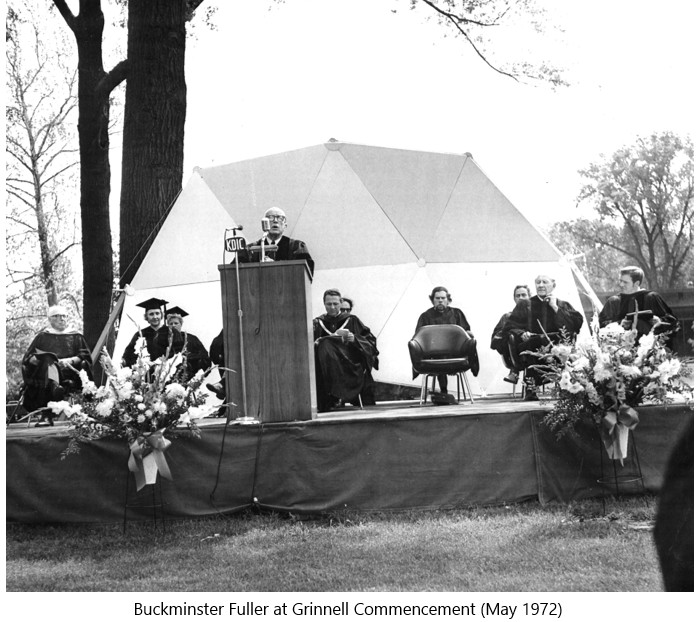
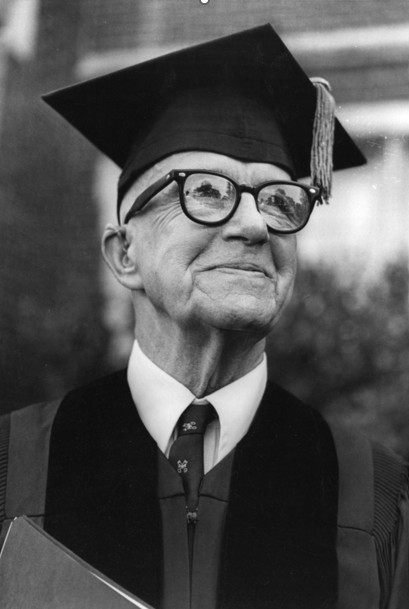
As we celebrate Earth week, it’s interesting to look back at some of the early response on campus to the growing environmental movement of the 1960s and 1970s. An earlier post showcased some archival items from the first Earth Day at Grinnell, on April 22, 1970. Two years later, in April of 1972, much of the attention was focused on the construction of a futuristic structure, a geodesic dome, and the upcoming commencement speaker who had inspired this design: Buckminster Fuller.  The choice of commencement speaker, in fact, had been determined by student ballot, and Fuller was the clear choice of the class of 1972.

While few may have heard of that name today, Fuller was one of the most charismatic and beloved figures in the environmental movement of this era.  An architect and engineer—known for his futuristic designs that emphasized sustainability—Fuller inspired many with the hope that better design and technological improvement could solve the environmental crisis brought on by industrial capitalism. Whereas some environmentalists chose to join the “back-to-the land” movement, embracing a return to pre-industrial ways of life, Fuller encouraged his followers to design a new technological future, living in his iconic geodesic domes that would save energy and resources, modeling the ideal of a “spaceship earth.” One of Fuller’s most energetic followers would be Stewart Brand, creator of the Whole Earth Catalog, which promoted this vision of technology as a liberating force, and the key to sustainability. “Fuller said…you can’t change human nature,” Brand recalled, “but you can change tools, you can change techniques, you can change civilization.”

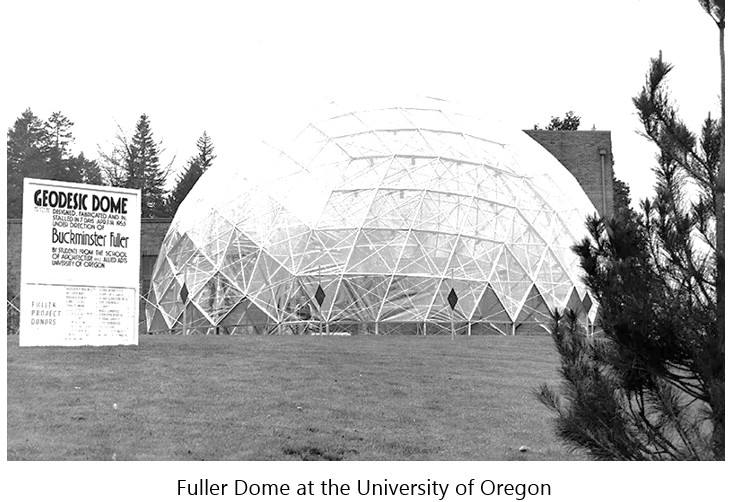
In April of 1972, as the graduating class awaited Fuller’s commencement address, another group of Grinnell students were busy constructing two geodesic domes of their own that were based on Fuller’s design. These students, in fact, were part of a special topics course that spring, ART 295: Geodesic Domes, that was created to channel the campus interest in Fuller’s work. Taught by William Trotter, in the art department, the course “included  lectures on spherical trigonometry and structural engineering” and focused on the construction of two domes. One would be a larger model that would appear behind the commencement stage, and be used for outdoor events in the future, while a much smaller version was created to serve as a kind of jungle gym for the nearby pre-school.  These domes were an iconic symbol of one strand of environmentalism that embraced technology as a potential solution to the ecological crisis unfolding.

Visualizing The Color Line: W.E.B. Du Bois’ Grinnell Lecture (1905)

In the early 1900s, the Y.M.C.A. lecture series was an important institution in the shared intellectual life of Grinnell, bridging town and gown. Each year, a local committee of the Y.M.C.A. lined up a program of nationally renowned politicians, writers, musicians, orators, theologians, or performers who would appear monthly at the Congregational Church, or the Colonial Theatre (the two largest venues in town).

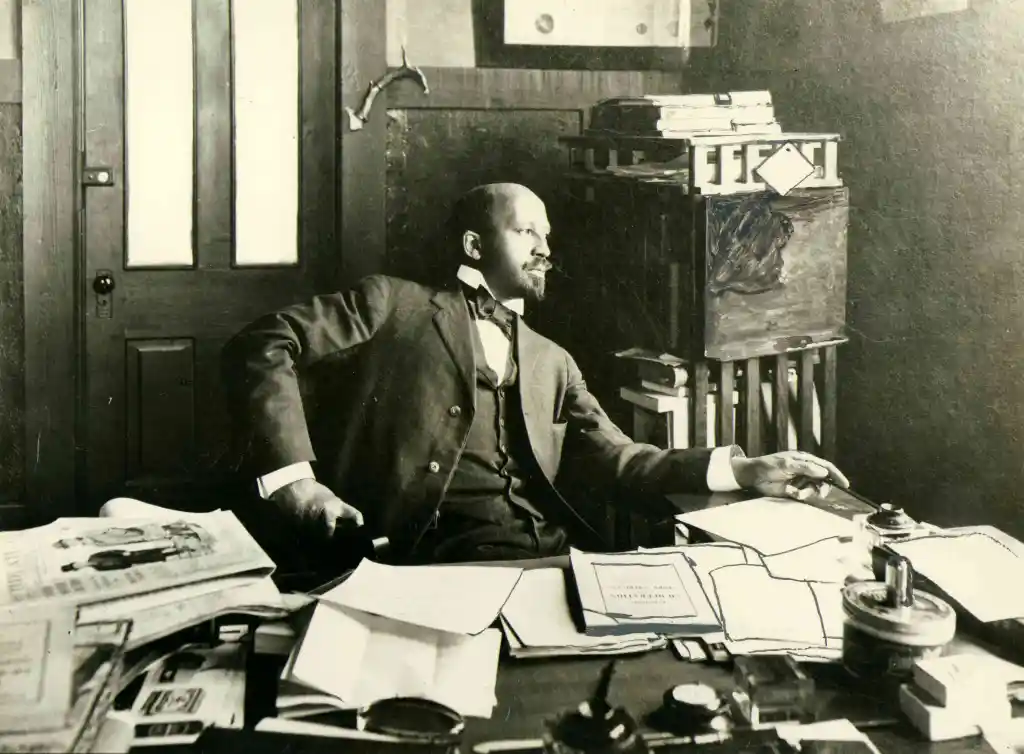
In February 1905, Grinnellians were looking forward to the next scheduled speaker in the “Y” series, the famed historian, sociologist, and intellectual, W.E.B. Du Bois. In fact, the prior speaker, Senator Robert LaFollete (a lion of progressive politics) had reportedly told the assembled crowd  “Miss anything else this winter, but do not miss hearing Professor Du Bois.” Unfortunately, a Valentine’s Day snowstorm cancelled Du Bois’ train (even back then, winter weather made scheduling visits and speakers a fraught endeavor). But the committee coordinated with Du Bois to reschedule his lecture for Thursday, March 2nd, when he spoke before “one of the largest audiences of the season.”

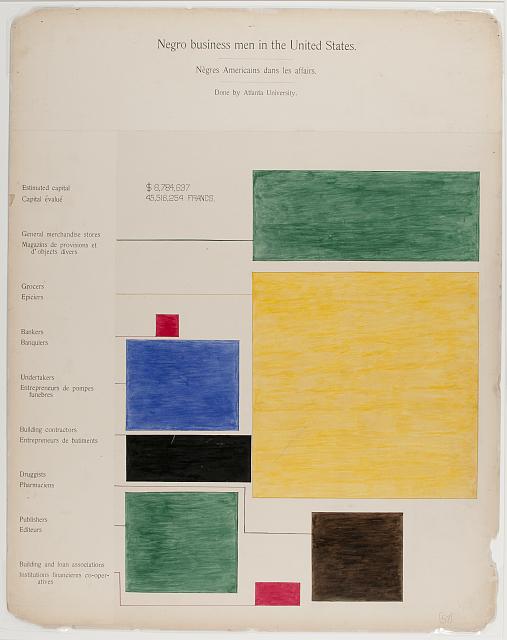
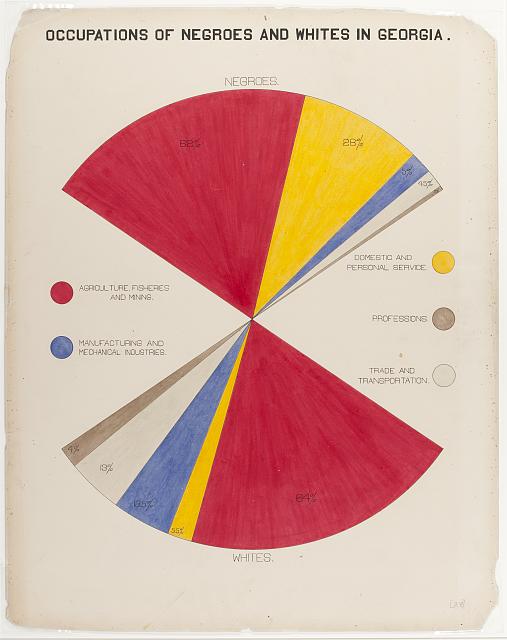
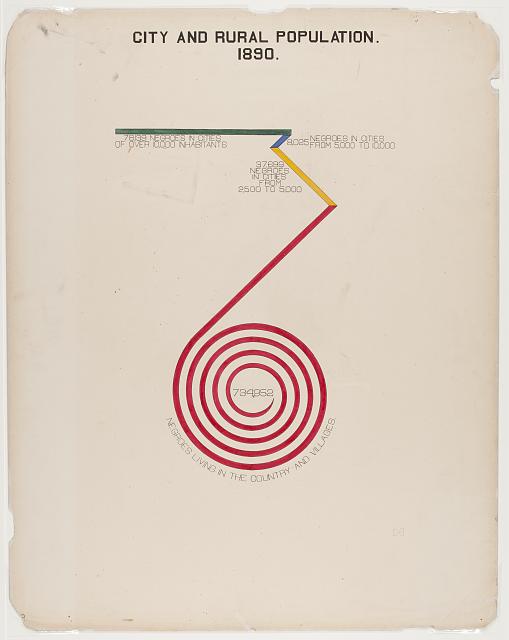
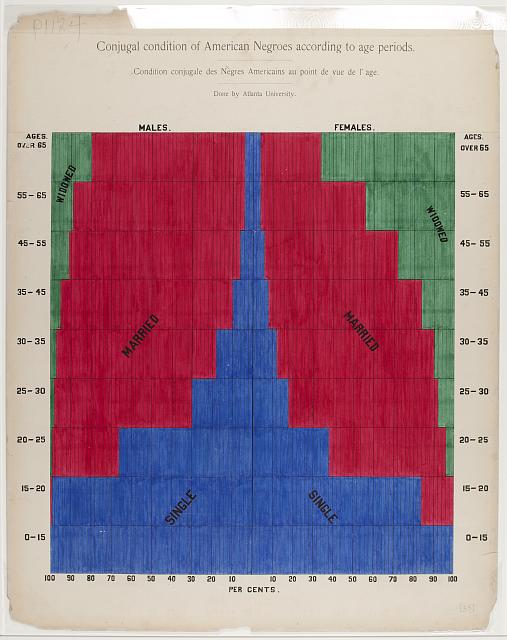
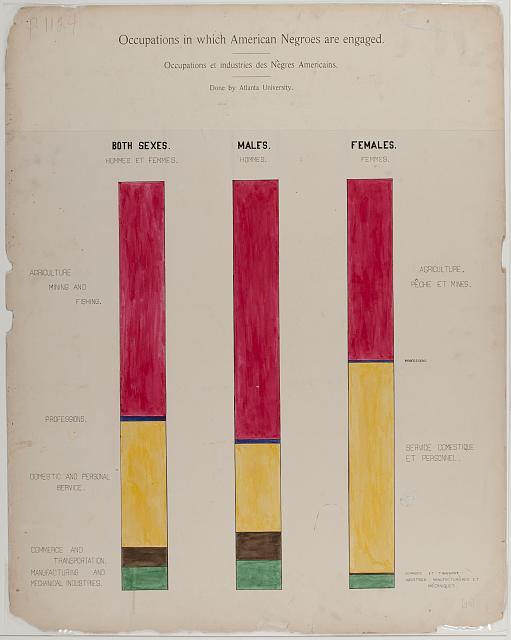
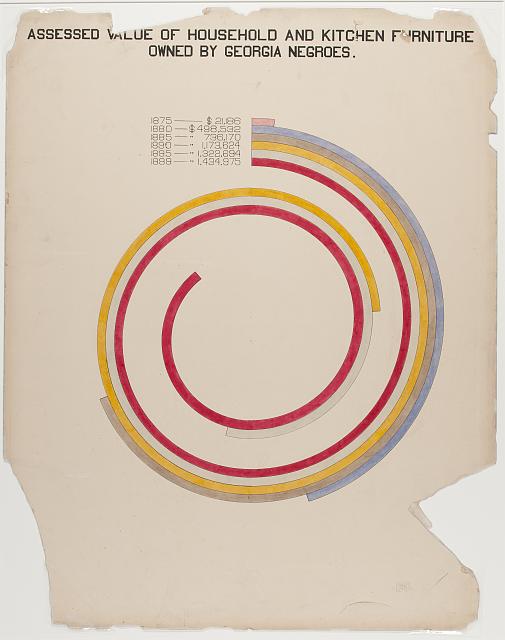
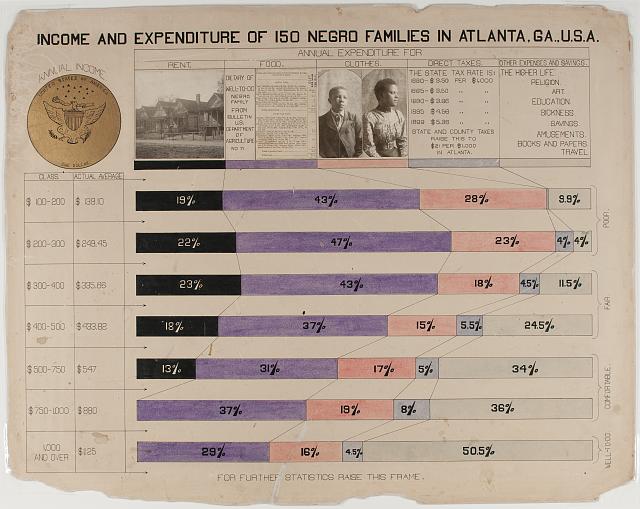
His address, entitled “The South and Its Problems,” focused on the systematic discrimination that African Americans faced in the Jim Crow South, and Du Bois illustrated these systematic consequences through a series of novel “charts…which greatly assisted the audience to a clear understanding of the importance of the problems and the direction recent developments have taken.” These colorful “charts” had been carefully created by Du Bois and his students at his Sociological Laboratory, at Atlanta University, where they creatively experimented with new kinds of data visualizing strategies that turned census data into evocative infographics. Each year, Du Bois and his students focused on a particular theme: in 1905, they were working on the issues surrounding health and medicine; the previous year had focused on crime; and other recent topics included Churches & Religious Life (1903), Work & Labor (1902), Education (1901), Business (1899), and Urban Life (1897).

Just a few years before his Grinnell lecture, Du Bois had showcased 63 of these prints—what he called at the time “data portraits”—at the Paris Exposition. Some of those items, pictured here, were likely featured in his Grinnell lecture at the Colonial Theater.

Today, Du Bois’s work in the field of data visualization has begun to receive much greater attention and recognition from scholars interested in reclaiming these pioneering forms of quantitative advocacy and graphic design. Those interested in seeing more examples can explore the full collection at the library of Congress; the 2023 exhibit at the Cooper Hewitt museum, Deconstructing Power: W.E.B. Du Bois at the World’s Fair; and the interactive website, The Du Boisian Visualization Toolkit.


The “Red Special” Comes to Grinnell (1908)

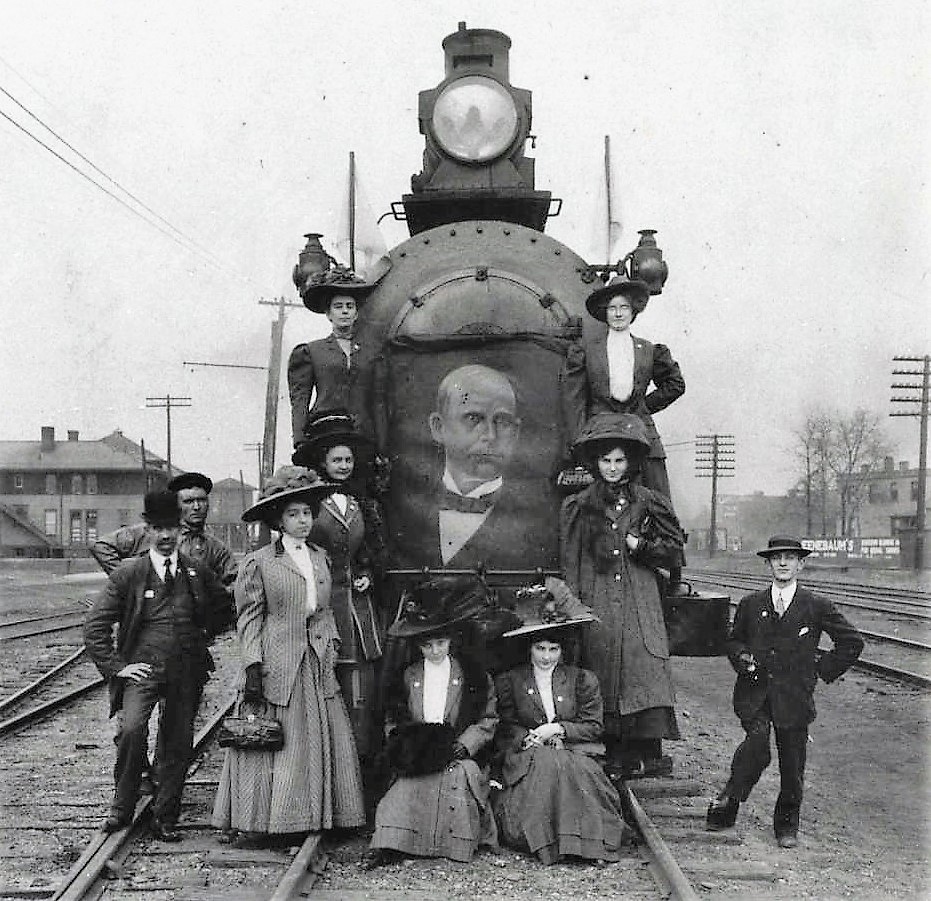
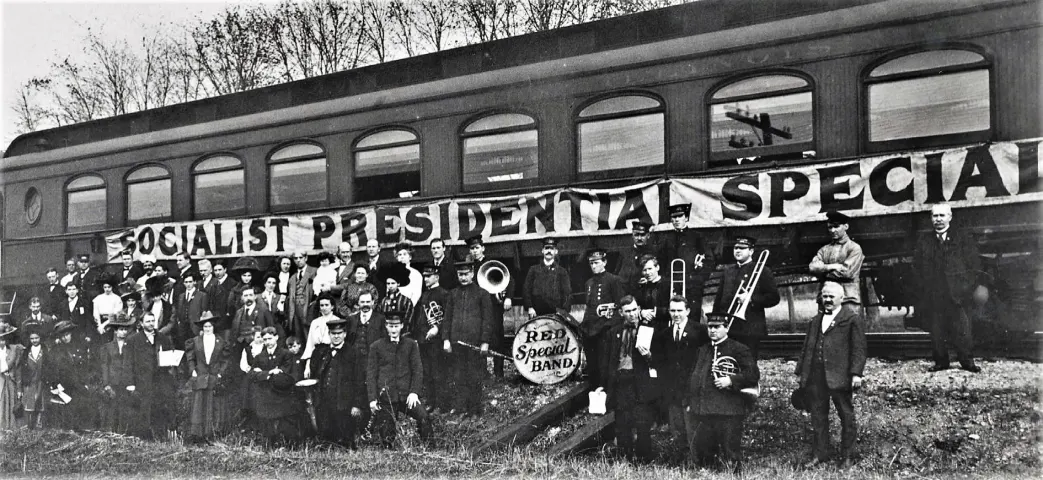
Just after 2pm on the afternoon of September 1st, Eugene Debs’s special train pulled into Grinnell’s Union Station. Debs was running for president on the Socialist party ticket that Fall (1908), and had organized a cross-country campaign in which he and a party of about a hundred supporters, campaign workers, officials, and a musical band, would stop at various cities as their privately rented train made its way from New York to California. Dubbed, the “red special,” Debs’s train (see above and below) stopped at Grinnell for about two hours, giving the band time to play in central park; giving his associates time to distribute campaign flyers, sell party tracts, and solicit donations; and giving Debs time to deliver a speech to students and townspeople who had gathered around the gazebo in the park.

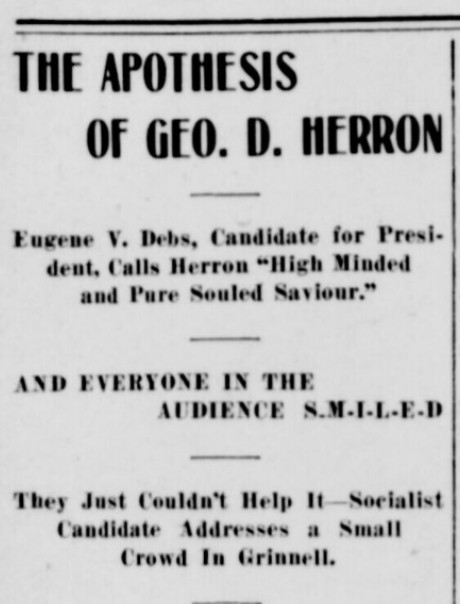
The Grinnell Herald, which was no fan of Debs, noted sarcastically that “Grinnell’s ‘down-trodden’ laboring class was so busy working at from $2 to $5 a day, that they didn’t have time to stop to hear from Mr. Debs how miserable was their condition.” In fact, the paper was less interested in reporting Debs’ political message than in discussing his controversial remarks about ex-Grinnellian, George D. Herron, who had been forced out of his endowed chair in Applied Christianity at the college when he eloped with Carrie Rand, the Dean of Women at the college (and daughter of Elizabeth Rand who had endowed the chair and larger program).  Herron was one of the most prominent spokesmen for the Social Gospel and Christian Socialism, and Debs took this opportunity to chastise Grinnell over its treatment of Herron, saying:

Grinnell had crucified its saviour; that because George D. Herron had been a high-minded, pure-souled man, Grinnell had driven him out and that when all the rest of us are forgotten Mr. Herron will be remembered

In fact, Herron received top-billing in the headline framing the story of Debs’ visit in the Herald:

One person who would have agreed with Debs, however, was Laetitia Moon Conard, who was a personal friend and follower of George Herron; who taught sociology at Grinnell College; and who would eventually run for governor of Iowa on the Socialist party ticket, a few decades later. Sadly, Laetitia never got her own “red special” when she campaigned for the governorship in 1932.


Thurgood Marshall’s Commencement at Grinnell

Thurgood Marshall’s Commencement Address, 1954

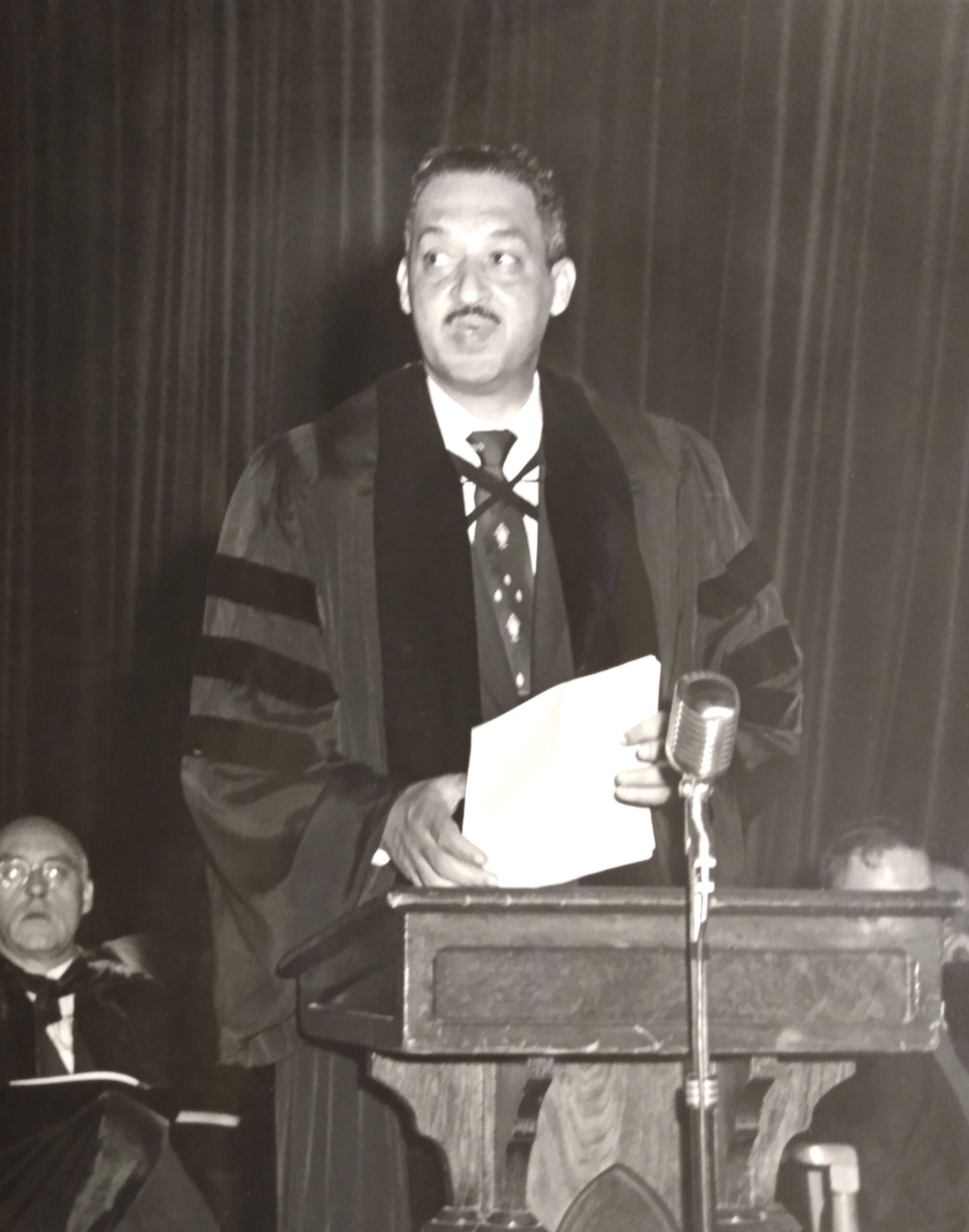
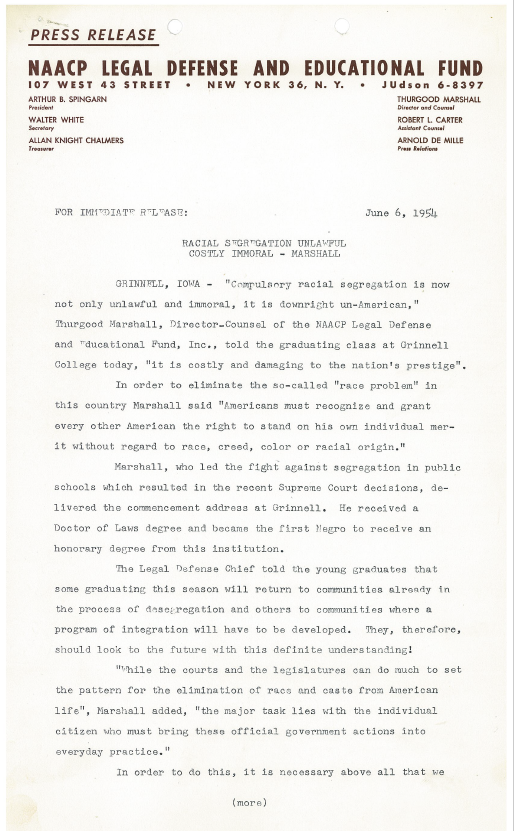
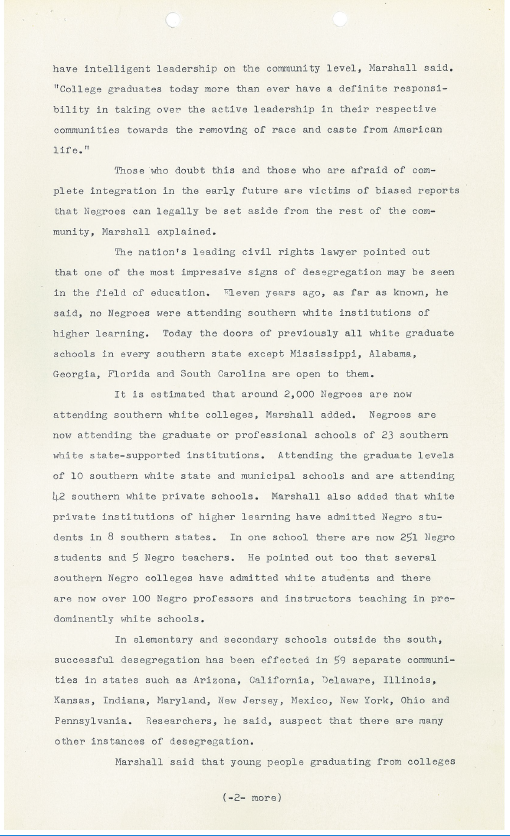
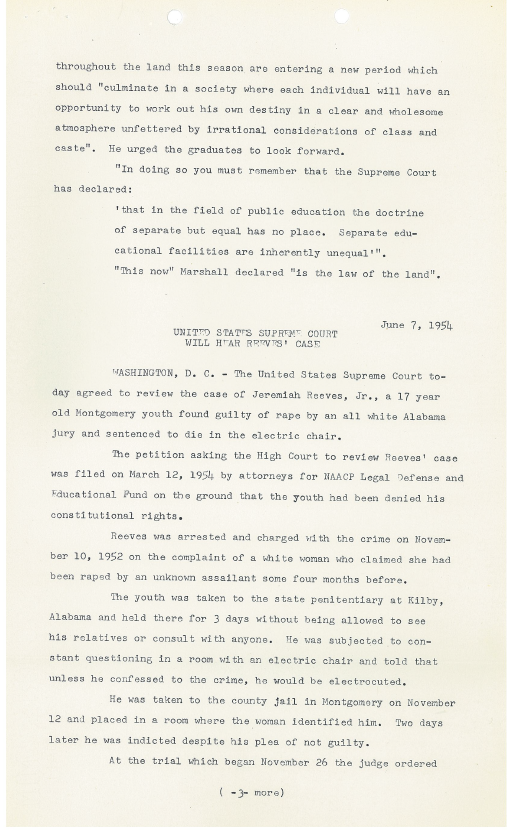
On May 17th, 1954, (seventy years ago) the Supreme Court issued its landmark ruling in Brown v. Board of Education, striking down racial segregation in public schools. Thurgood Marshall, had been the principle architect of the NAACP’s legal campaign to combat racial discrimination though the courts. Just a few weeks later, Thurgood Marshall arrived in Grinnell, to deliver the commencement address to the class of 1954, and to receive an honorary doctorate of Laws from the college (the first African-American to receive an honorary degree from Grinnell, or to deliver its commencement address). Marshall (pictured here at the commencement podium of Darby Gymnasium) delivered an important address, entitled “Race and Caste Distinctions: Effective Barriers to Education for Democracy,” that attracted national media attention, as seen in the NAACP press release (below).

Ruth Bader Ginsburg, PBK Convocation, 1974

Ruth Bader Ginsburg, PBK Convocation, 1974

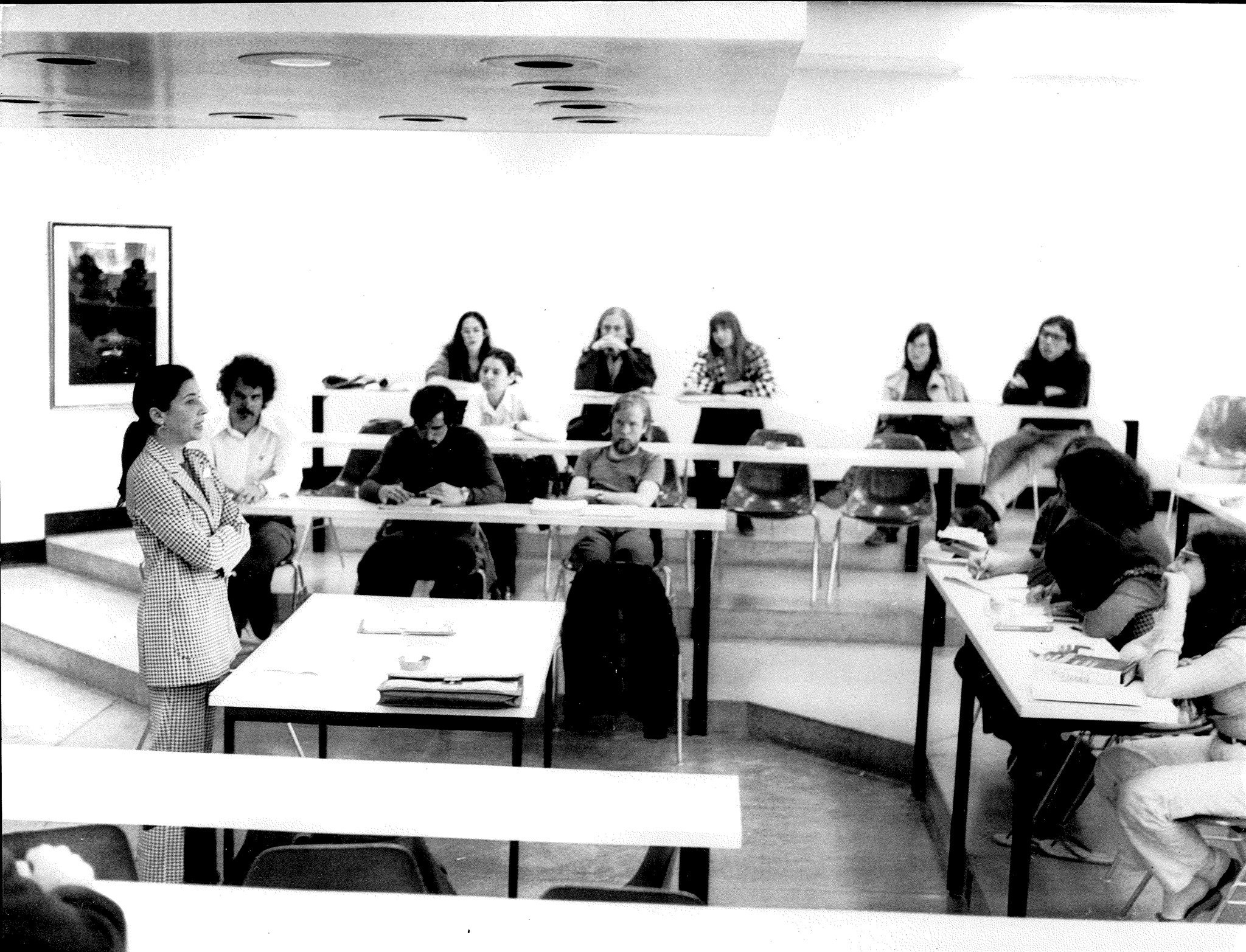
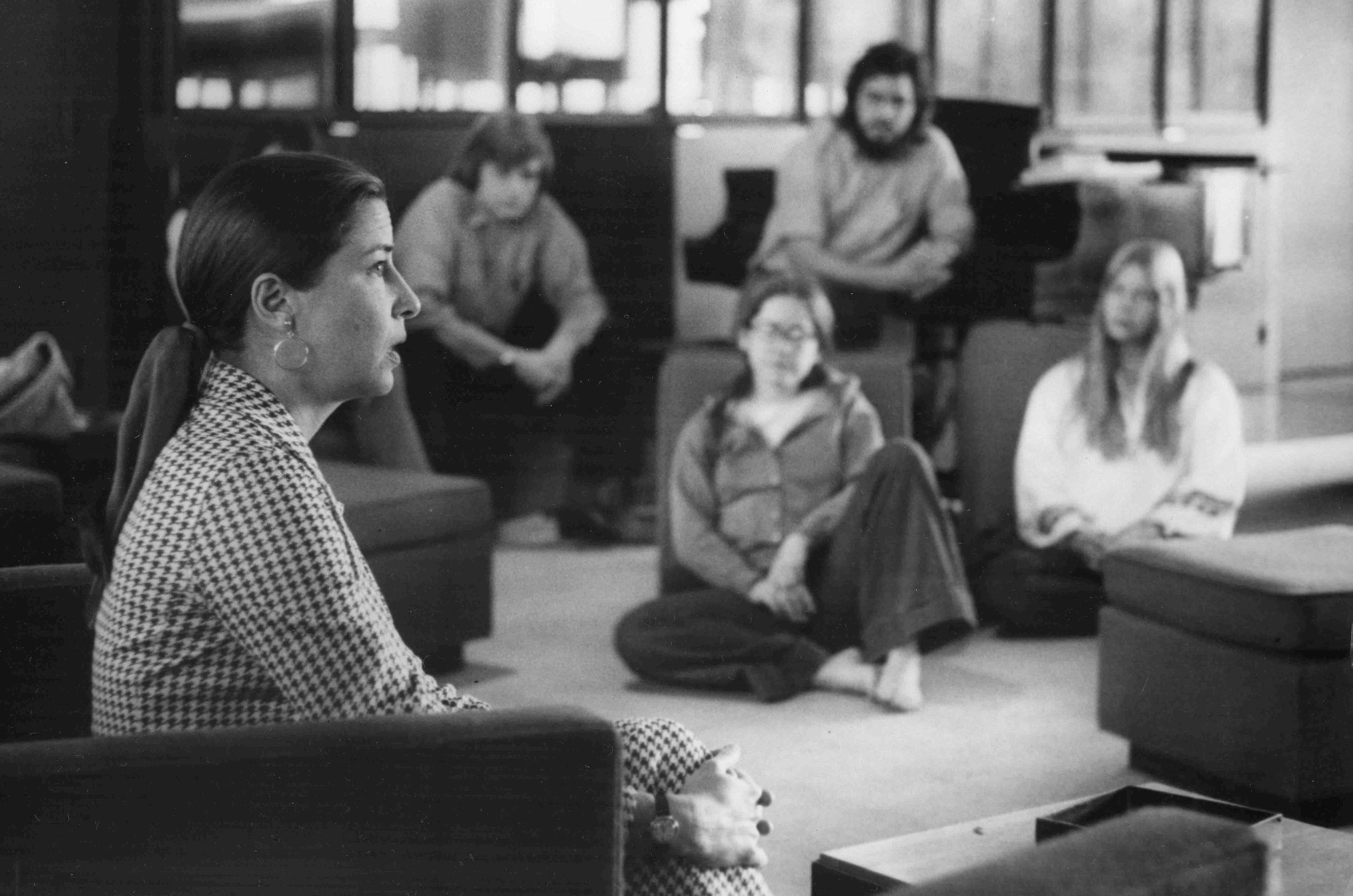
Grinnell’s chapter of Phi Beta Kappa has a tradition of hosting a convocation speaker at the end of each year, an event that also serves as a ceremony to recognize those students invited to join PBK and to celebrate the achievements of those who have won particular awards/prizes given out annually by the chapter. On May 6, 1974 (50 years ago, this week), a young Ruth Bader Ginsburg delivered the PBK convocation address, in Herrick Chapel, on the theme of “Equal Rights and Responsibilities for Men and Women as Constitutional Principle.” These pictures are from a class visit, on that trip, and a more informal discussion she held in the evening with students at the Forum lounge. In 1974, Ginsburg was serving as general counsel for the Women’s Rights Project at the American Civil Liberties Union, and as a law professor at Columbia University.

Powered by WordPress & Theme by Anders Norén