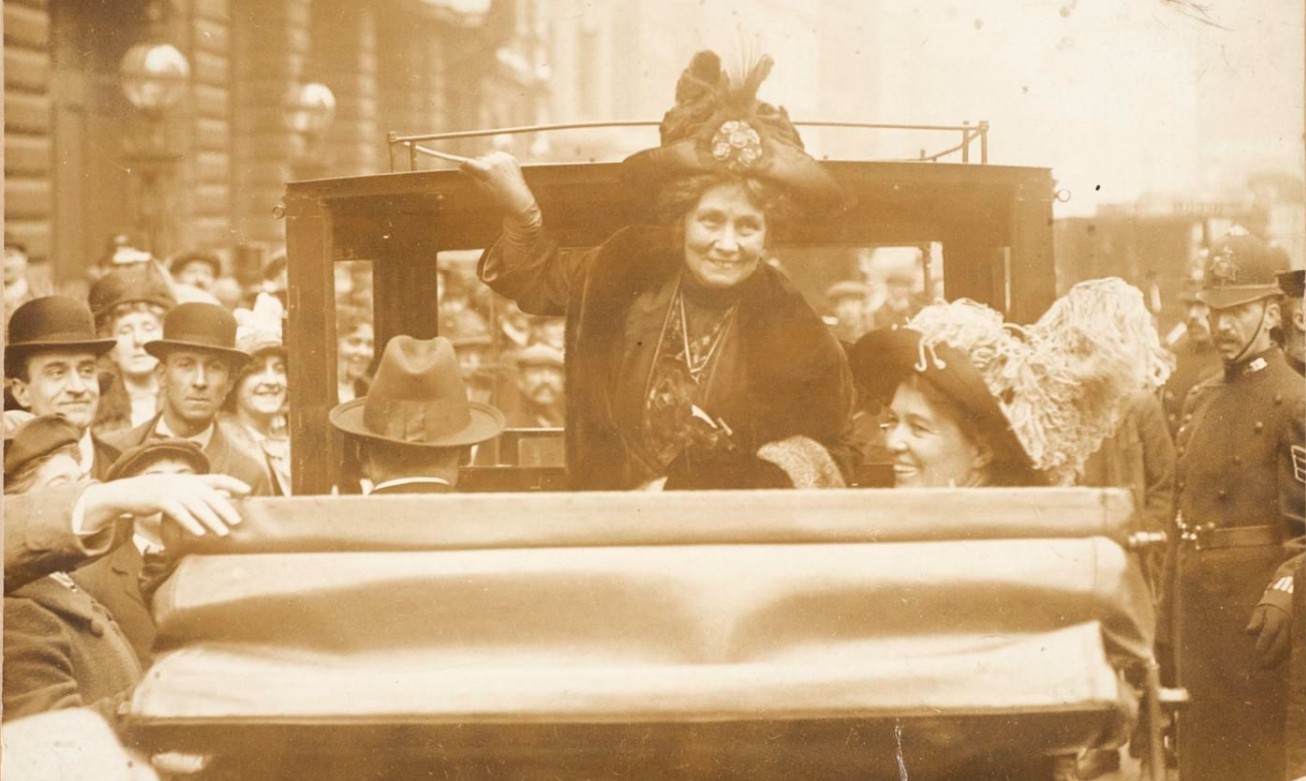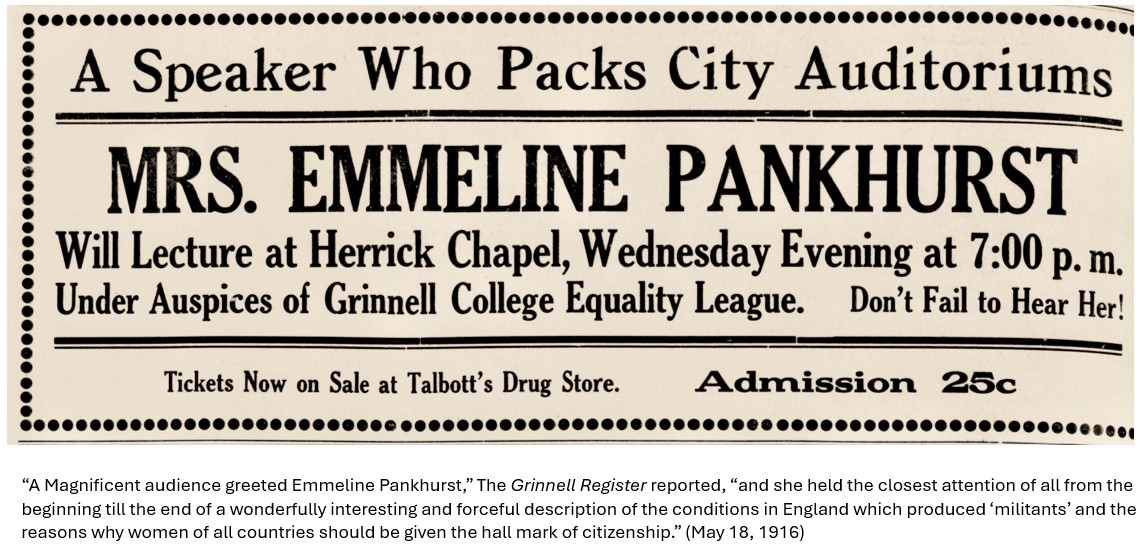
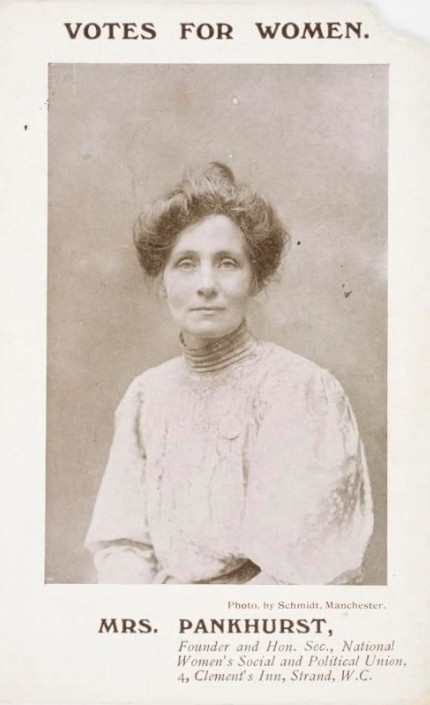
 In May of 1916, a group of Grinnell students managed to persuade Emmeline Pankhurst, the famed leader of the radical suffrage movement in Britain, to give a public lecture in Herrick Chapel. Pankhurst had founded the Women’s Social and Political Union in 1903, which organized more confrontational forms of protest and civil disobedience—ranging from blocking roads to disrupting sessions of Parliament to smashing windows and setting fires. Draped in their colors of purple, white, and green, and often brandishing their trademarks signs & badges declaring “votes for women” or “deeds not words,” the members of the WSPU became the iconic face of the suffragette movement (both then and now). Like many of her colleagues, Pankhurst spent considerable time in prison where she engaged in rounds of hunger strikes that attracted even more attention to the cause.
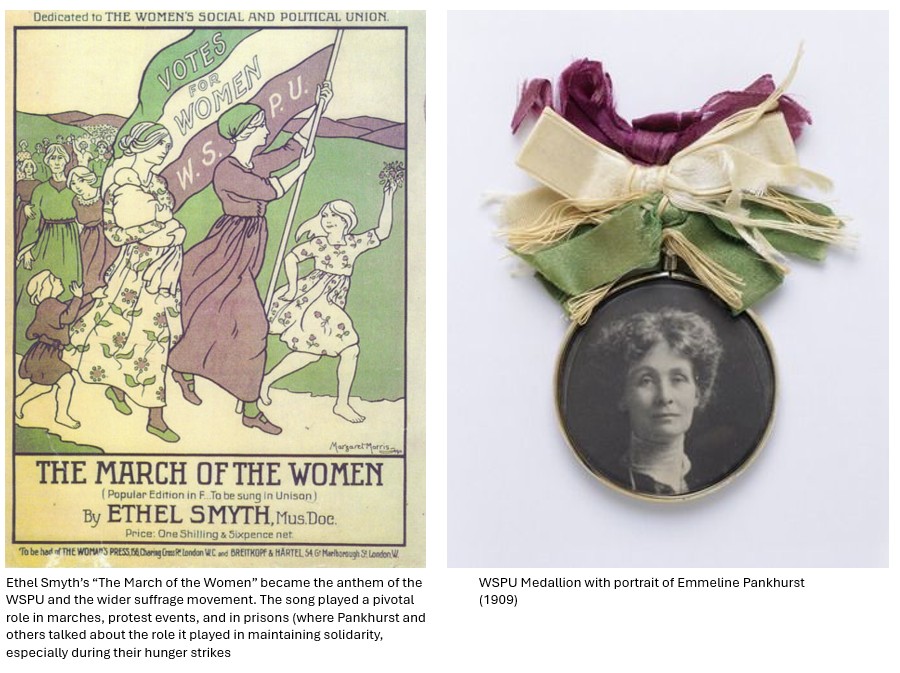
Yet, the beginnings of the First World War brought a temporary truce to these battles, as Pankhurst and the majority of the WSPU agreed to suspend their political protests and support the British government’s war effort. In this spirit, Pankhurst agreed to tour the United States in 1916, giving lectures on the war to raise funds for Britain and its allies.
Given the goals of Pankhurst’s American tour, and her pact with the British government, it is surprising that she agreed to come to Grinnell College to lecture specifically on the suffrage issue. She had been invited to come to Grinnell by the newly formed “Political Equality League,” comprised of female students at the college who were eager to mobilize support for the upcoming vote (in July) on an amendment to the Iowa constitution that would grant equal voting rights to women. That Grinnell would become the main speaking stop between Chicago and Denver on her American tour, and that she would speak explicitly about suffrage here (while avoiding the topic elsewhere), makes her Grinnell lecture all the more intriguing. Pankhurst might have been swayed by the personal appeal of the Grinnell college students, whose organizing efforts mirrored her own work (in fact, Pankhurst stayed another day in town, so as to attend several meetings and events with college women in their new Quadrangle facilities). Pankhurst might have been equally tempted to speak in Iowa at that particular moment, given the upcoming constitutional referendum that was emerging as a bellwether of the suffrage cause in America. Whatever the precise reasoning, Pankhurst delivered a rousing speech to a packed audience in Herrick Chapel that evening of May 17, 1916.