Month: February 2026

A Fateful February: The Busy Agenda of W.E.B. Du Bois in Feb 1905

Note: this is a postscript to the previous week’s topic (about Du Bois’ 1905 lecture at Grinnell).


In the summer of 1904, W.E.B. Du Bois agreed to give a lecture in Grinnell as part of the community’s Y.M.C.A lecture series. The talk would be part of a larger Midwest speaking tour in January and February of 1905, taking Du Bois to various communities in Illinois, Wisconsin, and Iowa.

Yet, the first two months of 1905 proved to be some of the most consequential weeks in Du Bois’ career. Dismayed by the accommodationist stance of Booker T. Washington, and the hard-ball tactics of his “Tuskegee Machine,” Du Bois chose this moment to publicly break with Washington. In January, he published an article, “Debit and Credit” in The Voice of the Negro magazine, accusing Washington of systematically bribing the African-American press to silence his critics. The essay set of a firestorm of controversy, with Du Bois’ receiving numerous letters in February asking for proof or further comment. While travelling to and from Grinnell, for example, Du Bois was drafting letters to Oswald Garrison Villard, the powerful editor of the New York Evening Post, explaining his accusations, while also writing to his friend, William Monroe Trotter (editor of the influential Guardian paper) to provide more concrete evidence to satisfy skeptics. The controversy served as a sort of Rubicon, pushing Du Bois to turn this growing rift into an official break—Du Bois resigned from several Washington-allied organizations in February, such as the “Committee of Twelve” and the Afro-American Council (AAC).
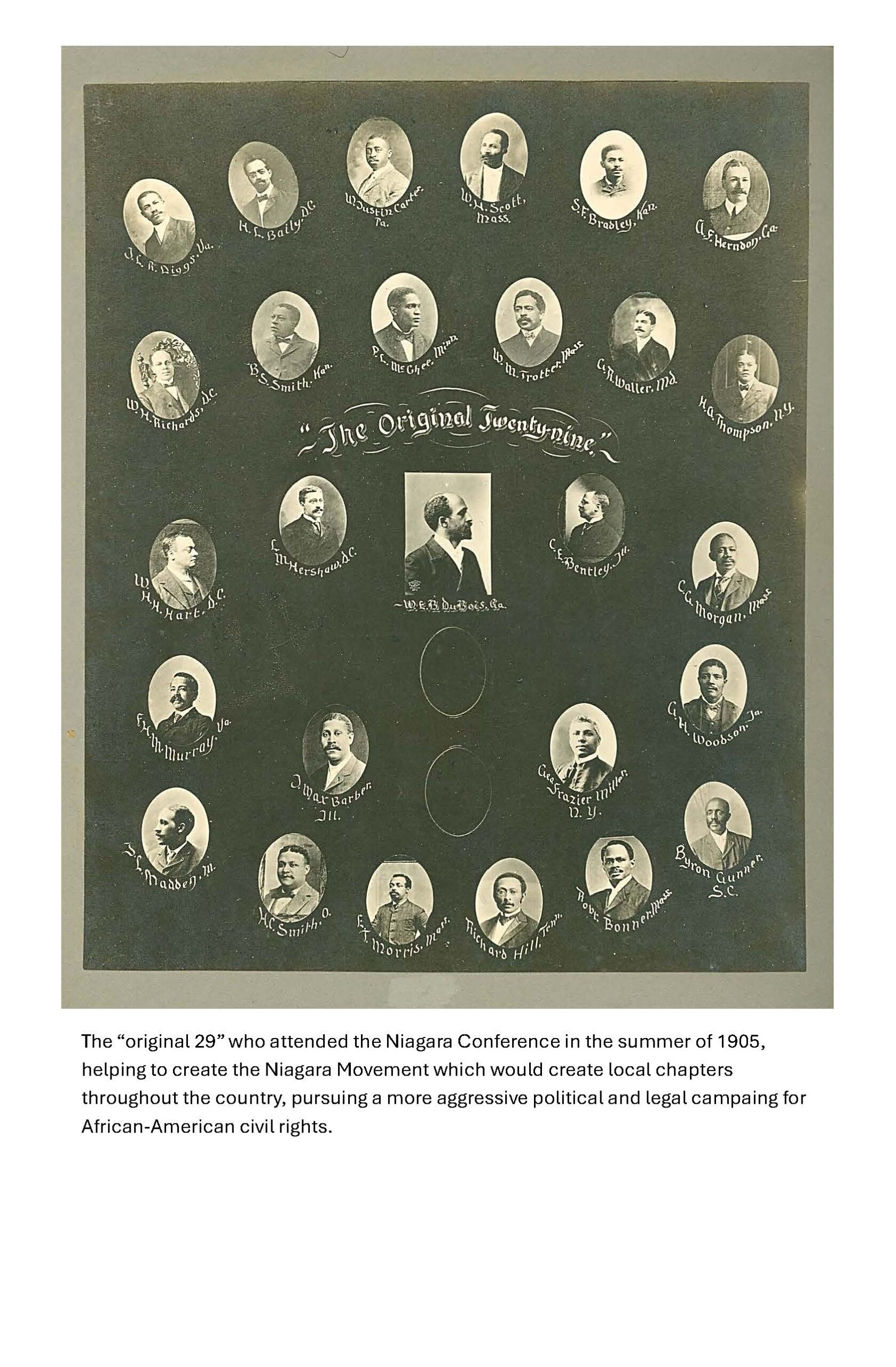
It was during this period—February of 1905—that Du Bois and a few of his close associates held key meetings to launch a new, and more aggressive, civil rights organization, which would culminate in the Niagara Movement (named after the conference, that summer, held near Niagara Falls). Because the Niagara Movement would lay the groundwork for the creation of the NAACP a few years later, historians have long been interested in tracing its origins. We know that one of these meetings was held around February 14th, when Du Bois was in Boston for a week of talks that were nestled between the Wisconsin and Iowa legs of his speaking tour (Du Bois was lecturing in Wisconsin until Feb. 6th, was in Boston from the 8th through the 15th, and then was supposed to start his Iowa tour at Grinnell on Feb. 17th). William Trotter, a leading critic of Booker T. Washington, assembled Du Bois and others for a meeting in his Boston home. Within two days, Du Bois was on a train to Grinnell, but snow prevented him from making the connection in Chicago on Feb 17th.  Sometime between Feb 17thand Feb 28th, Du Bois held another meeting in Chicago, coordinated by Charles Edwin Bentley, and a pivotal meeting in Buffalo, at the home of the civil rights leader, Mary Talbert, that developed the final blueprint for the Niagara Movement (that meeting was kept secret, to avoid “spies”, but we know it included Trotter, Du Bois, Bentley, Ida B. Wells, Frederick McGhee and others).  From there, Du Bois made an unexpected trip to the twin cities (Feb 26-28), to meet with Frederick McGhee to further develop plans for the summer conference.  And then Du Bois boarded a train from St. Paul’s to Grinnell to deliver his rescheduled lecture on March 2.

It appears, then, that the snowstorm and cancellation of Du Bois’ Iowa circuit came at a key moment when he was racing to organize this new political movement (although Grinnell audiences at the colonial theater would have had little clue about all these developments unfolding behind the scenes).
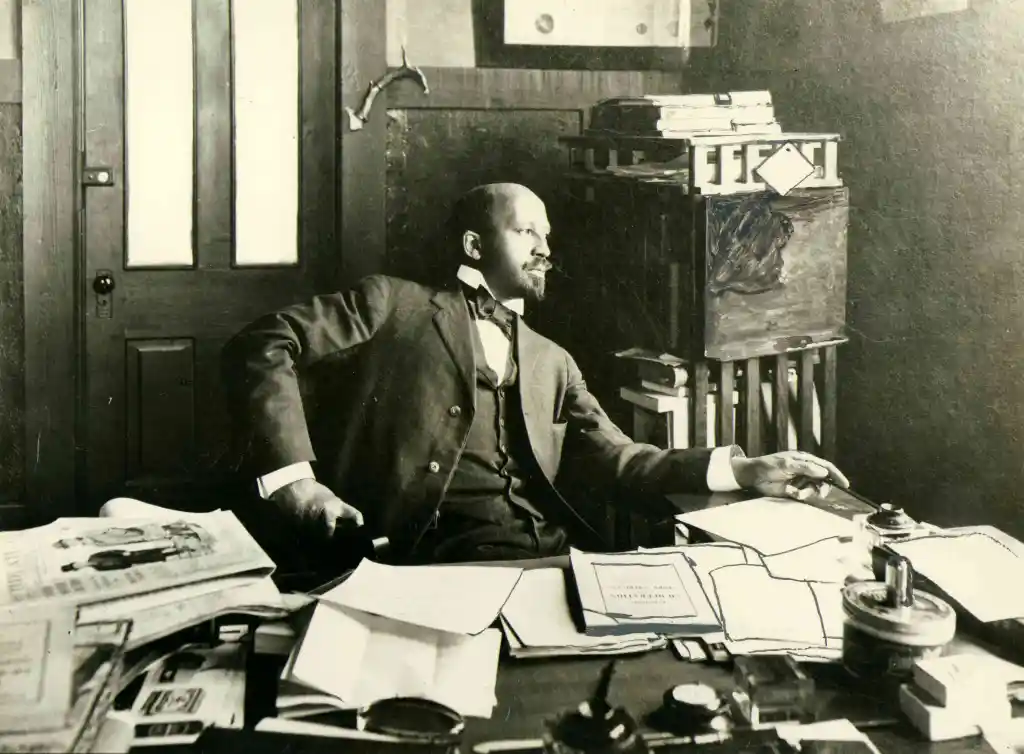
Visualizing The Color Line: W.E.B. Du Bois’ Grinnell Lecture (1905)

In the early 1900s, the Y.M.C.A. lecture series was an important institution in the shared intellectual life of Grinnell, bridging town and gown. Each year, a local committee of the Y.M.C.A. lined up a program of nationally renowned politicians, writers, musicians, orators, theologians, or performers who would appear monthly at the Congregational Church, or the Colonial Theatre (the two largest venues in town).

In February 1905, Grinnellians were looking forward to the next scheduled speaker in the “Y” series, the famed historian, sociologist, and intellectual, W.E.B. Du Bois. In fact, the prior speaker, Senator Robert LaFollete (a lion of progressive politics) had reportedly told the assembled crowd  “Miss anything else this winter, but do not miss hearing Professor Du Bois.” Unfortunately, a Valentine’s Day snowstorm cancelled Du Bois’ train (even back then, winter weather made scheduling visits and speakers a fraught endeavor). But the committee coordinated with Du Bois to reschedule his lecture for Thursday, March 2nd, when he spoke before “one of the largest audiences of the season.”

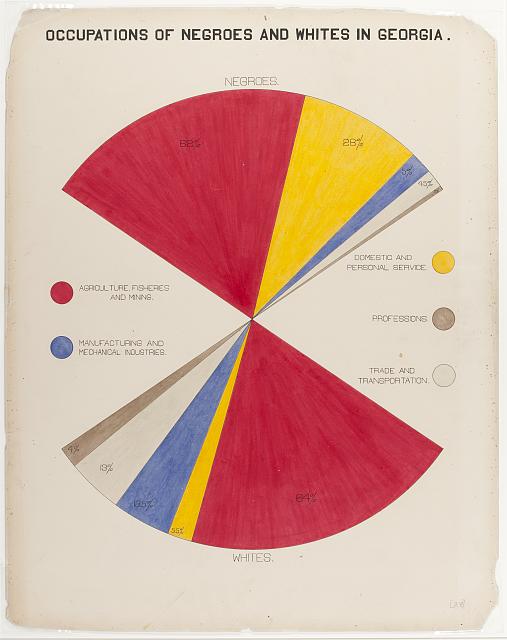
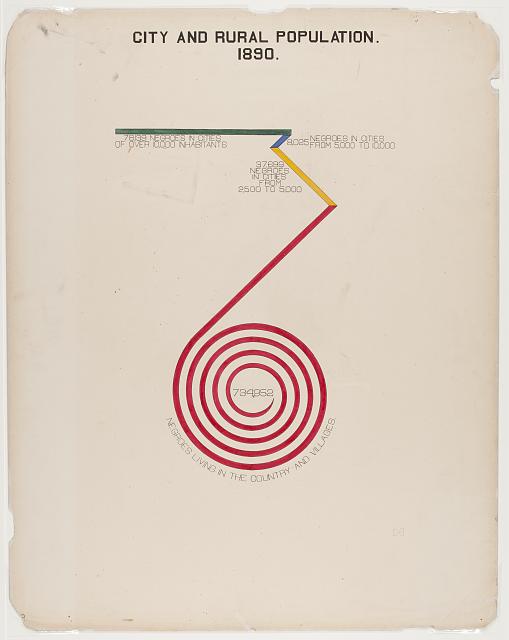
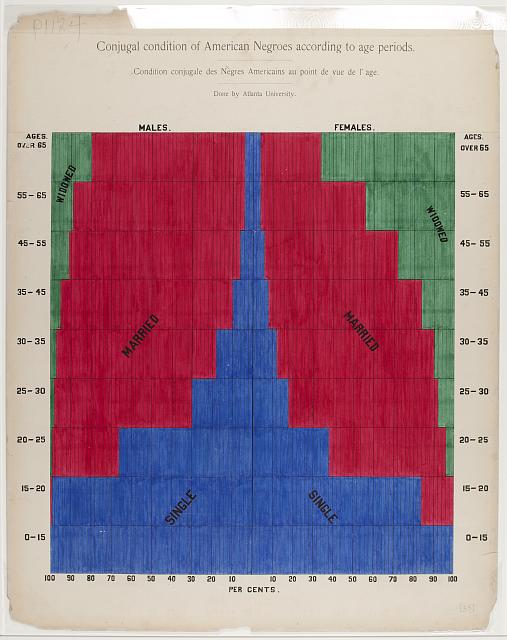
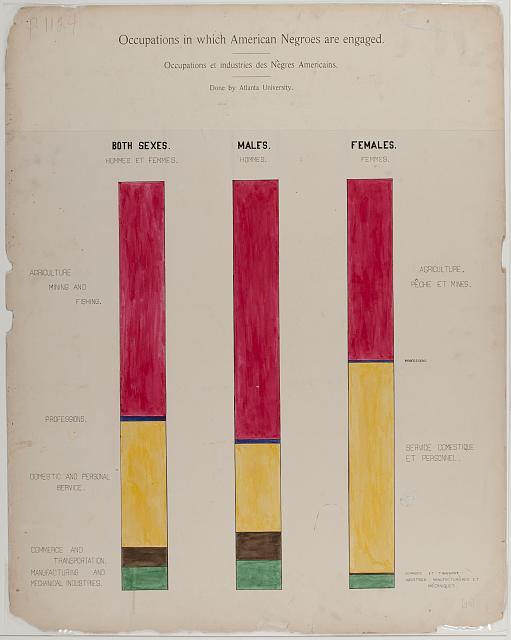
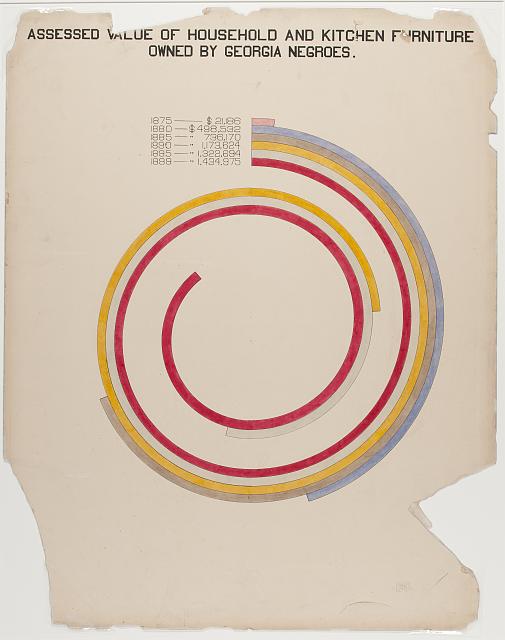
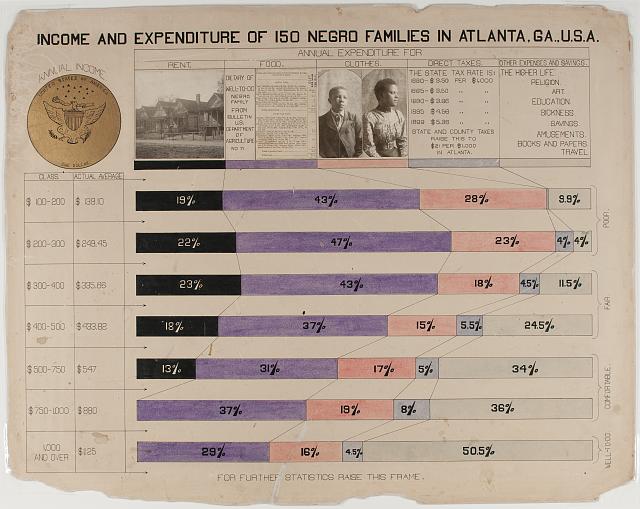
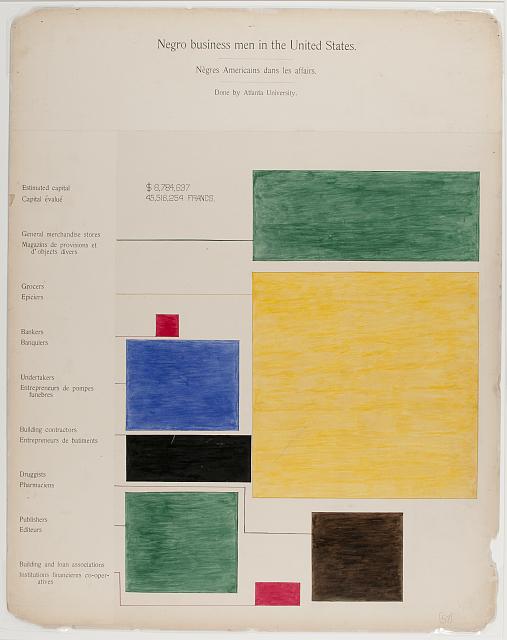
His address, entitled “The South and Its Problems,” focused on the systematic discrimination that African Americans faced in the Jim Crow South, and Du Bois illustrated these systematic consequences through a series of novel “charts…which greatly assisted the audience to a clear understanding of the importance of the problems and the direction recent developments have taken.” These colorful “charts” had been carefully created by Du Bois and his students at his Sociological Laboratory, at Atlanta University, where they creatively experimented with new kinds of data visualizing strategies that turned census data into evocative infographics. Each year, Du Bois and his students focused on a particular theme: in 1905, they were working on the issues surrounding health and medicine; the previous year had focused on crime; and other recent topics included Churches & Religious Life (1903), Work & Labor (1902), Education (1901), Business (1899), and Urban Life (1897).

Just a few years before his Grinnell lecture, Du Bois had showcased 63 of these prints—what he called at the time “data portraits”—at the Paris Exposition. Some of those items, pictured here, were likely featured in his Grinnell lecture at the Colonial Theater.

Today, Du Bois’s work in the field of data visualization has begun to receive much greater attention and recognition from scholars interested in reclaiming these pioneering forms of quantitative advocacy and graphic design. Those interested in seeing more examples can explore the full collection at the library of Congress; the 2023 exhibit at the Cooper Hewitt museum, Deconstructing Power: W.E.B. Du Bois at the World’s Fair; and the interactive website, The Du Boisian Visualization Toolkit.


The Liberal Arts at Grinnell: The Birth of the Major (1895-1930s)

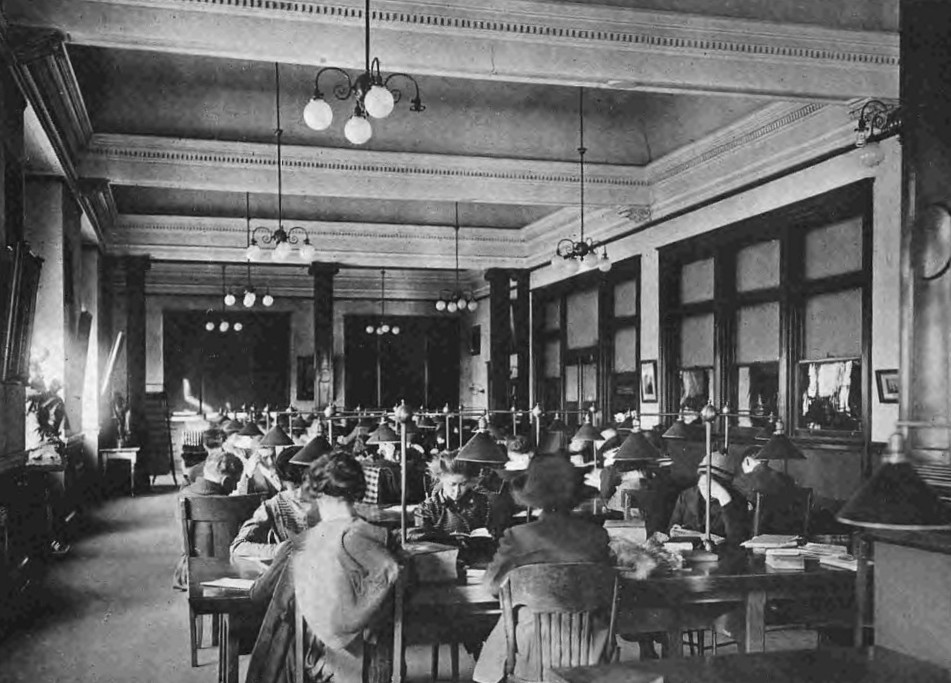
The Reading Room in Carnegie Library (1913)Carnegie Reading Room 1913
In the 1890s, there was heated debate within higher education about the appropriate way to structure the curriculum, with one camp of traditionalists favoring the established path of a carefully defined sequence of courses to be taken at each stage, while new reformers promoted a far more open curriculum that would be almost entirely elective (a trend popularized by many of the new colleges and state universities emerging in the West). Grinnell originally tried to accommodate both philosophies by having a degree track, with a well-defined sequence of courses students had to fulfill each year on their way to a bachelor’s degree, while also having an “Optional Studies” track where students could choose any array of courses they wanted, but would not lead to an actual degree.

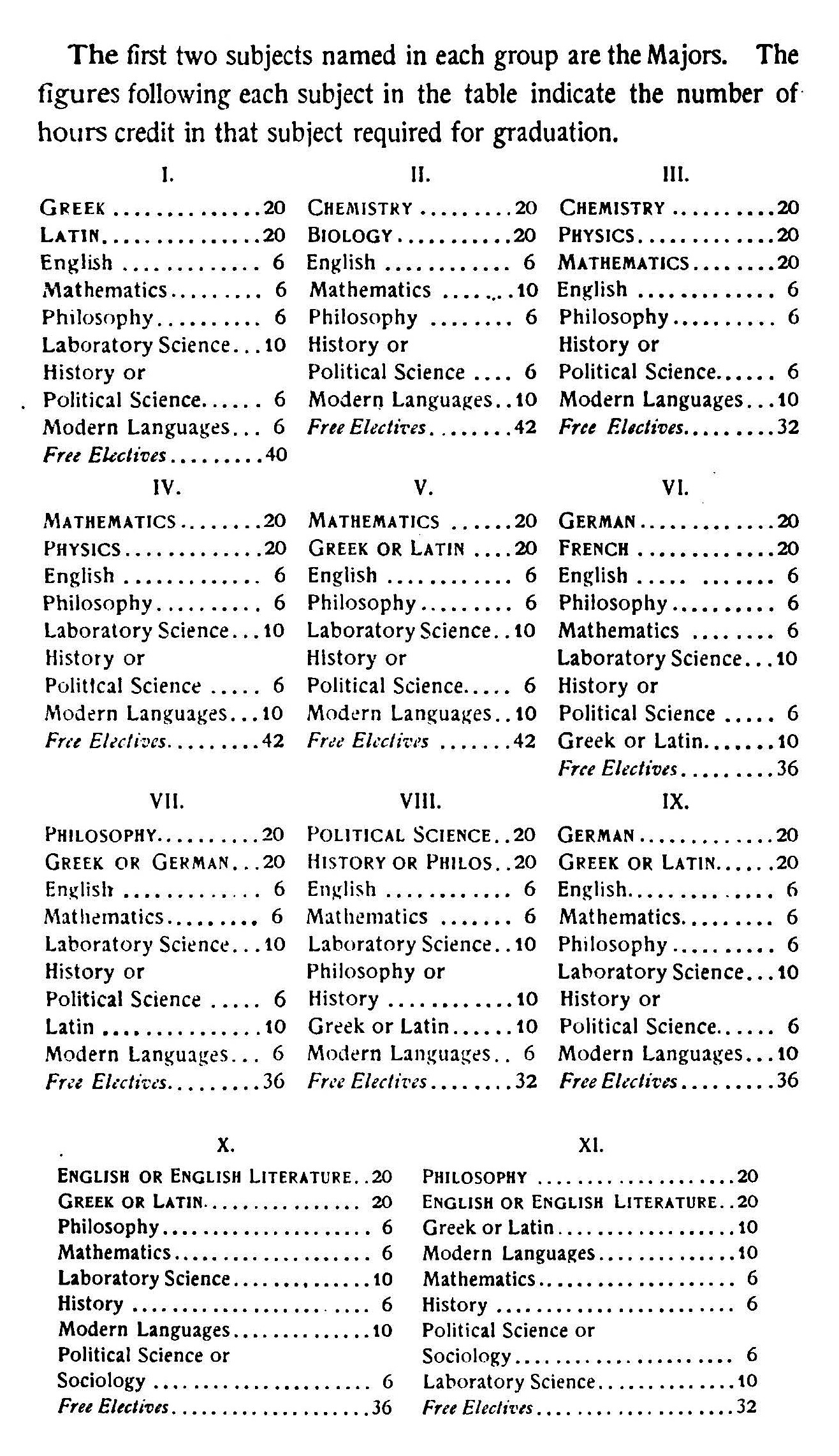
When George Gates became president of the college, in 1887, he began a series of important administrative and curricular reforms that would lead to Grinnell’s adoption of the “Group System” curriculum in 1895. This system, pioneered by the newly created Johns Hopkins’ University, tried to balance the demands of structure and choice, while addressing the mounting problem of how to incorporate new subjects into a fast-changing collegiate environment. For the first time, this system required students to choose a “major”—actually, two complimentary majors—each of which would consist of 20 credits of sequenced course work in those departments. At Grinnell, students could pair these complimentary majors in 9 combinations (increased to 11 in the catalog below), although students could also petition the newly created curriculum committee (yes, we can thank George Gates for creating the first standing committees of the faculty) to approve a new combination. In addition to their two majors (40 credits), students would also choose courses from a variety of required subjects, as specified in the catalog. But note that students could select what course to take in History, for example, or what modern language they would study (as opposed to the older curriculum which spelled out the specific classes a student would take each year).  The end result was a curriculum of roughly thirds (one third of the credits in their major fields, one third in required fields, and one third as open electives).

The college touted the virtues of this compromise, explaining that:

The Group system aims to combine the advantages of the rigid course system with those of the free elective system, while avoiding the dangers of each to maintain a proper balance between educational control on the one side and individual freedom of choice and self-direction on the other…the aim has been to organize each Group that it may afford the opportunity for a well-rounded liberal education, while preventing the waste and dissipation of energy incident to absolutely unlimited election.

To guide students in these choices, the college (for the first time ever) mandated that a faculty member should serve as an individual advisor for students who were majoring in their department.

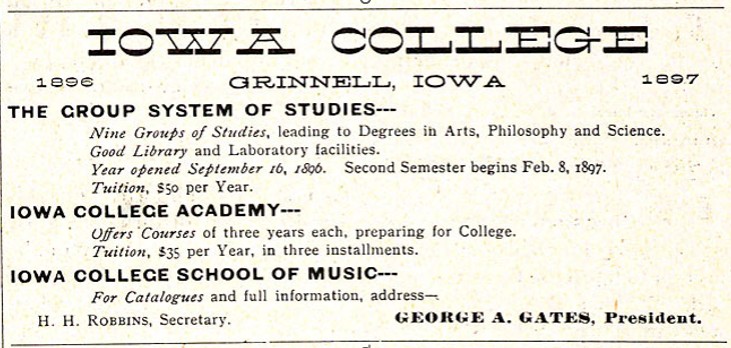
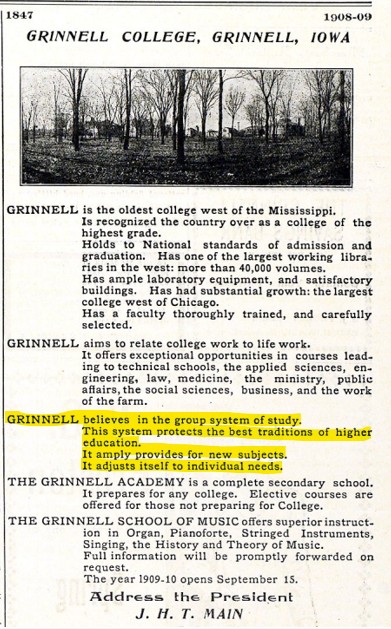
The College’s advertisements from this period (as you can see here), highlighted the group system as a defining feature of Grinnell.  While certain elements would evolve over time—the two majors, for example, became one “major” and one “minor”—the essential framework would remain in place for decades, shaping the institution.


The Liberal Arts Curriculum at Grinnell: c.1870-1895

In light of recent faculty discussions, underscoring the desire for more consistent reflection and conversation about the meaning of a liberal arts education at Grinnell, we’re going to spend some time this spring highlighting how this issue has played out over the college’s history. The early years of Iowa College—both in Davenport and then subsequently in Grinnell—saw very few students attaining a bachelor’s degree, and little structure in terms of the requirement for the B.A. (most of the students were enrolled in the preparatory academy). It was the period after the Civil War, when Grinnell’s first President, George Magoun, took charge that the faculty created an organized curriculum and set of requirements for entering college students, which would hold sway until a series of curricular reforms in the 1890s.

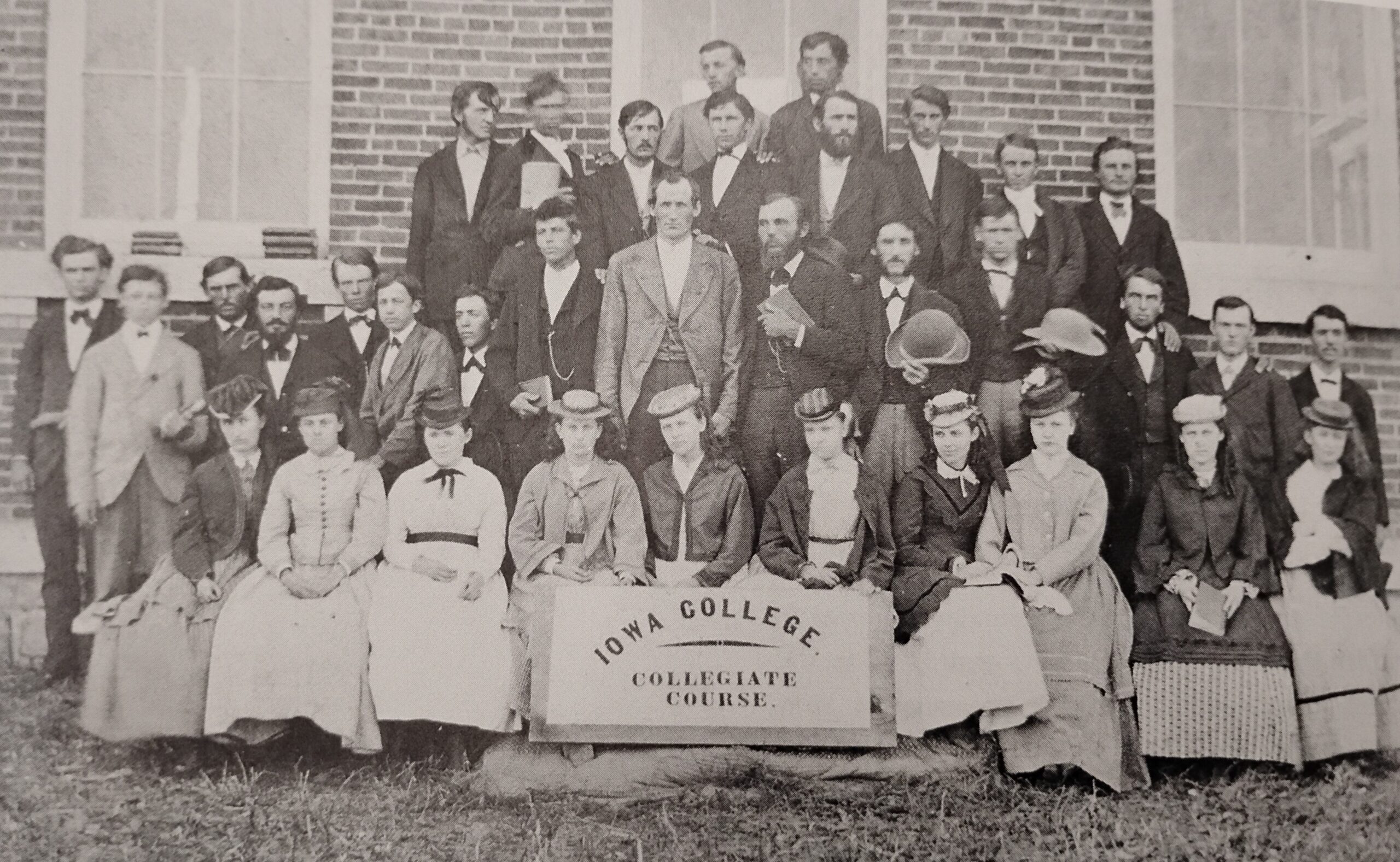
How did Grinnell approach a liberal arts education in 1870 (when the students pictured here, entered the college)?  There were four main “courses,” or tracks, that students could pursue:

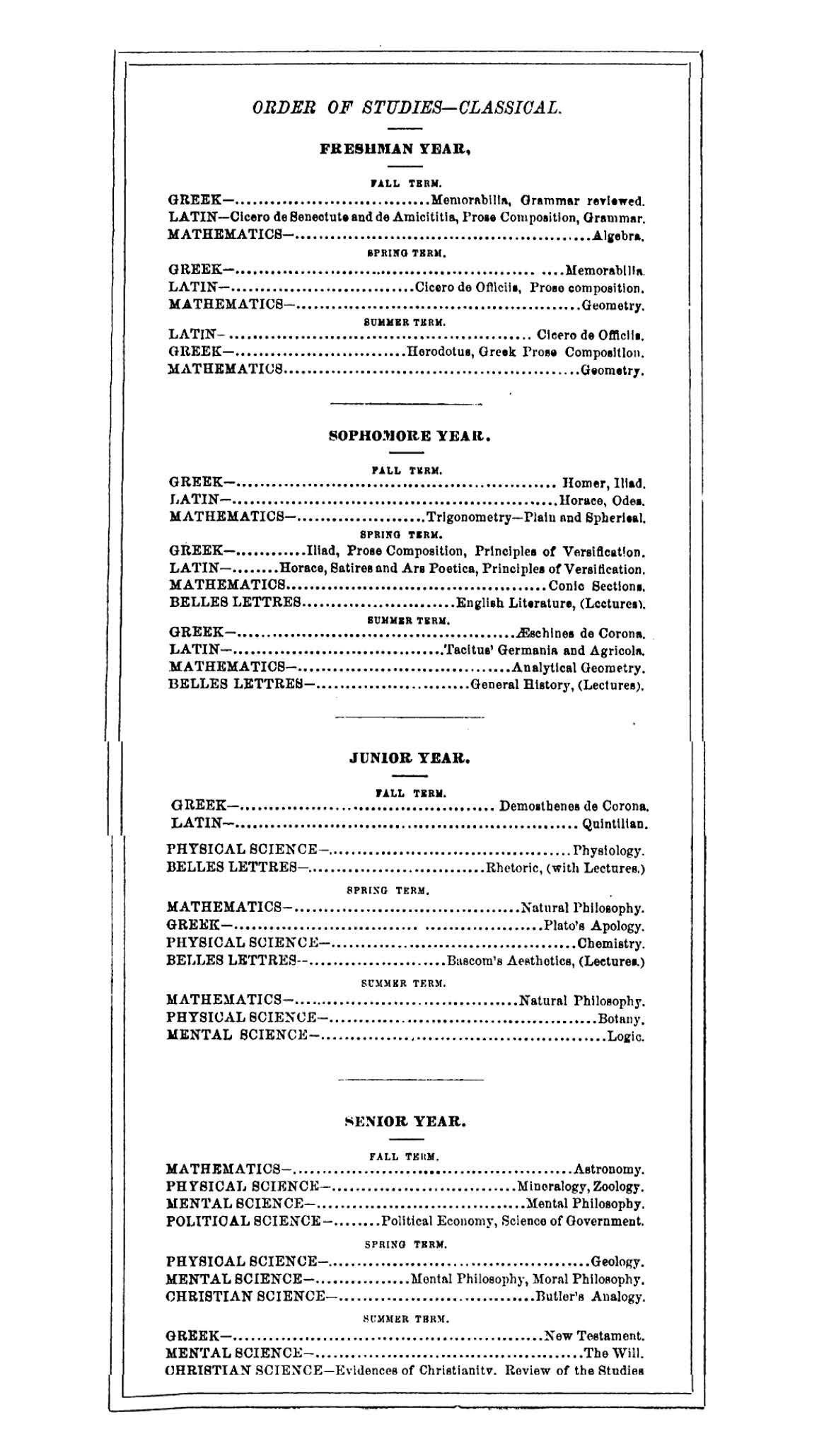
1.) a classical course, leading to the Bachelor’s of Arts (A.B.) degree

2.) a scientific course, leading to the Bachelor’s of Science (B.S.) degree

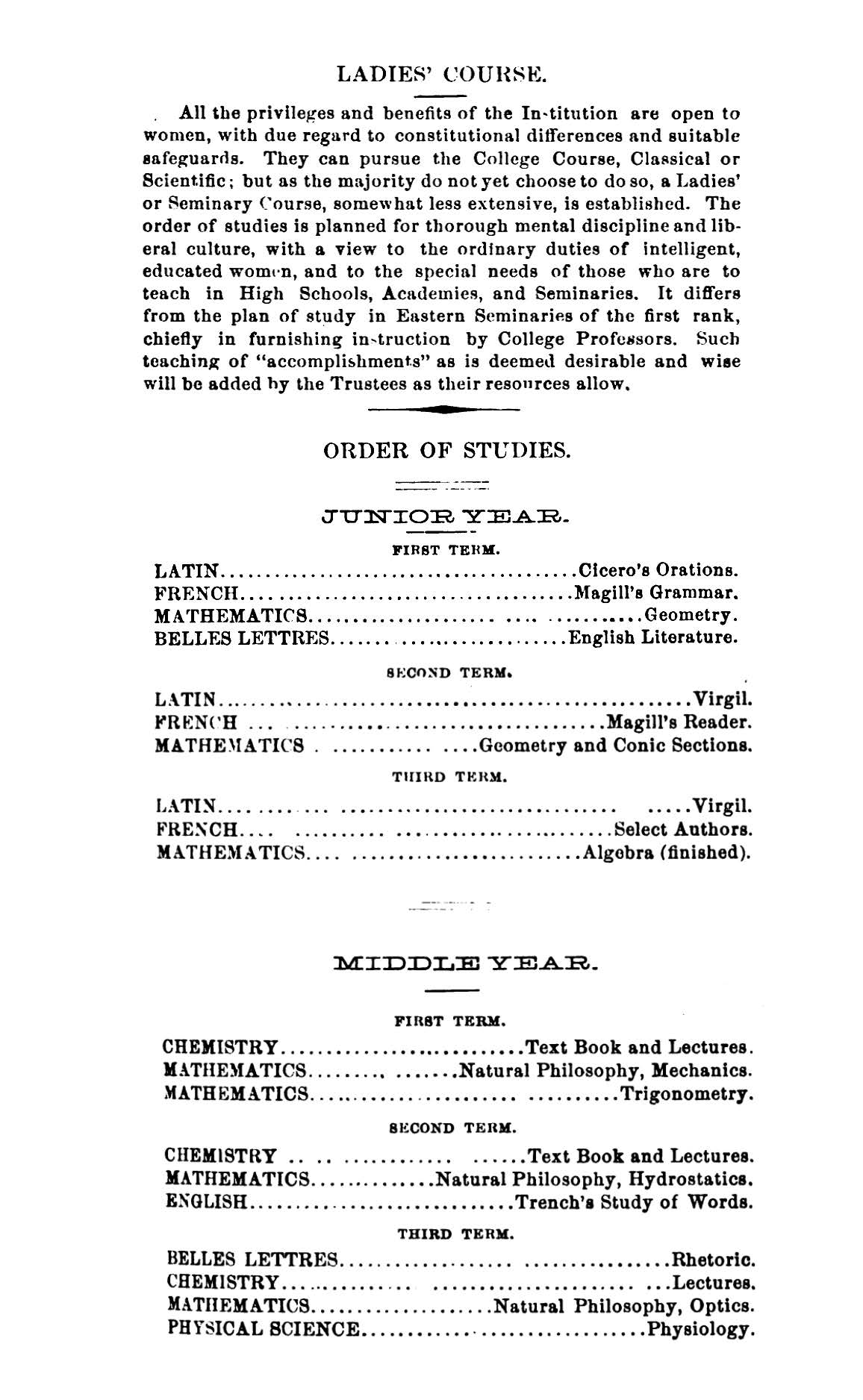
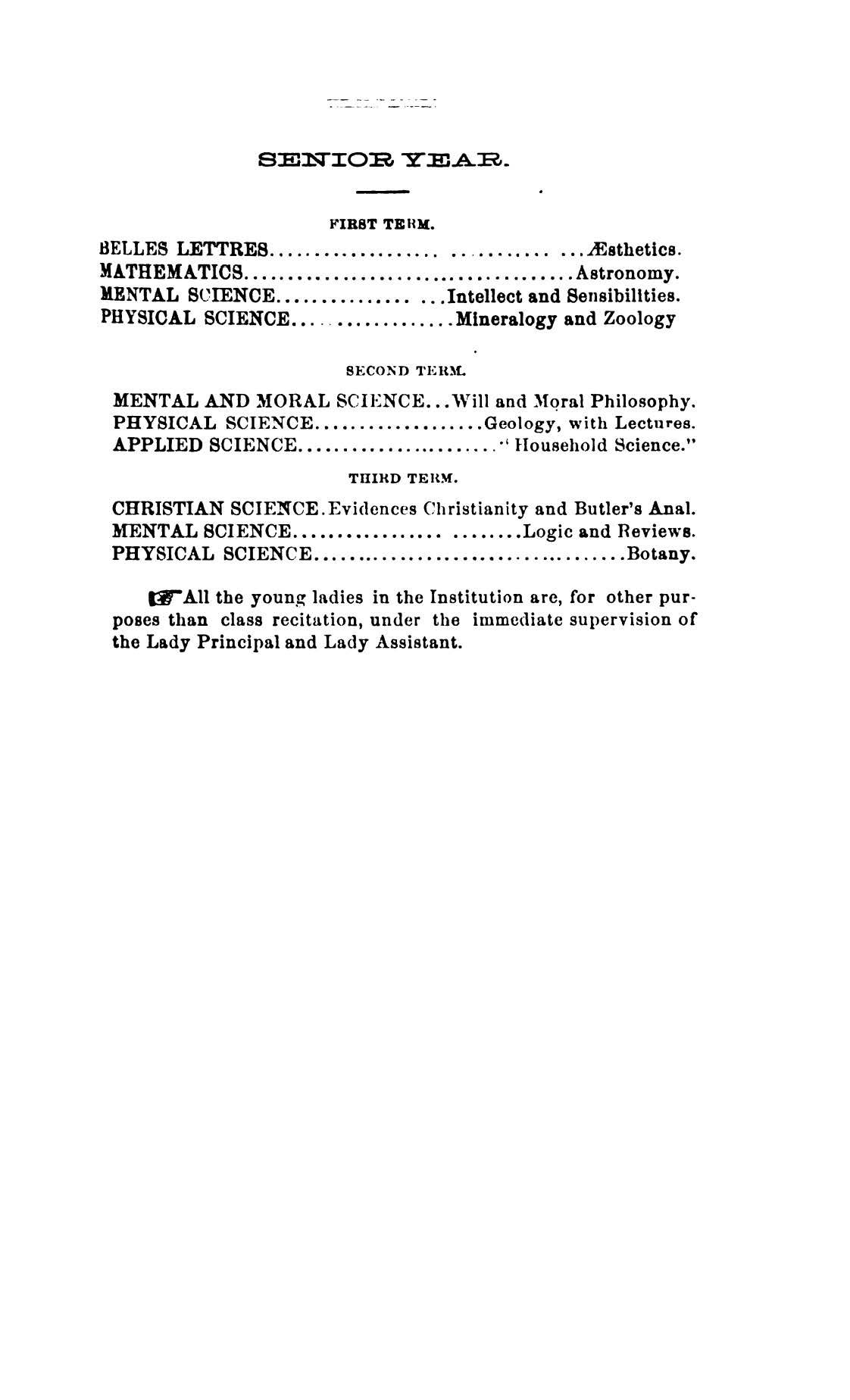
3.) a “Ladies Course,” (explained in the catalog page below) that evolved a decade later into the “Literary” course, and increased from 3 to 4 years. This course, however, led to a diploma rather than a bachelor’s degree.

4.) an “Optional Studies” course, which allowed students to freely choose the classes they wanted to take, but did not lead to a formal diploma or degree.

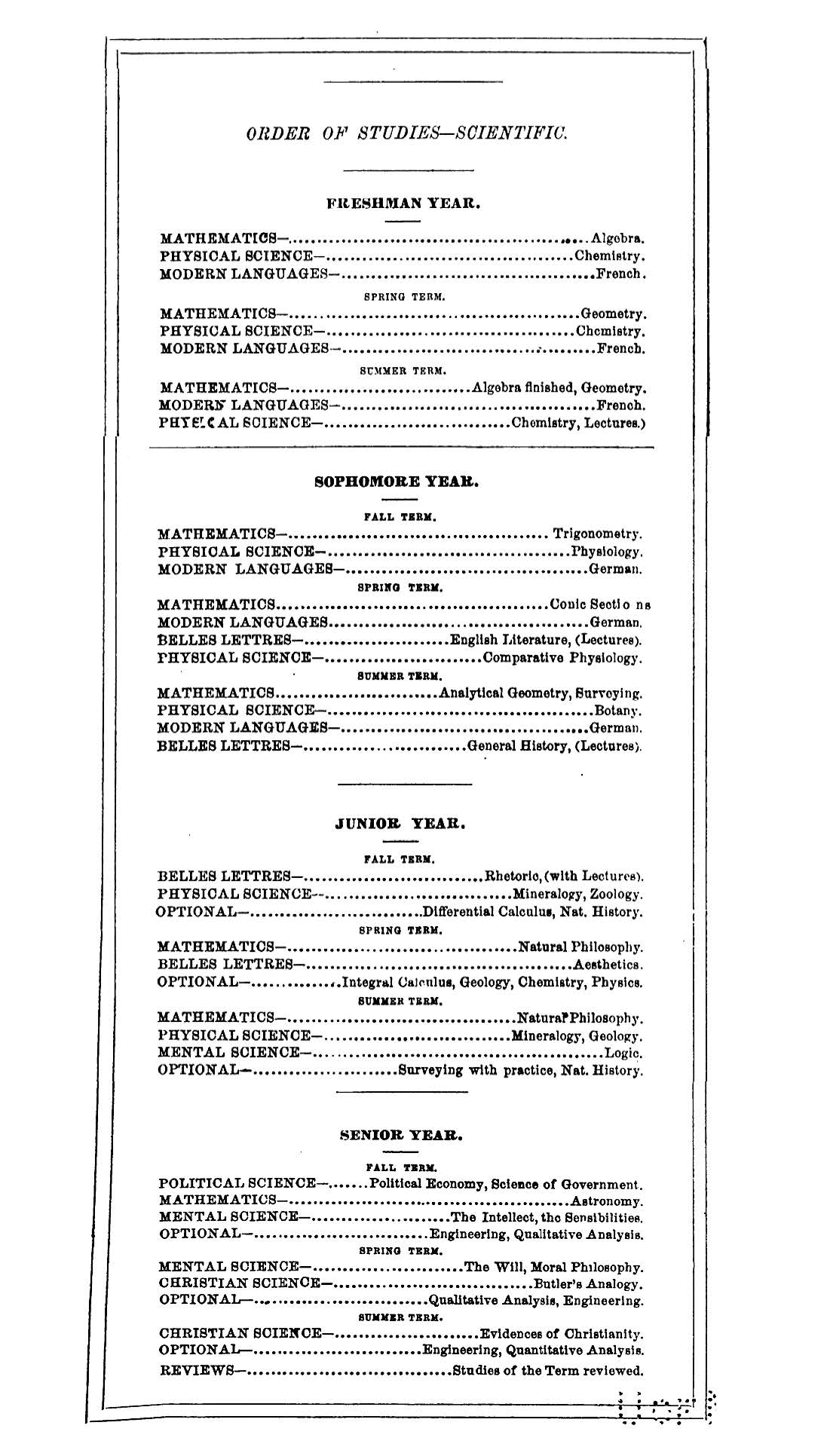
As you will see (below), each of these tracks were pretty rigid in terms of specifying the array and sequence of courses students would take each year.

Printed, here, are the course requirements and sequencing for those three main tracks, established in 1870.  All students were also required to attend religious service each morning (and twice on Sundays) while Men were required to participate in “military drill.”

In 1875, a Conservatory, or School of Music, was also created as a separate institution (although it was under the supervision of the same board of trustees as the college). It initially awarded diplomas, but by 1890, it also offered a Bachelor’s of Music degree to those who completed the full course of study involving musical theory, musical history, musical education, and demonstrated proficiency in one major, and one minor, instrument. It’s also worth noted that, at this time period, Grinnell College continued to run its preparatory Academy as well as a sizable “English or Normal School” that focused on training future school teachers. At times, the Academy and Normal school enrollment was much larger than the number of students in these collegiate tracks.

Powered by WordPress & Theme by Anders Norén