
The Reading Room in Carnegie Library (1913)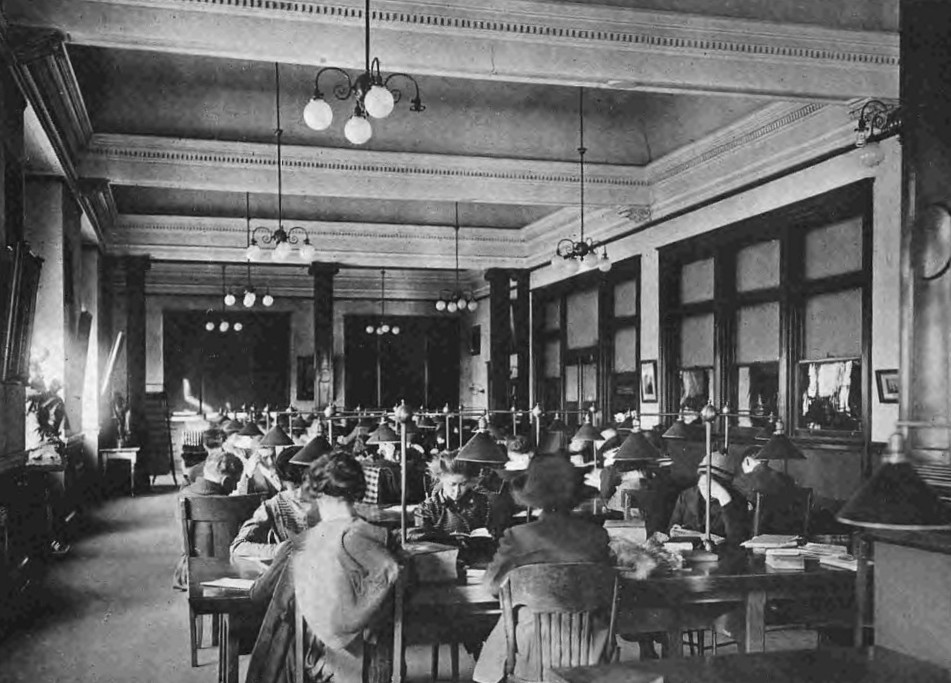
In the 1890s, there was heated debate within higher education about the appropriate way to structure the curriculum, with one camp of traditionalists favoring the established path of a carefully defined sequence of courses to be taken at each stage, while new reformers promoted a far more open curriculum that would be almost entirely elective (a trend popularized by many of the new colleges and state universities emerging in the West). Grinnell originally tried to accommodate both philosophies by having a degree track, with a well-defined sequence of courses students had to fulfill each year on their way to a bachelor’s degree, while also having an “Optional Studies” track where students could choose any array of courses they wanted, but would not lead to an actual degree.
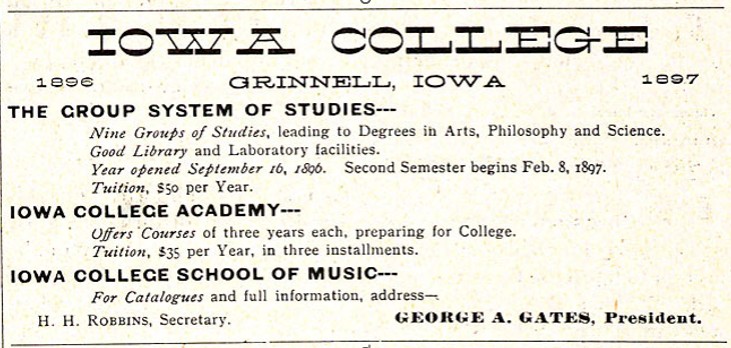 When George Gates became president of the college, in 1887, he began a series of important administrative and curricular reforms that would lead to Grinnell’s adoption of the “Group System” curriculum in 1895. This system, pioneered by the newly created Johns Hopkins’ University, tried to balance the demands of structure and choice, while addressing the mounting problem of how to incorporate new subjects into a fast-changing collegiate environment. For the first time, this system required students to choose a “major”—actually, two complimentary majors—each of which would consist of 20 credits of sequenced course work in those departments. At Grinnell, students could pair these complimentary majors in 9 combinations (increased to 11 in the catalog below), although students could also petition the newly created curriculum committee (yes, we can thank George Gates for creating the first standing committees of the faculty) to approve a new combination. In addition to their two majors (40 credits), students would also choose courses from a variety of required subjects, as specified in the catalog. But note that students could select what course to take in History, for example, or what modern language they would study (as opposed to the older curriculum which spelled out the specific classes a student would take each year). The end result was a curriculum of roughly thirds (one third of the credits in their major fields, one third in required fields, and one third as open electives).
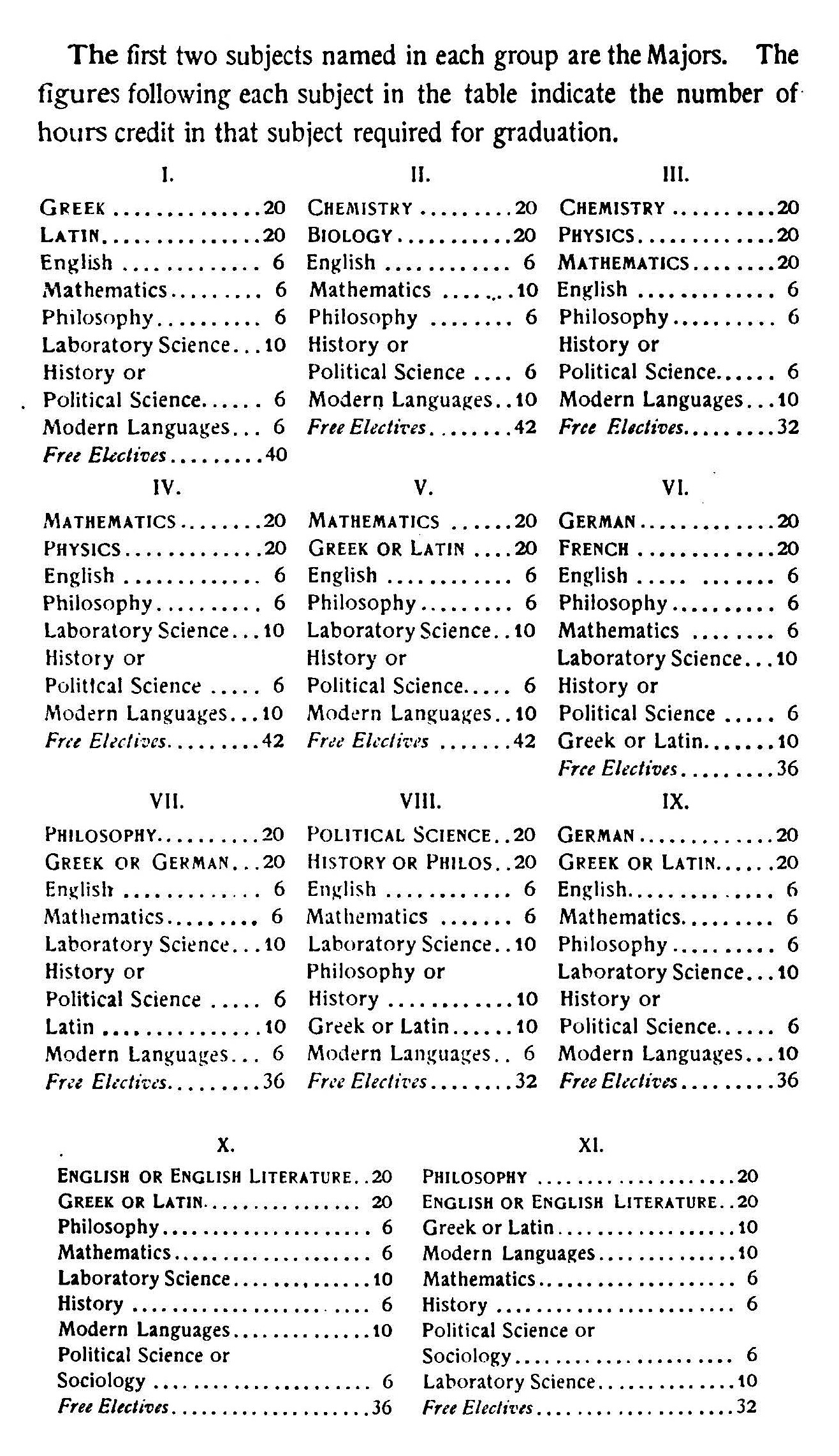
The college touted the virtues of this compromise, explaining that:
The Group system aims to combine the advantages of the rigid course system with those of the free elective system, while avoiding the dangers of each to maintain a proper balance between educational control on the one side and individual freedom of choice and self-direction on the other…the aim has been to organize each Group that it may afford the opportunity for a well-rounded liberal education, while preventing the waste and dissipation of energy incident to absolutely unlimited election.
 To guide students in these choices, the college (for the first time ever) mandated that a faculty member should serve as an individual advisor for students who were majoring in their department.
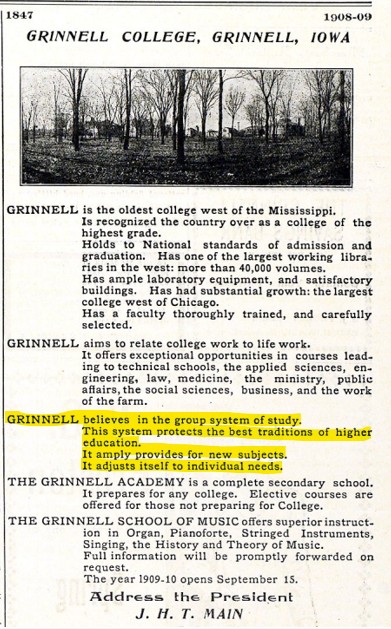
The College’s advertisements from this period (as you can see here), highlighted the group system as a defining feature of Grinnell. While certain elements would evolve over time—the two majors, for example, became one “major” and one “minor”—the essential framework would remain in place for decades, shaping the institution.
Leave a Reply