In April, grass grows at a prodigious rate in Iowa. On his visit to Grinnell, the famed agriculturalist, Wes Jackson, once expressed his astonishment at how quickly, and completely, Iowa goes from a sea of brown to a “riot of green”, in just a couple of weeks.
All of that grass, of course, requires mowing, and modern day Grinnellians are used to hearing the hum of lawnmowers around campus and town whenever the rain pauses and the sun comes out. Last week, in fact, City officials reminded residents, businesses, and institutions that they would be taking their rulers around town to measure grass height (anyone with grass over 8 inches will receive a citation and be fined).
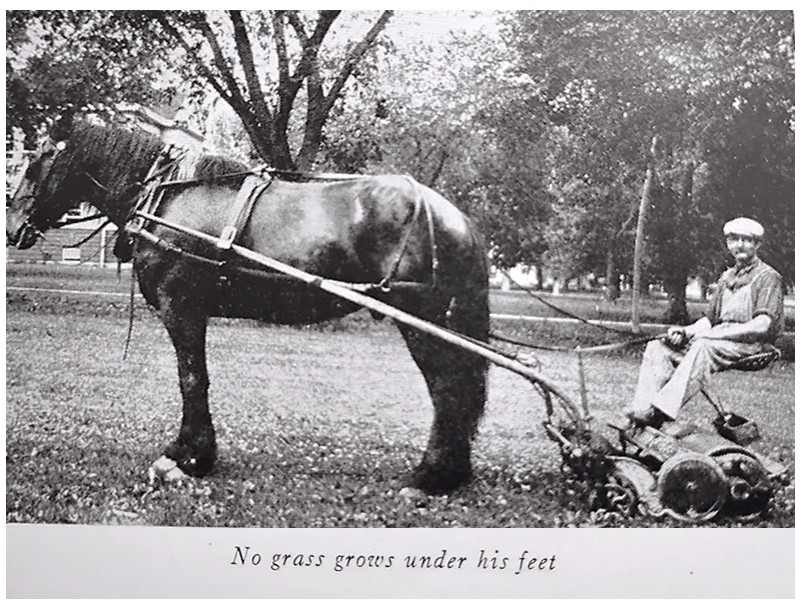
A century ago, one groundskeeper (captured in this 1916 photograph) was responsible for mowing all 22 acres of campus with a horse-drawn mechanical mower. In 1930, students published calculations about how much mowing this entailed. Estimating that he mowed the campus 20 times a year, and calculating how many miles that would translate into if he and the college horse travelled in a straight line, they determined (with a good dose of comic hyperbole) that:
They have traveled far enough to go from New York to San Francisco and back to the railroad crossing just this side of Kellogg, where they would undoubtedly block the Rock Island trains until next spring, when there will be more grass to cut and they could again move on.
This process of endless mowing is the kind of prosaic routine that typically fades into the background of college life. Although there are times when it surfaces. In the 1970s, for example, the staff of Buildings and Grounds went on strike for 19 weeks, forcing administrators to do much of the mowing (there are iconic photos of Dean Wally Walker mowing the campus lawn). And there were a number of debates in the 1980s about whether mowing should take place during class time, when open windows made it difficult to hear.
Still, the symphisian task of mowing continues on.