Month: September 2025

Professor Joseph Dunner

Dr. Joseph Dunner, Professor of Political Science at Grinnell from 1946-1963, had a remarkable life and career. As an Israeli newspaper asked, in a 1973 profile piece about the seemingly soft-spoken, pipe-wielding professor:

What would you say about a man who was chief of the intelligence section OWI (London, England) in 1944-45, was head of the press control section of Information Control in Munich, Germany 1945-46, was the director of the Institution of International Affairs 1946-58, and in 1954 was decorated with the Order of Ouissam Alaouite Cherifren by the Sultan of Morocco…and is the author of over ten books?

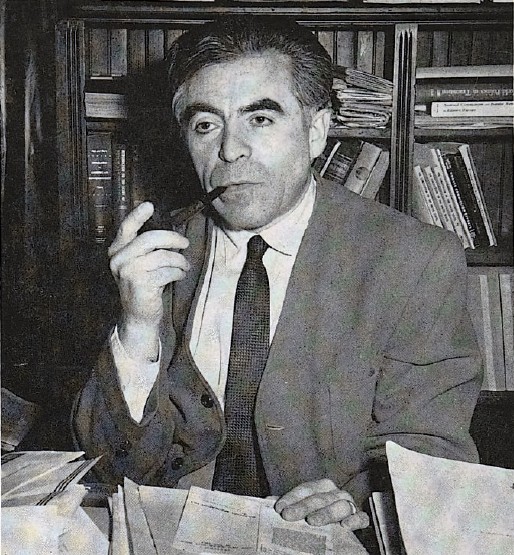
Born in Germany, Josef Dünner was a leader of the Social Democratic party, an outspoken opponent of Hitler, and a prominent Jewish intellectual. For these reasons, he appeared on the first list, issued by the Nazi regime in 1933, stripping particular individuals of their citizenship. Receiving a tip from local police, Dunner fled Germany the night before he was scheduled to be arrested, crossing the border into Switzerland. With the support of the Brookings Institute, he eventually resettled in America, and played a prominent role in intelligence in World War II (mentioned above).  After working to re-establish a free press in German in the wake of the war, Dunner moved to Grinnell to become the chair of its political science department. A specialist in both political philosophy and international relations, Dunner sought to infuse both areas into Grinnell’s program that had traditionally focused on domestic politics, municipal administration, and civic reform (the legacy of Jesse Macy and the Social Gospel movement).  The picture above shows Dunner in his office in Goodnow with his trademark pipe.
The Displaced Persons Program

In 1949, the Student Council at Grinnell decided to participate in a new program aimed at finding collegiate homes for young international students displaced by war, or fleeing repressive regimes behind the rapidly descending iron curtain. This idea had been created by the National Student Association, and the whole initiative appears to have been largely student driven (including raising scholarship funds to pay for tuition for these “displaced persons,” a term used to describe the participants and the program). Pictured here are 2 of the first participants to join Grinnell College: Leon Bildusas, from Lithuania, on the left, and Serafim Romberg, from Czechoslovakia, on the right (along with a student guide showing them the campus). Between the two of them, these new arrivals spoke 7 languages: German, Lithuanian, Russian, Latvian, Ukrainian, Polish, and English.

The Much-Maligned Norris Hall Gets a Make-Over

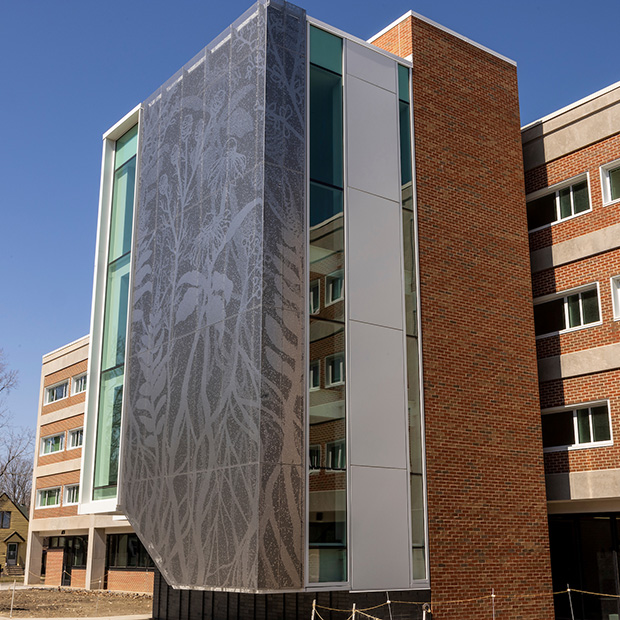
In 2022, the College completed an ambitious renovation project of Norris Hall, which won a “Masters Award” from the Master Builders of Iowa, not to mention wide applause from students.

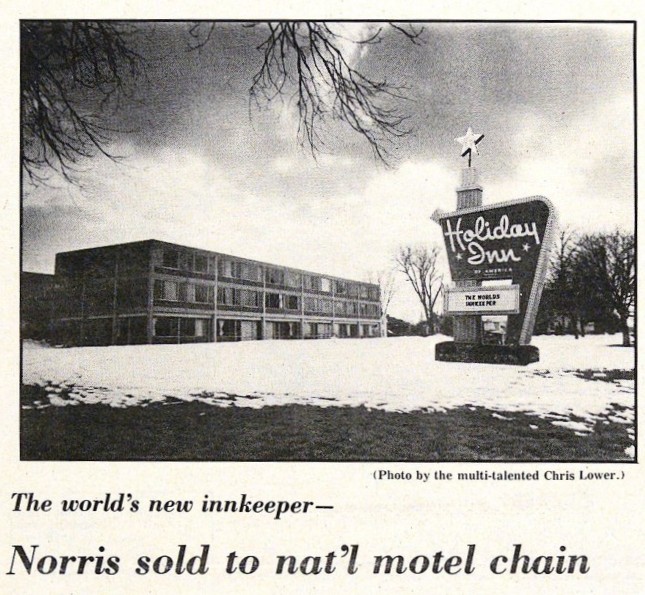
Norris has always had its fair share of detractors, criticized for it’s sterile architecture and cramped space.  In the 1970s, it was nicknamed the “Holiday Inn North” which led to the following spoof in the S&B:

Perhaps the best part of the satirical article was its depiction of why the chain motel was so pleased with its purchase:

Holiday Inn was reportedly very pleased with their new purchase. A representative of that organization spoke with the S&B about the existing structure: “It fit all our needs perfectly. The walls are thin and we are impressed with the conspicuous use of Formica and the modular furniture. We’re also very happy that the hallways are so narrow . . . it makes them easier to clean. We  couldn’t have done any better if we had designed, it ourselves,” he said


Isaac Newton at Grinnell

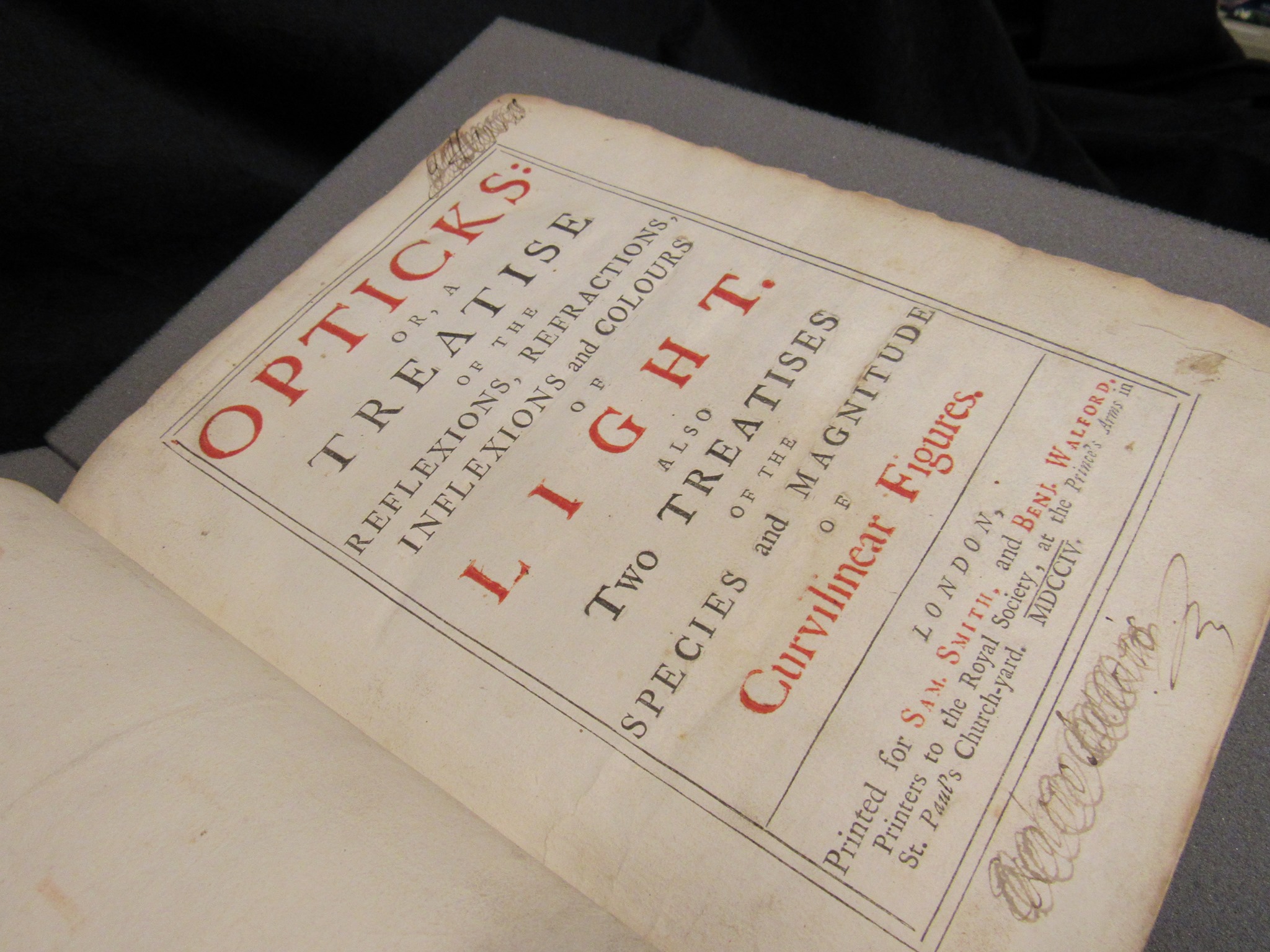
Grinnell Special Collection's Copy of Opticks (1704)

In 2019, Grinnell acquired the impressive collection of rare books and documents that had been assembled by Carl Weeks and housed at his residence, Salisbury House, in Des Moines. Visitors to special collections, in Burling Library, can now peruse the more than 5000 items in the collection–a virtual treasure trove of historic texts, ranging from medieval manuscripts to a limited edition of James Joyce’s Ulysses (illustrated by Henri Matisse).

One of these gems is a first edition of Isaac Newton’s Opticks, a work that was filled with experimental reports and musings about a wide range of topics surrounding the nature of light, its transmission and absorption, the nature of color, and the hidden structure of matter. While contemporaries praised Newton’s Principia, few people could understand its complicated mathematics, whereas the Opticks was a widely popular book that inspired many people to take up experimental science. And, in fact, Grinnell’s copy of the Opticks contains a number of annotations and comments (i.e. marginalia) that were inscribed by one its enthusiastic readers.

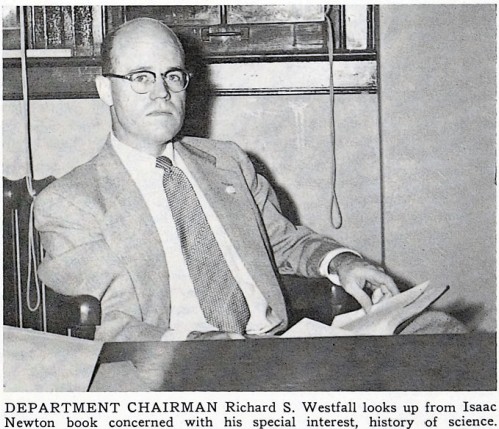
This book would have been particularly appreciated by one of Grinnell’s former History professors–Richard S. Westfall–who was a world renowned scholar of Newton and the scientific revolution. Prof. Westfall taught at Grinnell in the 1950s and 1960s, winning a National Science Foundation grant in 1961 that allowed him to spend a year or archival work in Cambridge, among Newton’s papers. One of the last pieces he published at Grinnell, before leaving to head the Department of History and Philosophy of Science at the University of Indiana, in 1963, was a scholarly article, “The Development of Newton’s Theory of Color” that put forward a new interpretation of the Opticks. In 1980, Westfall would publish what is still considered the definitive biography of Newton: Never at Rest: A Biography of Isaac Newton, that he started while teaching at Grinnell College. Eventually, Westfall was awarded the George Sarton Medal, the highest honor in this field, in recognition of his lifetime contributions to the history of science.

The Entering Class Picture

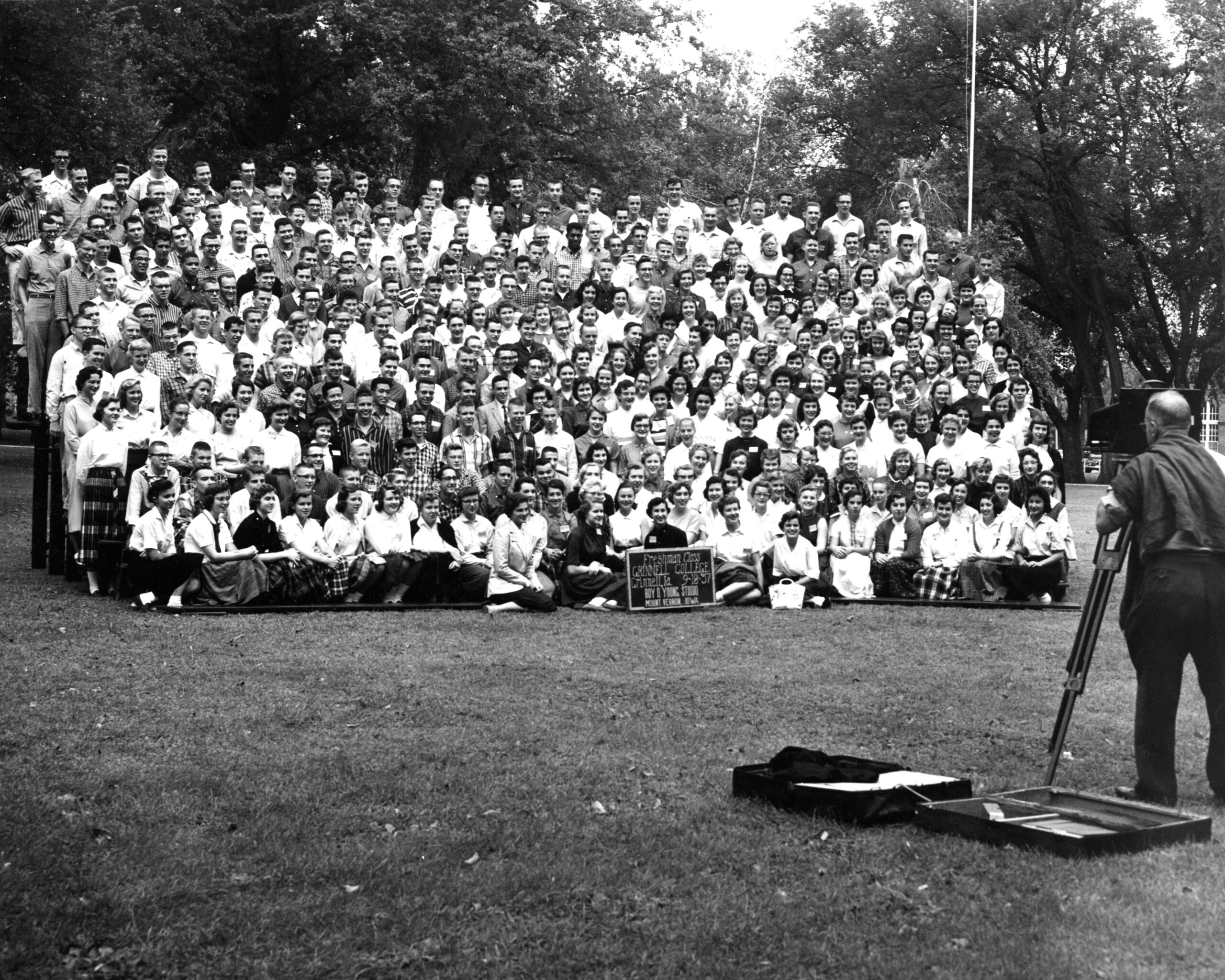
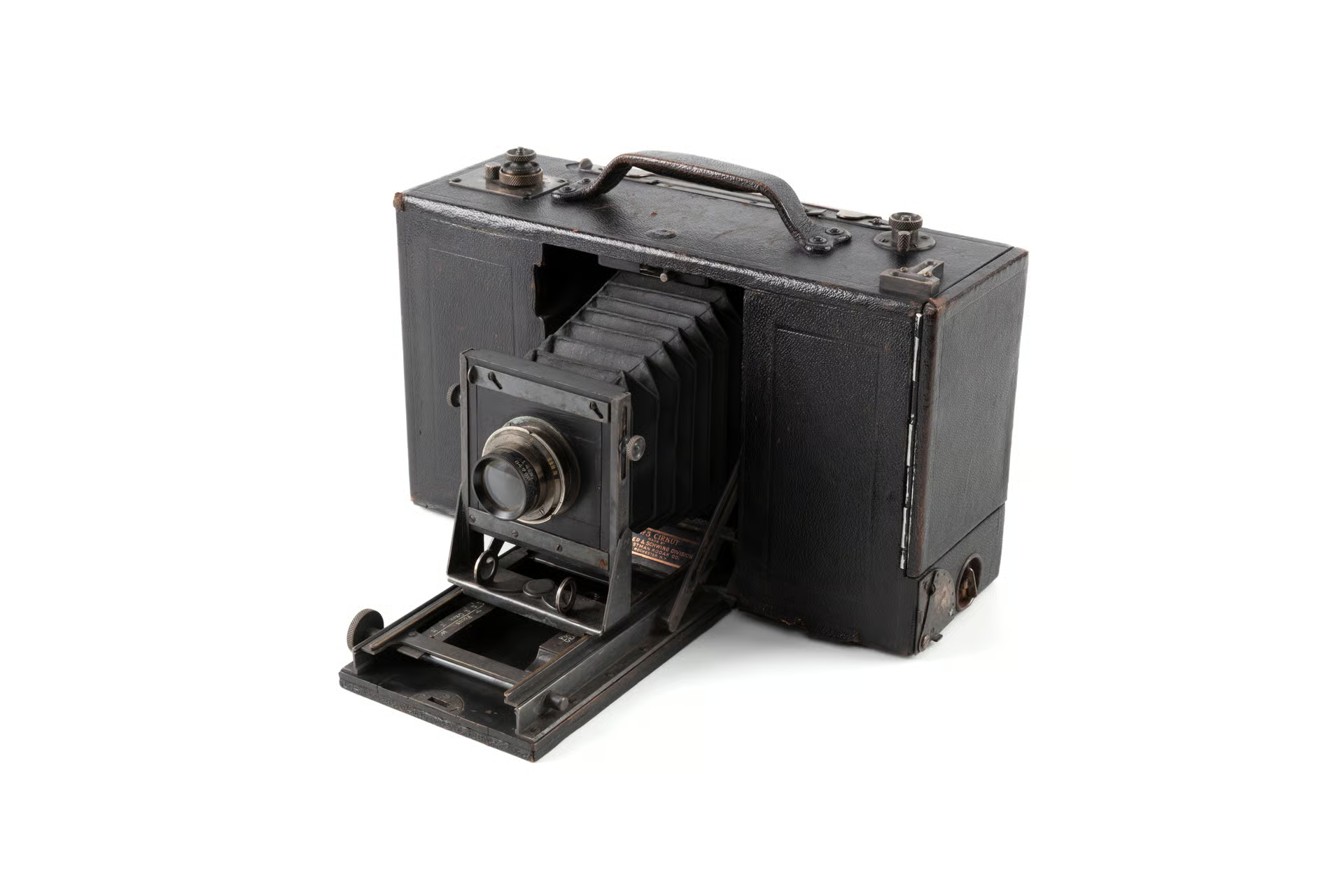
One of the older traditions on campus involved taking a group photo of the entering class during new students week. Here the class of 1961 poses for a photo in mid-September of 1957.  Interestingly, the photographer, Roy Young, was not chosen simply because his studio was nearby in Mt. Vernon, Iowa. Rather, Young was a highly sought after “specialist in large group photography” who photographed at colleges and military installations around the country–as far afield as Georgia and Florida.  Young used a variety of large-format cameras, such as “view” cameras, “banquet” cameras, and “Cirkut” cameras (shown below) that could revolve and pivot for panoramic, group photographs. It took a fair amount of skill and technical equipment to capture hundreds of faces in clear focus.

Powered by WordPress & Theme by Anders Norén