
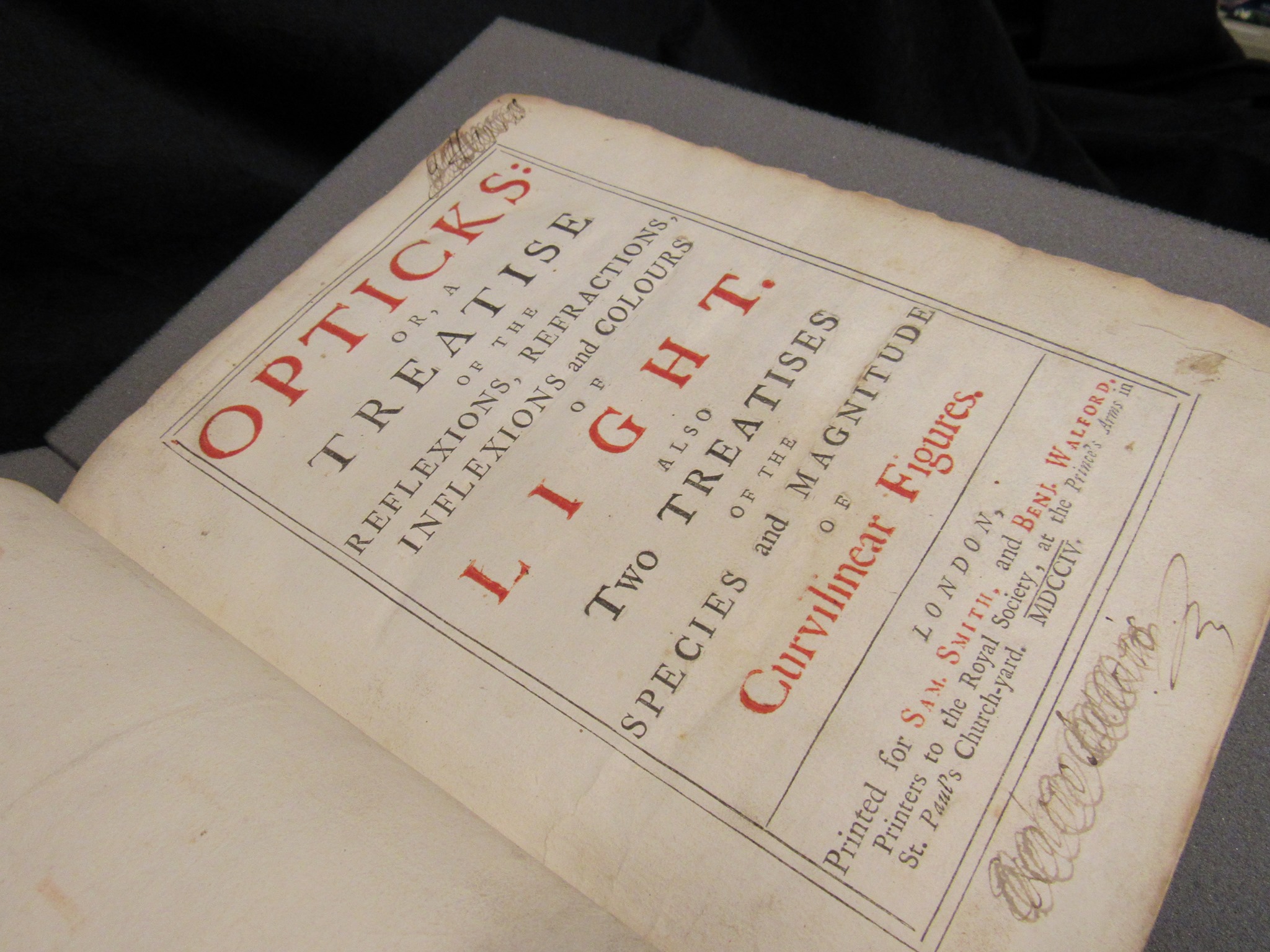
In 2019, Grinnell acquired the impressive collection of rare books and documents that had been assembled by Carl Weeks and housed at his residence, Salisbury House, in Des Moines. Visitors to special collections, in Burling Library, can now peruse the more than 5000 items in the collection–a virtual treasure trove of historic texts, ranging from medieval manuscripts to a limited edition of James Joyce’s Ulysses (illustrated by Henri Matisse).
One of these gems is a first edition of Isaac Newton’s Opticks, a work that was filled with experimental reports and musings about a wide range of topics surrounding the nature of light, its transmission and absorption, the nature of color, and the hidden structure of matter. While contemporaries praised Newton’s Principia, few people could understand its complicated mathematics, whereas the Opticks was a widely popular book that inspired many people to take up experimental science. And, in fact, Grinnell’s copy of the Opticks contains a number of annotations and comments (i.e. marginalia) that were inscribed by one its enthusiastic readers.
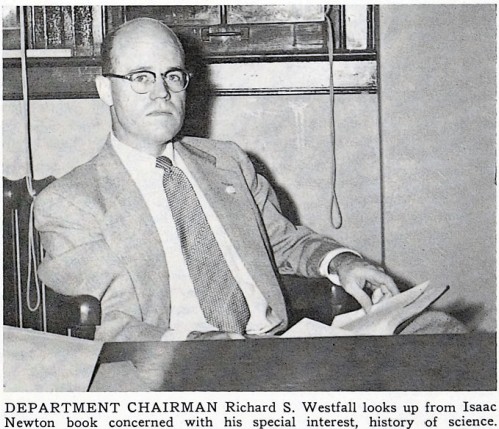 This book would have been particularly appreciated by one of Grinnell’s former History professors–Richard S. Westfall–who was a world renowned scholar of Newton and the scientific revolution. Prof. Westfall taught at Grinnell in the 1950s and 1960s, winning a National Science Foundation grant in 1961 that allowed him to spend a year or archival work in Cambridge, among Newton’s papers. One of the last pieces he published at Grinnell, before leaving to head the Department of History and Philosophy of Science at the University of Indiana, in 1963, was a scholarly article, “The Development of Newton’s Theory of Color” that put forward a new interpretation of the Opticks. In 1980, Westfall would publish what is still considered the definitive biography of Newton: Never at Rest: A Biography of Isaac Newton, that he started while teaching at Grinnell College. Eventually, Westfall was awarded the George Sarton Medal, the highest honor in this field, in recognition of his lifetime contributions to the history of science.
Leave a Reply