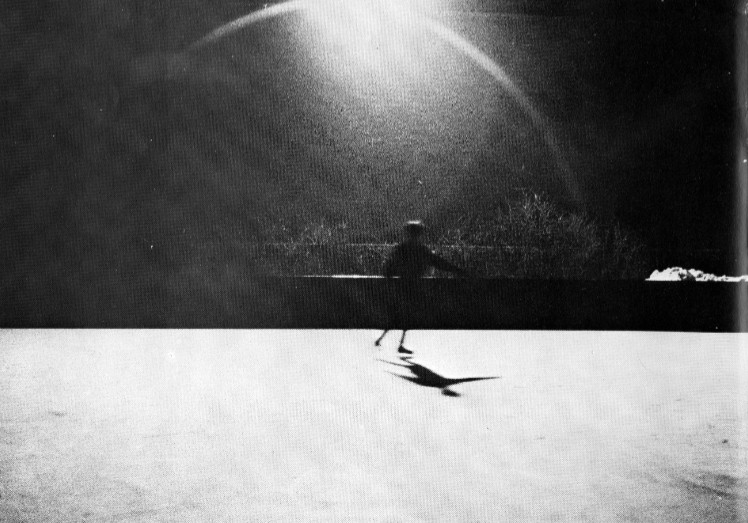
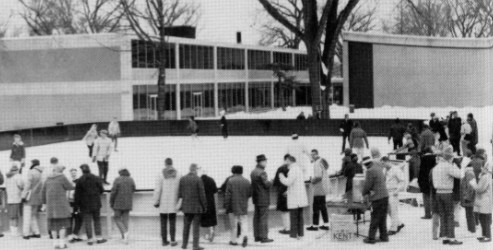
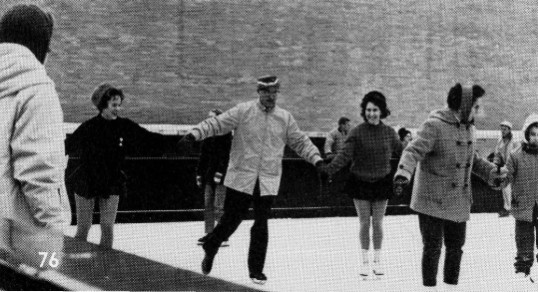
 For most of Grinnell’s history, students interested in ice skating took to nearby frozen lakes (such as Arbor Lake in town, or beginning in the 1950s, to the newly created Rock Creek Lake, located seven miles west of the college), while hockey enthusiasts made use of a temporary rink set up each winter for intramural games. But in 1961, a Grinnell alumna and ice-skating enthusiast, Margaret Kyle Barber ’99, donated funds for a more permanent ice-skating rink on campus that would be open from October through March. Named, “Barber Plaza,” and modelled loosely on the ice rink at Rockefeller Center in New York City, this 7,000 square foot rink was constructed to the immediate north-east of the Fine Arts Building, and in fact, used that building’s air-conditioning system to maintain consistently frozen ice on the rink through a network of cooling channels embedded in the plaza’s concrete. During the warmer months—i.e. March through September—the plaza became a useful space for hosting outdoor dances, dinners, concerts, and other events*
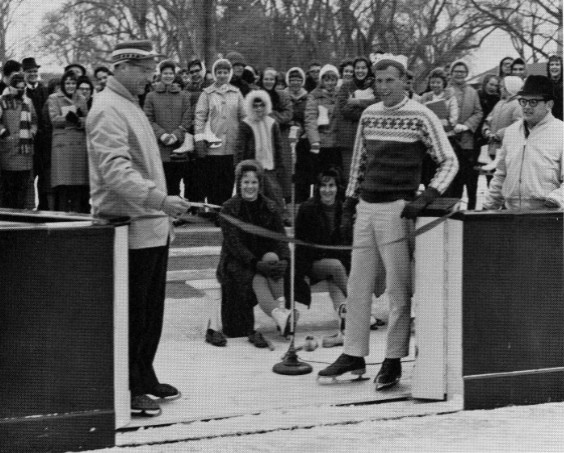
At the opening ceremony of Barber Plaza, in January of 1962, President Howard Bowen spoke about the importance of physical exercise and education within a liberal arts college, which was a consistent theme of his presidency which saw a notable expansion in both areas. It also seems as if the 1950s and 1960s represented the peak of “winter culture” on campus, with an impressive range of outdoor activities, programming, and winter sports.
*Having just marked Martin Luther King day, last week, it is worth noting that Barber Plaza served as the site for a large campus gathering on Sunday, April 7th (3 days after King’s assassination in Memphis), in which hundreds gathered to mourn King’s death, to rally in support of the civil right’s movement, and to raise money for the striking sanitation workers in Memphis, TN.