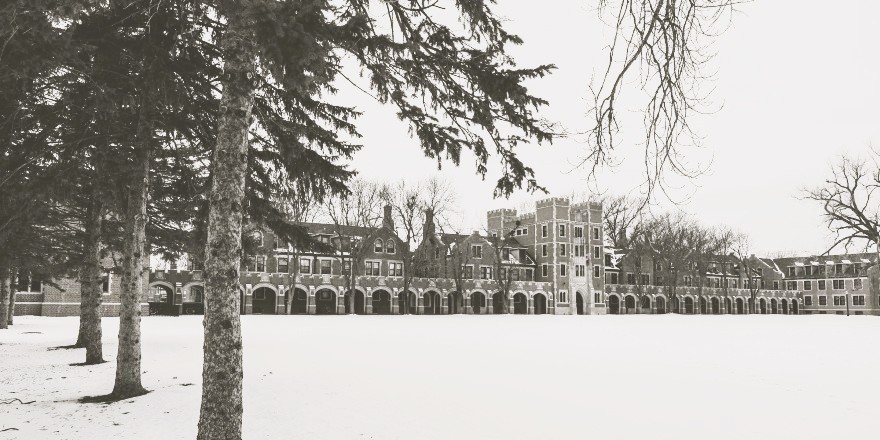
 The Fall semester is now officially over, and the college will be on winter break until January 20th.
Enjoy the holidays!

The Fall semester is now officially over, and the college will be on winter break until January 20th.
Enjoy the holidays!
One hundred years ago (on December 16, 1925), the students of Grinnell College started a new holiday tradition by hosting a special Christmas dinner for local children from the Uncle Sam’s Club. The Uncle Sam’s Club was a local organization that had been created by Grinnell students at the turn of the century to provide programming, education and recreation to local kids at time when there were very few such programs or services. It proved so successful that, within a few years, they had raised enough funds to build a large clubhouse on the south side of town, where more than 50 students a year volunteered to work with hundreds of local kids on everything from art classes to Sunday school to sports leagues.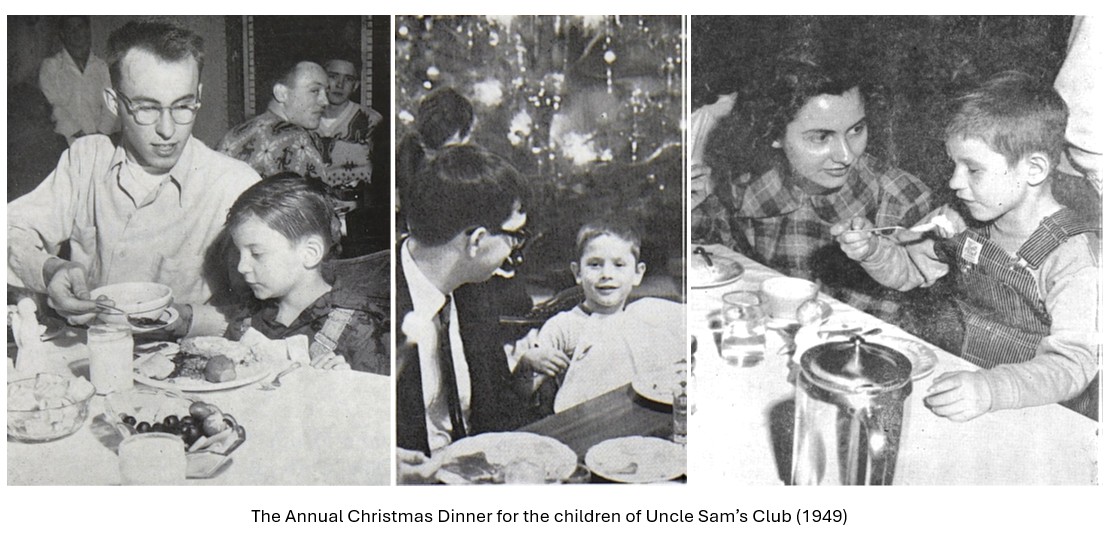
The holiday dinners became an annual tradition that grew in size, so that by the 1950s, there were as many as a 150 children attending these Christmas feasts, held in the Cowles Dinning Hall (pictured here). The meal consisted of roast meats, served with almost a dozen different side dishes, and capped off with special ice cream for dessert. These meals took on added importance during the 1930s and 1940s, when the Great Depression, and then the rationing of the war years, made this kind of holiday feast more extraordinary and appreciated. The tradition also grew to include after dinner entertainment—ranging from variety shows to magician acts to movies—as well as distributing Christmas toys.
It may be hard to believe, today, but the holiday calendar used to be even more packed with events, parties, festivals and fetes that Grinnellians somehow managed to squeeze into the last week of the semester. And among these, the Uncle Sam’s Club Dinner always proved to be a favorite.
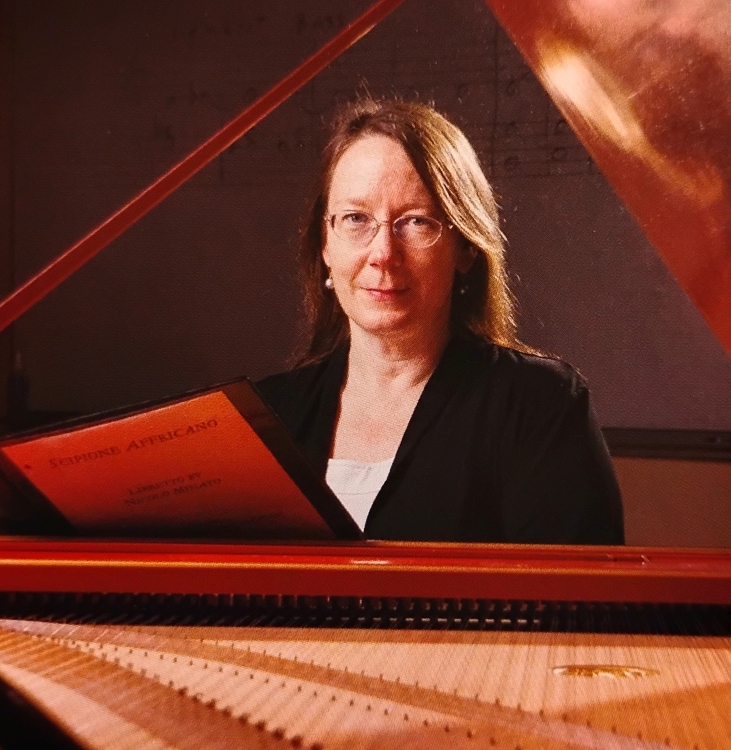 Last week, Jennifer Williams Brown, Professor of Music, passed away at her home in Grinnell after a long battle with ALS. Prof. Brown was a distinguished musicologist and performer, who specialized in early modern opera (particularly translating and analyzing the work of Francesco Cavalli). She taught baroque music and dance at LSU and the Eastman School of Music before joining Grinnell’s Music department in 2005.
Twenty years later, at the 2025 commencement, President Harris’s special recognition citation (marking Prof. Brown’s transition to Senior Faculty Status) captured the wide-ranging contributions she made to the college, and to her field, through a remarkable record of teaching, scholarship, and service.
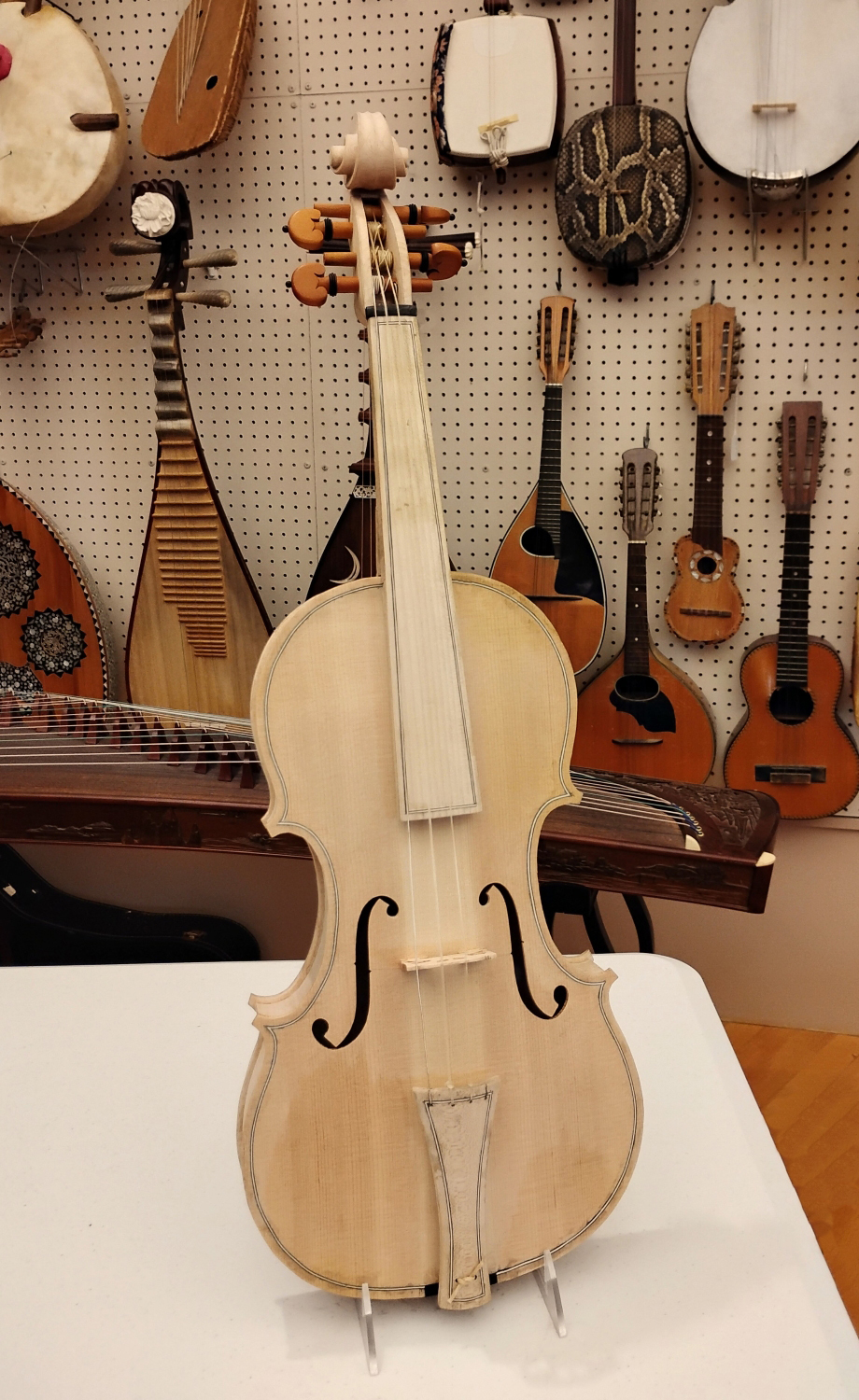 For this Archive Alcove post, we wanted to focus on one revealing artifact in the college’s collection that illuminates some of the creativity, passion and expertise that Prof. Brown brought to her work with students. The violin (pictured here) is a special instrument that was carefully crafted during a summer MAP by one of her students, Katie Krainc ’17, who wanted a project that would tie together her interests as a Physics and Music major. The challenge of crafting such an instrument—modelled on the baroque violins made by famed Cremona luthiers like Amati and Stradivarius—required complex craftsmanship married to an understanding of acoustics, geometry, and musicology. “To me, this is a model kind of MAP,” Prof. Brown explained in an interview at the time. “It’s taking academic knowledge and historical research and applying them practically to the process of making the instrument. And then, the ultimate test is the music it can make. To me, it’s totally perfect.”
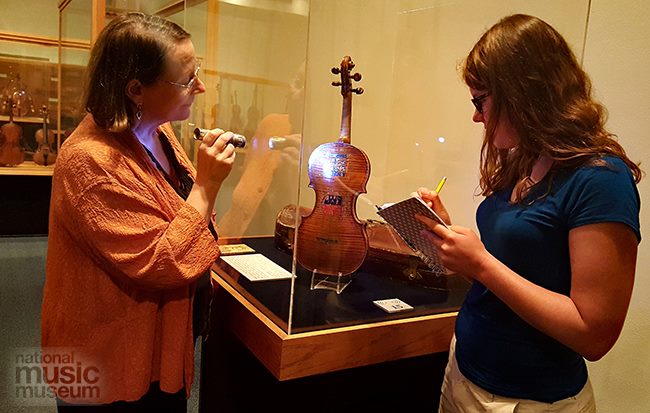 Prof. Brown and Katie travelled to the National Music Museum that summer to study, up close, historic examples that would serve as models for the violin (pictured here). Ultimately, the violin became part of the larger collection of historic instruments used by Collegium Musicum, the college’s early music ensemble that Prof. Brown created and directed. In that sense, it represents the larger legacy of instruments and scores, people and performances, that will live on as a testimony to Prof. Brown’s impact at Grinnell.
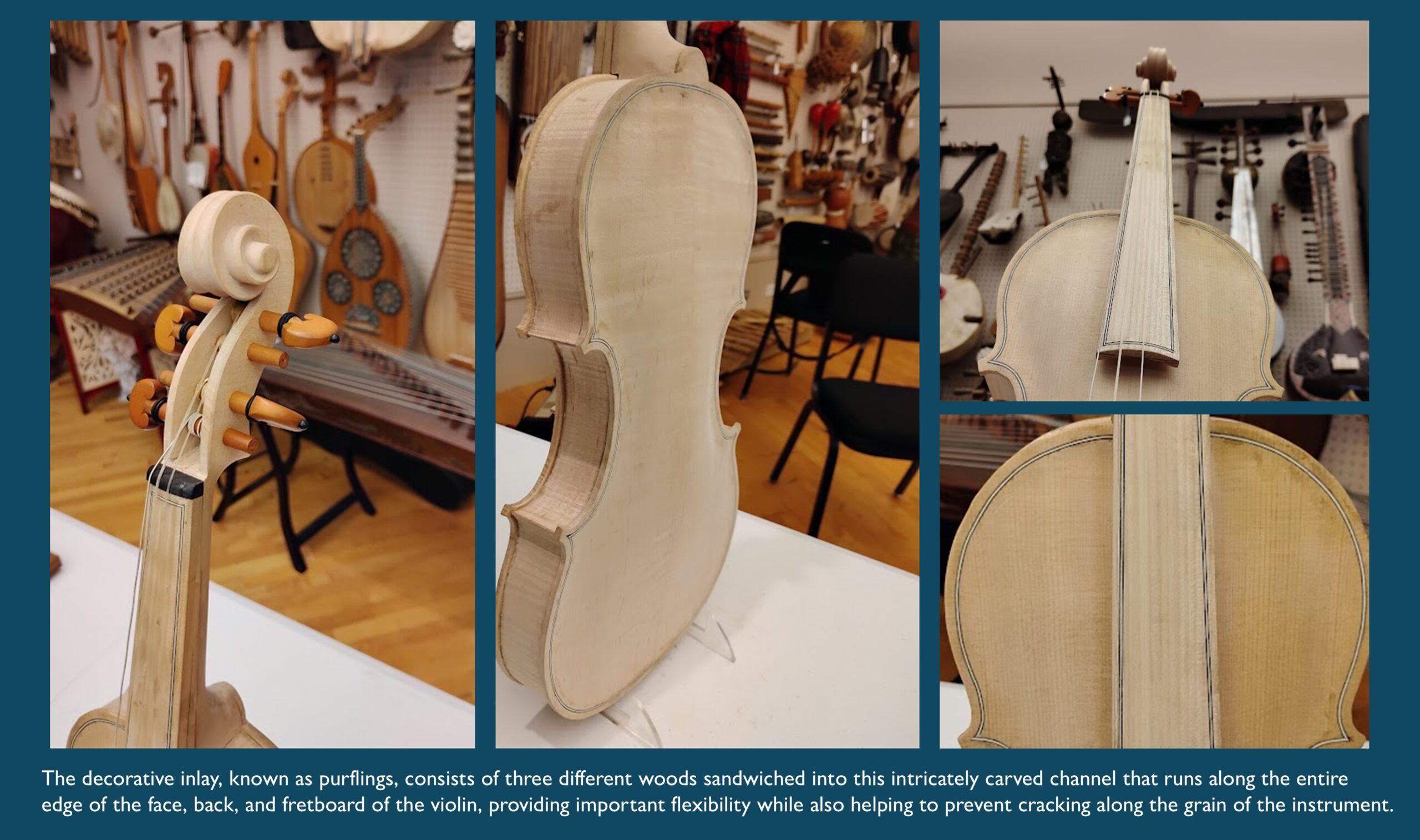
Those interested in learning more about the college’s fascinating collections of musical instruments are encouraged to visit their website: https://omeka-s.grinnell.edu/s/MusicalInstruments/page/welcome
To learn more about Collegium Musicum, including an inventory of the early instrument collection, you can visit:https://www.grinnell.edu/academics/majors-concentrations/music/ensembles/collegium-musicum
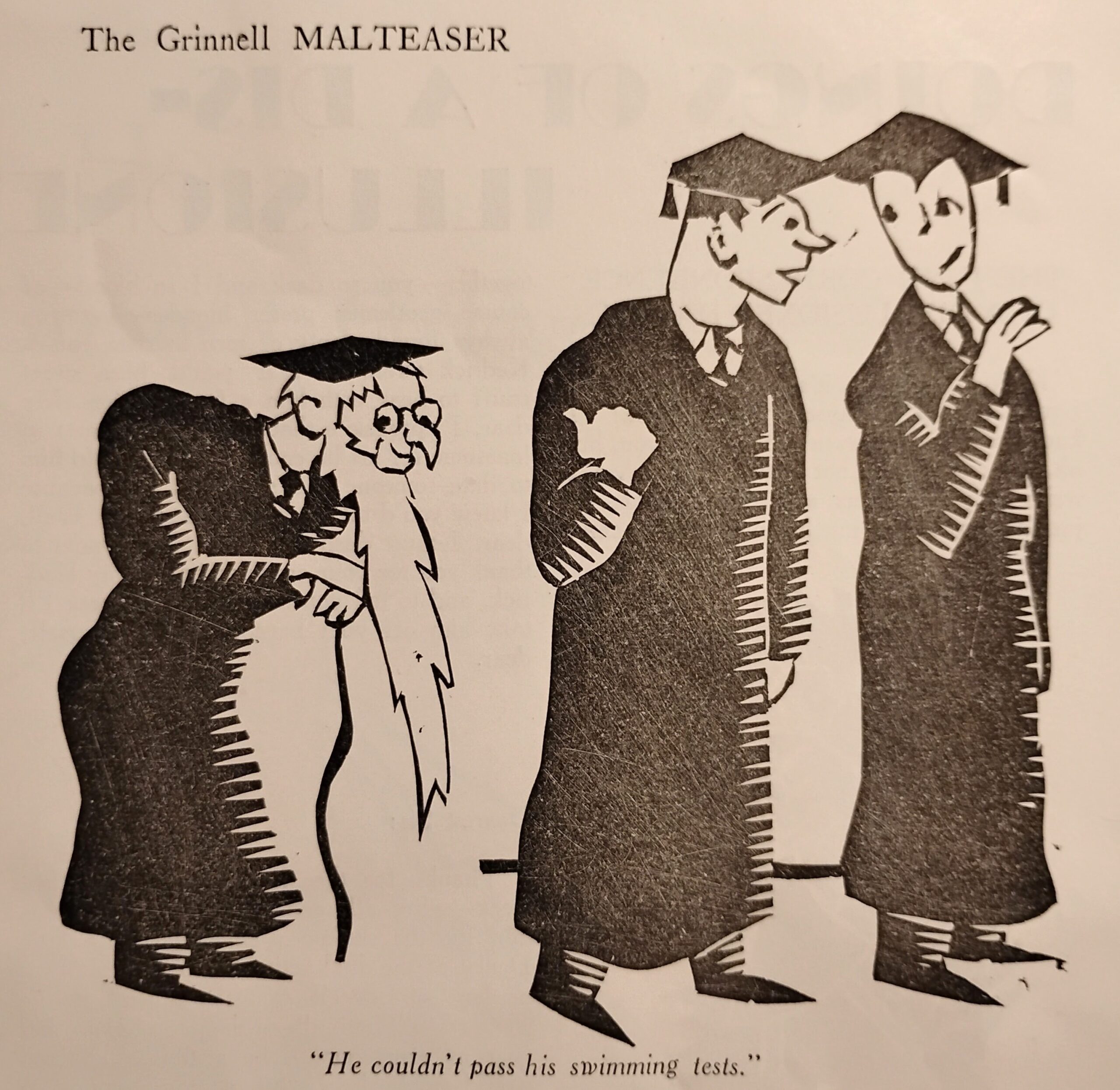
This 1930s cartoon, from a student-run magazine, The Malteaser, pokes fun at one of the relatively new requirements for graduation: passing a swim test. When the college built its first swimming pool, in 1927, it changed its physical education requirements to include a series of mandatory swimming classes, which could be circumvented by passing a swim test, administered at the start of each school year.
Swim tests became widely popular during the 1920s and 1930s, with most colleges and universities adding them to their list of graduation requirements. This trend reflected three inter-connected developments: 1.) the military’s recognition of the importance of teaching swimming to soldiers and sailors (which began at the service academies around the turn of the century, and then rippled outward through ROTC programs at many other colleges in the wake of WWI) 2.) progressive-minded campaigns to teach swimming as a life-saving technique (in an era when drowning was one of the leading causes of accidental death, and when access to pools or swimming instruction was confined to elites) 3.) the rapid expansion of physical education as a serious component of college curricula in the opening decades of the 20th century.
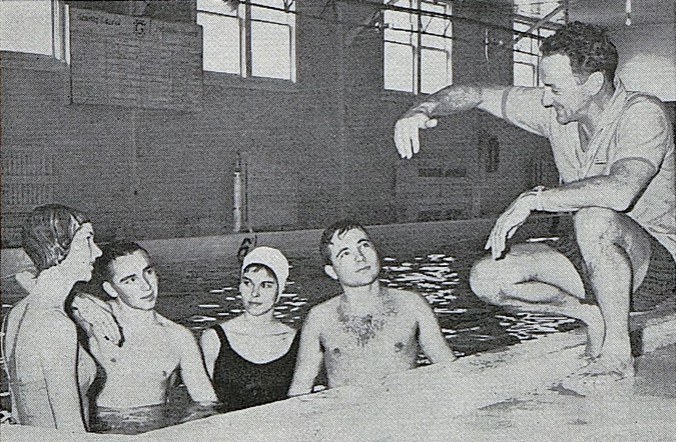 Over the years, the swimming test became one of a number of physical education tests that students had to pass for graduation. In 1961, for example, the college revised its requirements to include multiple physical fitness tests, conditioning tests, a junior “exam” in in a major and a minor sport, and most curious of all, a “dance test” that college women had to pass (in either modern, classical, or folk dance).
All of these required tests were abolished 55 years ago, when in December of 1970, the faculty voted to eliminate all physical education requirements as part of the larger overhaul that led to the open curriculum-tutorial system we have today. Interestingly, it took two faculty votes to settle the matter: the first time, the faculty voted to keep the physical education requirements, which led to some consternation and a second faculty meeting (in which an additional 30 or so faculty attended, helping to push through a majority vote in favor of jettisoning PE requirements).
One beneficiary of the change was Herbie Hancock, who did not receive his Grinnell degree in 1960, because he had not taken the swimming test or completed swim classes. With the change in requirements, the college awarded Hancock his B.A. in 1976, which helps explain why there has always been some confusion around his status (Grinnell lore often links him to other famous alumni, like Gary Cooper, who left before finishing their degrees, while Hancock’s own website, and many other sources, describe him as having received a B.A. from the college).
Powered by WordPress & Theme by Anders Norén