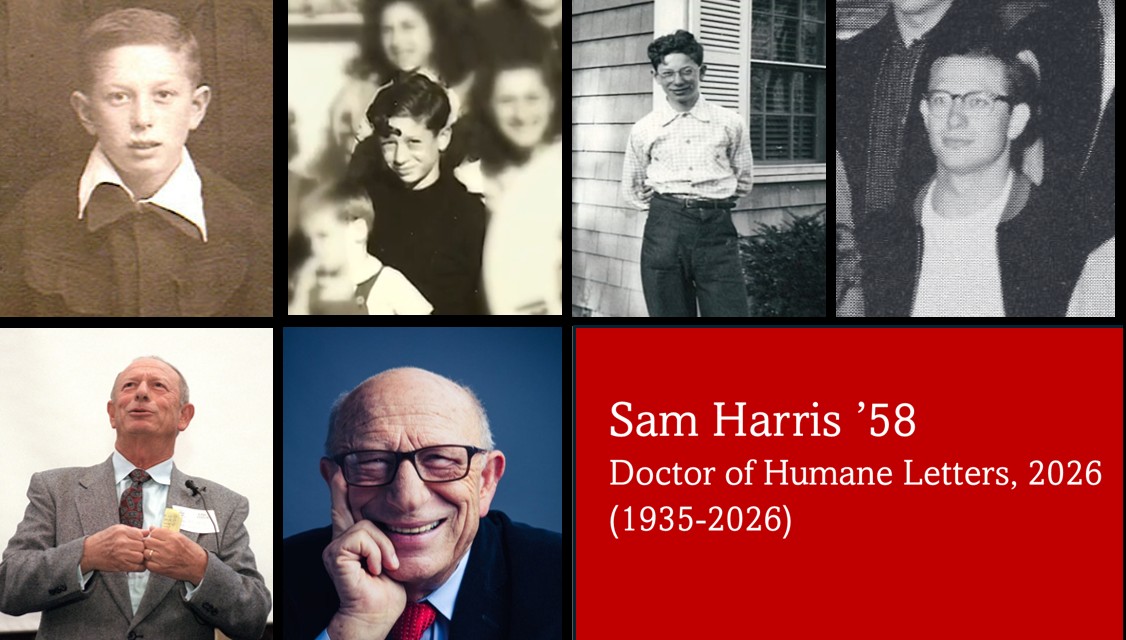
 This weekend, as Grinnell celebrates commencement for the class of 2026, one of the invited speakers and honorary degree recipients, Sam Harris ’58, will be sadly absent. Sam passed away last month, at the age of 90, ending a remarkable life that touched many and helped reshape public education and memorialization of the Holocaust in America.
Sam was a childhood survivor of the Shoah, hidden by his sister inside the camps, while his parents and four siblings were sent to Treblinka where they were murdered. Emigrating to the United States after the war, Sam was reticent to talk about those traumatic experiences as he made his way through high school, Grinnell College, a successful career in the insurance industry, and raising a family. That changed in the 1970s, however, as he learned about the growing movement of Holocaust denialism and antisemitism. Sam chose to speak out, sharing his story in classrooms, in public testimony, in oral histories, documentaries, and even in a children’s book, Sammy: Child Survivor of the Holocaust. Sam also took a leading role in helping to create the Illinois Holocaust Museum & Education Center in Skokie, Illinois, one of the worlds largest Holocaust museums. His voice and story will live on at the museum where visitors can experience an interactive hologram of Sam, who will speak with audiences and answer their questions (Sam’s hologram was created by the University of Southern California’s Shoah Foundation, along with similar holograms for 12 other survivors, based on hours of their testimony, video recording, and answering nearly 2,000 questions).
In honor of Sam’s life and work, we wanted to shine a light on those Grinnellians (both students and faculty) who survived the Holocaust. Despite being a small college in Iowa, Grinnell has had survivors on campus almost continually from 1946 to the present day. Each of these individuals have led remarkable lives—impossible to condense into a few paragraphs—but fortunately five of the six have recorded their stories as part of the USC Shoah project. Anyone can visit their online archives (https://vha.usc.edu/home) to learn more about these amazing people, and to hear their stories recounted in their own words. As Celina Karp Biaz ’52 said: “I believe the human voice speaks louder than history books. So many people have watched my testimony and contacted me to say that it touched their lives…We must always remember the power each individual has to transform the lives of others.”
Joseph Dunner (1908-1978) Grinnell Faculty (1946-1963)
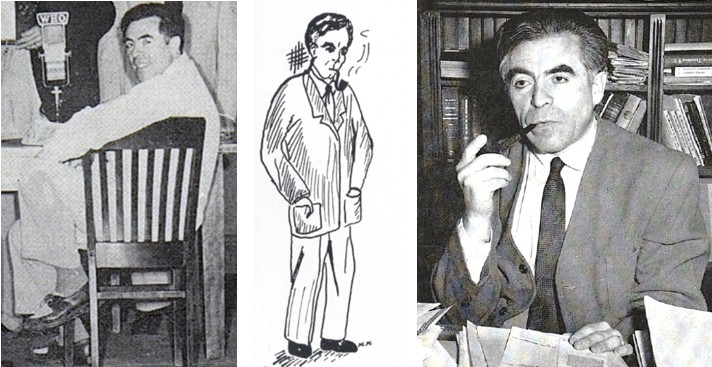
Born in Bavaria in 1908, Joseph Dunner studied political science at the University of Berlin and at Frankfurt am Main, and was an outspoken critic of the Nazi party. Dunner’s prominence as a Jewish intellectual and opponent of Hitler made him an early target of the regime. He had the distinction of appearing on the first list, issued in 1933, which stripped those particular individuals of their German citizenship. A few days later, Dunner received a tip from local police that he should flee Germany, and was able to cross into Switzerland the night before his scheduled arrest. With the support of the Brookings Institute, he eventually resettled in America, although he spent most of the war years serving in Europe—first as the chief of the intelligence section of the OWI (Office of War Information) in London, and then was tasked with helping to create a free press in Germany after the war, assigned to the Office of Military Government (OMGUS) which administered the American occupation zone. In this later role, Dunner became incensed by the treatment of holocaust survivors, who were crowded into squalid “displaced persons” camps, surrounded by barbed wire and kept under armed guard. Dunner became increasingly embroiled in conflicts with army officials who aimed to deport many Jews back to parts of Eastern Europe where they were likely to face hostility and even violence. These tensions came to a head when General Patton signed the orders to deport “displaced” Jews from the Buchberg camp to Poland, and army trucks arrived to take them away. Dunner intervened to stop this order, sending the trucks back, and was informed that he would be facing a court martial for his actions. In the meantime, his reports about the shameful treatment of Jewish survivors reached Earl G. Harrison, whom President Truman had sent to Germany as a special commissioner to oversee U.S. treatment of refugees, displaced persons, and surviving Jews. Harrison travelled immediately down to Munich, met with Dunner, visited the camps, and issued a scathing report to Truman which the president made public, initiating a series of important changes in refugee and resettlement policy. While Dunner was not court-martialed, he was ultimately pushed out of his position in the spring of 1946, and decided to return to academia, taking a teaching position at Grinnell College that Fall. Professor Dunner would teach at Grinnell from 1946 to 1963, serving as chair of the political science department for much of that time. Dunner was particularly interested in promoting the study of international relations at Grinnell—developing new coursework, fostering a new student club, and creating the Grinnell Institute of International Affairs which coordinated speaker series, symposia, and an annual summer conference (in some respects, the Institute resembled the present-day Rosenfield Program). Dunner was also committed to fostering a greater sense of community among the Jewish students at Grinnell, developing religious services at Herrick Chapel, helping launch a new student organization, and driving Grinnellians to Des Moines for cultural events and Temple service. In 1963, he became a Fulbright visiting professor at the University of Freiburg, and the following year, Dunner left Grinnell to become the David W. Petegorsky Chair of Political Science at Yashiva University (New York City), where he remained until his death in 1978. Over the course of his distinguished career, Dunner published more than 10 books, numerous articles, and a steady stream of newspaper articles and editorials, chiefly about politics in the Middle East, the Cold War, and the United Nations. Joseph’s wife, Ruth A. Bevan ’62, also taught political science at Yeshiva University, and held the Petegorsky chair from 1978 to 2017, when she retired.
John G. Stoessinger ’50, Doctor of Laws ‘70 (1927-2017)
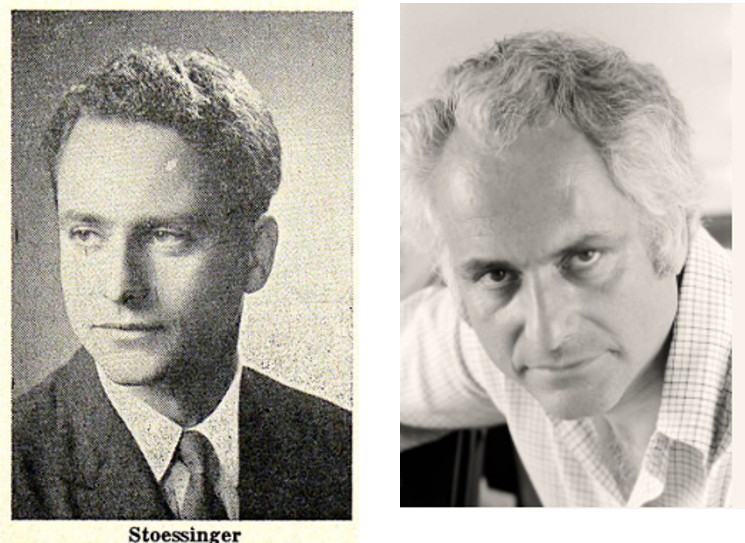
In 1938, John Stoessinger (who was just ten years old) fled Vienna with his mother in the wake of the Nazi annexation of Austria, moving to Prague to be near his grandparents. Their escape proved short lived, however, as the Nazi invasion of Czechoslovakia left them trapped in Prague, facing the prospect of being sent to labor or concentration camps (a fate that would befall John’s grandparents, who died in Auschwitz in 1944). But John and his mother were able to escape to Shanghai by obtaining a travel visa from a Japanese consular official—Chiune Sugihara—who sympathized with the plight of local Jews and issued hundreds of such visas. There, the Stoessingers befriended K.C. Wu ’23, who became mayor of Shanghai after the war, and helped arrange for John to study at his alma mater, Grinnell College, in the Fall of 1947. John majored in political science, working with Prof. Joseph Dunner, and doing research on the topic of international refugee policy, which would become the basis of his Harvard dissertation, and first book, The Refugee and the World Community (1956). Stoessinger would go on to teach at Hunter College, Harvard University, and the University of San Diego, authoring more than 10 books (including the Might of Nations which won the Bancroft Prize for best history book in 1962). He also had high profile positions in the United Nations in the 1970s and was an influential voice in international relations due to his strong ties to Henry Kissinger, Zbigniew Brzezinski, and Stanley Hoffmann. Grinnell College recognized his achievements in 1970, awarding him an honorary Doctor of Laws degree at that year’s commencement.
Celina Karp Biniaz ’52, Doctor of Humane Letters ‘18 (1931 –)
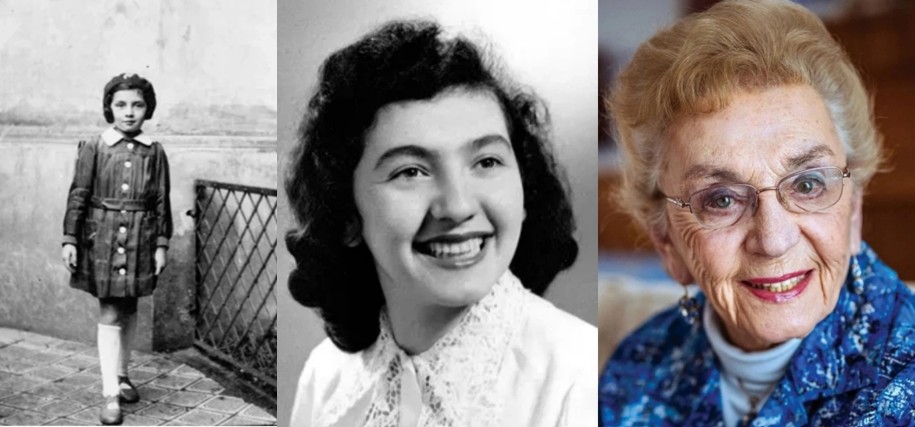
Celina Karp was bon in Krakow, Poland, on May 28, 1931. Eight years later, the Nazi occupation of Poland ended the life she had known. In Krakow, Jewish families, like the Karps, were forced to live in a tiny, fenced-in ghetto, and children, like Celina, were no longer allowed to attend school. By 1943, most of Krakow’s Jewish population was being sent to various camps: Belzec, Auschwitz-Birkenau ,and Plaszow. The Karps’ fate was shaped by their employment (and employer). Instead of heading straight to death camps, the Karps were among the 800 or so Jewish workers that had been laboring in Julius Madritsch’s textile plant (on the edge of the Krakow ghetto). Madritsch, along with his factory manager, Raimund Tisch, tried to protect their workers—hiding many children in the factory, helping others escape, and ultimately, striking a deal with the SS that would allow the remaining families, like the Karps, who had been sent to the nearby SS camp at Plaszow, to continue working in his factory. This arrangement ended a year later, as Russian troops advanced and the SS began to send remaining prisoners to nearby death camps. Madritsch and Tisch tried to get as many families as they could transferred to Oskar Schindlers’ factory in Czechoslovakia to save their lives. The Karps were one of the families fortunate enough to get onto Schindler’s famous “list”—in fact, Celina may have been the youngest person on Schindler’s list since her parents created false documents so she would appear working age during this period. Yet, 300 of the women on Schindler’s list, including Celina and her mother, were sent by the SS to Auschwitz instead, where they spent several harrowing weeks before Schindler was able to convince officials (often with bribes) to get them transferred to his factory. At Auschwitz, Celina barely escaped death. She was part of a group of young, malnourished, prisoners inspected by Dr. Josef Mengele (the notorious “angel of death”), who decided which individuals were fit to work, and which were not (and thus would be sent to the gas chamber). When Mengele pointed to the left, signaling Celina to join those heading to their deaths, she spoke out:
Honestly, I don’t know what prompted me to say to him, in German, three words. I said: lassen sie mich [gehen], which means, ‘let me go.’ He looked at me, and the pencil went to the right. And believe me, I ran. I picked up my clothes, and, crying hysterically…ran out
Celina and her family would work in Schindler’s Brunnlitz factory till they were liberated by the Red Army in May of 1945.Two years later, they moved to Des Moines, where Celina incredibly enough managed to start her senior year of high school despite having been out of school since the second grade. She entered Grinnell College with the class of 1952, majoring in philosophy and taking an active role in various clubs and activities on campus. Afterwards, she pursued a master’s degree in education at Columbia University, and dedicated her career to teaching young people (a career path that is now fostered by the Celina Karp Biniaz ’52 Model of Resilience Award given to a Grinnell senior who has overcome challenges in their life and is interested in a teaching career, or more broadly “devoted to the advancement of the education and welfare of young people”).
Celina rarely talked about her experiences, noting that it was difficult for others to comprehend what she and others witnessed. But that changed in the 1990s, when Steven Spielberg’s film Schindler’s List opened up broader conversations about the holocaust. As Celina put it: “Oskar Schindler gave me my life, but Steven Spielberg gave me my voice.”
That voice has helped shape the public memory of the holocaust and Celina has received numerous awards in recent years for her service, including an honorary doctorate from Grinnell (in 2018) and, most recently, the University Medallion given by the University of Southern California (the Medallion is a rare honor bestowed on those who have made a significant contribution to society).
Sam Harris ’58, Doctor of Humane Letters ‘26 (1935-2026)
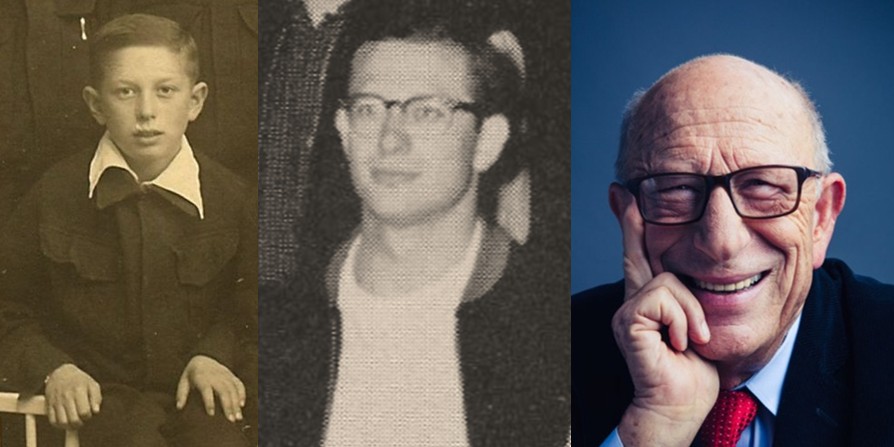
Note: The text below is taken from the college’s write up of Sam’s life and legacy, for the commencement program)
Harris was just four years old when the Nazis occupied his hometown in Poland. Sam’s entire family, with the exception of two of his sisters, was murdered in concentration camps. It would be many decades before he could bring himself to talk about what he experienced as one of the youngest Holocaust survivors.
After graduating from Grinnell, he worked in sales and joined Equitable Life insurance. He rose up the ranks, earning recognition as a life member of the prestigious Million Dollar Round Table, and was inducted into the Equitable Hall of Fame. Harris also gave back to his community. He became chairman of Northbrook United Way and volunteered with the Boy Scouts of America, among many other civic organizations.
It was not until the 1970s, when neo-Nazi Holocaust deniers were growing ever bolder and more vocal, that Harris knew he needed to begin speaking publicly about what he had endured as a child. Eventually, in 1981, he reconnected with his past at the World Gathering of Jewish Holocaust Survivors in Jerusalem. He took early retirement to devote virtually all his time to help build what would become the Illinois Holocaust Museum & Education Center, a place where education would be key to learning from the lessons of the Holocaust and confronting antisemitism.
Later, he wrote a book for children, Sammy: Child Survivor of the Holocaust. His life also has been the subject of several film and documentary projects, including “An Undeniable Voice,” which won 13 international prizes, and the “The Bridge Back Home,” produced by Names, Not Numbers.
Harris was awarded the state of Illinois’ “Human Rights Award for Distinguished Leadership for Protecting the Human Rights of the People of Illinois” in 2005. Chicago Magazine named Harris Chicagoan of the Year in 2009, the same year Forward Magazine honored him as one of the most influential Jewish People in America. In 2021, he received the Survivor Legacy Award from the Illinois Holocaust Museum & Education Center. Today, the museum is the third largest Holocaust museum in the world. Like so much of Harris’ remarkable life, it bears witness to the Holocaust and is dedicated to the mission of preventing future genocides anywhere on Earth.
Rita Schorr Germain (1930?-2022) Grinnell Faculty (1961-1966)
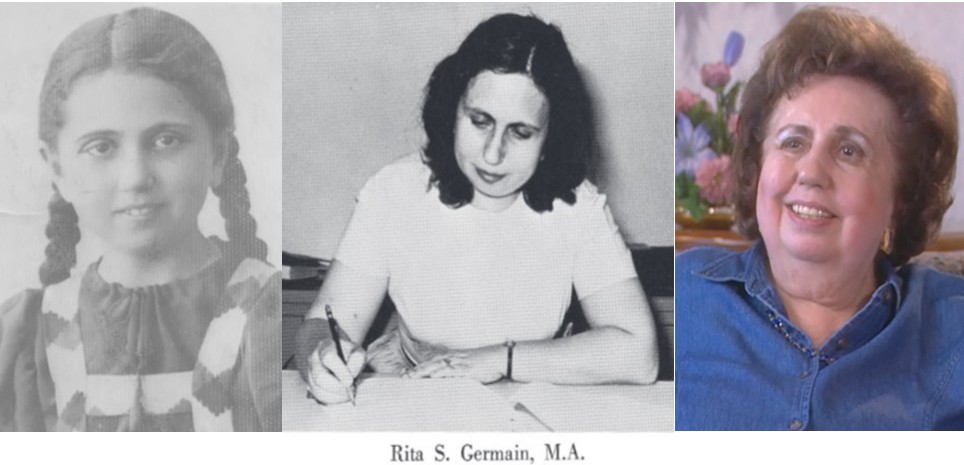
Rita Schorr was born in Boryslaw, Poland, sometime around 1930. Like many children who survived the holocaust, and who lost parents, siblings, and family records, she was never entirely sure as to her actual age or birthdate. Rita’s family, including her mother, father, and sister, were sent to the Auschwitz-Birkenau Concentration Camp, where she emerged as the lone survivor, liberated by Russian forces in January of 1945. After the war, Rita immigrated to the United States, where she enrolled at Brown University (Pembroke College). She studied history and international relations, earning her B.A. in 1953 and then going on to Harvard University (Radcliffe College) to do graduate work in Eastern and Central European Studies. At Harvard, Rita met her husband, Sumner Germain, who was finishing a Ph.D in American Literature, under the direction of Perry Miller. Miller happened to be close friends with the chair of Grinnell’s English department, and had spent a few weeks on campus, in 1957, as part of the special convocation program on “American Culture at Midcentury.” In oral histories, Rita explained how Miller helped arrange for teaching positions for both of them at Grinnell (Sumner in English, Rita in History). While they were nervous about moving to the Midwest in 1961, Rita fell in love with the town and the college—enjoying the open prairie, spending time with her daughters on local farms, and sharing her passion for eastern European history with students and colleagues. The couple taught for several years at Grinnell, before deciding to move back to the east coast to be closer to family, settling in Lancaster (PA) where Rita had a notable career teaching at Millersville University. Like Sam Harris, and many other survivors, Rita often acknowledged the pain and difficulty that survivors faced in discussing these experiences in the 1950s and 1960s. But like others, she began to share her testimony more broadly in the 1980s and 1990s, becoming a staunch advocate for holocaust education and public memorialization.
Harold Kasimow (1937 –) Grinnell Faculty (1972-2008)
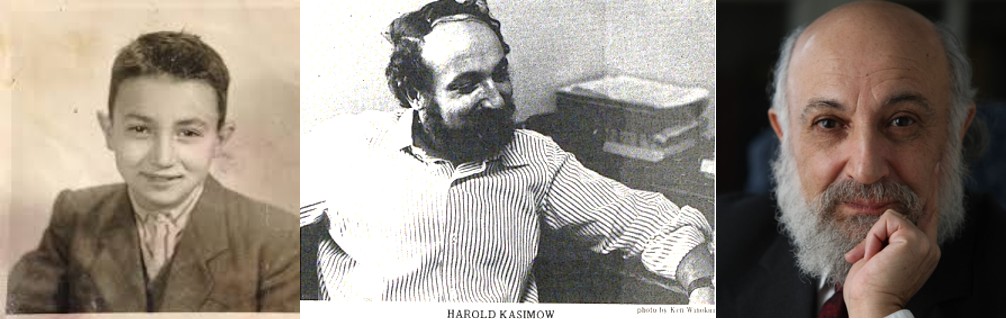
Of the estimated 1 million Jewish children living in Poland in 1938, only 5,000 would survive the war’s end. Professor Harold Kasimow was one of those children…as were Sam Harris, Rita Schorr Germain, and Celina Karp Biniaz.
Harold was born into a fishing family, living in a small village in north-eastern Poland, and was approaching his fourth birthday when German troops invaded the region. While most Jewish families were taken away, Harold’s family was one of a handful that were allowed to stay because their skill as fisherman was deemed too valuable to lose. That ended, however, in April of 1942 when the Kasimows learned that the Nazis planned to round up and kill the remaining Jews. The family fled, and with the help of friends and acquaintances, they were able to go “underground”—both figuratively, in terms of being hid by various families, and quite literally, spending 19 months living in an underground pit beneath a cow barn that they sometimes referred to, grimly, as the keyver (the “grave”). Although the Kasimow’s were “liberated” in July of 1944 when Soviet troops entered the Vilnius region, they experienced the dangers that many Jews faced in the immediate aftermath of the war, when the family was nearly killed in one incident, and spent about 3 years in Bad Reichenhall, a displaced persons camp in Germany. Nearly all of the Kasimow’s extended family and relatives were murdered during the Holocaust.
In 1949, the Kasimows migrated to the United States, settling in the Bronx, where he attended Yeshiva University High Schook, then Jewish Theological Seminary, studying under the famed theologian, Abraham Joshua Heschel, who would become a role-model and scholarly focus for years to come. After being drafted into the Army, and serving in Japan and Thailand, Harold pursued a Ph.D in religion at Temple University. He came to Grinnell in 1972, joining the religion department to teach courses in Judaism, Islam, and Buddhism. Harold became a valued mentor to many Jewish students at Grinnell, who fondly remember going to his home on Friday evenings for Shabbat and other occasions. In terms of scholarship and service, Prof. Kasimow became a leading voice in the global conversations surrounding interfaith dialogue, meeting with Popes and other religious leaders around the world.
While Prof Kasimow did not talk about his Holocaust experiences for much of his adult life, that changed in recent years. “I felt I had a responsibility to tell my story,” he explained in a 2022 lecture at Grinnell, “but I also felt it should be told by people who were older than me, and who remember their experience much better than I do.” The first time Harold remembers telling his story was when he came to Grinnell, in 1972, and met Prof. Emil Fackenheim, himself a survivor of Sachsenhausen concentration camp, who was on campus to lecture about the Holocaust as the Gates Lecturer. Over time, Harold began teaching more units about the Holocaust in his classes, and became involved in the work of the Holocaust Memorial Committee in Des Moines. In recent years, though, Prof. Kasimow has began sharing his story with wider audiences, ranging from school age kids to college lecture halls to Yom HaShoah events. Like the other Grinnell survivors (with the exception of Joseph Dunner who died in the 1970s), Prof. Kasimow has recorded his experiences as part of the USC Shoah project, creating a lasting record that will be available for future generations.