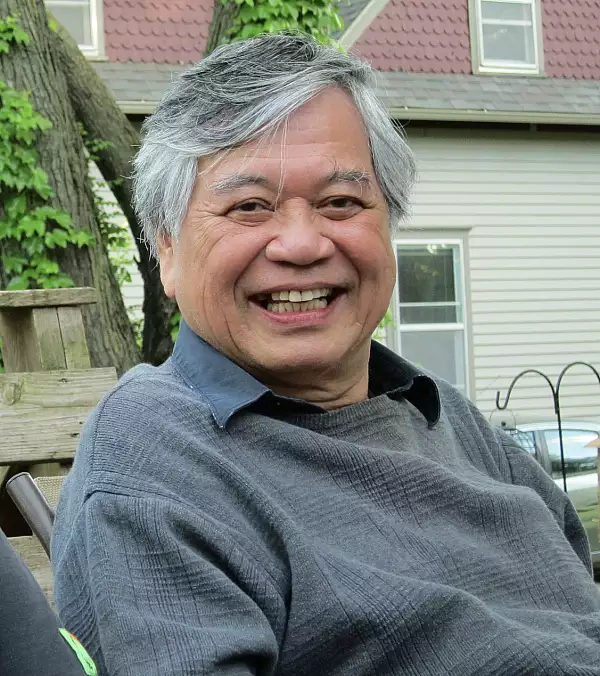
This winter, we learned that Andrew Hsieh, Professor Emeritus in the History department, passed away at his home in California. There will be a special memorial gathering at reunion, this weekend, for his friends, colleagues, and former students.
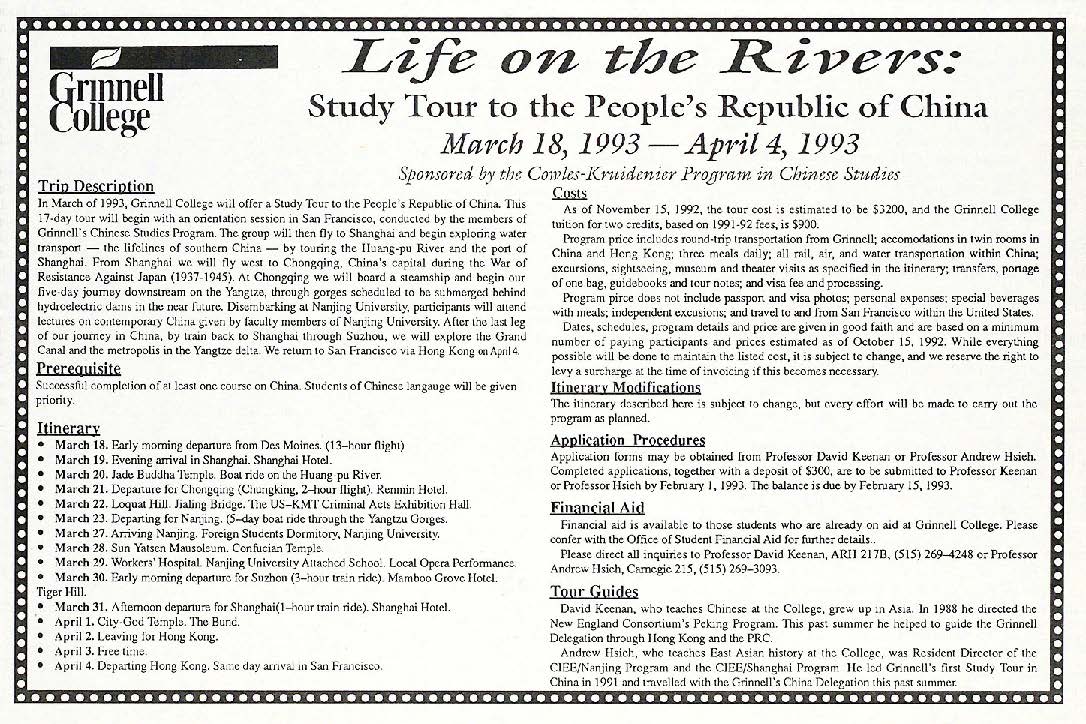
Andrew Hsieh began teaching at Grinnell in the Fall of 1978, having completed a Ph.D in history at Yale University, where he wrote a dissertation about the intellectual world of Tseng Kuo-fan, an important figure who struggled to reconcile Confucianism and the demands of officialdom in the wake of the Taiping Rebellion. Over the years, Prof. Hsieh taught a series of survey courses on Chinese and Japanese History, and played a key role in developing East Asian Studies at the college. In 1985, Prof. Hsieh helped secure a Cowles-Kruidenier grant that financed new coursework, programming, and educational opportunities centered around Chinese Studies. Hsieh organized a five-day conference in 1987, for example, that helped launch this new programming. The conference revolved around questions of reunification between Taiwan and the People’s Republic of China. Hsieh invited speakers from Hong Kong, China, and Taiwan, alongside academics and policy-makers from the U.S., creating a “list of participants that reads like a Who’s Who in the world of Chinese Studies” (according to the S&B coverage at the time). In addition to a long list of speakers and conferences, Hsieh used the grant to fund embedded course travel to China, such as the study tour in 1993:
Hsieh’s management of the grant also led to more sustained curricular changes, such as the hiring of faculty to teach east Asian languages, the creation of a new department of Classical and East Asian Languages (housing these new faculty and courses in the Classics department), and above all, the creation of an exchange program and partnership between Grinnell and Nanjing University, that began in 1987. That program facilitated not only the exchange of faculty members, but also supported Grinnell students teaching English in the high schools in Nanjing (which would become one element of the “GrinnellCorps” program). Hseih would frequently point to Grinnell’s deep historic ties to China, encouraging students and others to do historical work on the earlier “Grinnell-in-China” program of the 1920s and 1930s.
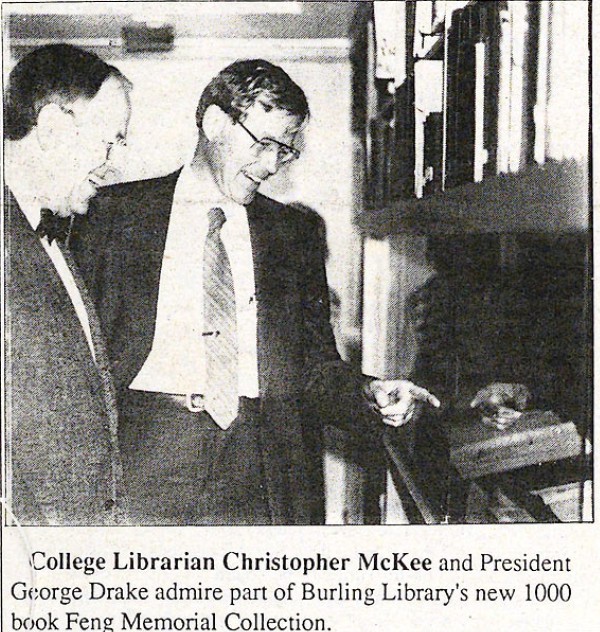
Prof. Hsieh also made a lasting contribution to the college through the Feng Memorial Collection–which contained over a 1,000 carefully chosen Chinese books that Hsieh acquired from collectors throughout China and Hong Kong to serve as a foundation for students studying Chinese language, history, culture and literature. The collection was named after Hsieh’s mother, Yu-Kuei Feng, who came from a long line of scholars going back to the 18th century, and loved books.
Hsieh’s own love of books came through in one of his last major projects, helping to develop a Faulconer Gallery exhibit–“From the Book Forest”–on Chinese print culture that drew from the collections of Nanjing University, the Yangzhou Block Printing Museum, and the C.V. Starr East Asian Library (at UC Berkeley) in 2011.
In his retirement, Prof. Hsieh finished a book The Lius of Shanghai, that explores how this influential family navigated the challenges of war and upheaval over the course of the twentieth century to establish a business dynasty. The book was co-authored with fellow historian Sherman Cochran (of Cornell University) and was published by Harvard University Press.