
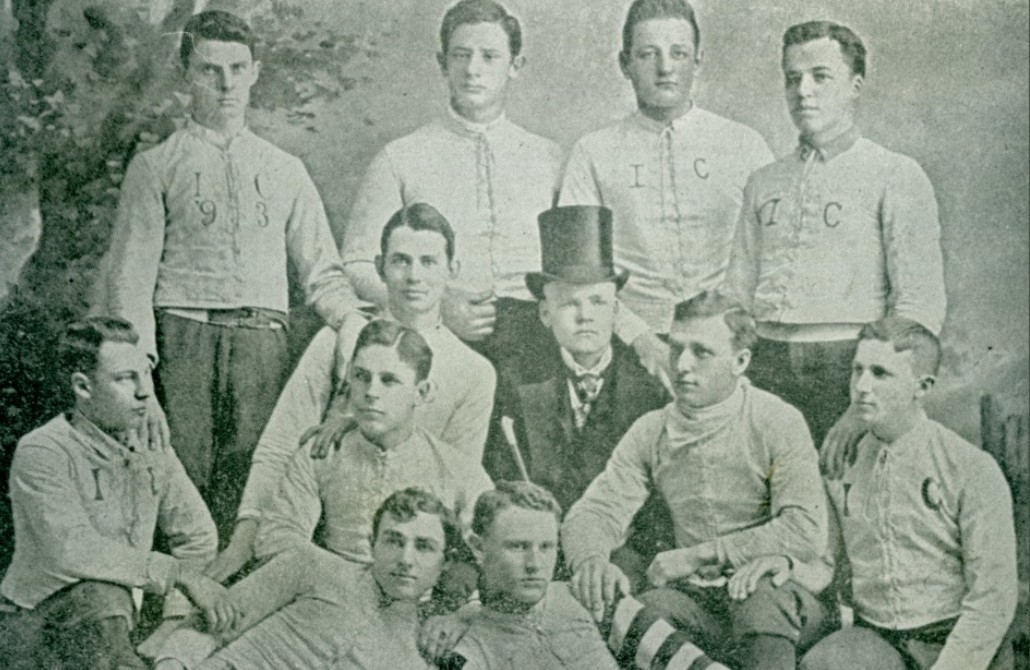
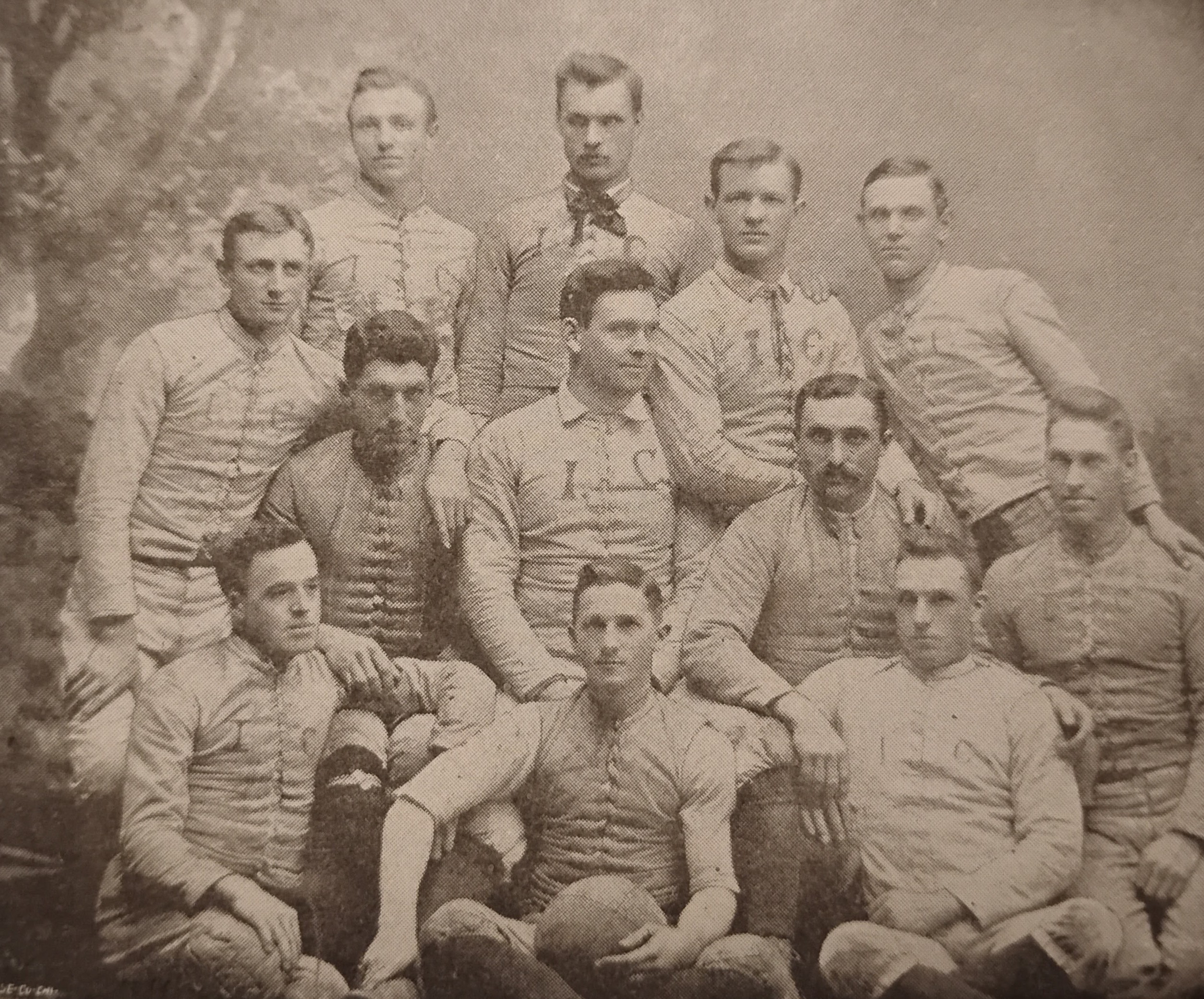
 Grinnell sports teams decided to ditch their original school colors in 1891, in favor of Scarlett and Black, which was seen as more sporting/manly.
Question: What were the original school colors?
Answer: Pink and Green, as modeled by the football team (the 1889 squad is pictured on top, jaunty headware and all, while the 1890 squad is pictured below them).
 Pink was actually quite popular as a school color in the 19th century. In fact, Syracuse University also sported Green and Pink as their school colors, until they abandoned them in favor of blue and orange in the 1890s, as well. Today, there are few schools with these colors, although North High School in Des Moines, still proudly wears pink and green each year. Go Polar Bears!
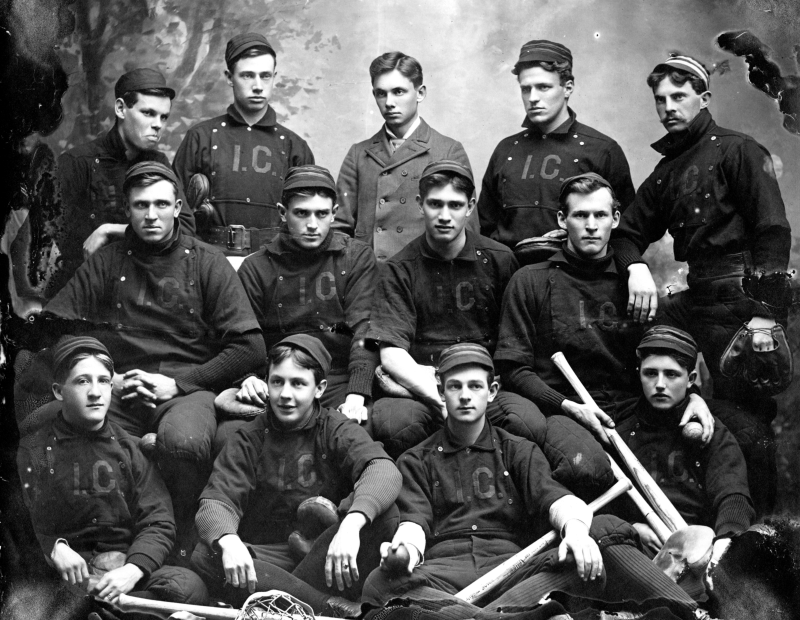 The Men’s Baseball team was actually the first to abandon the school colors, choosing scarlet and black uniforms for their 1891 season. Here they are pictured a couple of years later in those outfits.
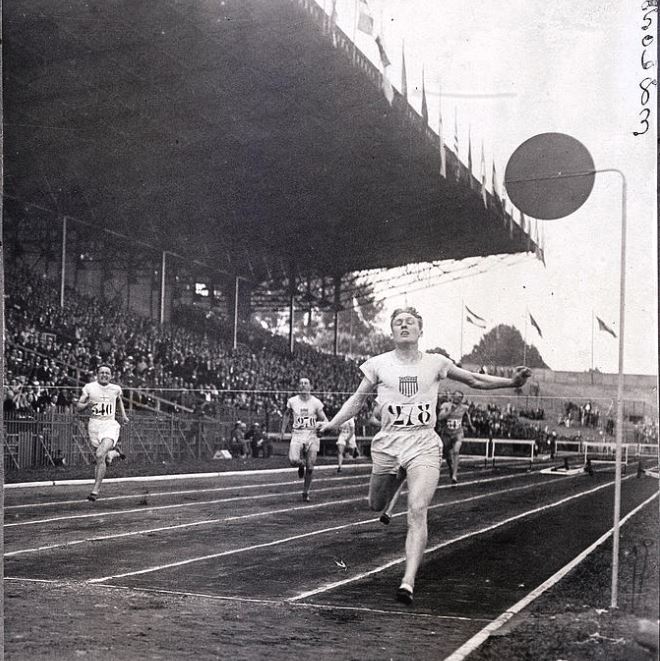
 F. Morgan Taylor was one of Grinnell’s most decorated athletes of the 20th century. In the summer of 1924, while a student at Grinnell, Taylor won the U.S. Olympic trials for the 440-yard hurdle, setting a world record time of 52.6 seconds in the process (because a hurdle was knocked down, it did not count as an official world record). At the Paris games, Morgan again came in under 53 seconds, winning a gold medal (pictured here). In all, Morgan won four collegiate (AAU) titles, and two more Olympic bronze medals in 1928 and 1932 (loosing out to the famed British hurdler, Lord Burghley, who was fictionally immortalized in the film, Chariots of Fire). Morgan was widely respected by his colleagues and was elected as the captain of the U.S. track and field team for the 1932 Olympics (Los Angeles) as well as the official flag bearer for team U.S.A (pictured here) one of the highest honors in Olympic sports.