Tag: women

Emmeline Pankhurst comes to Grinnell (1916)

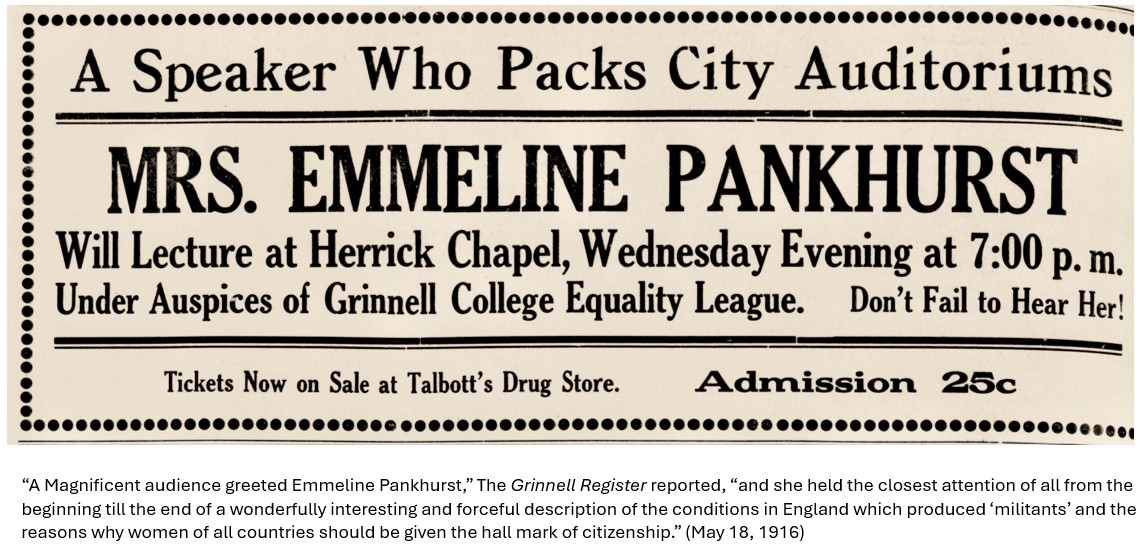
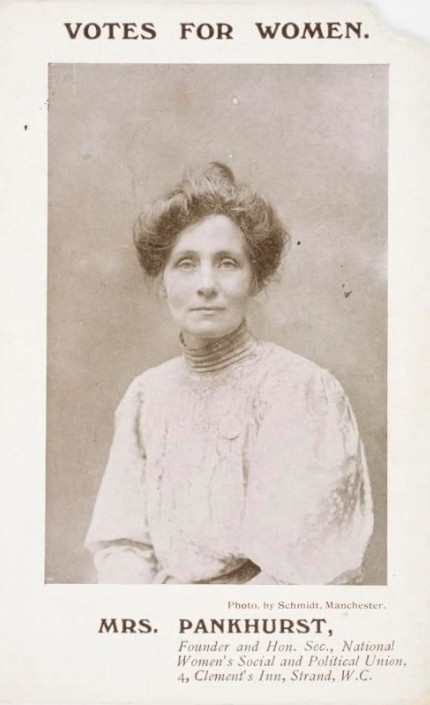
In May of 1916, a group of Grinnell students managed to persuade Emmeline Pankhurst, the famed leader of the radical suffrage movement in Britain, to give a public lecture in Herrick Chapel. Pankhurst had founded the Women’s Social and Political Union in 1903, which organized more confrontational forms of protest and civil disobedience—ranging from blocking roads to disrupting sessions of Parliament to smashing windows and setting fires. Draped in their colors of purple, white, and green, and often brandishing their trademarks signs & badges declaring “votes for women” or “deeds not words,” the members of the WSPU became the iconic face of the suffragette movement (both then and now). Like many of her colleagues, Pankhurst spent considerable time in prison where she engaged in rounds of hunger strikes that attracted even more attention to the cause.
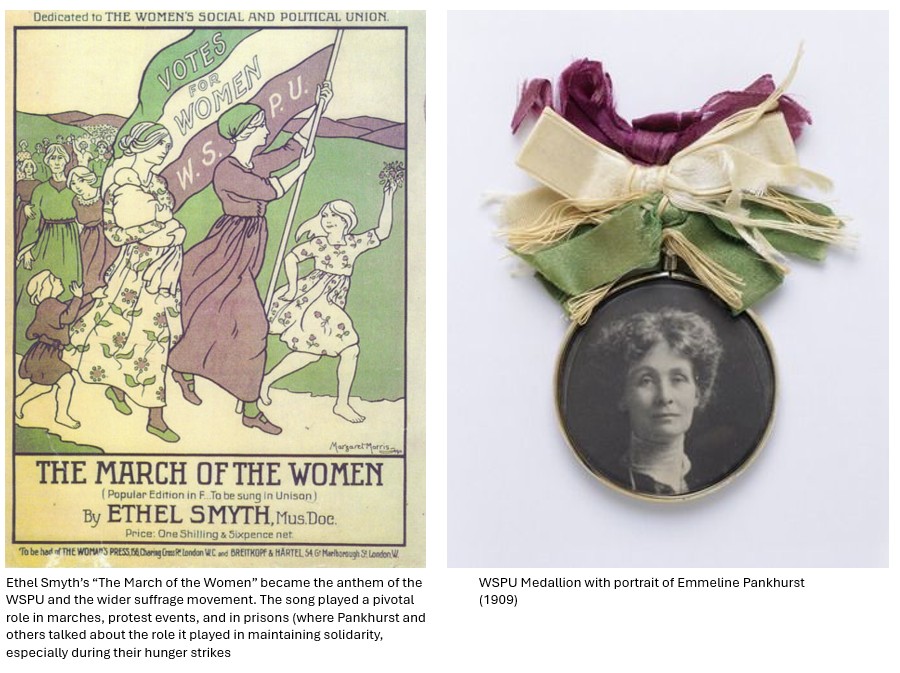
Yet, the beginnings of the First World War brought a temporary truce to these battles, as Pankhurst and the majority of the WSPU agreed to suspend their political protests and support the British government’s war effort. In this spirit, Pankhurst agreed to tour the United States in 1916, giving lectures on the war to raise funds for Britain and its allies.


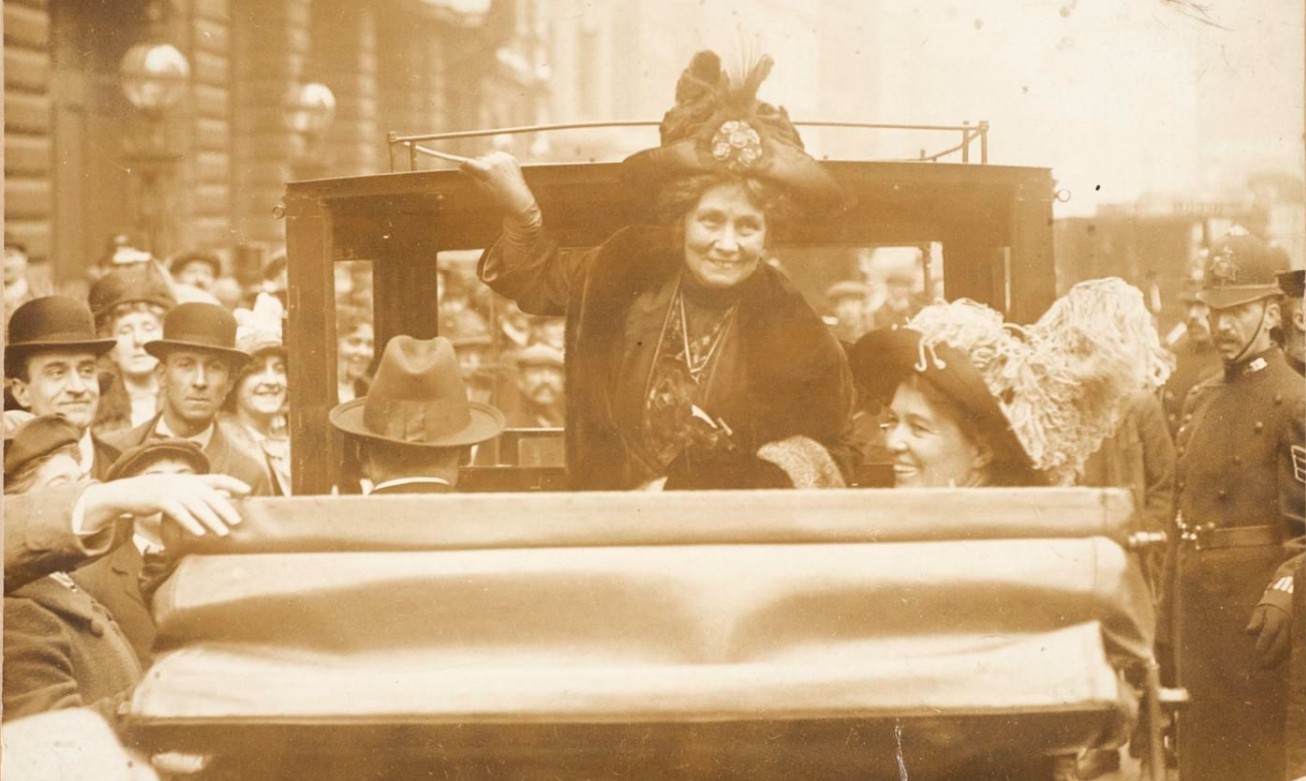
Given the goals of Pankhurst’s American tour, and her pact with the British government, it is surprising that she agreed to come to Grinnell College to lecture specifically on the suffrage issue. She had been invited to come to Grinnell by the newly formed “Political Equality League,” comprised of female students at the college who were eager to mobilize support for the upcoming vote (in July) on an amendment to the Iowa constitution that would grant equal voting rights to women. That Grinnell would become the main speaking stop between Chicago and Denver on her American tour, and that she would speak explicitly about suffrage here (while avoiding the topic elsewhere), makes her Grinnell lecture all the more intriguing.  Pankhurst might have been swayed by the personal appeal of the Grinnell college students, whose organizing efforts mirrored her own work (in fact, Pankhurst stayed another day in town, so as to attend several meetings and events with college women in their new Quadrangle facilities). Pankhurst might have been equally tempted to speak in Iowa at that particular moment, given the upcoming constitutional referendum that was emerging as a bellwether of the suffrage cause in America. Whatever the precise reasoning, Pankhurst delivered a rousing speech to a packed audience in Herrick Chapel that evening of May 17, 1916.
The Women’s Edition of the Scarlet & Black

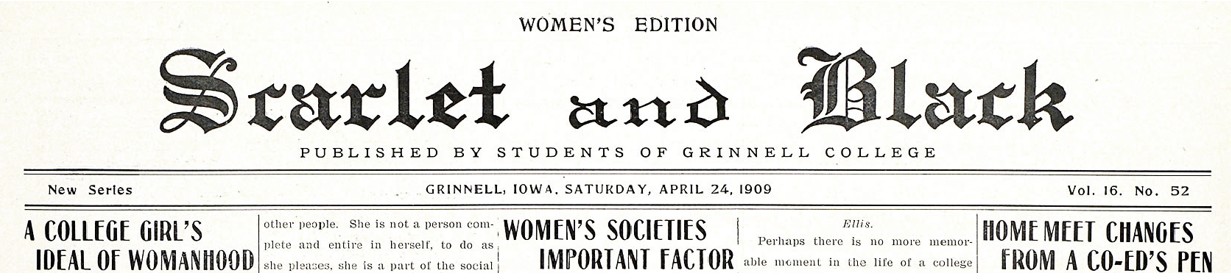
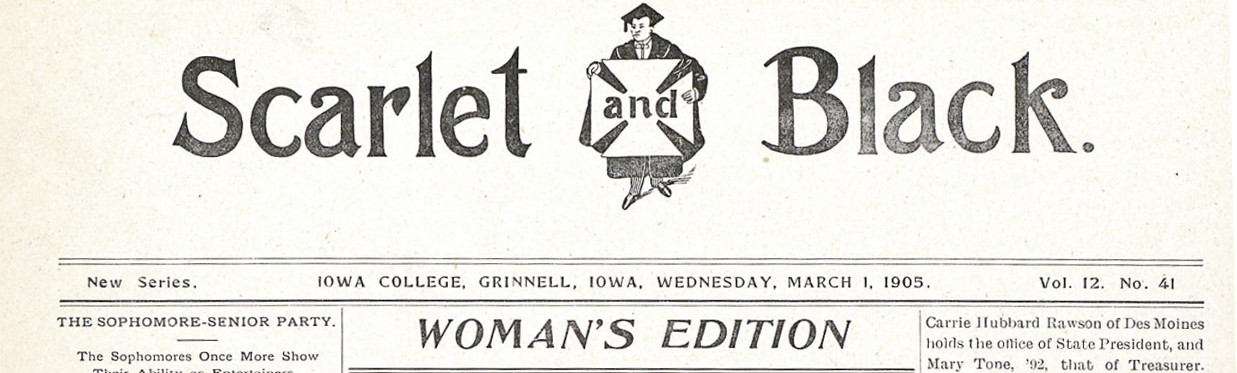
In the spring of 1905, the editorial board of the Scarlet and Black turned over their paper to a special editorial team that would create the paper’s first “Woman’s Edition,” which appeared on March 1st. The all-female team—led by Adah Hopkins ’05 (who would go on to teach Sociology at the college before carving out a trailblazing career in the newly professionalized field of social work)—noted the surprising lack of women in shaping the college’s newspaper. At a time when women outnumbered men at Grinnell (267 to 195), and had such “a prominent share” in the literary clubs and cultural life of the institution, the lack of female input and leadership in the school paper was striking: “for several years the Scarlet and Black has been entirely in the hands of the men of the institution.”

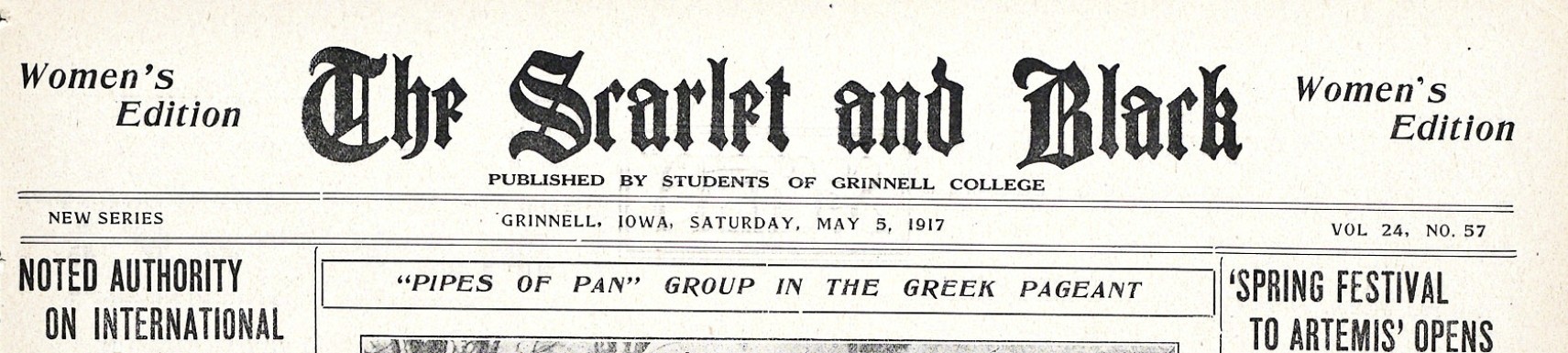
While the first woman’s edition would aim to reflect the interests, perspectives, and voice of women on campus, they also conveyed their hopes “of future appearances some years hence, of Woman’s Editions of forty pages, properly illustrated” that would serve “as a record of the history and conditions of co-ed life at Grinnell.” For a dozen years or so, the S&B carried on this tradition of creating a special women’s edition each year, produced by an all-female team (the spelling changed to women’s, instead of woman’s, and they dropped the title of “editresses”). Over time, these special editions would start to include a growing numbers of letters, sent in by alumnae, expressing their appreciation for these annual issues. But like so many other elements of the Progressive era, this tradition ended in 1917, disrupted by the First World War never to really resume. Still, these editions continue to offer a unique “record of the history and conditions of co-ed life at Grinnell” and are fascinating to explore.

1905 Editorial Statement: 1905 editorial

Alumnae Letters: Alumnae Letter Section


Carrie Adeline Barbour: Artist, Paleontologist, & Professor


Last week’s post focused on the college’s museum of natural history; or more precisely, the third iteration of this museum, that was assembled after the devastating cyclone of 1882. As the new collection began to come together in Blair Hall, the college hired its first geologist and paleontologist, Erwin H. Barbour, who became the Stone Professor of Natural History, charged with overseeing the museum and related coursework. In addition to his academic training, Erwin had spent several years doing field work out west, serving as assistant paleontologist for the U.S. Geological Survey.

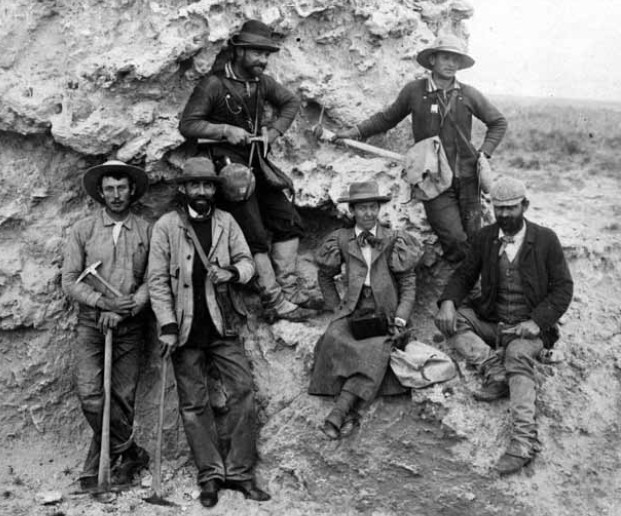
But Erwin Barbour did not come to Grinnell alone. His sister, Carrie Adeline Barbour, also joined the faculty at this time, teaching studio art courses in carving, ceramics, and porcelain painting (which she had studied at Oxford Female College, later absorbed into Miami of Ohio, and at a fine arts school in Cincinnati). Given the close links between art and science that existed in the world of natural history, as well as the tendency for family members to participate in the collective work of science, in an era before paid staff and technicians, it is not surprising to discover that Carrie Barbour became involved in the geological and paleontological work of her brother. Carrie was also personally drawn to the subject, revealing that her mother, Adeline Barbour, had instilled in both of her children a deep love of natural history and collecting specimens.

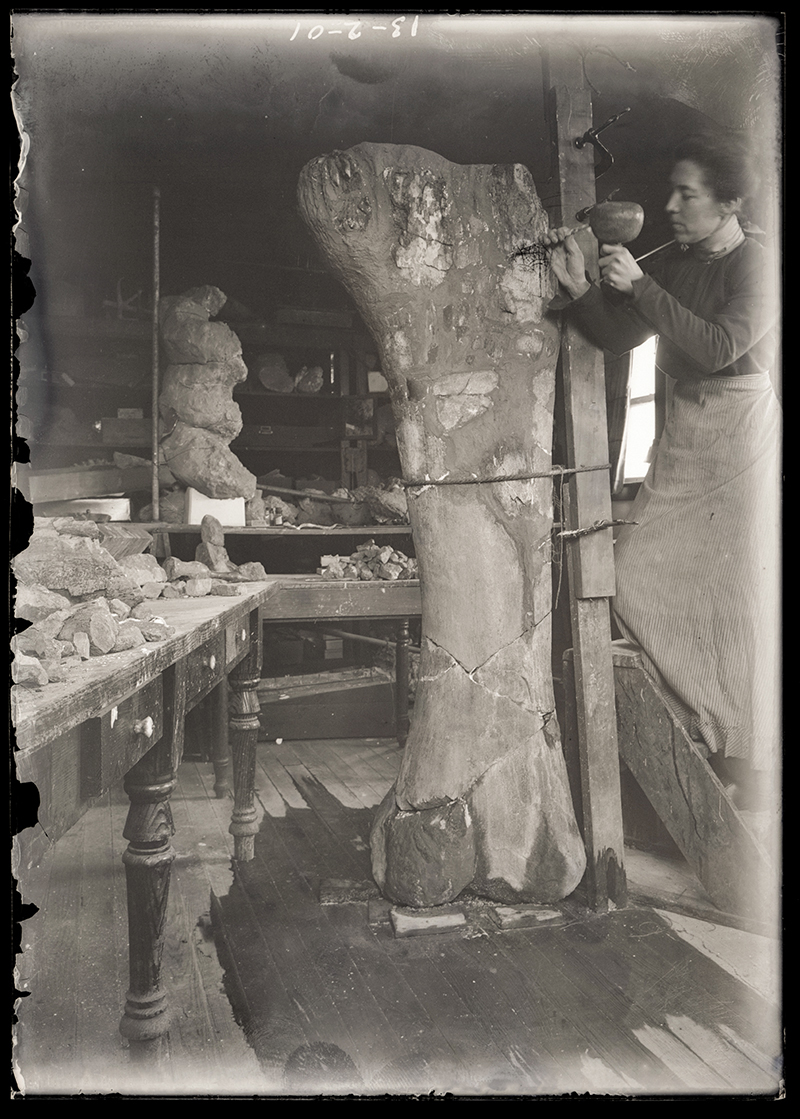
On the right of the image, Carrie Barbour stands on a short ladder and uses a chisel to work on the dinosaur femur. The femur is fastened to wooden boards, which hold it vertically. In the background are tables and shelves with other artifacts and equipment. Digitized from glass-plate negative.

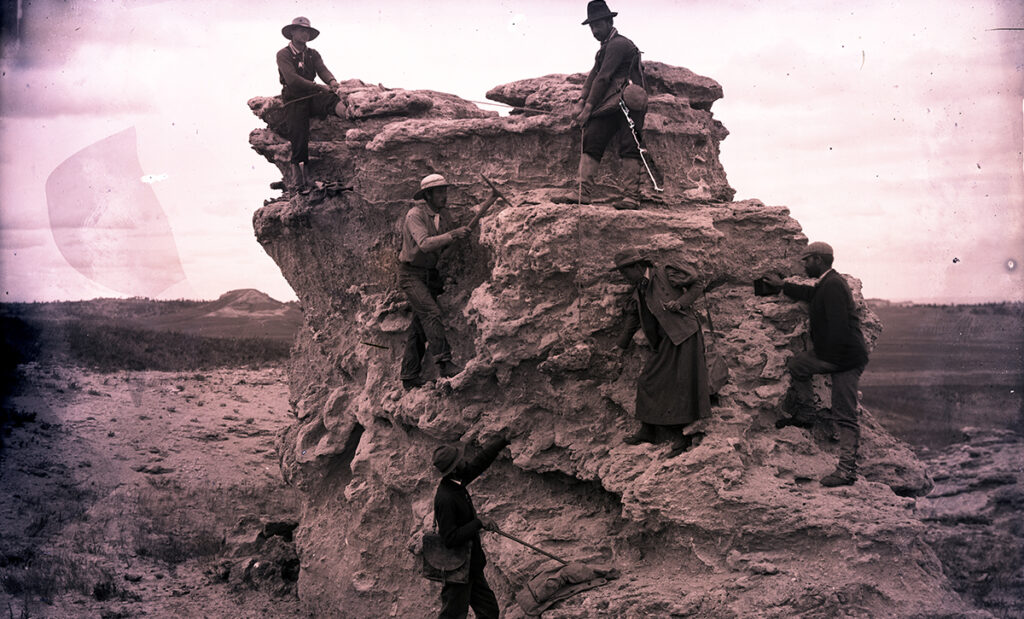
Eventually, Erwin left Grinnell College in 1891 to establish a geology department and museum at the University of Nebraska. Carrie was torn between continuing her career as an art professor, and taking up a position at Nebraska, working with her brother as a full-time paleontologist. “I realized I couldn’t divide my time between the two jobs and accomplish much in either,” she later recalled, “Fossils fascinated me so much I decided to continue a thorough work with them.” Over the next 40 years, Carrie Barbour carved out a remarkable career in paleontology, becoming an assistant curator of the museum, a professor of paleontology, an author of noted scientific papers, and perhaps most unusual for a female scientist at this time, a leader of field expeditions and excavations.

Although Carrie Barbour eventually received recognition, and an academic position of her own, her experience is also part of a larger story about the often-hidden role that wives, sisters, and daughters played in an age when academic work was often a shared, family endeavor while academic publication and credit was limited to the (mostly male) professoriate.


Local Election Attracts National Attention (1913)

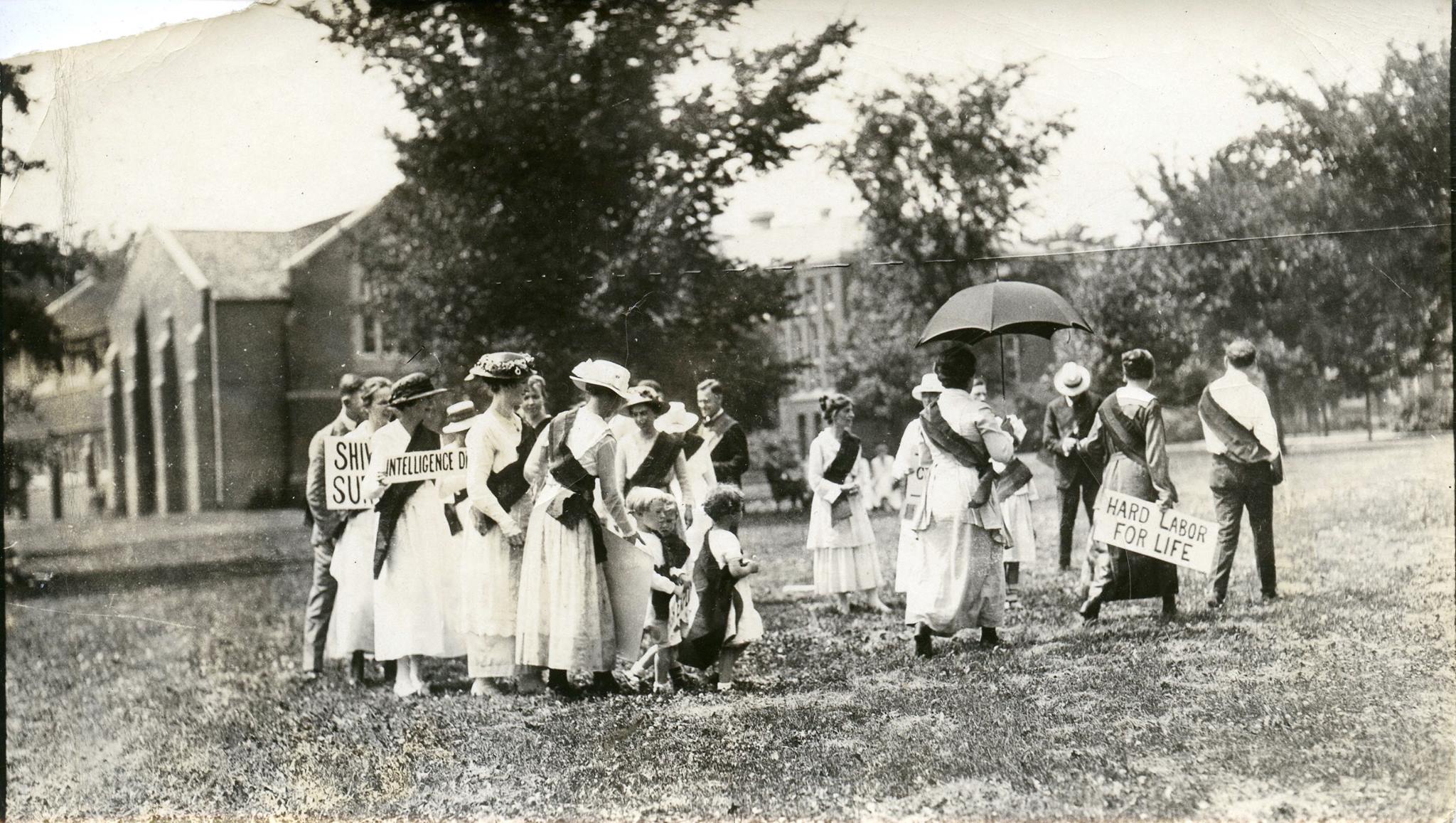
Suffragettes at Grinnell campus (date unknown)


On Tuesday, Grinnellians will go to the polls to vote on candidates for mayor, city council, and school board, as well as the fate of the Local Options Sales Tax. Local elections rarely receive much coverage, but in 1913, Grinnell attracted national, and even international attention, for a special primary it held regarding women’s suffrage.

The issue had been reinvigorated by the presidential election of 1912. Theodore Roosevelt embraced women’s suffrage that year, and made it a plank in the  platform of his new “Bull Moose” Party. Suffragettes also staged some of their largest and most publicized events that year, such as when 15,000 supporters paraded in New York City in May, followed by an even more dramatic nighttime march in November, in which a half-a-million New Yorkers turned out to see thousands of suffragettes marching with Japanese lanterns to illuminate their procession.

Responding to this atmosphere, a group of Grinnell’s civic leaders decided to organize a vote that would reveal where the women of the town stood on the issue of suffrage. All women over the age of 18 were invited to this special election—which was held in the Superior Court room from 8am till 8pm, on Friday, January 31st. The voting procedure mirrored a standard, local election—using the same ballot system, held in the chambers of the superior court, overseen by a panel of election monitors—but, this time, women (and only women) were invited to cast their vote. The situation was so novel that the Scarlett and Black was unsure whether to use the term “voters,” when talking about the election, or to create a new feminine version, “votettes.”

The night before the special election, suffragettes staged a rally at the Colonial Theatre (downtown) that included several important speakers; a screening of the new silent film, Votes for Women, showcasing the dramatic parades in New York; and ending with a musical performance by the Women’s Glee Club of the  college as well as the distribution of various pamphlets, posters and material supporting the suffrage cause (all handed out by suffragettes “in uniform,” as the Grinnell Herald described them)

The next day, despite snow and ice, 738 women made their way to the polling place to cast their vote: 663 voted in favor of women’s suffrage, and 75 voted against. Contemporaries estimated that about 80% of eligible women, including college students, voted in this election; and many were surprised by the lopsided victory.

The Associated Press latched onto this story, running several press bulletins that drummed up national interest before, during, and after the election. From Los Angeles to London, newspapers covered the spectacle of a small Iowa town holding a special election for women voters to express their position on women’s suffrage. The town eventually sent the results to the Iowa legislature—certified by a team of election judges that, for the first time, were half men, half women—so that it could inform the legislature’s debate on amending the Iowa Constitution.

May Pageantry

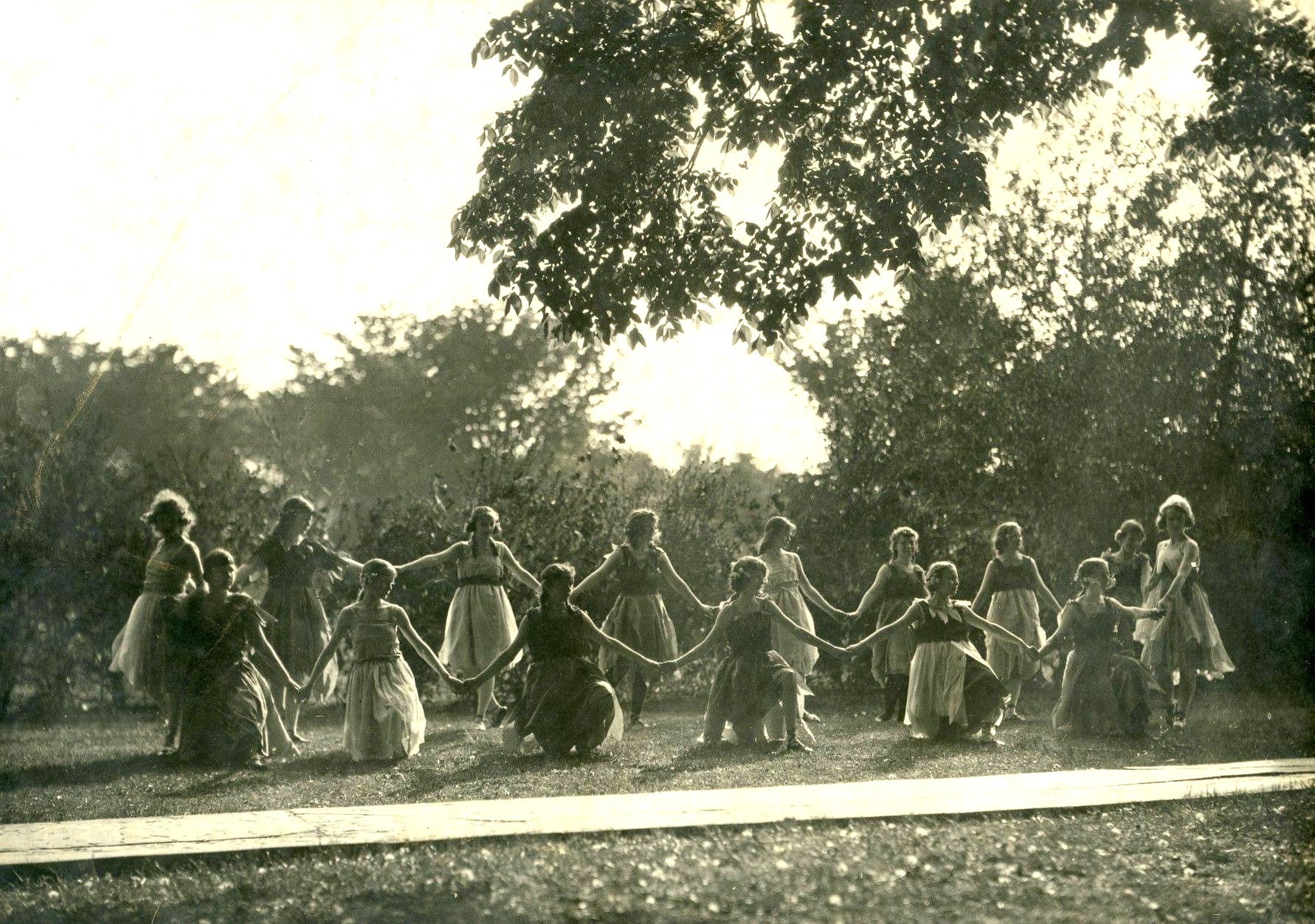
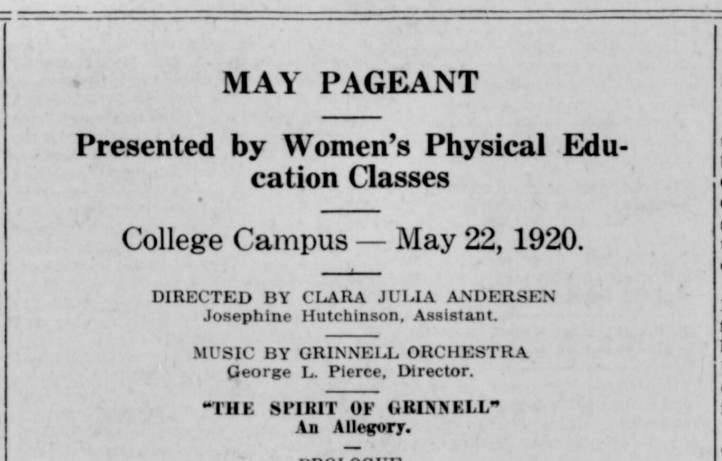
On May 22, 1920, the members of the Women’s Physical education classes performed an elaborate allegorical pageant, entitled “The Spirit of Grinnell,” on the campus grounds.  Accompanied by the Grinnell Orchestra, the pageant aimed to tell the story of the College in 5 stages:

1.) “The Spirit of the Prairie” (pictured above)

2.) “The Spirit of Education” (which depicted the founding of the college)

3.) “The Cyclone”

4.) “Grinnell’s Part in the Great Wars” (i.e. Civil War & WWI)

5.) “The Hope for the Future of Grinnell.”

According to the program, the dancing captured in the photograph above–from the prologue, the “Spirit of the Prairie”–was performed while the orchestra played portions of Charles Gounod’s 19th-century grand opera, Faust.

The 1915 Women’s Basketball Champions

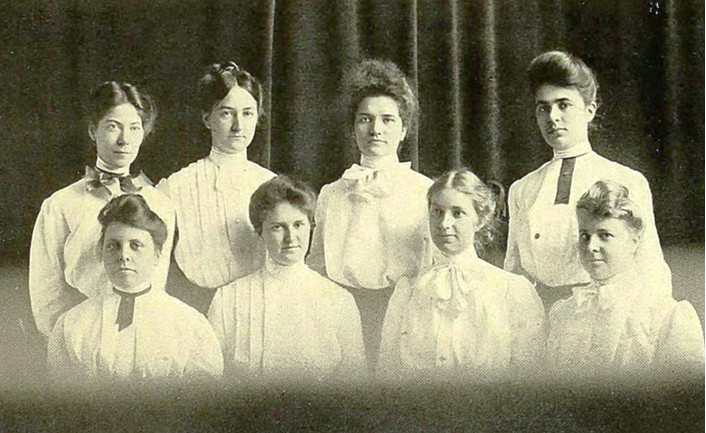
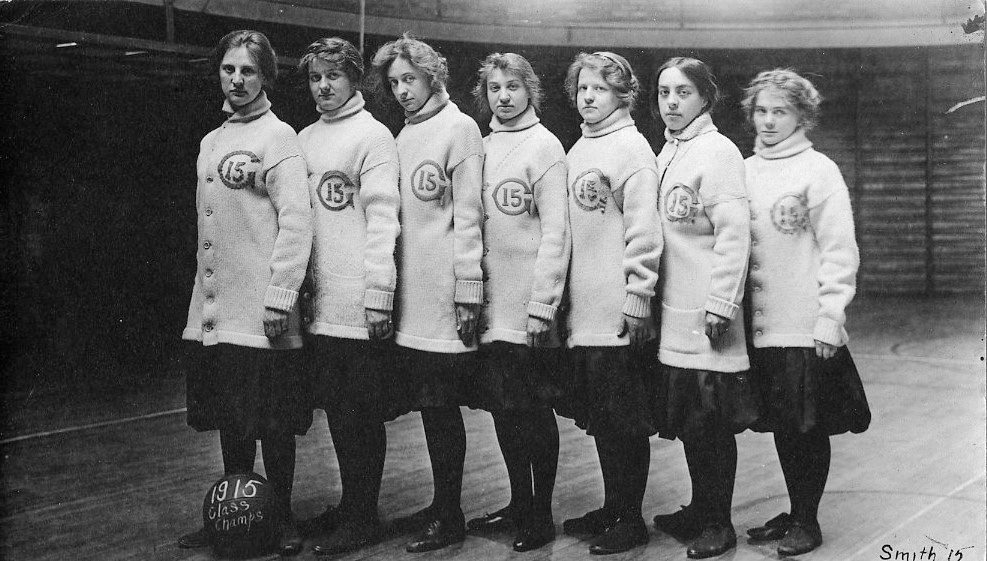
This picture captures the victorious senior women’s basketball team after they won the 1915 inter-class series (hence the “class champs” written on the basketball). While men’s athletics revolved around intercollegiate competition, women’s sports were organized along intramural lines, and at Grinnell, that meant that each academic class would field a team that competed against other years. In 1915, the “senior women” went undefeated, winning the title and the coveted Silver Loving Cup (which had been donated by H.W. Somers that year to promote a “keen spirit of rivalry” among the teams, and add even more drama to the series). The senior team was comprised of E. Hoesley, H. MacEachron, H. Whitney, E. Dunham, I. Barhite, I. Pyle, and R. Coy.  This same team won the previous year’s championship as the junior squad in 1914.


Powered by WordPress & Theme by Anders Norén