
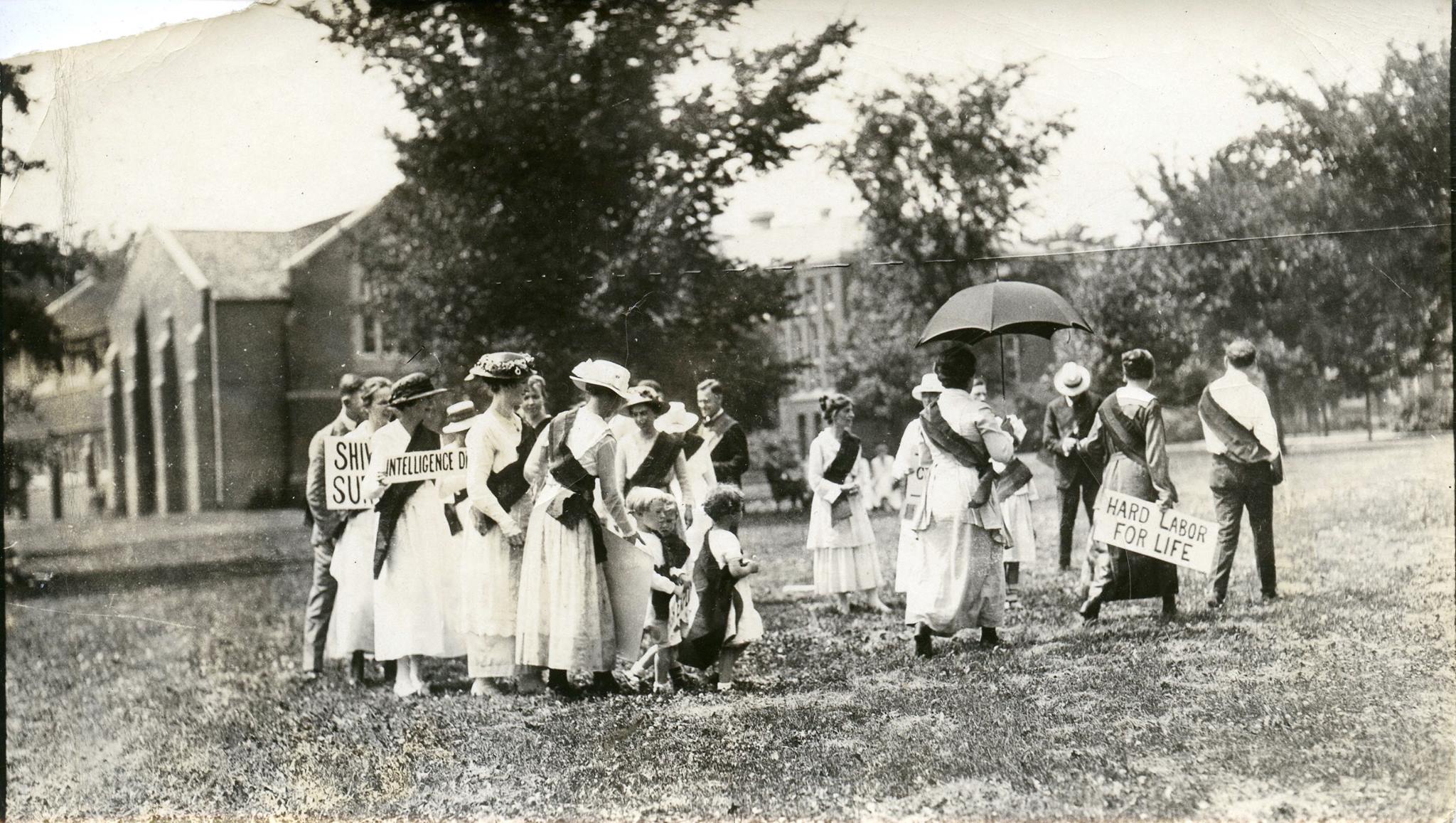
Suffragettes at Grinnell campus (date unknown)
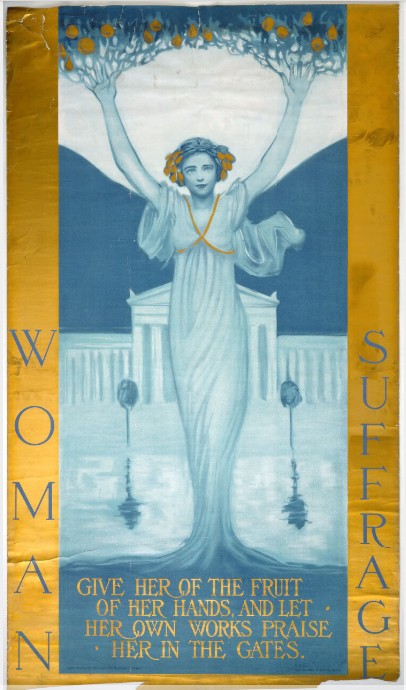 On Tuesday, Grinnellians will go to the polls to vote on candidates for mayor, city council, and school board, as well as the fate of the Local Options Sales Tax. Local elections rarely receive much coverage, but in 1913, Grinnell attracted national, and even international attention, for a special primary it held regarding women’s suffrage.
The issue had been reinvigorated by the presidential election of 1912. Theodore Roosevelt embraced women’s suffrage that year, and made it a plank in the platform of his new “Bull Moose” Party. Suffragettes also staged some of their largest and most publicized events that year, such as when 15,000 supporters paraded in New York City in May, followed by an even more dramatic nighttime march in November, in which a half-a-million New Yorkers turned out to see thousands of suffragettes marching with Japanese lanterns to illuminate their procession.
Responding to this atmosphere, a group of Grinnell’s civic leaders decided to organize a vote that would reveal where the women of the town stood on the issue of suffrage. All women over the age of 18 were invited to this special election—which was held in the Superior Court room from 8am till 8pm, on Friday, January 31st. The voting procedure mirrored a standard, local election—using the same ballot system, held in the chambers of the superior court, overseen by a panel of election monitors—but, this time, women (and only women) were invited to cast their vote. The situation was so novel that the Scarlett and Black was unsure whether to use the term “voters,” when talking about the election, or to create a new feminine version, “votettes.”
The night before the special election, suffragettes staged a rally at the Colonial Theatre (downtown) that included several important speakers; a screening of the new silent film, Votes for Women, showcasing the dramatic parades in New York; and ending with a musical performance by the Women’s Glee Club of the college as well as the distribution of various pamphlets, posters and material supporting the suffrage cause (all handed out by suffragettes “in uniform,” as the Grinnell Herald described them)
The next day, despite snow and ice, 738 women made their way to the polling place to cast their vote: 663 voted in favor of women’s suffrage, and 75 voted against. Contemporaries estimated that about 80% of eligible women, including college students, voted in this election; and many were surprised by the lopsided victory.
The Associated Press latched onto this story, running several press bulletins that drummed up national interest before, during, and after the election. From Los Angeles to London, newspapers covered the spectacle of a small Iowa town holding a special election for women voters to express their position on women’s suffrage. The town eventually sent the results to the Iowa legislature—certified by a team of election judges that, for the first time, were half men, half women—so that it could inform the legislature’s debate on amending the Iowa Constitution.
Leave a Reply