
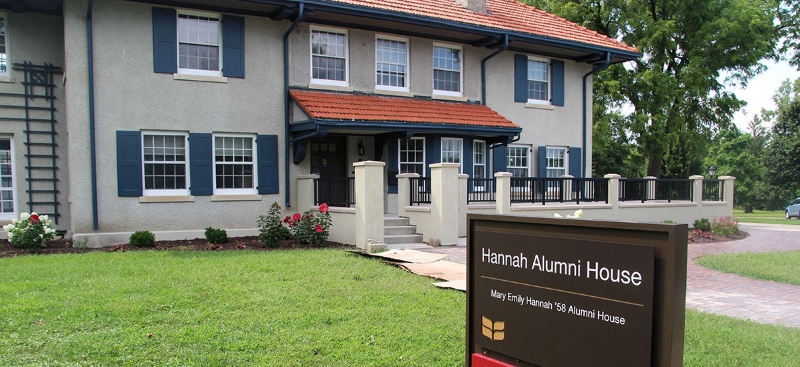
Last week, the college celebrated the opening of its new Hannah Alumni House, at 1527 Broad Street, made possible by a generous donation from Mary Emily Hannah ’58. The project involved extensive renovations to a historic home long known as the “Fellows House”—built more than a century ago by Jesse and Maude Fellows , both graduates of the college class of 1901, and prominent leaders in the community.
In the 1930s, the Fellows sold their Broad Street home to the college, which decided to turn the building into a special residential hall focused on issues of civic and community engagement. Named “Macy Hall”— in honor of Jesse Macy, the longtime professor of political science at the college—this “experiment in group living for students interested in public affairs” was actually intended to be the first step in the creation of a larger program. Reflecting the spirit of the 1930s, when so many Grinnell alumni were prominently involved in the New Deal, and in public service, President Nollen hoped to create a new “school of public affairs” that would garner the college national attention as it prepared to celebrate its centenary.
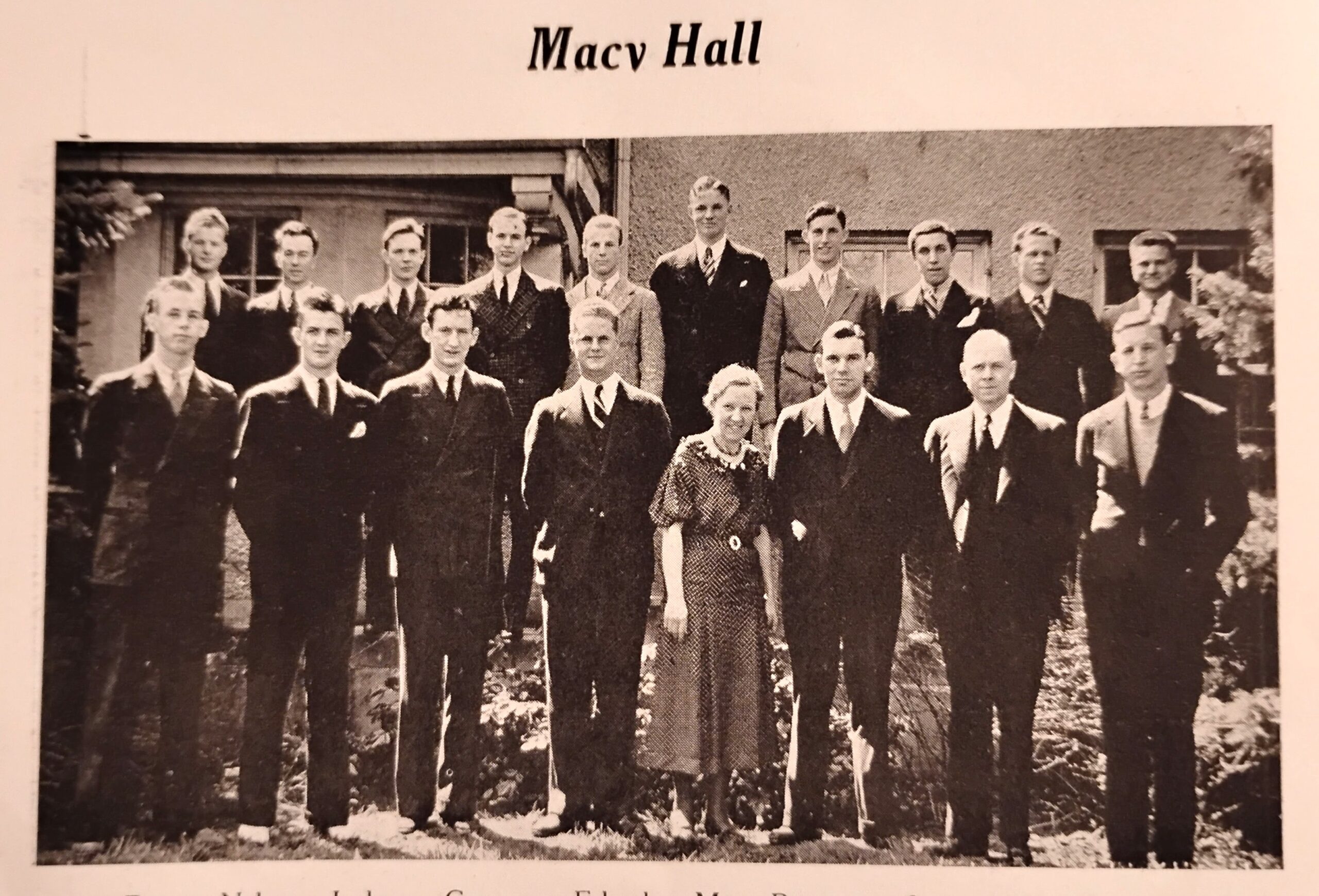
 In 1935, the college hired a new professor of Sociology, W. Ryland Boorman, who became the residential director of Macy Hall (which housed 17-20 male students), and took charge of plans to develop the proposed school of public affairs. Initial programming revolved around a community series each Thursday evening, in which an invited speaker had dinner (in the Macy Hall dining room) with invited students and faculty ,followed by a talk, and more informal conversation. The line up of speakers focused on a broad range of topics related to civic life, municipal administration, and social reform—one semester, for example, featured speakers from the Red Cross, the Social Service League, the WPA, the office of school superintendent, City Hall, the Women’s International League for Peace and Freedom, and an agricultural organization. In addition to the talks and events, students could also use Macy Hall’s special “statesmanship library” that contained key works addressing civic reform.
Despite a lot of activity in the 1930s, the school of public affairs never came to fruition, and Macy Hall was sold to private owners during World War II. But its recent return to the college fold means that it will be embarking on yet another chapter in its interesting history.
Leave a Reply