Tag: Talks/Lectures

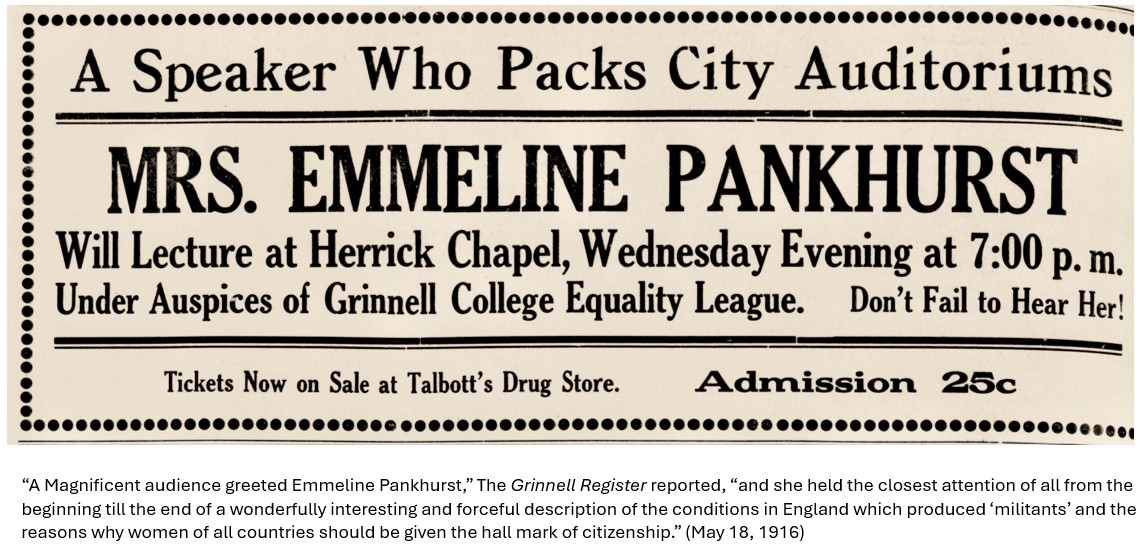
Emmeline Pankhurst comes to Grinnell (1916)

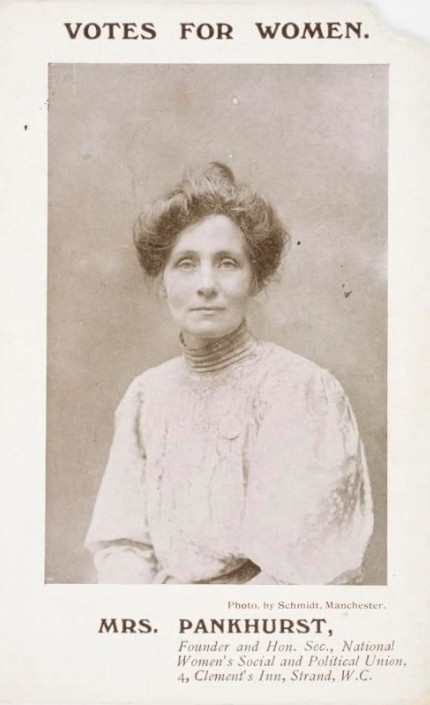
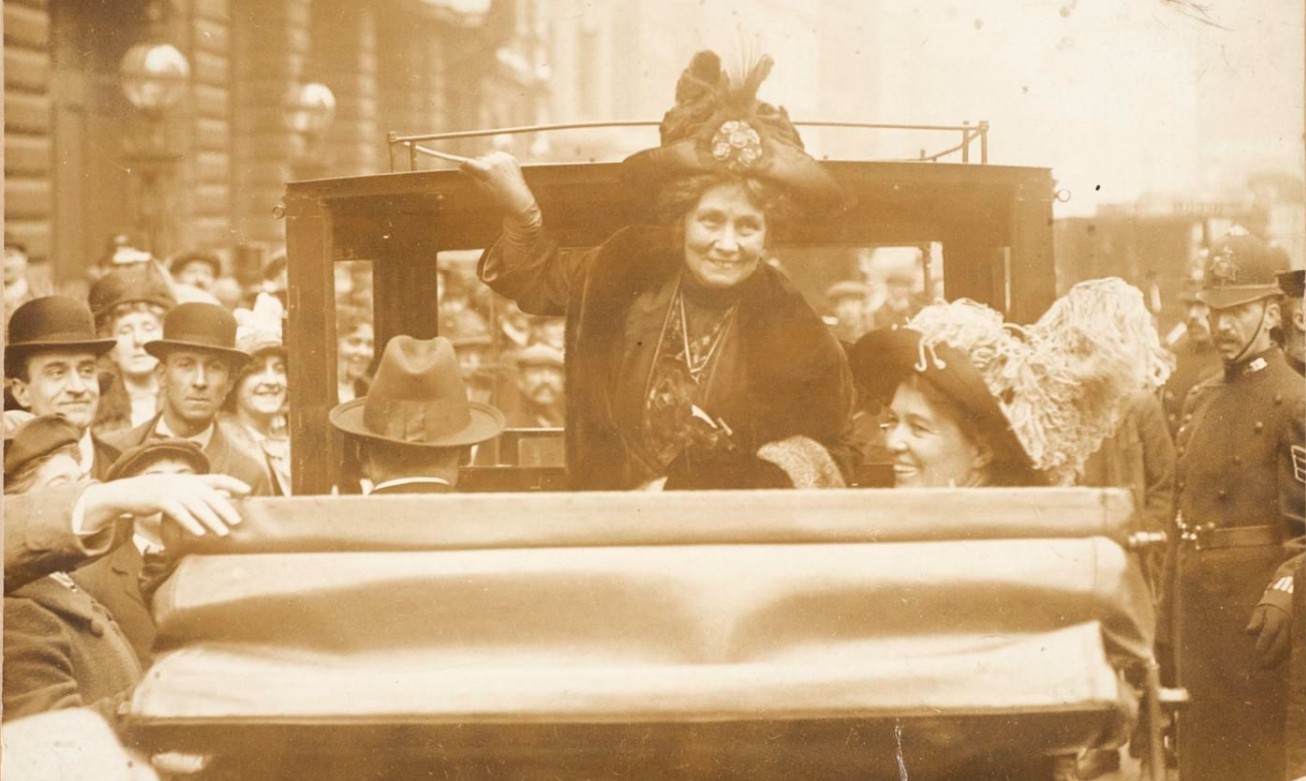
In May of 1916, a group of Grinnell students managed to persuade Emmeline Pankhurst, the famed leader of the radical suffrage movement in Britain, to give a public lecture in Herrick Chapel. Pankhurst had founded the Women’s Social and Political Union in 1903, which organized more confrontational forms of protest and civil disobedience—ranging from blocking roads to disrupting sessions of Parliament to smashing windows and setting fires. Draped in their colors of purple, white, and green, and often brandishing their trademarks signs & badges declaring “votes for women” or “deeds not words,” the members of the WSPU became the iconic face of the suffragette movement (both then and now). Like many of her colleagues, Pankhurst spent considerable time in prison where she engaged in rounds of hunger strikes that attracted even more attention to the cause.
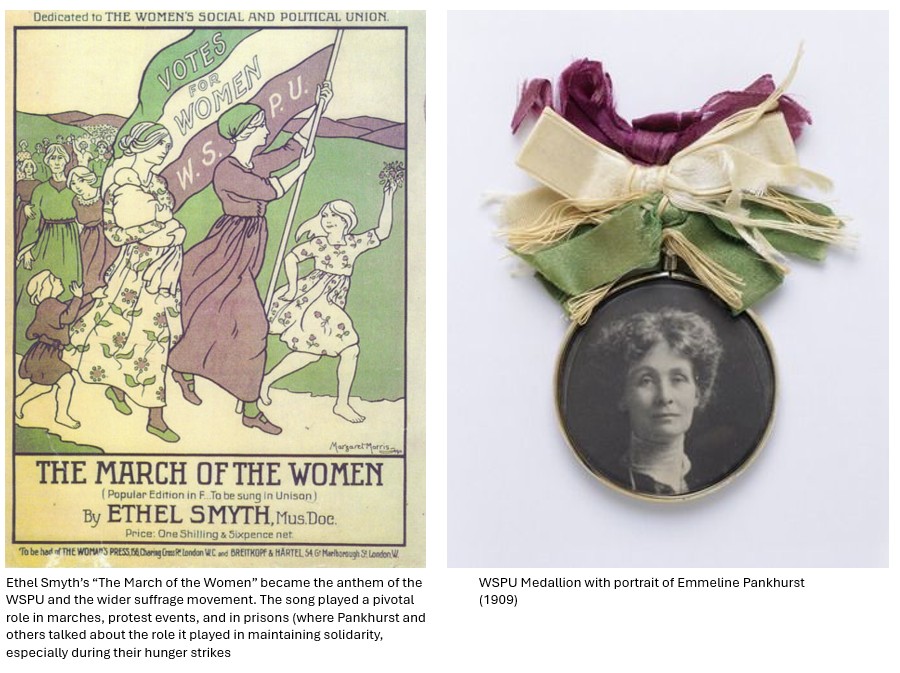
Yet, the beginnings of the First World War brought a temporary truce to these battles, as Pankhurst and the majority of the WSPU agreed to suspend their political protests and support the British government’s war effort. In this spirit, Pankhurst agreed to tour the United States in 1916, giving lectures on the war to raise funds for Britain and its allies.


Given the goals of Pankhurst’s American tour, and her pact with the British government, it is surprising that she agreed to come to Grinnell College to lecture specifically on the suffrage issue. She had been invited to come to Grinnell by the newly formed “Political Equality League,” comprised of female students at the college who were eager to mobilize support for the upcoming vote (in July) on an amendment to the Iowa constitution that would grant equal voting rights to women. That Grinnell would become the main speaking stop between Chicago and Denver on her American tour, and that she would speak explicitly about suffrage here (while avoiding the topic elsewhere), makes her Grinnell lecture all the more intriguing.  Pankhurst might have been swayed by the personal appeal of the Grinnell college students, whose organizing efforts mirrored her own work (in fact, Pankhurst stayed another day in town, so as to attend several meetings and events with college women in their new Quadrangle facilities). Pankhurst might have been equally tempted to speak in Iowa at that particular moment, given the upcoming constitutional referendum that was emerging as a bellwether of the suffrage cause in America. Whatever the precise reasoning, Pankhurst delivered a rousing speech to a packed audience in Herrick Chapel that evening of May 17, 1916.
A Fateful February: The Busy Agenda of W.E.B. Du Bois in Feb 1905

Note: this is a postscript to the previous week’s topic (about Du Bois’ 1905 lecture at Grinnell).


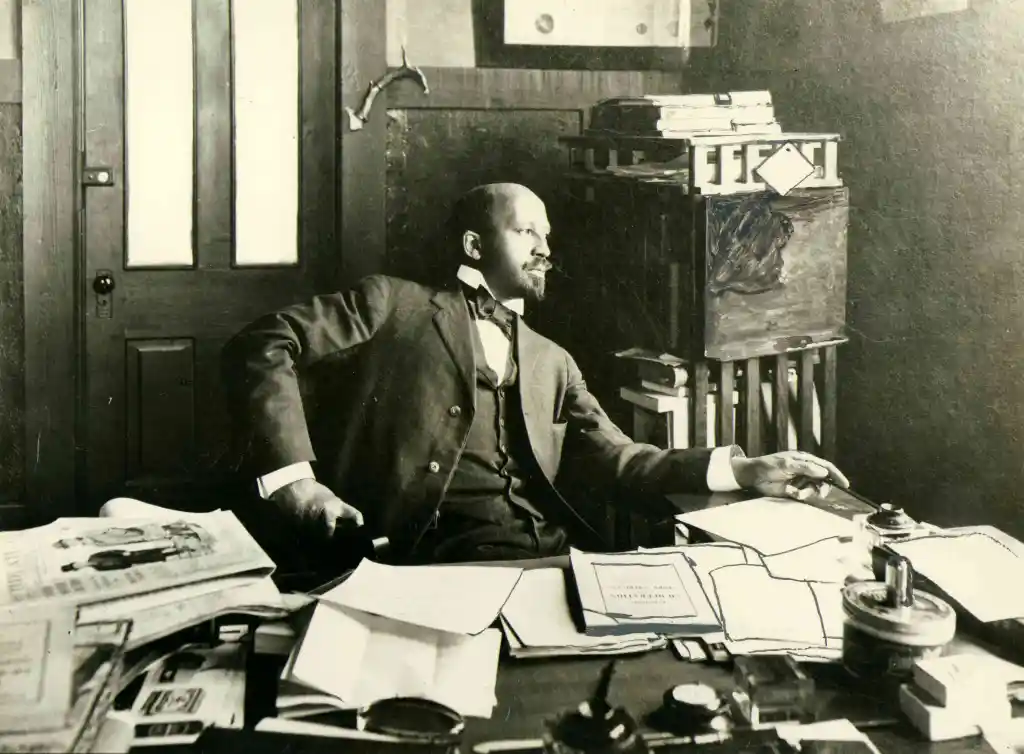
In the summer of 1904, W.E.B. Du Bois agreed to give a lecture in Grinnell as part of the community’s Y.M.C.A lecture series. The talk would be part of a larger Midwest speaking tour in January and February of 1905, taking Du Bois to various communities in Illinois, Wisconsin, and Iowa.

Yet, the first two months of 1905 proved to be some of the most consequential weeks in Du Bois’ career. Dismayed by the accommodationist stance of Booker T. Washington, and the hard-ball tactics of his “Tuskegee Machine,” Du Bois chose this moment to publicly break with Washington. In January, he published an article, “Debit and Credit” in The Voice of the Negro magazine, accusing Washington of systematically bribing the African-American press to silence his critics. The essay set of a firestorm of controversy, with Du Bois’ receiving numerous letters in February asking for proof or further comment. While travelling to and from Grinnell, for example, Du Bois was drafting letters to Oswald Garrison Villard, the powerful editor of the New York Evening Post, explaining his accusations, while also writing to his friend, William Monroe Trotter (editor of the influential Guardian paper) to provide more concrete evidence to satisfy skeptics. The controversy served as a sort of Rubicon, pushing Du Bois to turn this growing rift into an official break—Du Bois resigned from several Washington-allied organizations in February, such as the “Committee of Twelve” and the Afro-American Council (AAC).

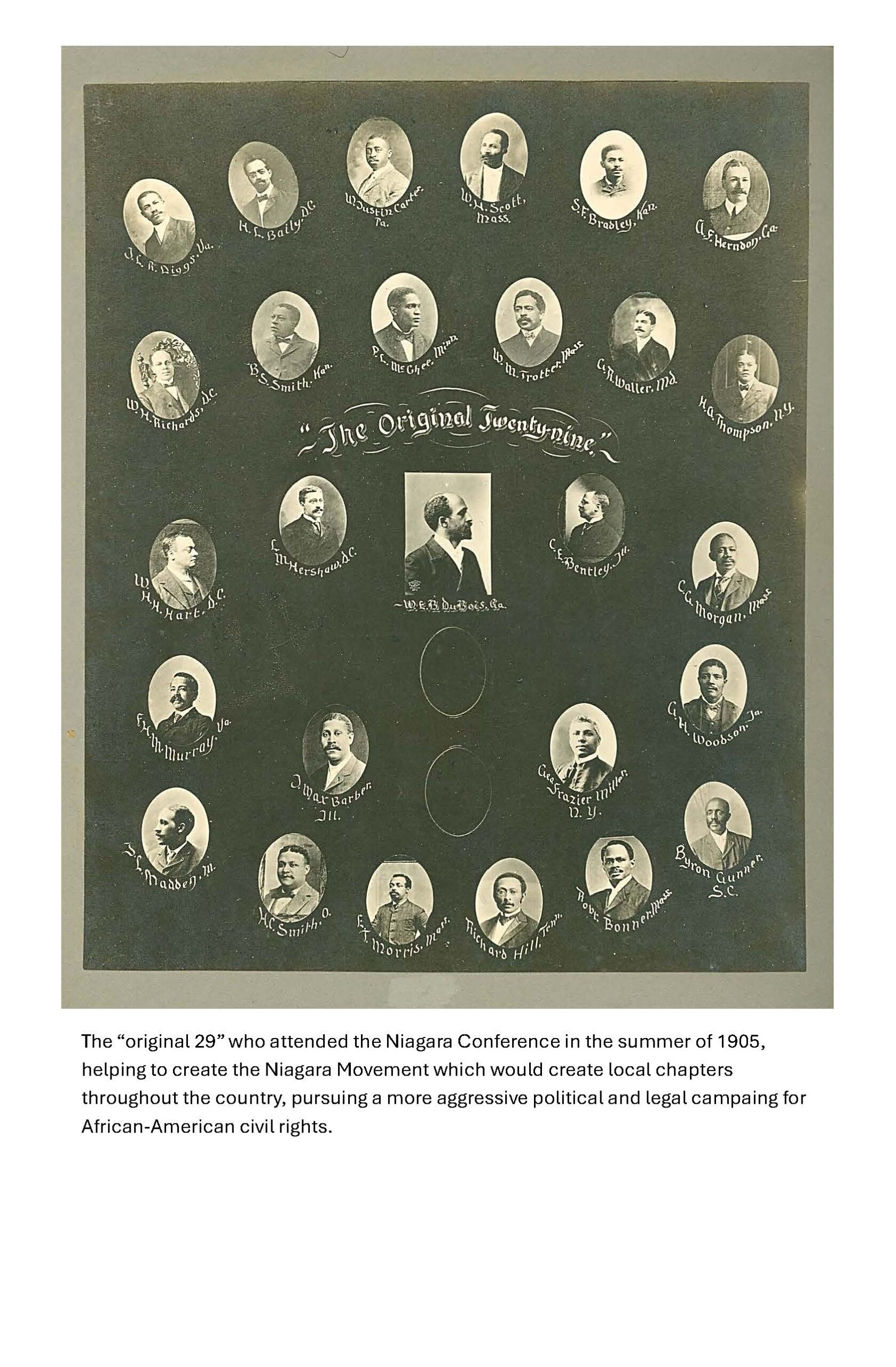
It was during this period—February of 1905—that Du Bois and a few of his close associates held key meetings to launch a new, and more aggressive, civil rights organization, which would culminate in the Niagara Movement (named after the conference, that summer, held near Niagara Falls). Because the Niagara Movement would lay the groundwork for the creation of the NAACP a few years later, historians have long been interested in tracing its origins. We know that one of these meetings was held around February 14th, when Du Bois was in Boston for a week of talks that were nestled between the Wisconsin and Iowa legs of his speaking tour (Du Bois was lecturing in Wisconsin until Feb. 6th, was in Boston from the 8th through the 15th, and then was supposed to start his Iowa tour at Grinnell on Feb. 17th). William Trotter, a leading critic of Booker T. Washington, assembled Du Bois and others for a meeting in his Boston home. Within two days, Du Bois was on a train to Grinnell, but snow prevented him from making the connection in Chicago on Feb 17th.  Sometime between Feb 17thand Feb 28th, Du Bois held another meeting in Chicago, coordinated by Charles Edwin Bentley, and a pivotal meeting in Buffalo, at the home of the civil rights leader, Mary Talbert, that developed the final blueprint for the Niagara Movement (that meeting was kept secret, to avoid “spies”, but we know it included Trotter, Du Bois, Bentley, Ida B. Wells, Frederick McGhee and others).  From there, Du Bois made an unexpected trip to the twin cities (Feb 26-28), to meet with Frederick McGhee to further develop plans for the summer conference.  And then Du Bois boarded a train from St. Paul’s to Grinnell to deliver his rescheduled lecture on March 2.

It appears, then, that the snowstorm and cancellation of Du Bois’ Iowa circuit came at a key moment when he was racing to organize this new political movement (although Grinnell audiences at the colonial theater would have had little clue about all these developments unfolding behind the scenes).

Visualizing The Color Line: W.E.B. Du Bois’ Grinnell Lecture (1905)

In the early 1900s, the Y.M.C.A. lecture series was an important institution in the shared intellectual life of Grinnell, bridging town and gown. Each year, a local committee of the Y.M.C.A. lined up a program of nationally renowned politicians, writers, musicians, orators, theologians, or performers who would appear monthly at the Congregational Church, or the Colonial Theatre (the two largest venues in town).

In February 1905, Grinnellians were looking forward to the next scheduled speaker in the “Y” series, the famed historian, sociologist, and intellectual, W.E.B. Du Bois. In fact, the prior speaker, Senator Robert LaFollete (a lion of progressive politics) had reportedly told the assembled crowd  “Miss anything else this winter, but do not miss hearing Professor Du Bois.” Unfortunately, a Valentine’s Day snowstorm cancelled Du Bois’ train (even back then, winter weather made scheduling visits and speakers a fraught endeavor). But the committee coordinated with Du Bois to reschedule his lecture for Thursday, March 2nd, when he spoke before “one of the largest audiences of the season.”

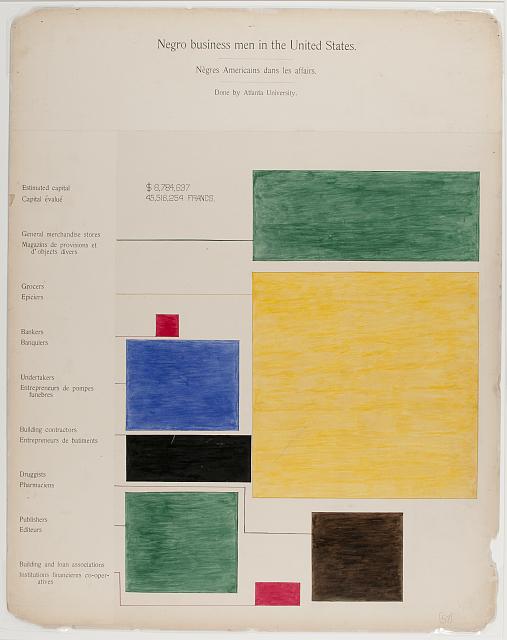
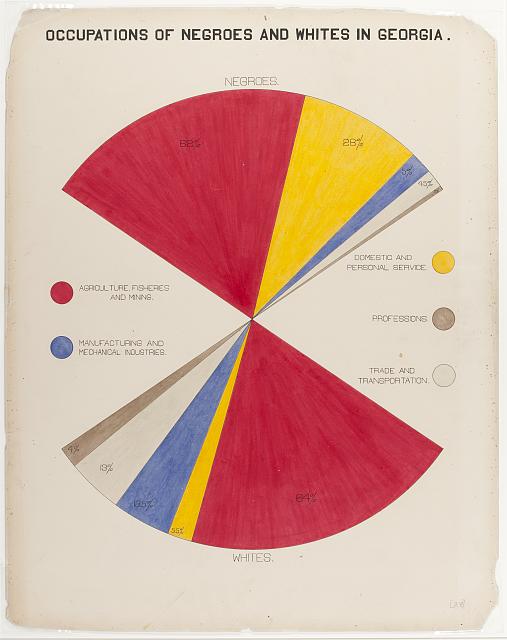
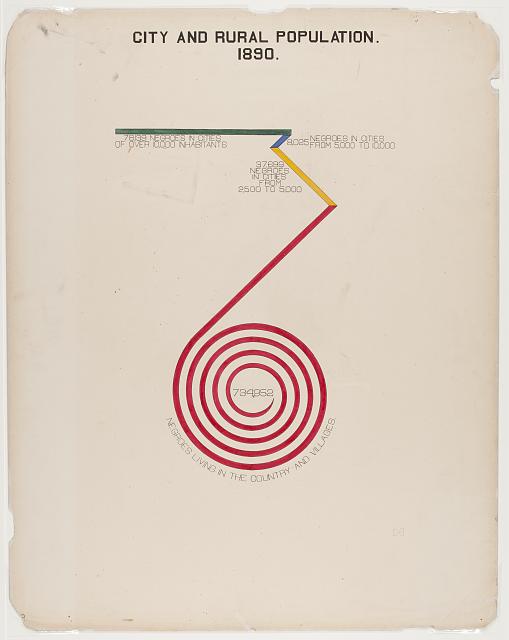
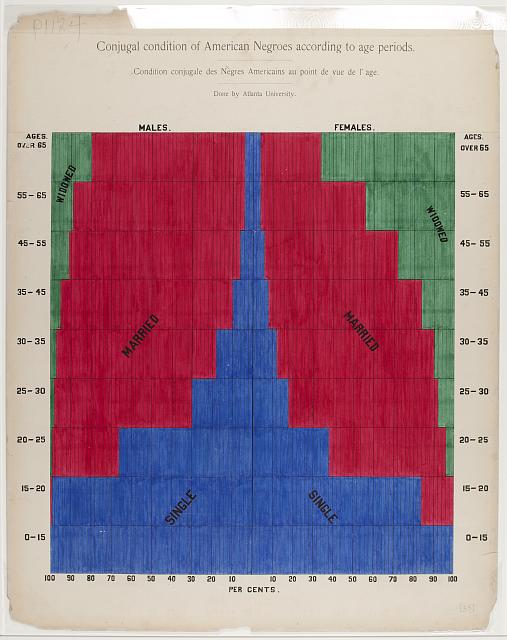
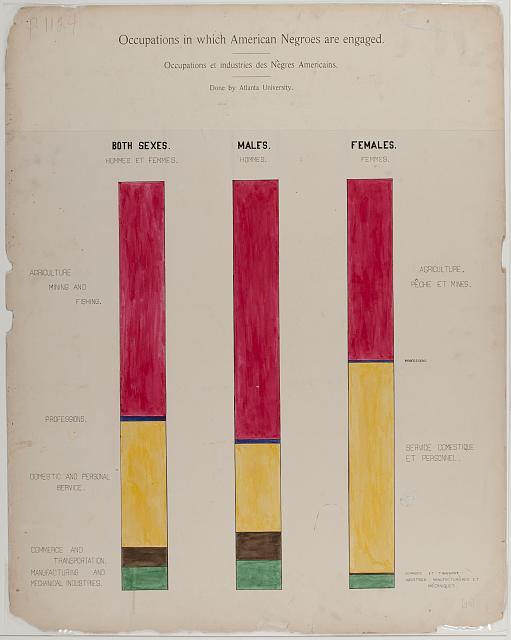
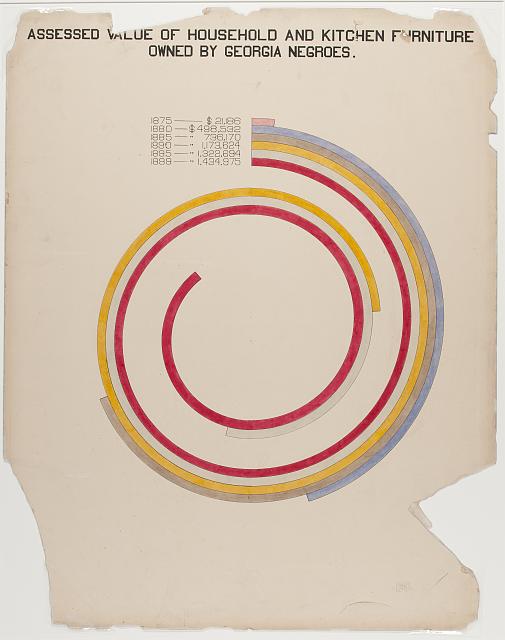
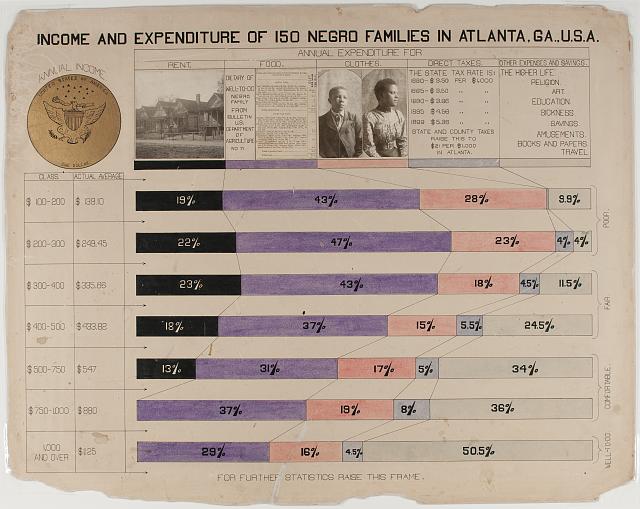
His address, entitled “The South and Its Problems,” focused on the systematic discrimination that African Americans faced in the Jim Crow South, and Du Bois illustrated these systematic consequences through a series of novel “charts…which greatly assisted the audience to a clear understanding of the importance of the problems and the direction recent developments have taken.” These colorful “charts” had been carefully created by Du Bois and his students at his Sociological Laboratory, at Atlanta University, where they creatively experimented with new kinds of data visualizing strategies that turned census data into evocative infographics. Each year, Du Bois and his students focused on a particular theme: in 1905, they were working on the issues surrounding health and medicine; the previous year had focused on crime; and other recent topics included Churches & Religious Life (1903), Work & Labor (1902), Education (1901), Business (1899), and Urban Life (1897).

Just a few years before his Grinnell lecture, Du Bois had showcased 63 of these prints—what he called at the time “data portraits”—at the Paris Exposition. Some of those items, pictured here, were likely featured in his Grinnell lecture at the Colonial Theater.

Today, Du Bois’s work in the field of data visualization has begun to receive much greater attention and recognition from scholars interested in reclaiming these pioneering forms of quantitative advocacy and graphic design. Those interested in seeing more examples can explore the full collection at the library of Congress; the 2023 exhibit at the Cooper Hewitt museum, Deconstructing Power: W.E.B. Du Bois at the World’s Fair; and the interactive website, The Du Boisian Visualization Toolkit.


Black Martyrs’ Weekend

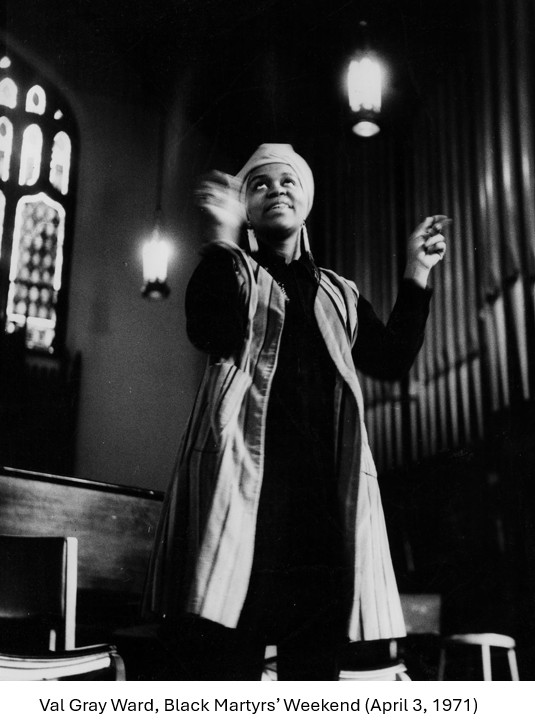
In the wake of Martin Luther King’s assassination, on April 4, 1968, the  Concerned Black Students organization (CBS), began planning a “Black Martyrs’ Weekend” that would commemorate the one-year anniversary of Dr. King’s death, the following spring. The first Black Martyrs’ weekend took place from April 3rd to the 6th (1969), and included a range of talks, performances, panels, and lectures honoring those who had died in the struggle for racial justice, while also educating the campus and community, more broadly, about Black culture and the continuing fight for equality. That year’s program included:

  • a talk by the head of the Black Student Party (from San Francisco State)
  • a panel discussion, “In Defense of Black People—The Black Panther Party” (led by members of the Des Mones Black Panther Party)
  • a lecture by Dr. Charles Nichols on “Martin Luther King, Jr. and the present American Mood,”
  • a performance of African dance by members of CBS
  • a concert by The Jackson Five
  • a screening of Martin Luther King’s speech, “Remaining Awake through a Great Revolution.”
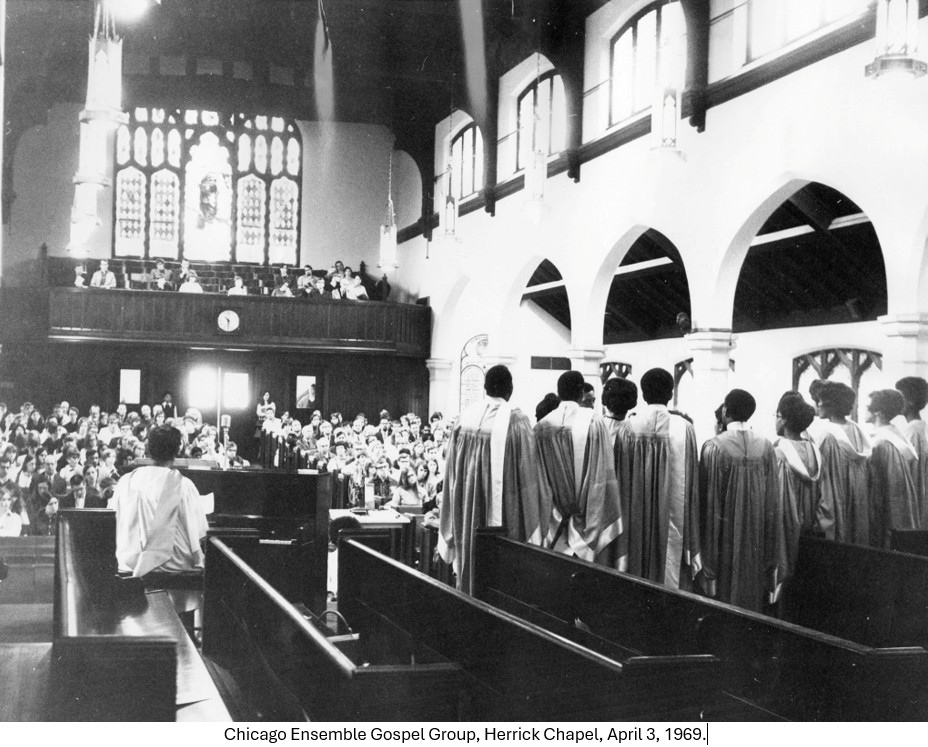
  • a performance by the Chicago Ensemble Gospel Group (pictured here)
  • a sermon by the Father Kwasi Benefee, a black liberation theologian/priest.


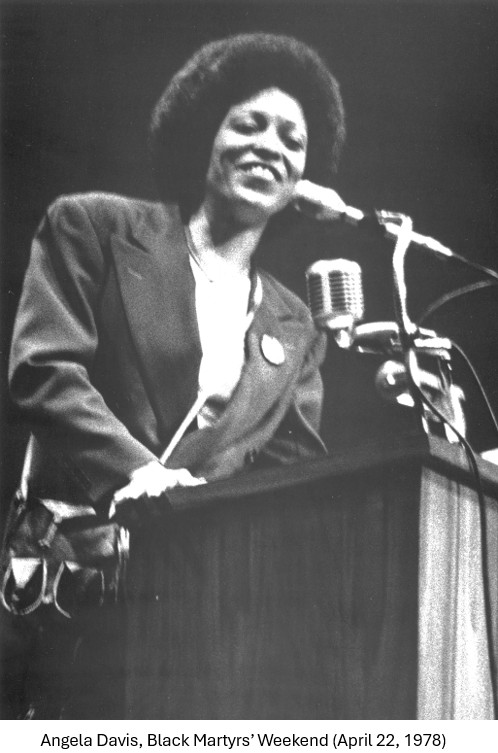
While some events were held in the Forum, many of the talks and performances took place in Herrick Chapel, which would serve as the main site for future iterations of the Black Martyrs’ Weekend that were held throughout the 1970s, and would include many prominent figures like Angela Davis, Gwendolyn Brooks, Dick Gregory, Herbie Hancock, and more.

On today’s campus, the commemoration of Martin Luther King has shifted to January, with the advent of the federal holiday marking MLK Day, in the 1980s. There is something fitting, however, about the fact that this year’s MLK Day speaker, Jamelle Bouie, will delivering his address on “The Civil Rights Movement and the Reconstruction Amendments,” in Herrick Chapel (this Thursday evening). It’s a space, and a pulpit, that has a rich tradition associated with this topic, thanks to the work of the CBS and others who began this process more than fifty years ago.

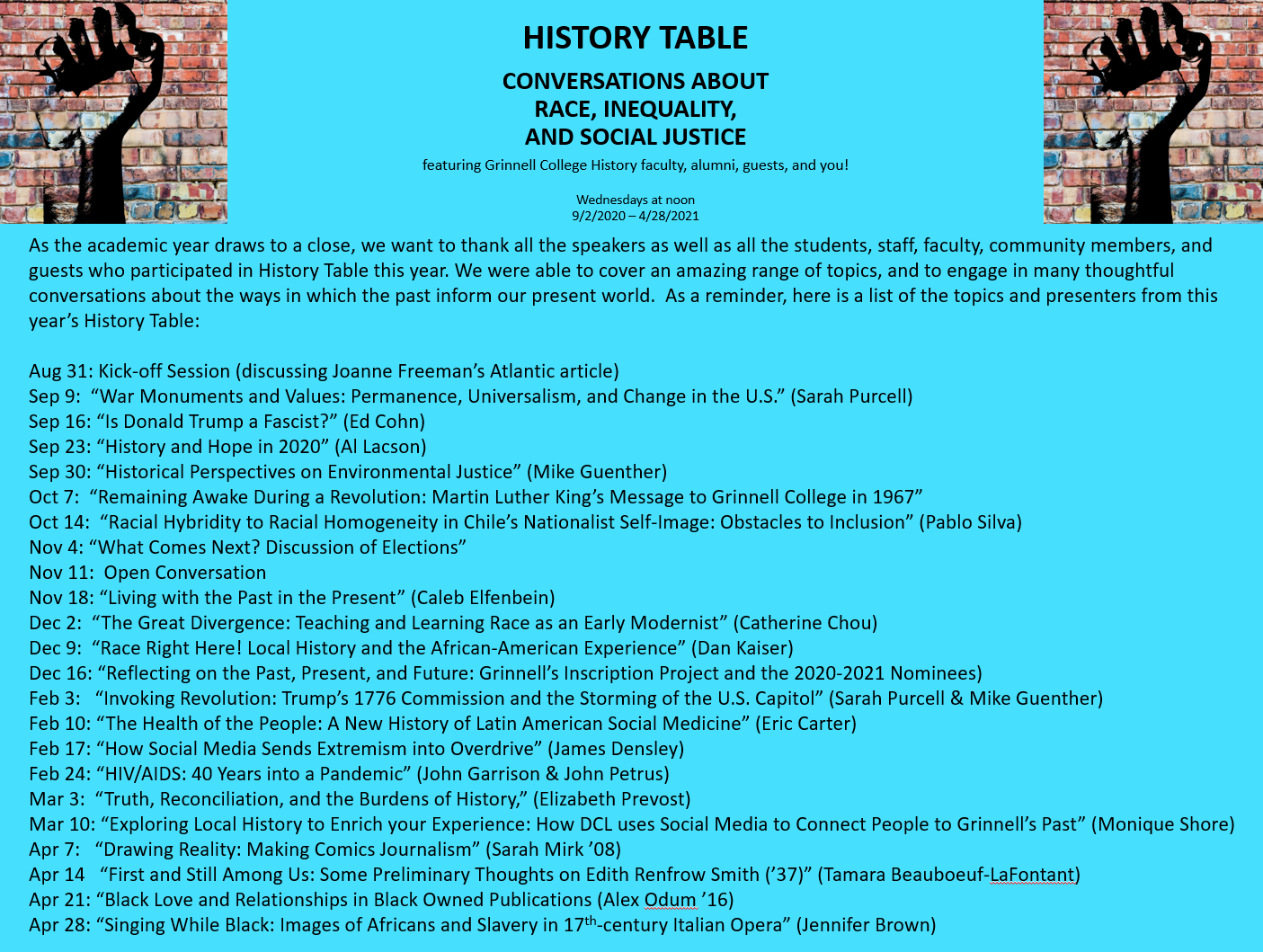
Covid Flashback: History Table, 2020-2021


With a few exceptions, virtually all of the classes and activities on campus were held online during the 2020-2021 academic year because of Covid. The History department, therefore, decided to experiment with running an online “History Table,” that was held over the noon hour each week of the semester, in which students, faculty, staff, alumni, and community members were invited to zoom in for a short (10-15 minute) presentation, followed by a half hour of group discussion about the topic. The overarching theme for the year was “Conversations about Race, Inequality, and Social Justice,” with each “presenter” exploring one facet of this topic that connected to their own teaching, research, or public advocacy, and then leading the subsequent conversation among the group.  Like many experiments, it was a bit chaotic, a bit exhilarating, and a bit exhausting, but definitely worthwhile.

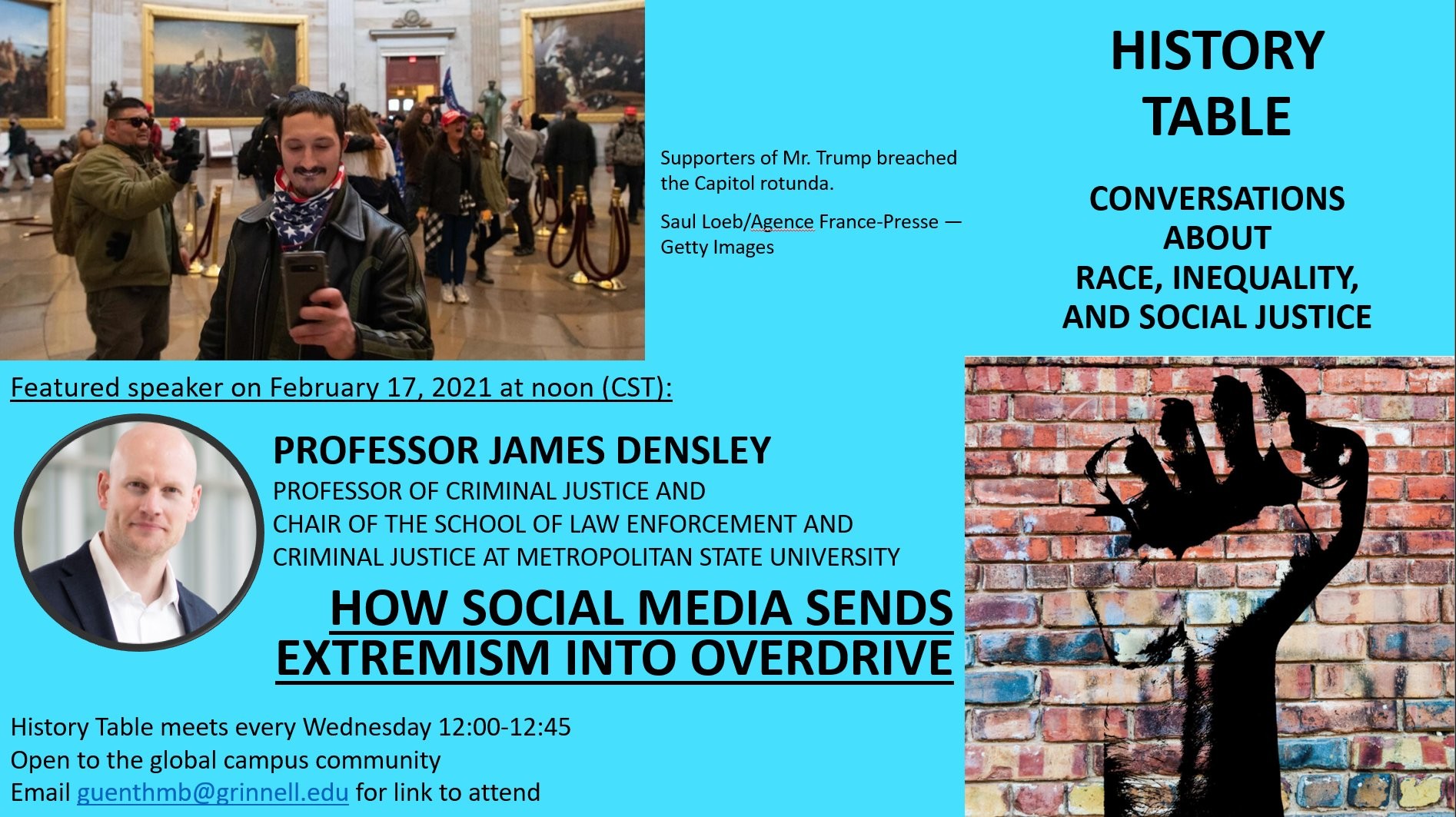
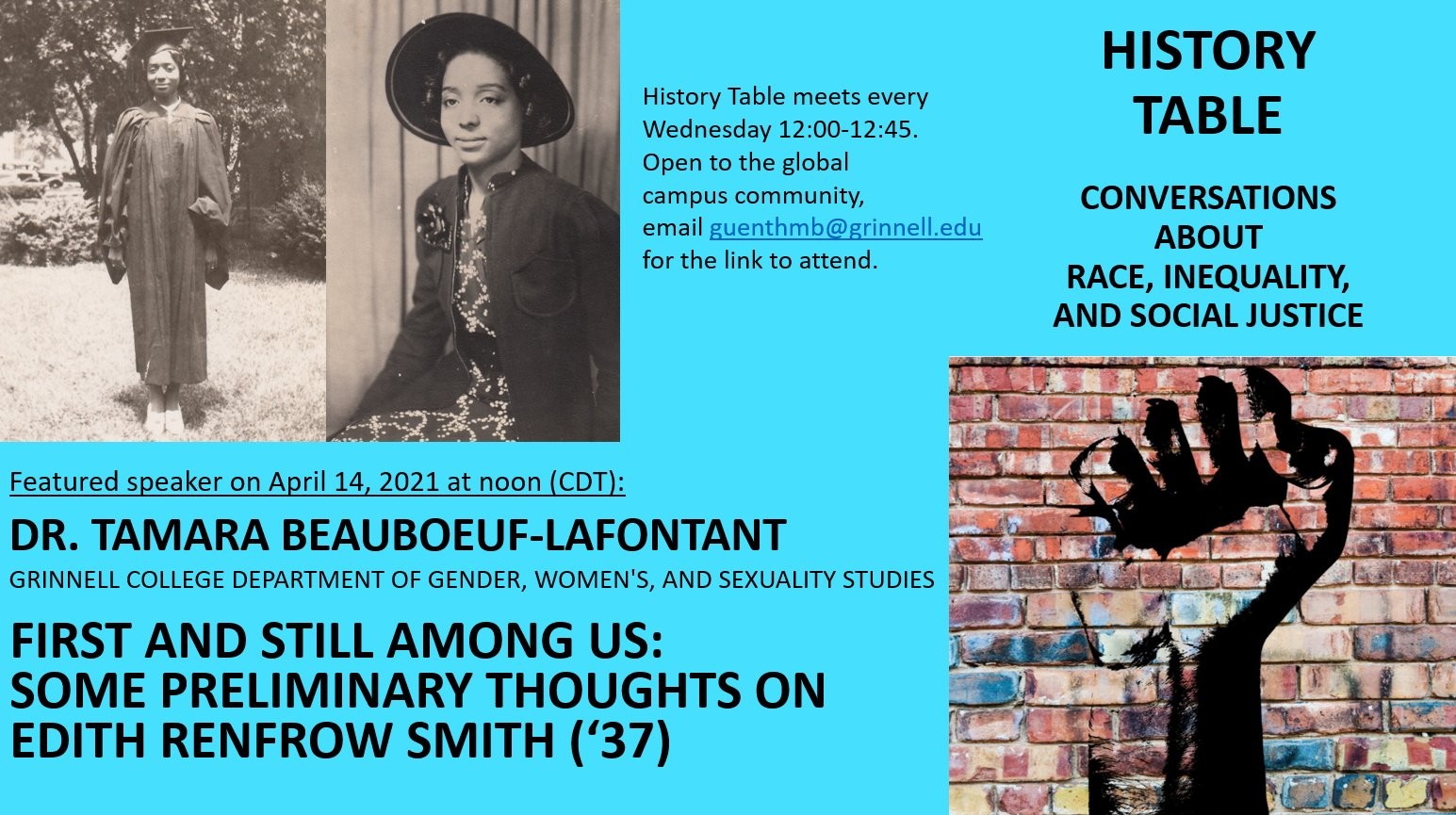
Above, is the poster from the February 17th session led by James Densley, who helped create The Violence Project, alongside Grinnell alumna, and professor of criminology, Jillian Peterson ’03. Their co-authored book, The Violence Project: How to Stop a Mass Shooting, was released a few months later and reshaped the national conversation on gun violence and gun control (we were immensely lucky to have James share this work with us, and are grateful to our departmental assistant that year, Mary Dillion, ’22, who worked on the Violence Project and helped make this event happen). There were many other special moments like this: you can see the full line up below). But we also want to highlight the poster from the April 14th session, in which Dr. Tamara Beauboeuf-LaFontant and Feven Getachew, ’24, led a discussion about the beginning stages of their work on the history of Edith Renfrow Smith ’37, which ended up having such a profound impact on Grinnell’s collective memory. Some good things did come out of Covid…


Rosenfield Lecturer (1960): Pierre Mendès France

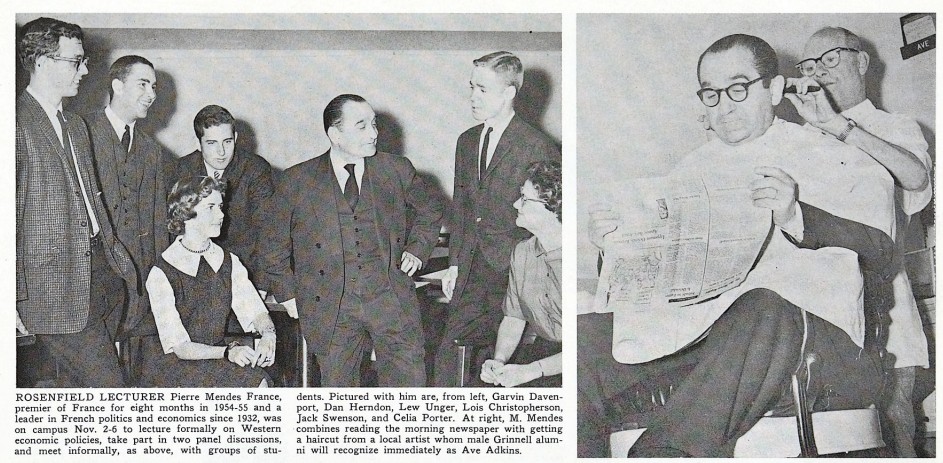
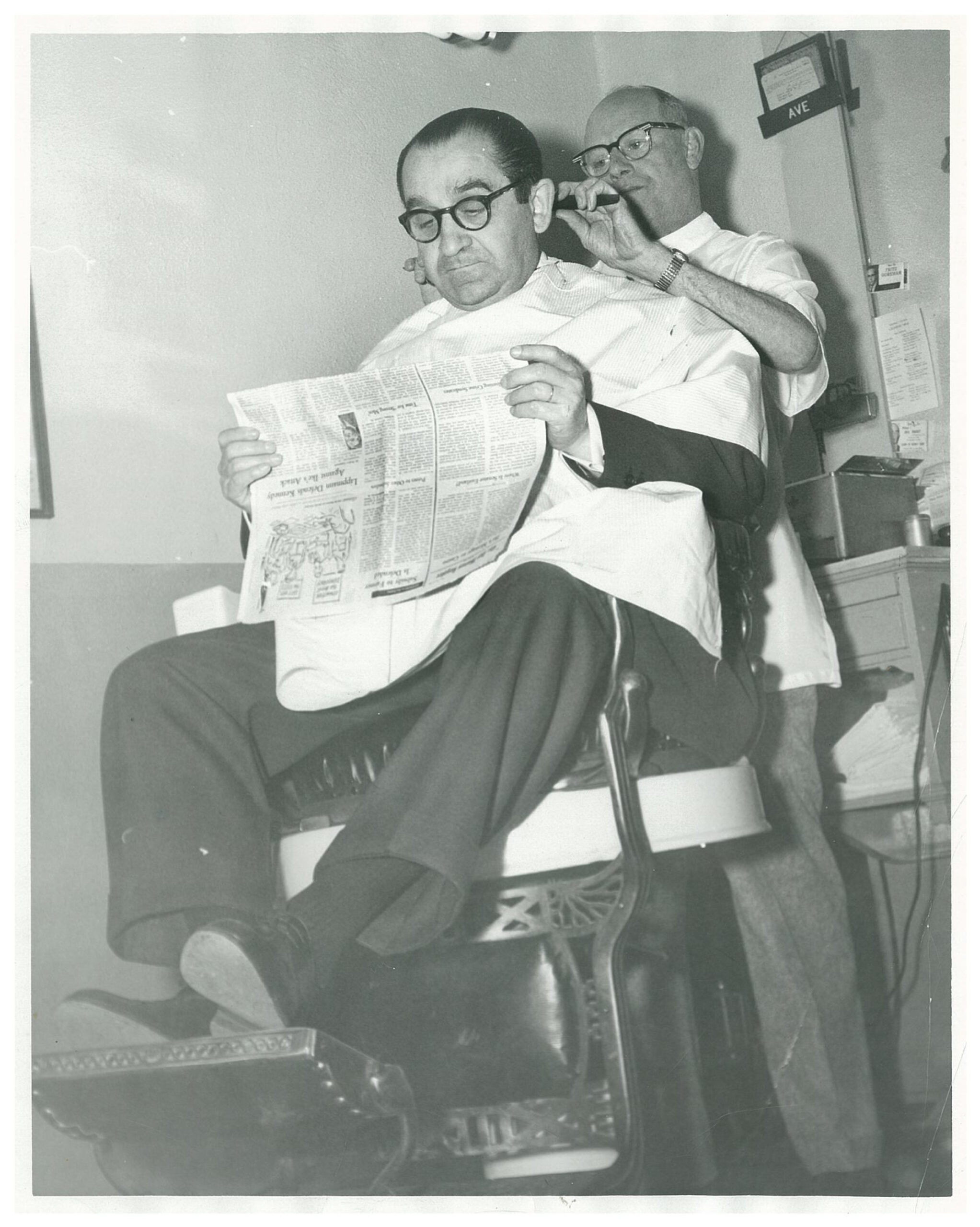
For 5 days in the the Fall of 1960, Pierre Mendès France, the one-time Premier of France and noted expert on international economics, was a resident of Grinnell, spending the week giving a series of lectures, talks, class visits, dinners, getting a haircut, etc., all leading up to his formal Rosenfield Lecture in Herrick Chapel, entitled “Can the West Retool its Economic Model?”

Mendès France had played a prominent role in the Free French government, in exile in London, and represented France at the Breton Woods Conference (where much of the post-war financial and economic order was established), leading to his appointment as Minister of the French economy by de Gaulle.  Described by the New York Times as “a towering figure of the French left for more than two decades,” Mendès France eventually broke with de Gaulle and became a leading figure in the opposition. A critic of French imperial entanglements in East Asia and North Africa, Mendès France was elected Premier in 1954, in the wake of the stinging defeat of French forces at Dien Bien Phu, and brokered France’s withdrawal from Vietnam.

Having Mendès France in Grinnell was seen as a notable milestone for the Rosenfield Lectureship–an endowed program established by Rose Frankel Rosenfield in 1934.  Rose Rosenfield had played a prominent role in civic affairs in Des Moines, particularly active in the women’s suffrage movement. Two of her children, Louise Frankel Rosenfield Noun and Joe Rosenfield, would both attend Grinnell College and play prominent roles in shaping the institution.

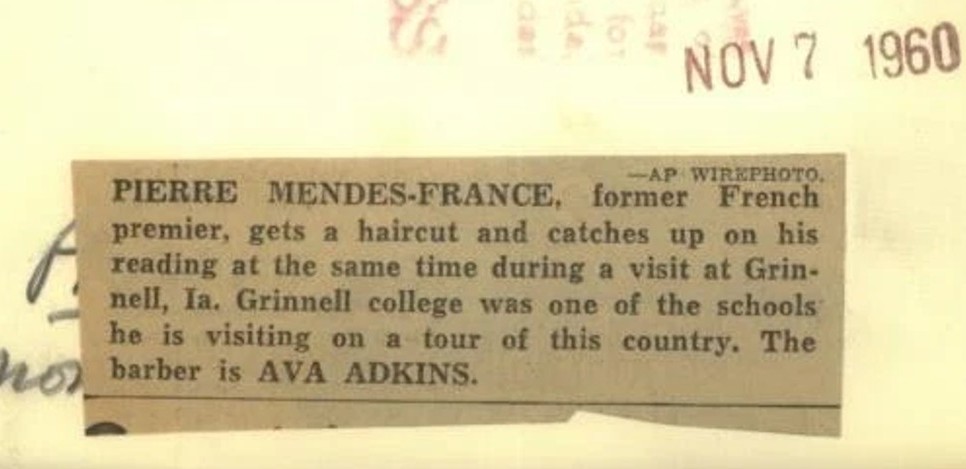
The photo of Mendès France (in the barber’s chair)  struck a chord both locally and nationally. On a local level, Grinnellians (and alumni) appreciated seeing a French premier getting his hair cut by Avery (Ave) Adkins, whose barber shop was a local institution. His son recalled that waves of college students and locals who got their hair cut at “Ave’s on Fifth Ave” from the 1930s to the late 1960s, many of whom would keep in touch for years, writing letters to his father, or swinging by to visit when they returned to Grinnell for reunions or family visits. Nationally, the photo was picked up by the AP Wire service, and appeared in newspapers around the country. It provided a kind of Rockwellesque tableau that seemed to strike a chord with audiences.

The Visual Showmanship of J.B.L. Noel

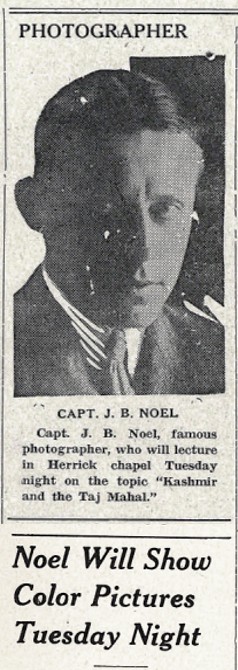
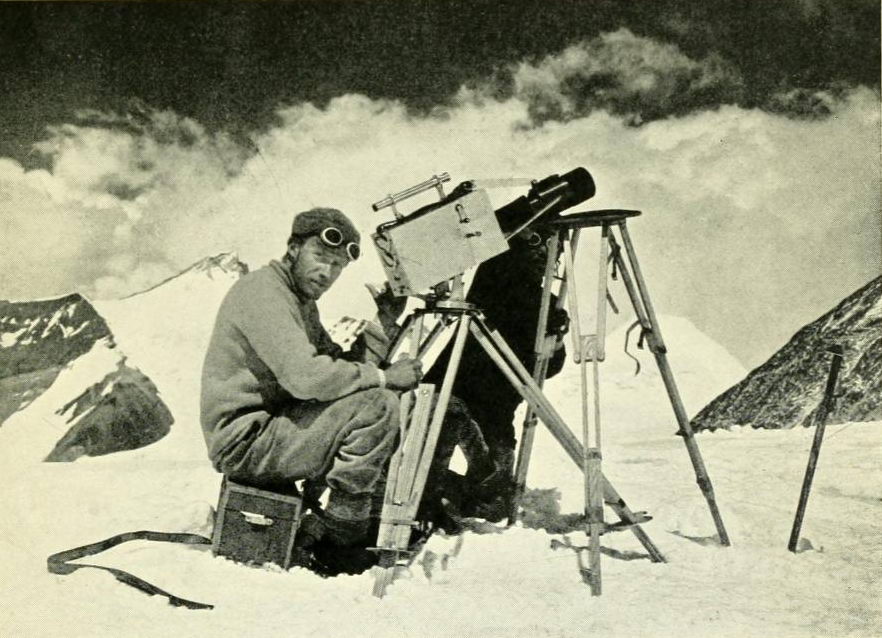
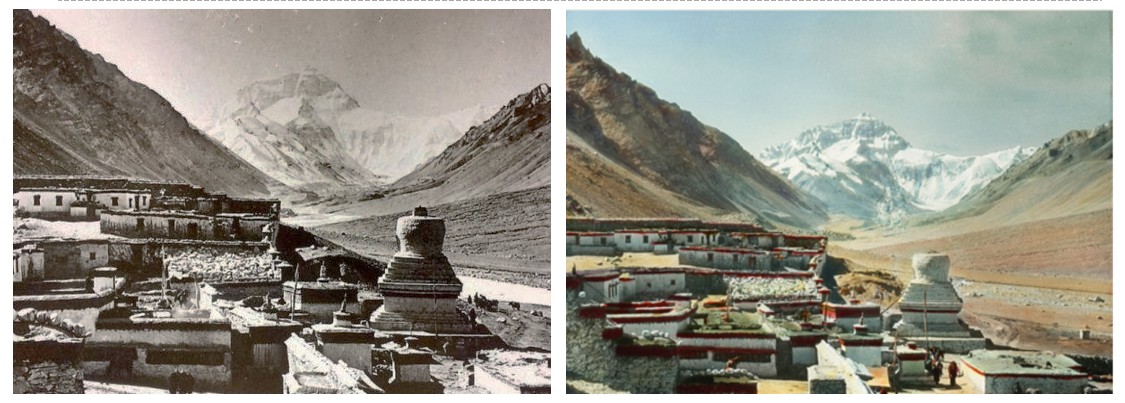
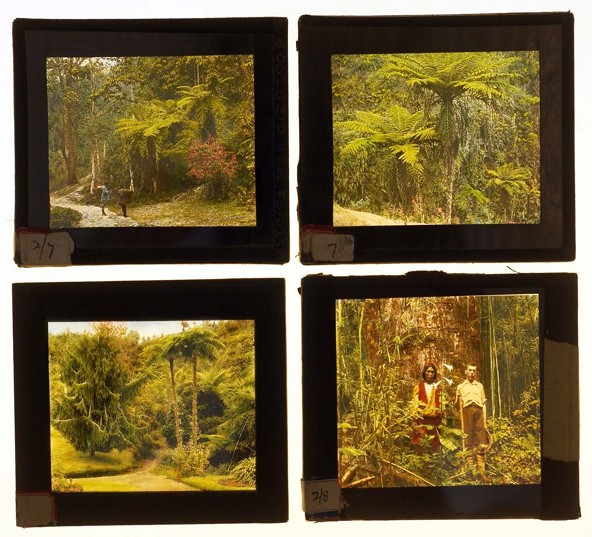
The use of visual images in talks and lectures became more popular by the 1910s and 1920s, when one encounters increasing references to slides, film, or large illustrations appearing in advertisements for campus events. But Grinnellenians got to see the cutting edge of this technology in 1936, when the famed photographer and cinematographer, Capt. John Baptist Lucius Noel came to Herrick Chapel to present colored slides and films from his travels in South Asia.  Noel had been the official photographer on the 1924 British Mount Everest expedition, which ended in tragedy, and a subsequent failed expedition two years later.  His work was developed into two films, Climbing Mount Everest (1922) and The Epic of Everest (1924).  In the early 1930s, he convinced Harvard University to fund an expedition through portions of Kashmir, Tibet, and Northern India–a trip that was captured in a short film, The Land of Shalimar and a series of photographic slides–both of which formed the basis for his Grinnell lecture, part of a larger North American lecture tour.

Contemporaries, as well as later scholars, consider Noel an important innovator in the development of new techniques for coloring slides and film. In particular, he developed a “Colour Dissolvograph” which allowed him to enhance the projection of hand tinted glass slides.  One reviewer exclaimed: “The method of projection which is special to this particular process merges scene into scene with all the Kaleidoscopic attraction that may rightly be called transformation.” Below is one example of a carefully colored slide that Noel used (the larger collection is preserved at the Royal Geographic Society, although no surviving version of his Dissolvograph exists, sadly).

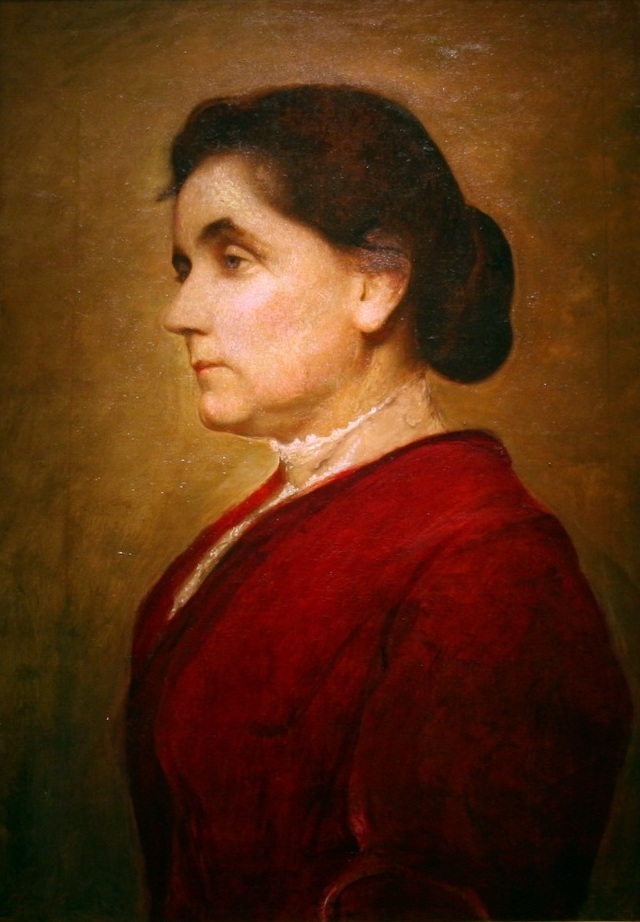
Jane Addams Lectures at Grinnell (1906)

Jane Addams made several visits to Grinnell, because of her close ties to leaders of the Social Gospel movement at the college (such as Carrie Rand, George Herron, President George Gates,and Edward Steiner).

In 1906, Addams gave a lecture on “The Rise and Development of the Social Settlement Idea” at the Congregational church, which also served as a local fundraiser for the Uncle Sam’s Club, which received the proceeds from the ticket sales for the sold-out event.  Newspaper coverage noted that this might be audiences last chance to hear from Addams because her growing list of duties and responsibilities were such that she would have to “retire from the stage” (i.e. be unable to lecture widely in the future).  Addams discussed the origins of the settlement movement in Whitechapel London, begun by students at Oxford and Cambridge, and focused heavily on her own work at Hull House in Chicago. Adams emphasized that settlement houses stood for “high moral, political, and educational ideals” which she juxtaposed with the “tin-pan Americanism” that animated nativists and their calls for assimilation. Addams also detailed some of the programming at Hull House: study classes, social clubs, a kindergarten, a labor museum, a music school, a theater program, a gymnasium, a coffee house, and gardens (serving a communities made up of more than 25 nationalities).

In true Grinnell fashion, Jane Addams also combined a class visit with her lecture, attending a course taught by her friend and colleague, Prof. Edward Steiner.


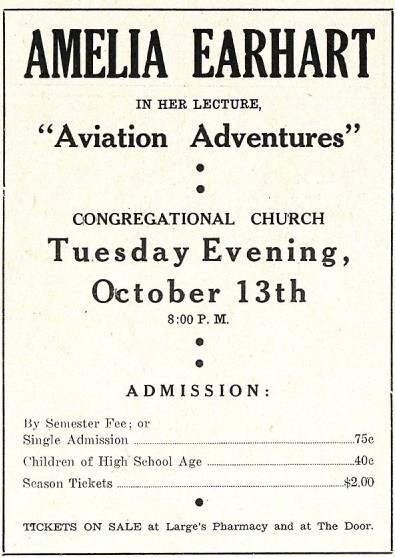
Amelia Earhart’s Visit to Grinnell

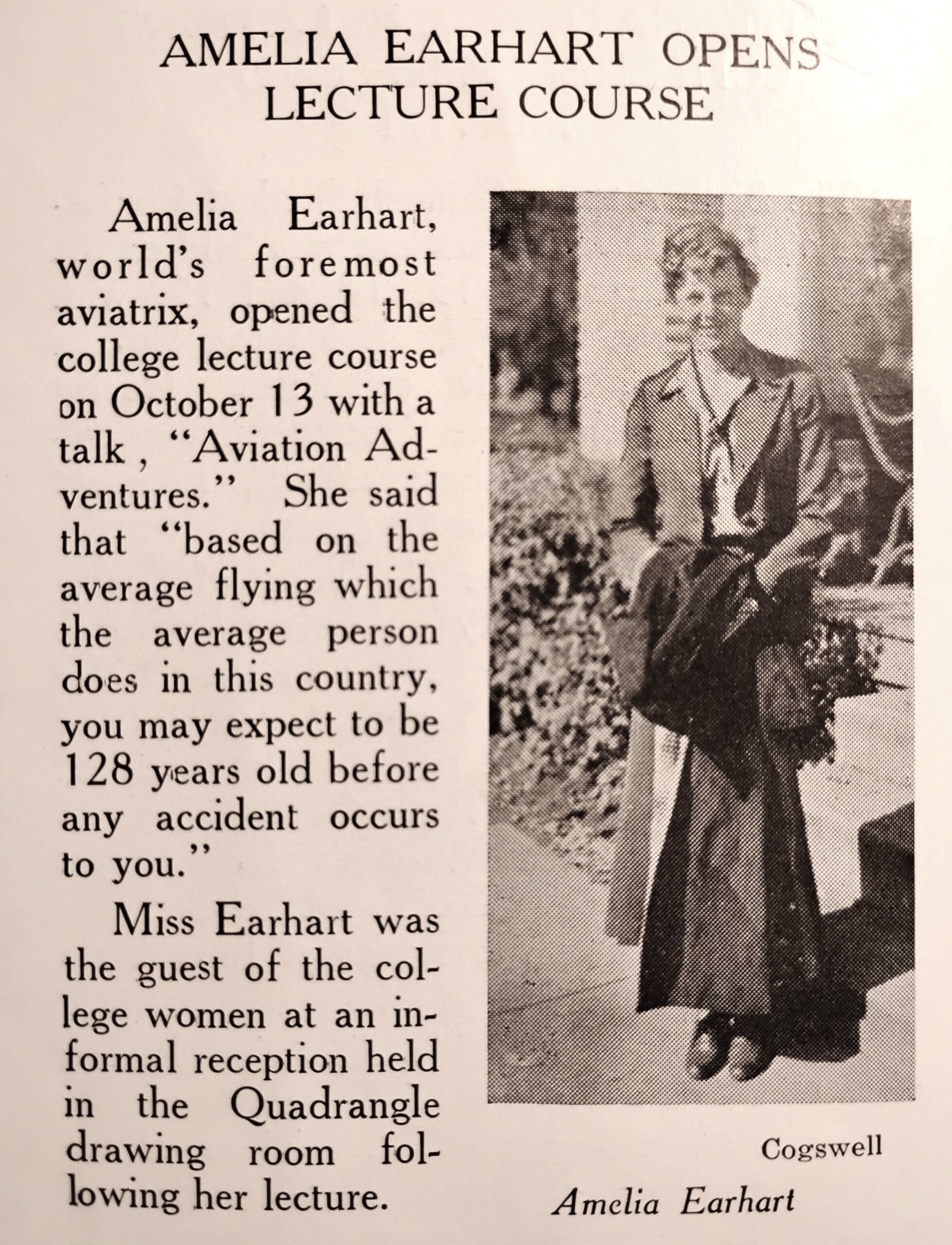
On a crisp October evening in 1936, an unusually large crowd gathered in the Congregational Church in Grinnell to hear Amelia Earhart deliver a lecture on “Aviation Adventures.” Originally scheduled for Herrick Chapel, the college event was moved to the Congregational Church since it could seat many more people and was used for such keynote gatherings (including graduation).

Billed as “the world’s premier aviatrix,” Earhart was touring the country in the wake of two unprecedented flights the year before: one was as the first person to fly solo across the Pacific from Hawaii to California (in January) while the other entailed the first solo (non-stop) flight from Mexico City to Newark, NJ (in May). Just a few years’ earlier, she had gained international fame as the first woman pilot to fly solo across the Atlantic Ocean.

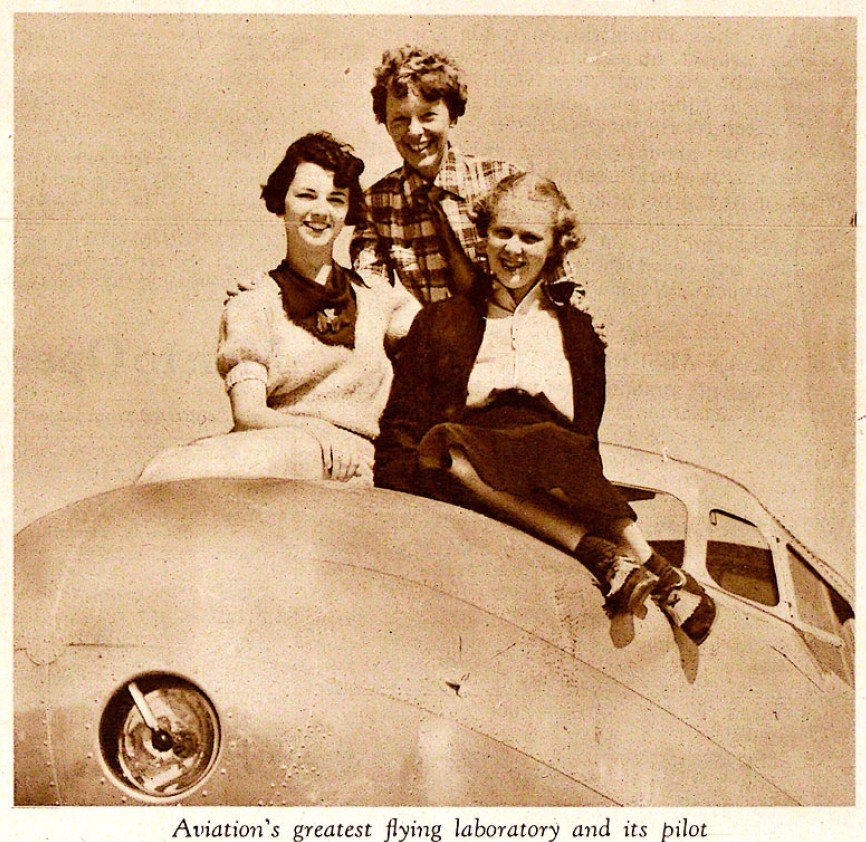
In the Fall of 1936, Earhart was making preparations for her most ambitious project yet: to become the first female pilot to circumnavigate the globe (flying solo, with just one companion, a navigator). To fly that distance, Earhart needed a different kind of plane, and was spending the Fall modifying a newly acquired Lockeed 10-E Electra (pictured here) that would be used to make the voyage the following summer.

Grinnellians were eager to make the most of this visit. The college library, in Carnegie, dedicated a “corner stall [that] will feature literature by and concerning the famous flyer.” And a special reception was held, after the talk, in the women’s Quandrangle drawing room–an event that was for “Grinnell co-eds and faculty women only.” Recently appointed a faculty member, herself, Earhart had joined Purdue University in 1935 to help them develop a new program in aviation (that she hoped would spread to other schools, opening up new opportunities for a rising generation of women and men).

Amelia Earhart’s plane disappeared the following July, n route from New Guinea to Howland Island.  Since it was during the summer, we don’t know much about how the campus reacted to the news of her disappearance.

Gwendolyn Brooks at Grinnell

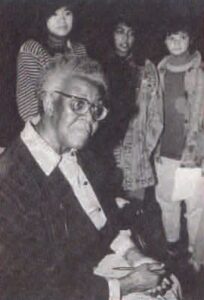
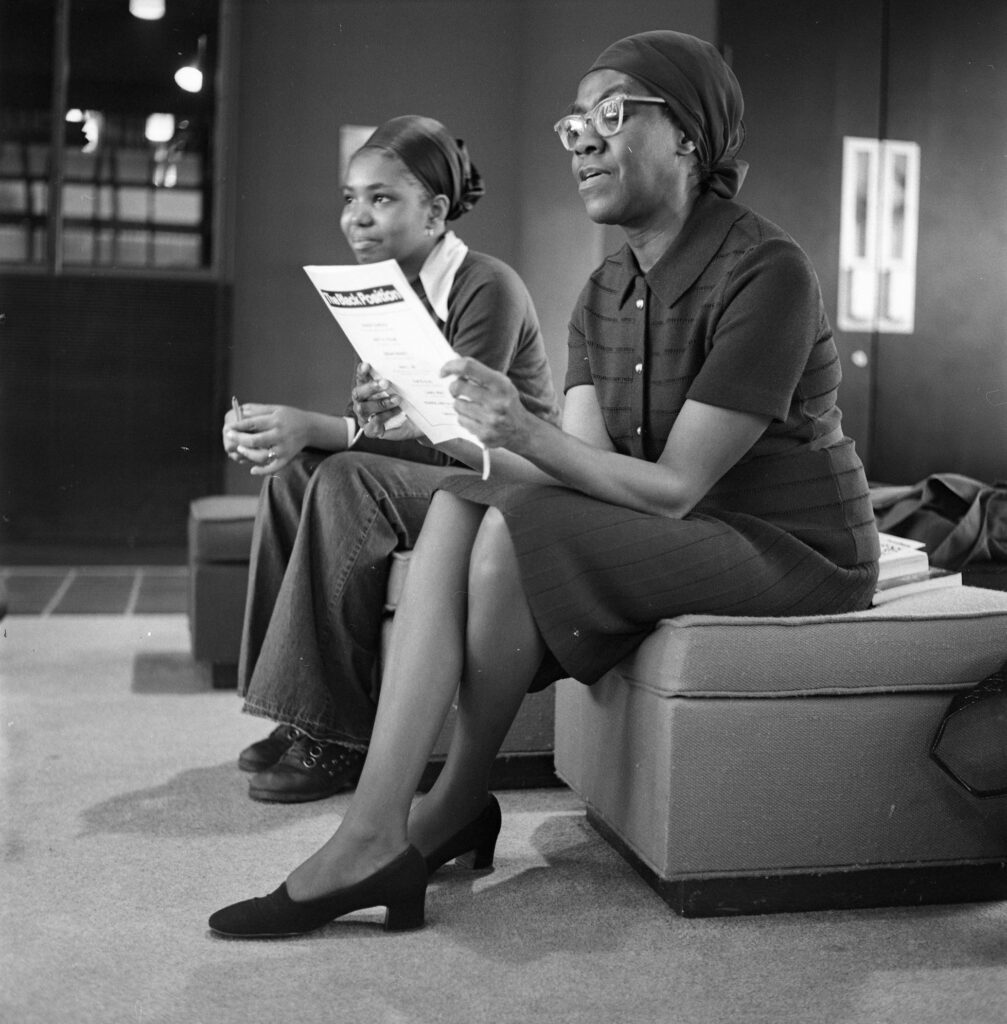
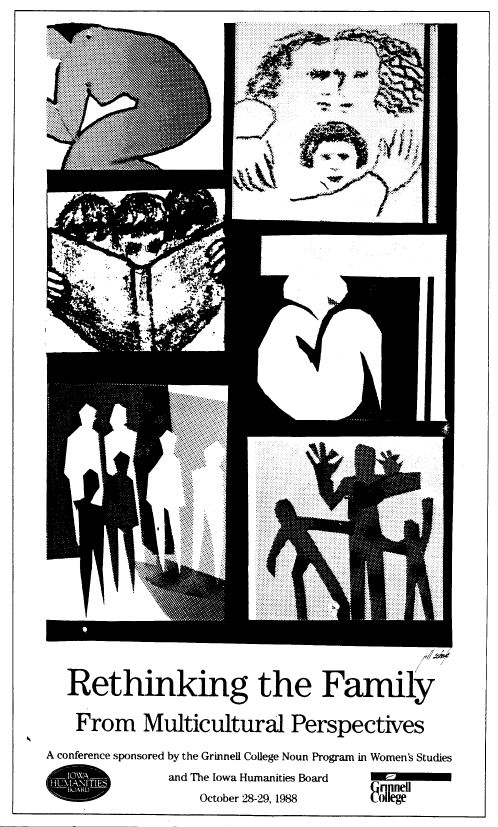
Before GWSS became a major—or even a concentration—Grinnell had the Noun Program in Women studies and the Noun Chair in Women’s Studies (both endowed by Louis Rosenfield Noun in 1986).  One of the first major events the Noun program sponsored was a large symposium in the Fall of 1988, entitled “Rethinking the Family From Multicultural Perspectives” (see the brochure posted here).  The keynote event of that conference was a reading by the Pulitzer Prize-winning poet, Gwendolyn Brooks, who was one of the defining voices of the 20th century (pictured here with three Grinnell Students behind her). This was not Brooks’ first visit to Grinnell, however. In 1972, students invited Brooks to headline the Black Martyrs Weekend event, which involved leading a workshop on poetry in the morning (captured in this picture showing Brooks and a student in the South Lounge), and then reading her own work in the evening.

Gwendolyn Brooks at 1988 symposium

Brooks leading a Poetry workshop in South Lounge, 1972

Rethinking_the_family_Noun_Symposium_1988 (Click here for full symposium brochure)

Powered by WordPress & Theme by Anders Norén