
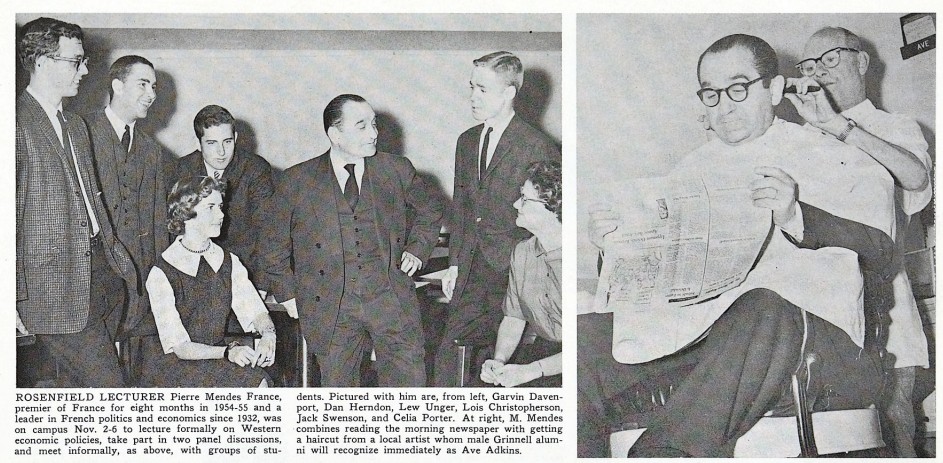
For 5 days in the the Fall of 1960, Pierre Mendès France, the one-time Premier of France and noted expert on international economics, was a resident of Grinnell, spending the week giving a series of lectures, talks, class visits, dinners, getting a haircut, etc., all leading up to his formal Rosenfield Lecture in Herrick Chapel, entitled “Can the West Retool its Economic Model?”
Mendès France had played a prominent role in the Free French government, in exile in London, and represented France at the Breton Woods Conference (where much of the post-war financial and economic order was established), leading to his appointment as Minister of the French economy by de Gaulle. Described by the New York Times as “a towering figure of the French left for more than two decades,” Mendès France eventually broke with de Gaulle and became a leading figure in the opposition. A critic of French imperial entanglements in East Asia and North Africa, Mendès France was elected Premier in 1954, in the wake of the stinging defeat of French forces at Dien Bien Phu, and brokered France’s withdrawal from Vietnam.
Having Mendès France in Grinnell was seen as a notable milestone for the Rosenfield Lectureship–an endowed program established by Rose Frankel Rosenfield in 1934. Rose Rosenfield had played a prominent role in civic affairs in Des Moines, particularly active in the women’s suffrage movement. Two of her children, Louise Frankel Rosenfield Noun and Joe Rosenfield, would both attend Grinnell College and play prominent roles in shaping the institution.
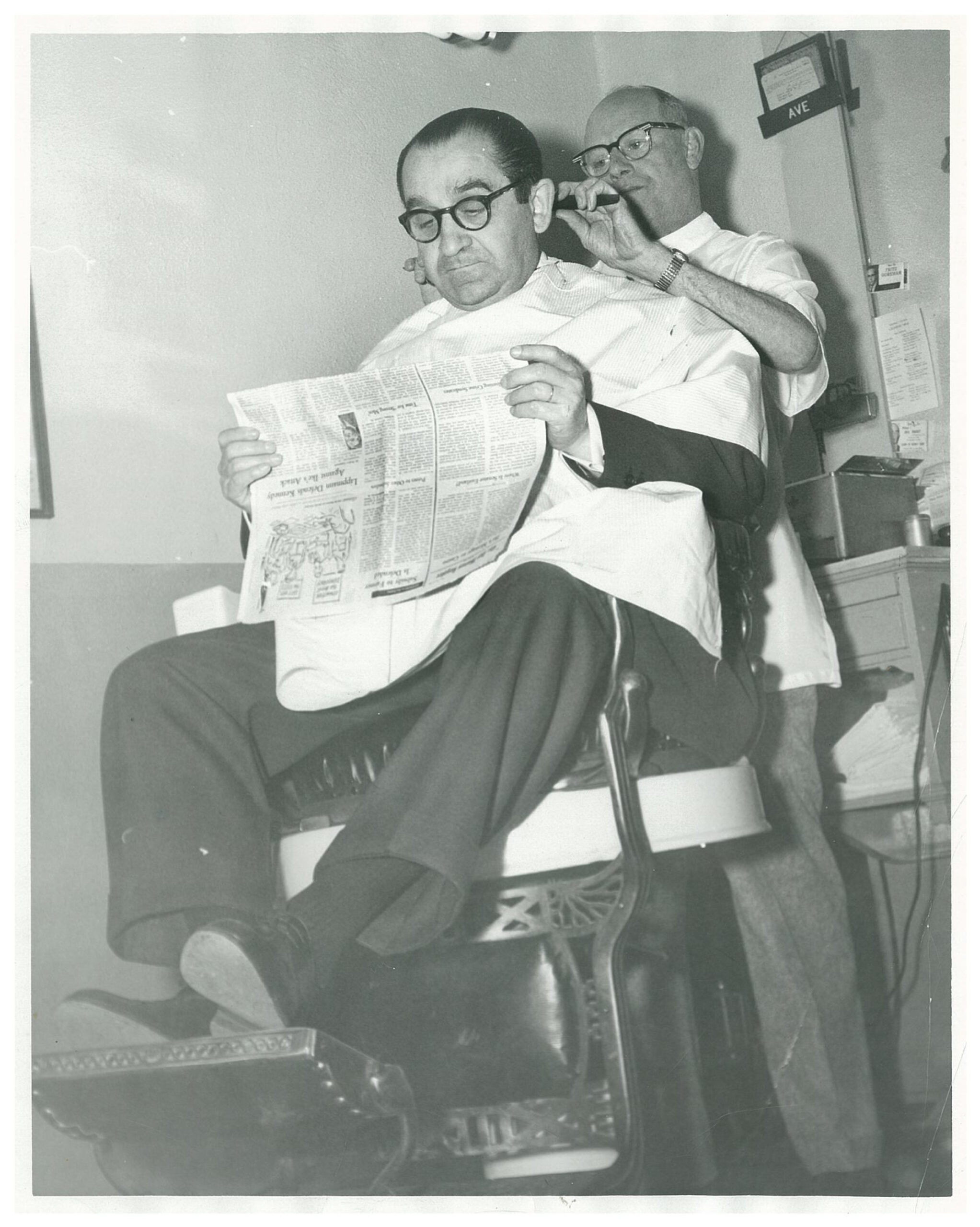
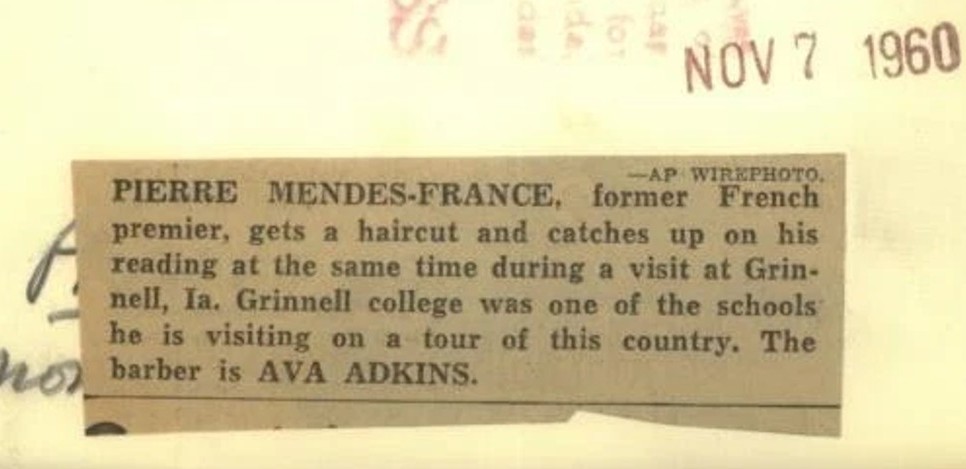
The photo of Mendès France (in the barber’s chair) struck a chord both locally and nationally. On a local level, Grinnellians (and alumni) appreciated seeing a French premier getting his hair cut by Avery (Ave) Adkins, whose barber shop was a local institution. His son recalled that waves of college students and locals who got their hair cut at “Ave’s on Fifth Ave” from the 1930s to the late 1960s, many of whom would keep in touch for years, writing letters to his father, or swinging by to visit when they returned to Grinnell for reunions or family visits. Nationally, the photo was picked up by the AP Wire service, and appeared in newspapers around the country. It provided a kind of Rockwellesque tableau that seemed to strike a chord with audiences.
Leave a Reply