Tag: curriculum

The Liberal Arts at Grinnell: The Birth of the Major (1895-1930s)

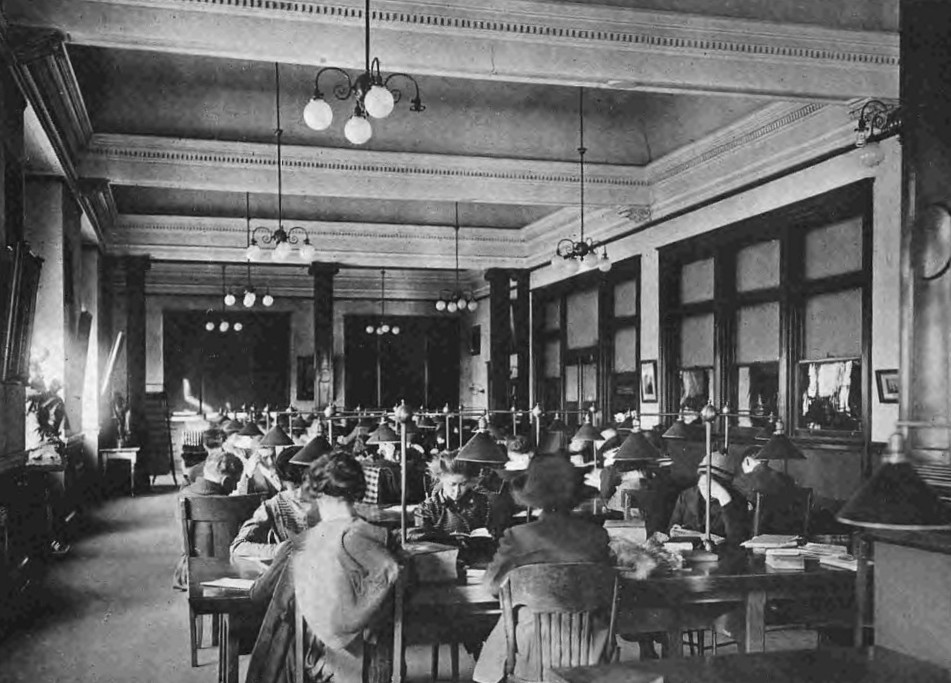
The Reading Room in Carnegie Library (1913)Carnegie Reading Room 1913
In the 1890s, there was heated debate within higher education about the appropriate way to structure the curriculum, with one camp of traditionalists favoring the established path of a carefully defined sequence of courses to be taken at each stage, while new reformers promoted a far more open curriculum that would be almost entirely elective (a trend popularized by many of the new colleges and state universities emerging in the West). Grinnell originally tried to accommodate both philosophies by having a degree track, with a well-defined sequence of courses students had to fulfill each year on their way to a bachelor’s degree, while also having an “Optional Studies” track where students could choose any array of courses they wanted, but would not lead to an actual degree.
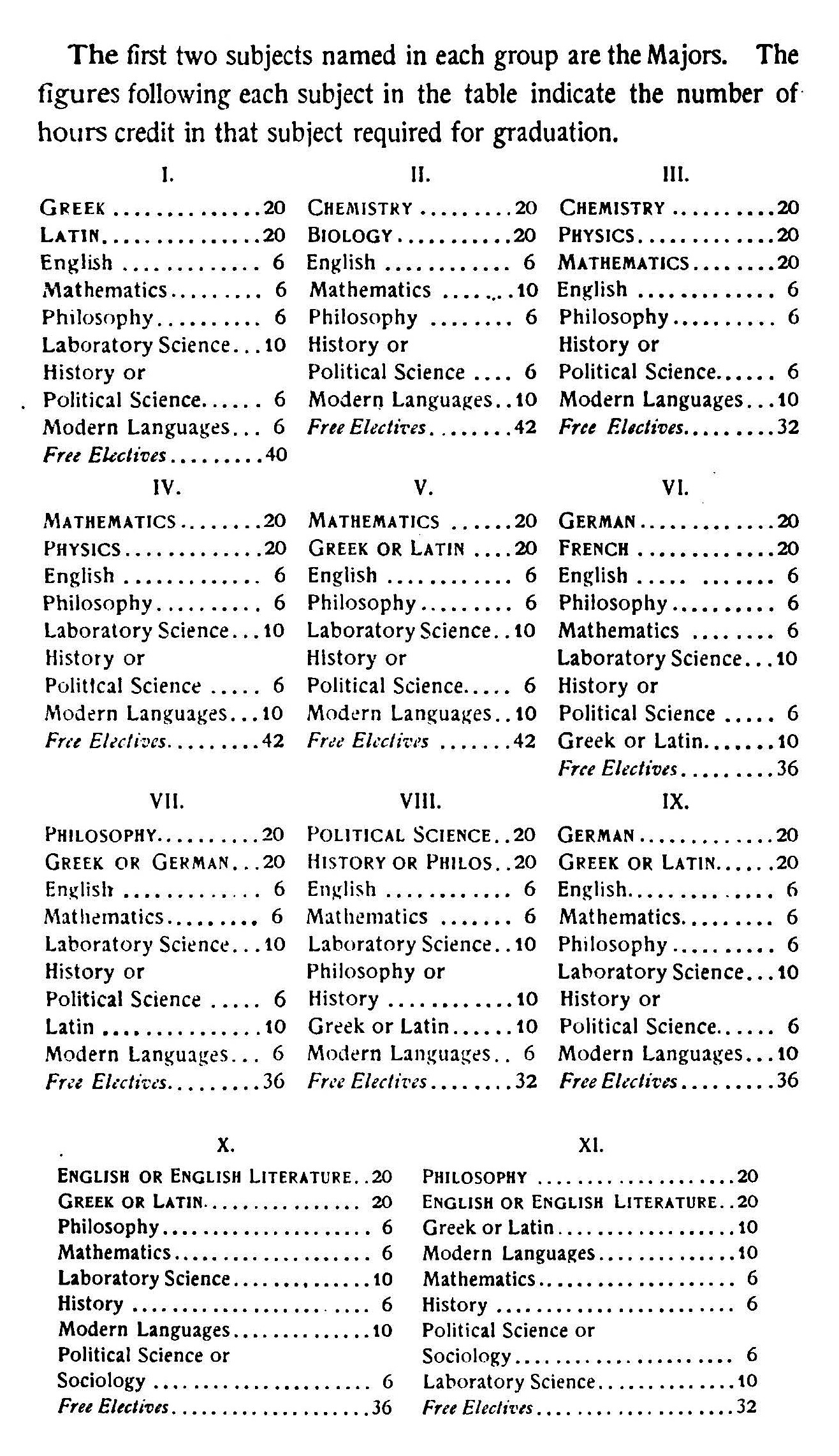
When George Gates became president of the college, in 1887, he began a series of important administrative and curricular reforms that would lead to Grinnell’s adoption of the “Group System” curriculum in 1895. This system, pioneered by the newly created Johns Hopkins’ University, tried to balance the demands of structure and choice, while addressing the mounting problem of how to incorporate new subjects into a fast-changing collegiate environment. For the first time, this system required students to choose a “major”—actually, two complimentary majors—each of which would consist of 20 credits of sequenced course work in those departments. At Grinnell, students could pair these complimentary majors in 9 combinations (increased to 11 in the catalog below), although students could also petition the newly created curriculum committee (yes, we can thank George Gates for creating the first standing committees of the faculty) to approve a new combination. In addition to their two majors (40 credits), students would also choose courses from a variety of required subjects, as specified in the catalog. But note that students could select what course to take in History, for example, or what modern language they would study (as opposed to the older curriculum which spelled out the specific classes a student would take each year).  The end result was a curriculum of roughly thirds (one third of the credits in their major fields, one third in required fields, and one third as open electives).
The college touted the virtues of this compromise, explaining that:

The Group system aims to combine the advantages of the rigid course system with those of the free elective system, while avoiding the dangers of each to maintain a proper balance between educational control on the one side and individual freedom of choice and self-direction on the other…the aim has been to organize each Group that it may afford the opportunity for a well-rounded liberal education, while preventing the waste and dissipation of energy incident to absolutely unlimited election.
To guide students in these choices, the college (for the first time ever) mandated that a faculty member should serve as an individual advisor for students who were majoring in their department.

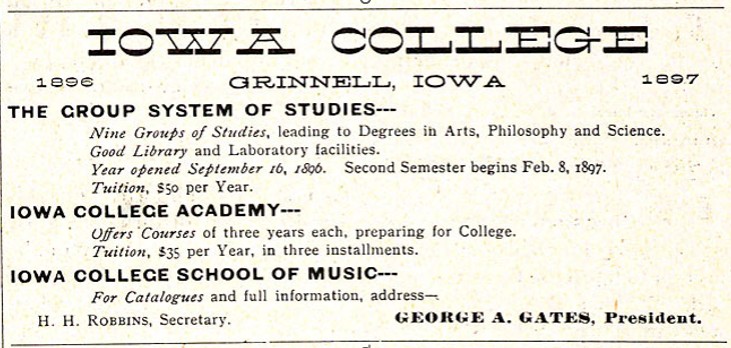
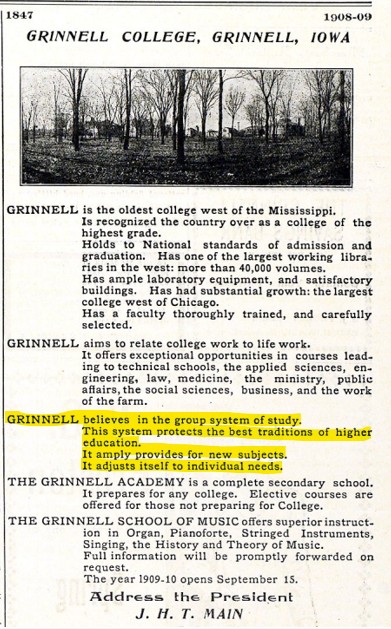
The College’s advertisements from this period (as you can see here), highlighted the group system as a defining feature of Grinnell.  While certain elements would evolve over time—the two majors, for example, became one “major” and one “minor”—the essential framework would remain in place for decades, shaping the institution.


The Liberal Arts Curriculum at Grinnell: c.1870-1895

In light of recent faculty discussions, underscoring the desire for more consistent reflection and conversation about the meaning of a liberal arts education at Grinnell, we’re going to spend some time this spring highlighting how this issue has played out over the college’s history. The early years of Iowa College—both in Davenport and then subsequently in Grinnell—saw very few students attaining a bachelor’s degree, and little structure in terms of the requirement for the B.A. (most of the students were enrolled in the preparatory academy). It was the period after the Civil War, when Grinnell’s first President, George Magoun, took charge that the faculty created an organized curriculum and set of requirements for entering college students, which would hold sway until a series of curricular reforms in the 1890s.

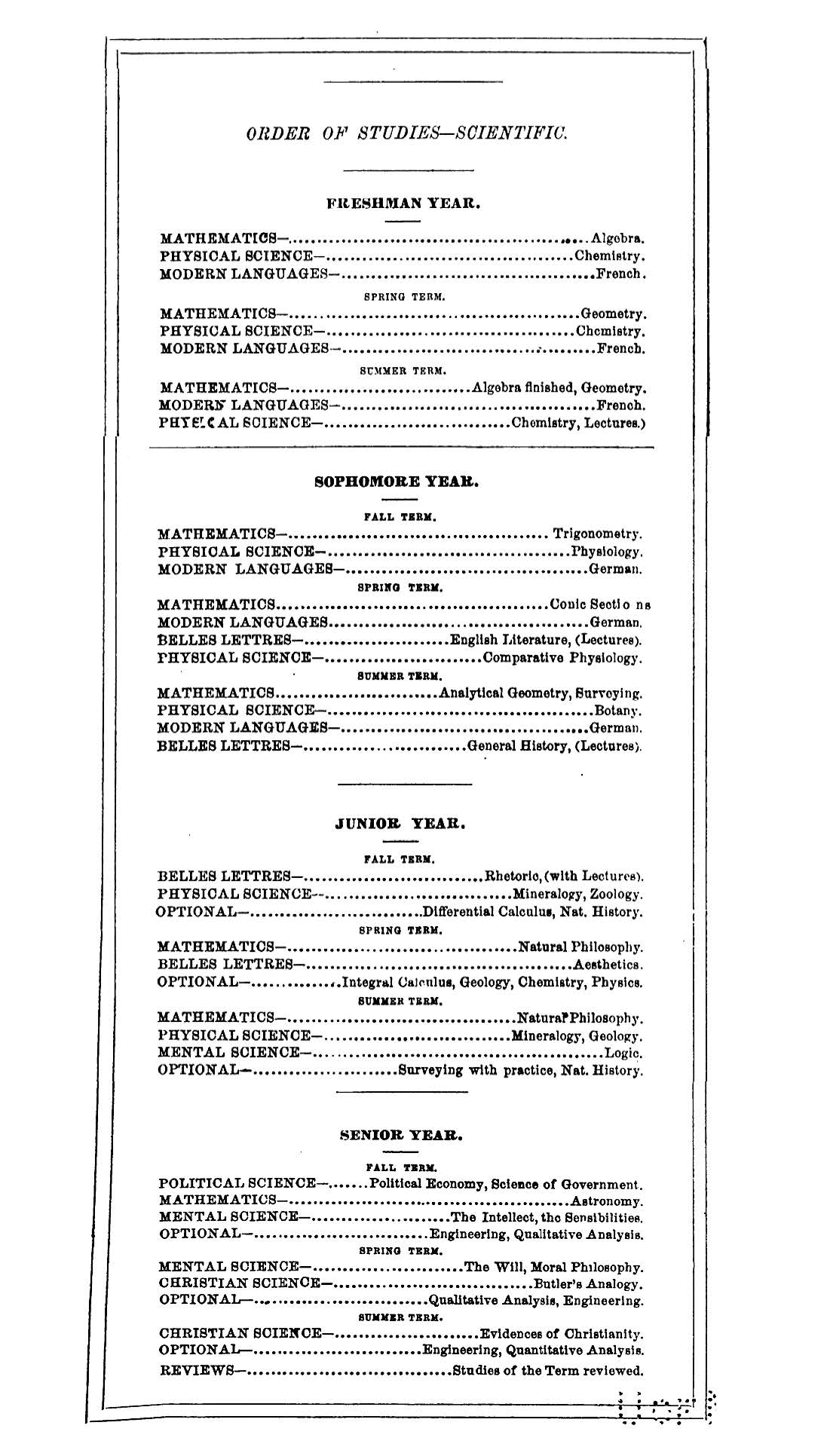
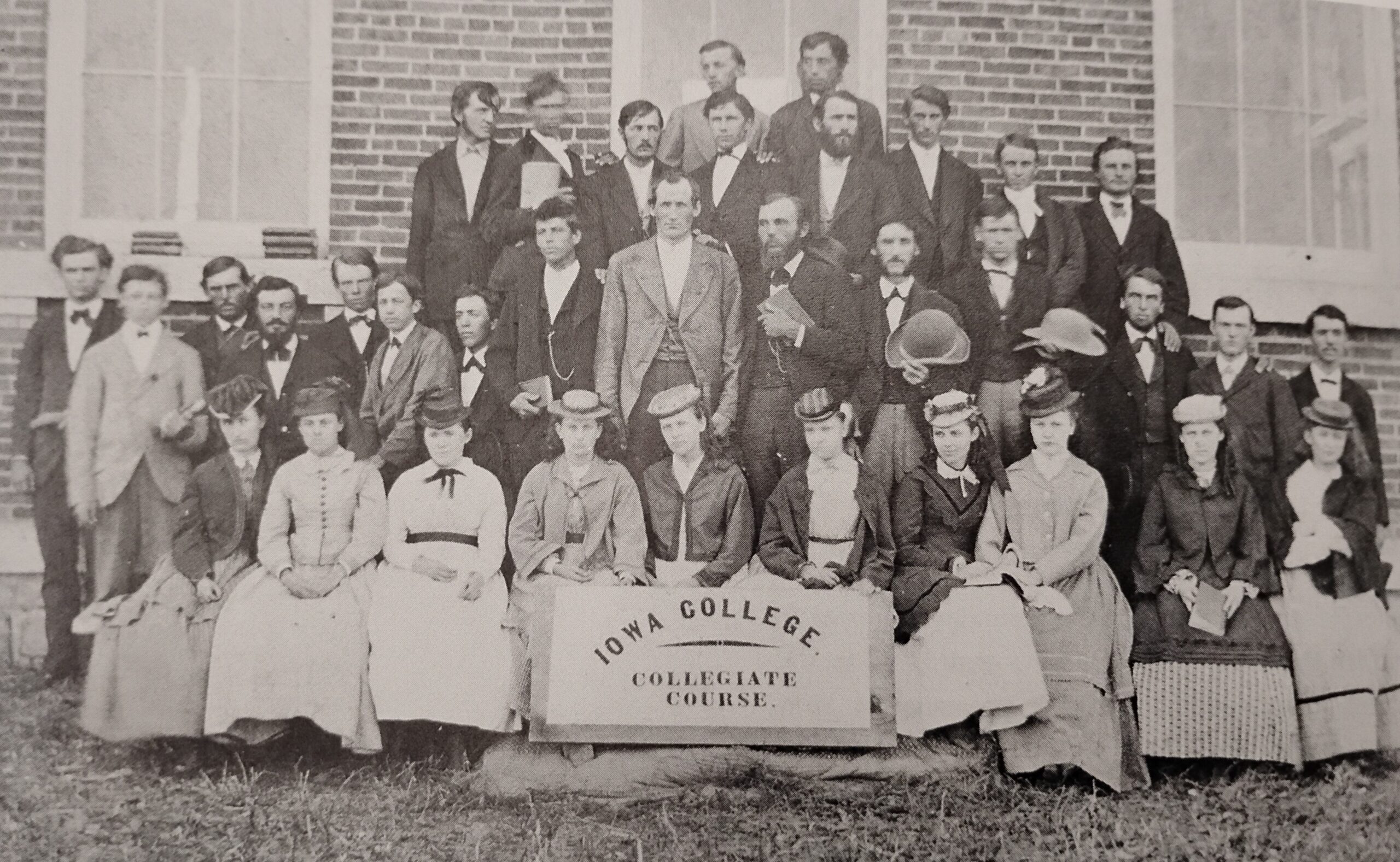
How did Grinnell approach a liberal arts education in 1870 (when the students pictured here, entered the college)?  There were four main “courses,” or tracks, that students could pursue:

1.) a classical course, leading to the Bachelor’s of Arts (A.B.) degree

2.) a scientific course, leading to the Bachelor’s of Science (B.S.) degree

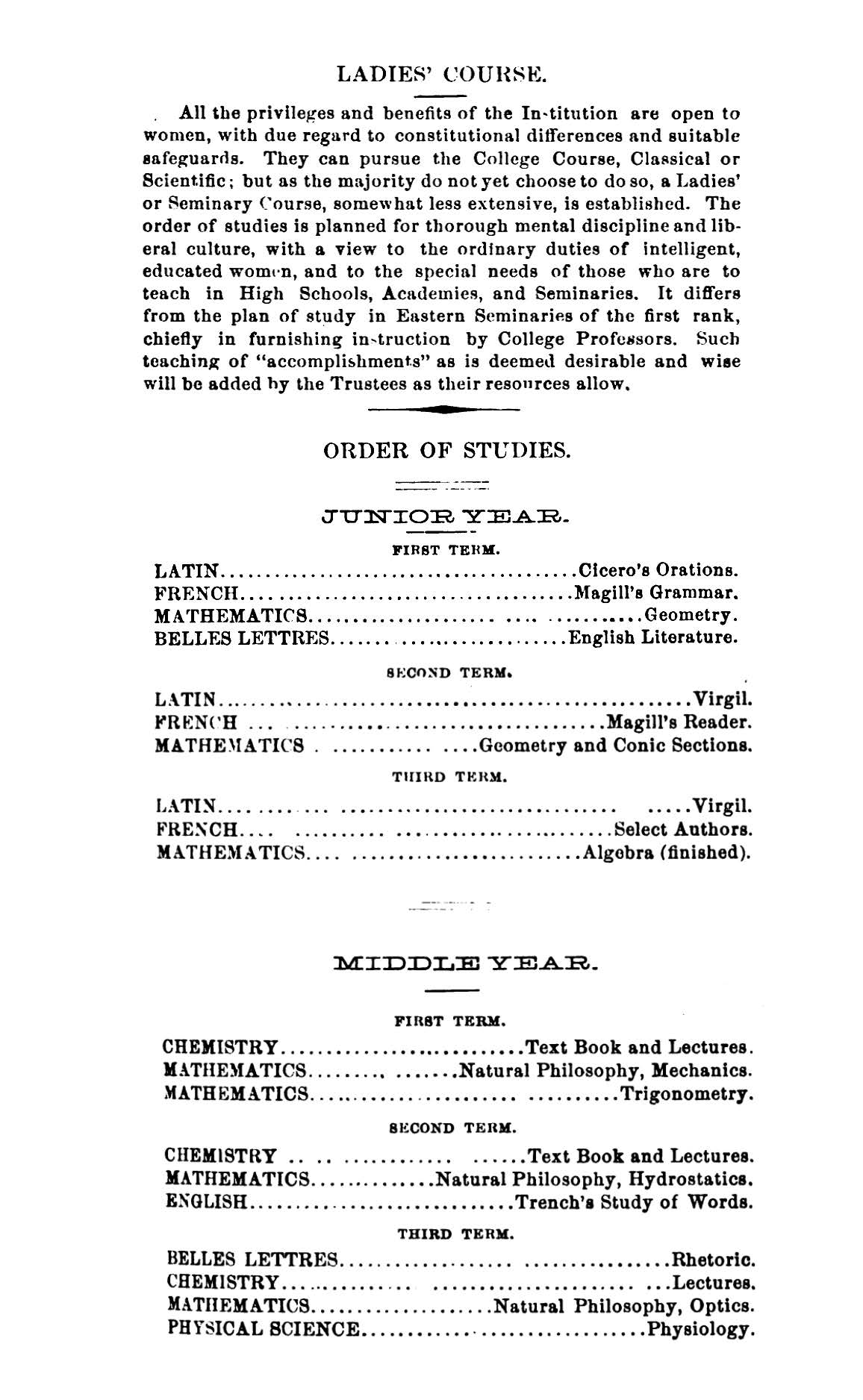
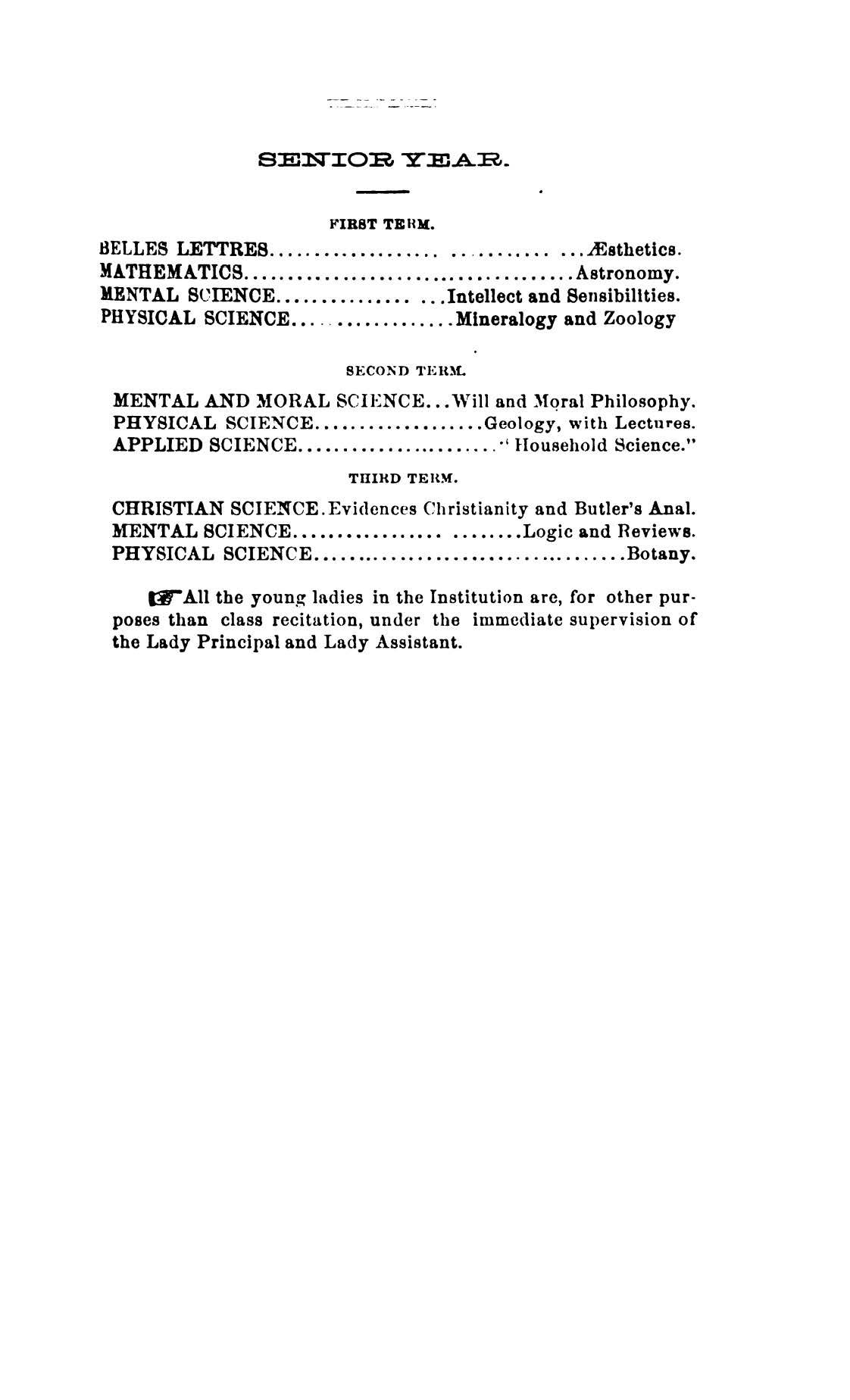
3.) a “Ladies Course,” (explained in the catalog page below) that evolved a decade later into the “Literary” course, and increased from 3 to 4 years. This course, however, led to a diploma rather than a bachelor’s degree.

4.) an “Optional Studies” course, which allowed students to freely choose the classes they wanted to take, but did not lead to a formal diploma or degree.

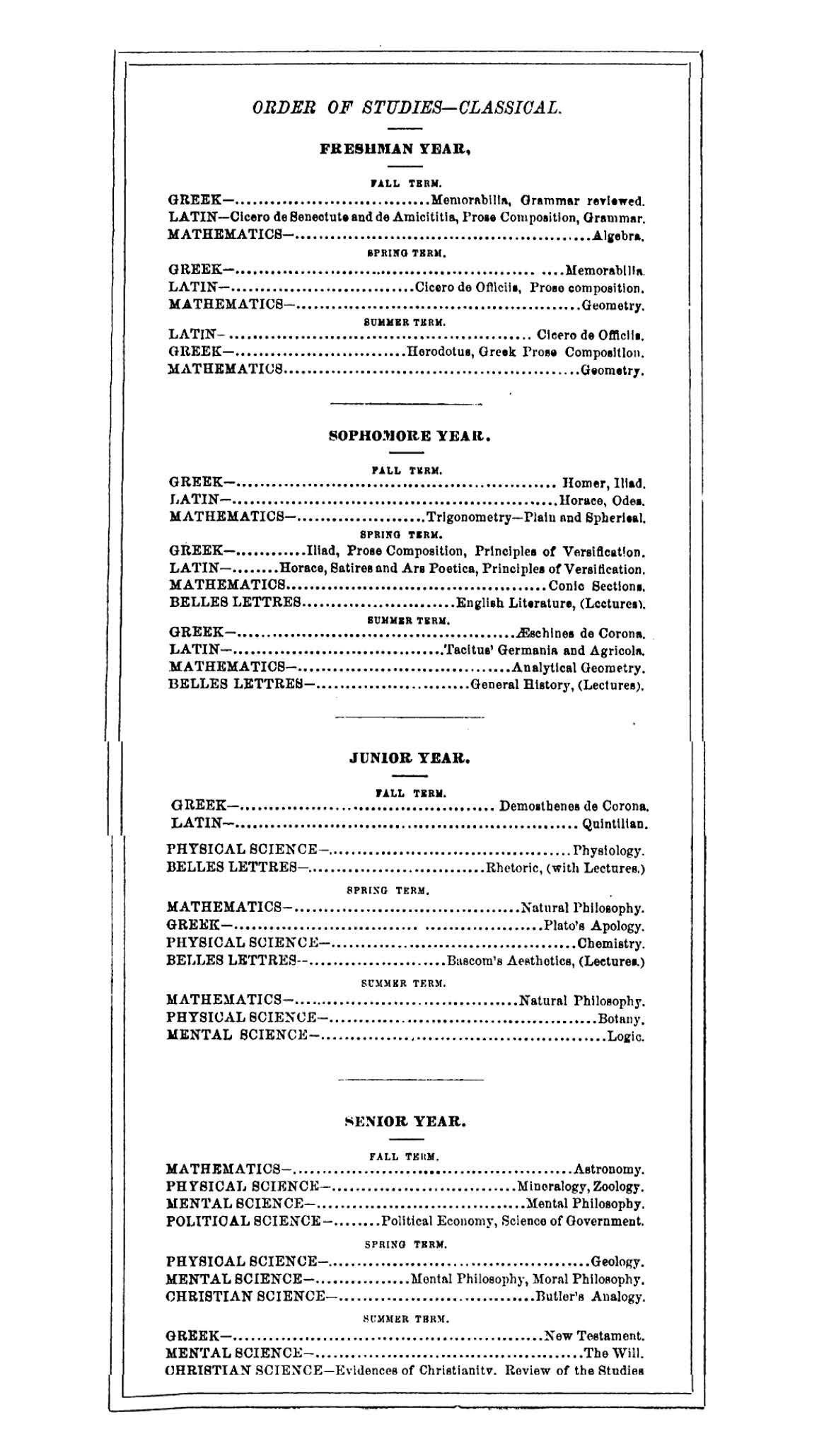
As you will see (below), each of these tracks were pretty rigid in terms of specifying the array and sequence of courses students would take each year.

Printed, here, are the course requirements and sequencing for those three main tracks, established in 1870.  All students were also required to attend religious service each morning (and twice on Sundays) while Men were required to participate in “military drill.”

In 1875, a Conservatory, or School of Music, was also created as a separate institution (although it was under the supervision of the same board of trustees as the college). It initially awarded diplomas, but by 1890, it also offered a Bachelor’s of Music degree to those who completed the full course of study involving musical theory, musical history, musical education, and demonstrated proficiency in one major, and one minor, instrument. It’s also worth noted that, at this time period, Grinnell College continued to run its preparatory Academy as well as a sizable “English or Normal School” that focused on training future school teachers. At times, the Academy and Normal school enrollment was much larger than the number of students in these collegiate tracks.

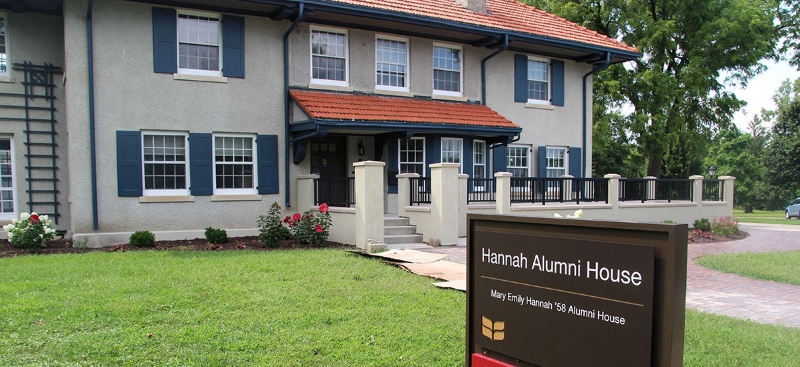
A Forgotten Chapter in the History of the New Hannah Alumni House

Last week, the college celebrated the opening of its new Hannah Alumni House, at 1527 Broad Street, made possible by a generous donation from Mary Emily Hannah ’58.  The project involved extensive renovations to a historic home long known as the “Fellows House”—built more than a century ago by Jesse and Maude Fellows , both graduates of the college class of 1901, and prominent leaders in the community.

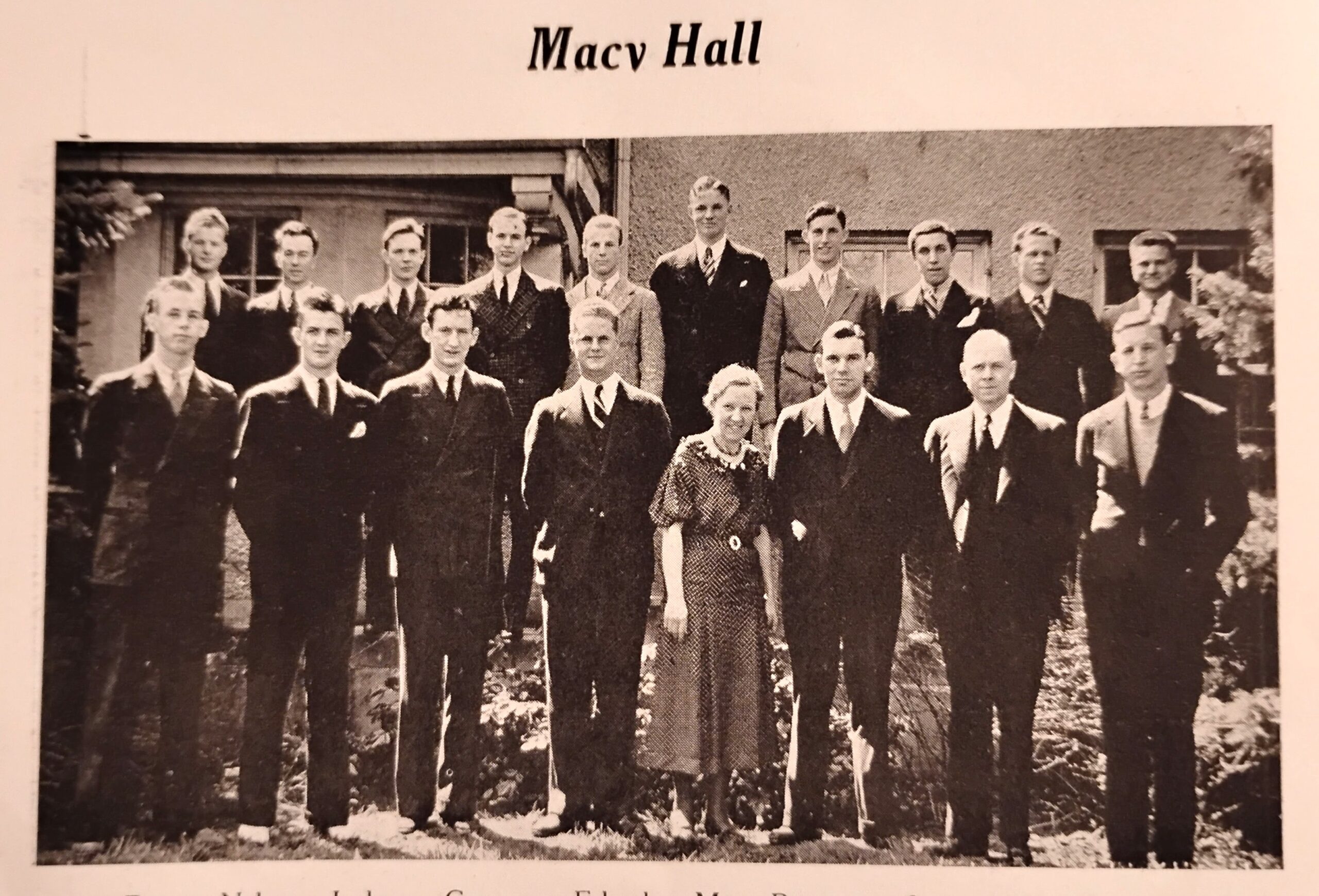
In the 1930s, the Fellows sold their Broad Street home to the college, which decided to turn the building into a special residential hall focused on issues of civic and community engagement.  Named “Macy Hall”— in honor of Jesse Macy, the longtime professor of political science at the college—this “experiment in group living for students interested in public affairs” was actually intended to be the first step in the creation of a larger program. Reflecting the spirit of the 1930s, when so many Grinnell alumni were prominently involved in the New Deal, and in public service, President Nollen hoped to create a new “school of public affairs” that would garner the college national attention as it prepared to celebrate its centenary.

In 1935, the college hired a new professor of Sociology, W. Ryland Boorman, who became the residential director of Macy Hall (which housed 17-20 male students), and took charge of plans to develop the proposed school of public affairs.  Initial programming revolved around a community series each Thursday evening, in which an invited speaker had dinner (in the Macy Hall dining room) with invited students and faculty ,followed by a talk, and more informal conversation.  The line up of speakers focused on a broad range of topics related to civic life, municipal administration, and social reform—one semester, for example, featured speakers from the Red Cross, the Social Service League, the WPA, the office of school superintendent, City Hall, the Women’s International League for Peace and Freedom, and an agricultural organization. In addition to the talks and events, students could also use Macy Hall’s special “statesmanship library” that contained key works addressing civic reform.

Despite a lot of activity in the 1930s, the school of public affairs never came to fruition, and Macy Hall was sold to private owners during World War II.  But its recent return to the college fold means that it will be embarking on yet another chapter in its interesting history.


Registration in the Days of Yore

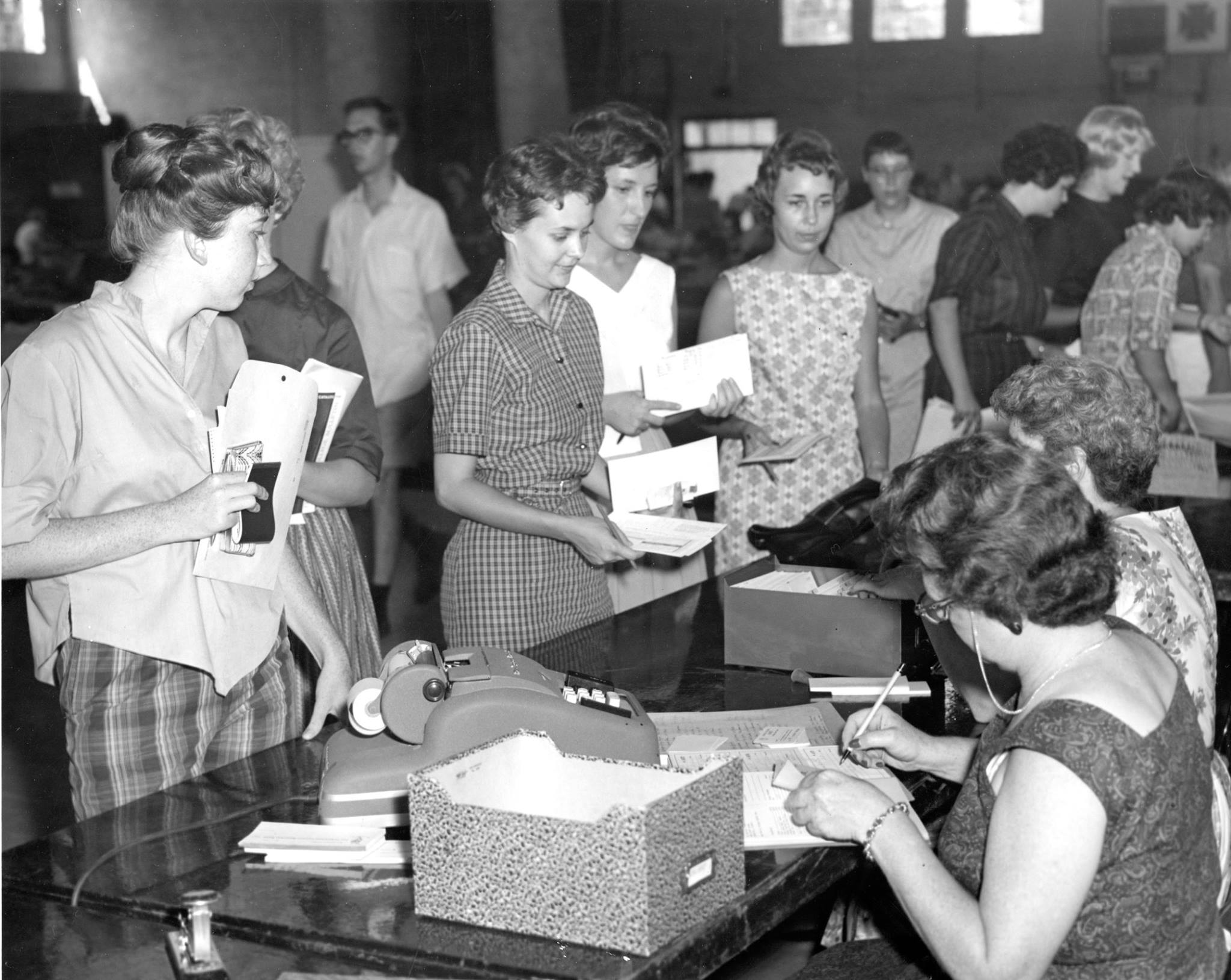
As students go through the rituals of pre-registration on campus, this week, it’s fun to look at an image of registration from the Fall of 1961, in Darby Gym, when everything was done by hand, face-to-face.

What curricular requirements would have been on the minds of students in 1961 as they selected their courses?

The College had just made some important changes to these requirements the year before:

  • It eliminated 3 requirements (e.g. 1 course in English & Speech, 1 course in Modern European History, and a numerical distribution requirement).
  • It added four new required courses:  Humanities I (first semester) and Humanities II (second semester), Historical Studies I (second semester) and Historical Studies II (third semester).
  • It kept in place required coursework in science, foreign language, fine arts, religion or philosophy, and physical education.
  • It also retained the requirement of passing a swim test (or, alternatively, completing a course in swimming).
  • Lastly, the college created a new “junior liberal arts exam” that 3rd year students would have to successfully pass to graduate (beginning with the class of ’63, who were no doubt excited to be pioneers in this regard).

Grinnell-in-Star Wars

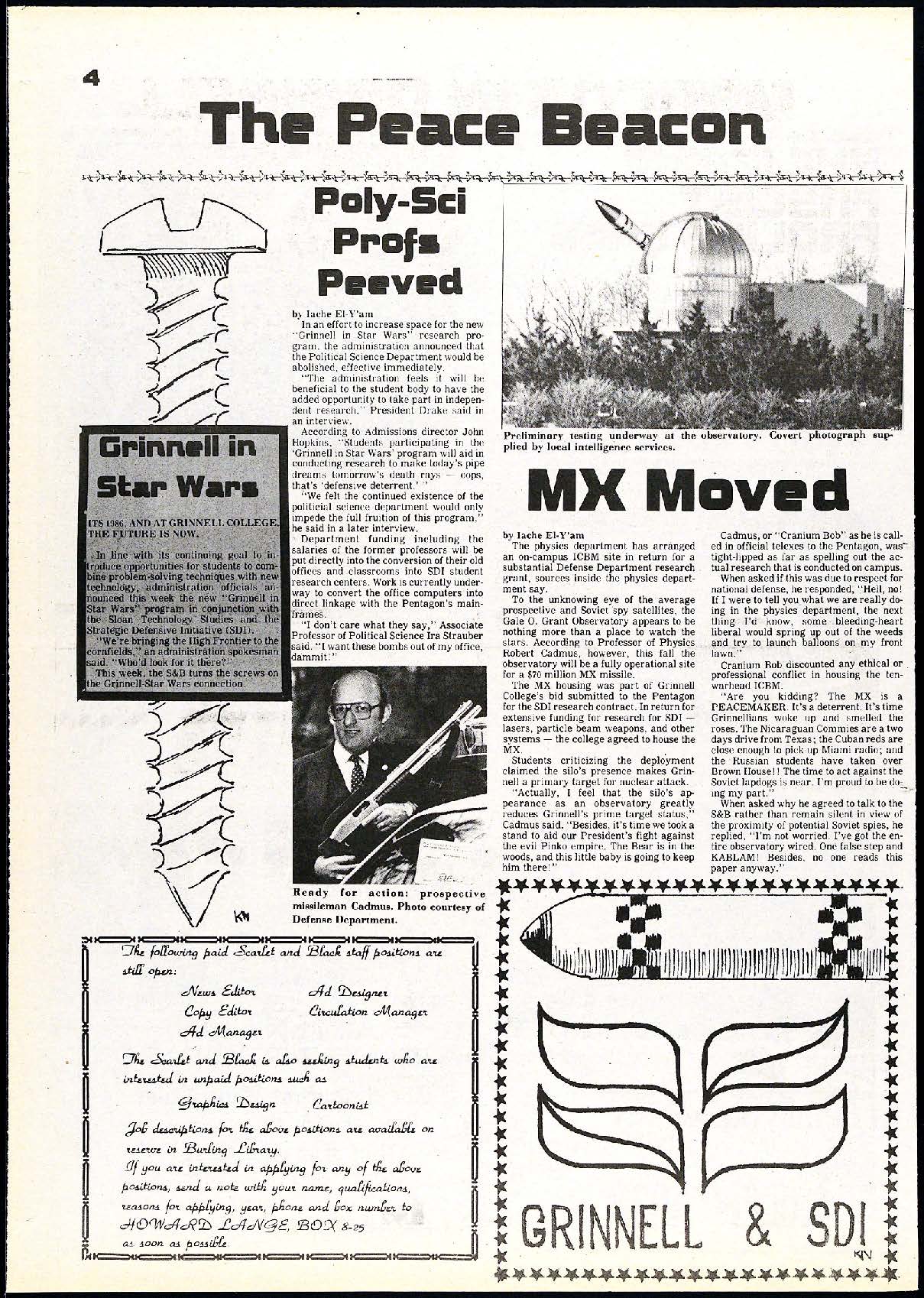
In the spring of 1986, a Grinnell alumnus gave a talk in support of Regan’s controversial Strategic Defense Initiative (SDI), commonly known as “Star Wars.” After dutifully reporting the contents of the talk, the S&B ended the paper with a satirical page describing how the college was launching its own “star wars” initiative.  The context for this spoof (that may be lost on those of us  who were not on campus in 1986), was the awarding of the large Sloan Foundation grant (relating to technology), the creation of the new Technology Studies program, and in turn, its creation of a new study program in Washington, D.C., which would become known as Grinnell-in-Washington (a program that ran until the 2010s). Fear not: the political science department was not abolished, the observatory was not turned into a missel silo, and Bob Cadmus never wielded a shotgun on campus.

Link to full-sized pdf:    Grinnell in Star Wars

Elections Past & Grinnell’s Program in Practical Political Education (PPPE)

Elections Past & Grinnell’s Program in Practical Political Education (PPPE)

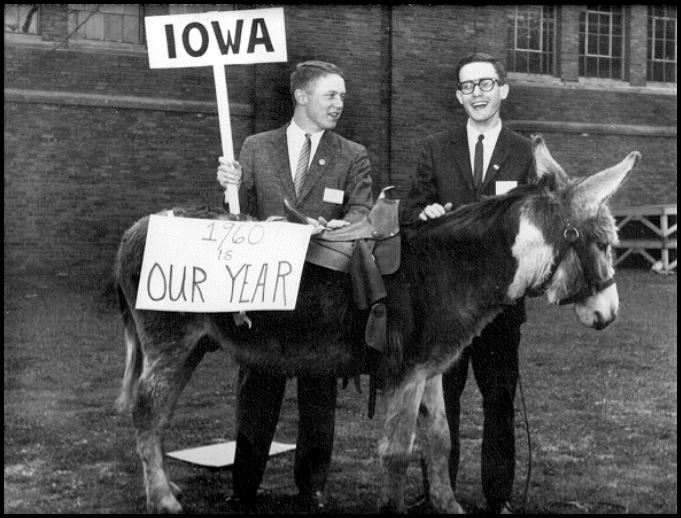
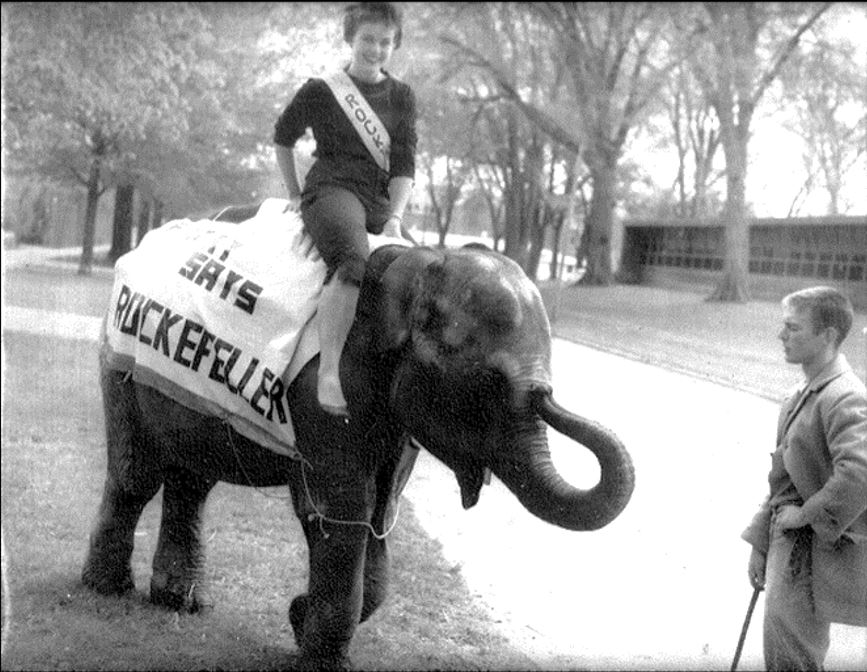
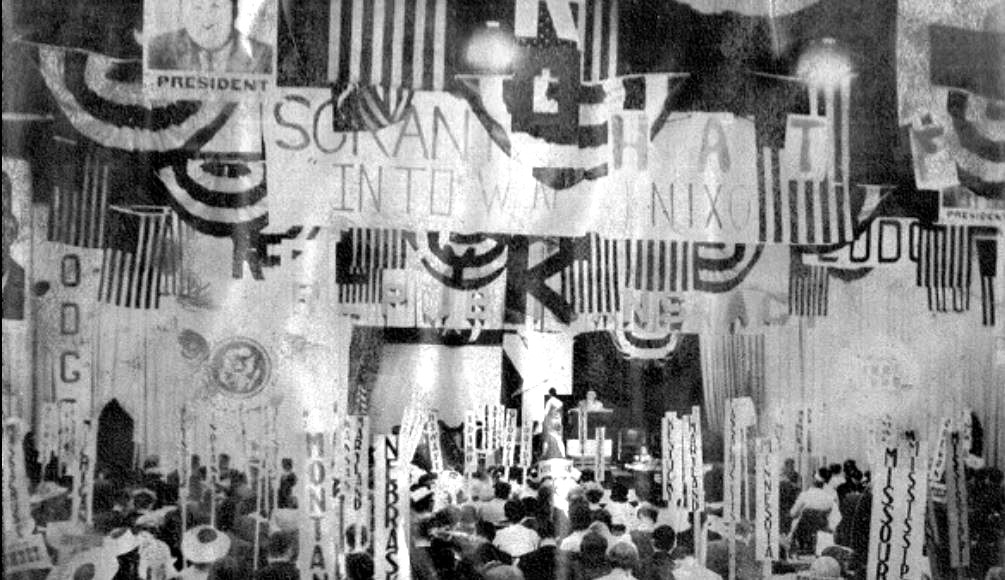
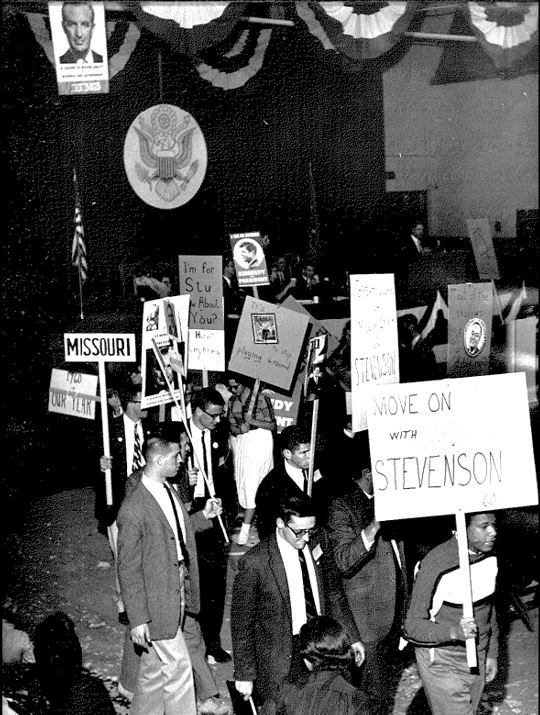
These images, from 1960, show students participating in full-blown, mock conventions for the Democratic party and the Republican party, as part of Grinnell College’s “Program in Practical Political Education” (PPPE) that ran from 1959 to 1970. Under the leadership of Prof. C. Edwin Gilmour, and funded largely by outside grants, the PPPE aimed to encourage students to become involved in day-to-day politics, even partisan politics, through a mixture of training, summer internships, funded fieldwork, political science “labs” that involved campaigns, election, or administrative experience, and a steady stream of state, local, and national politicians who came to Grinnell to give talks, teach short courses, or to work with students for a more extended period of time as “politicians-in-residence.” On election nights, the PPPE “caucus room” became the place on campus to watch coverage of the incoming election results.

The “Encampment” Tradition at Grinnell College

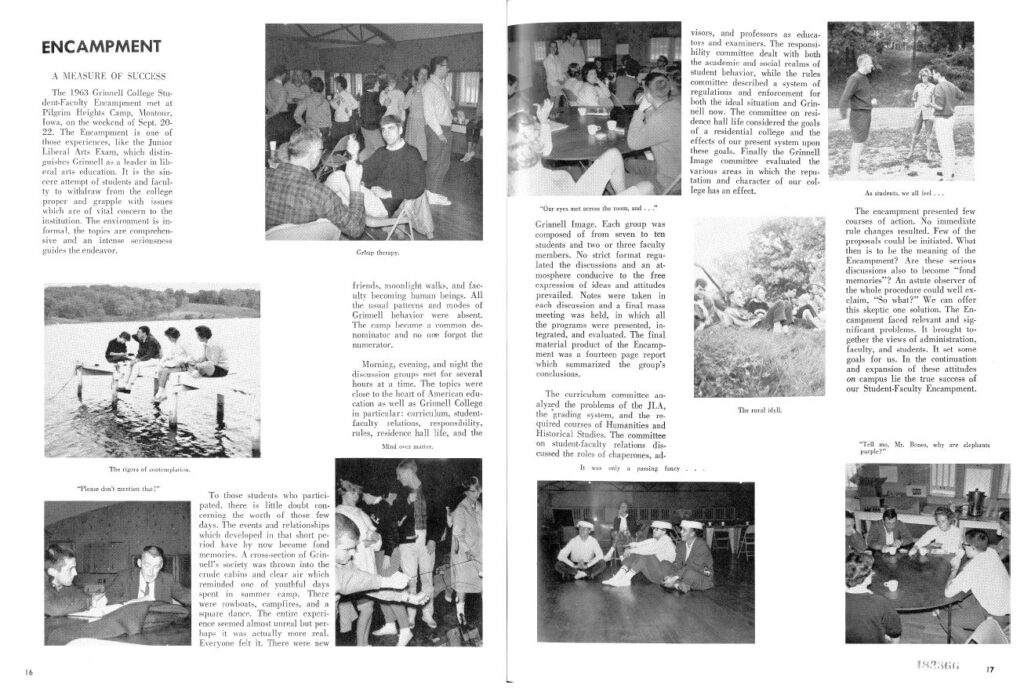
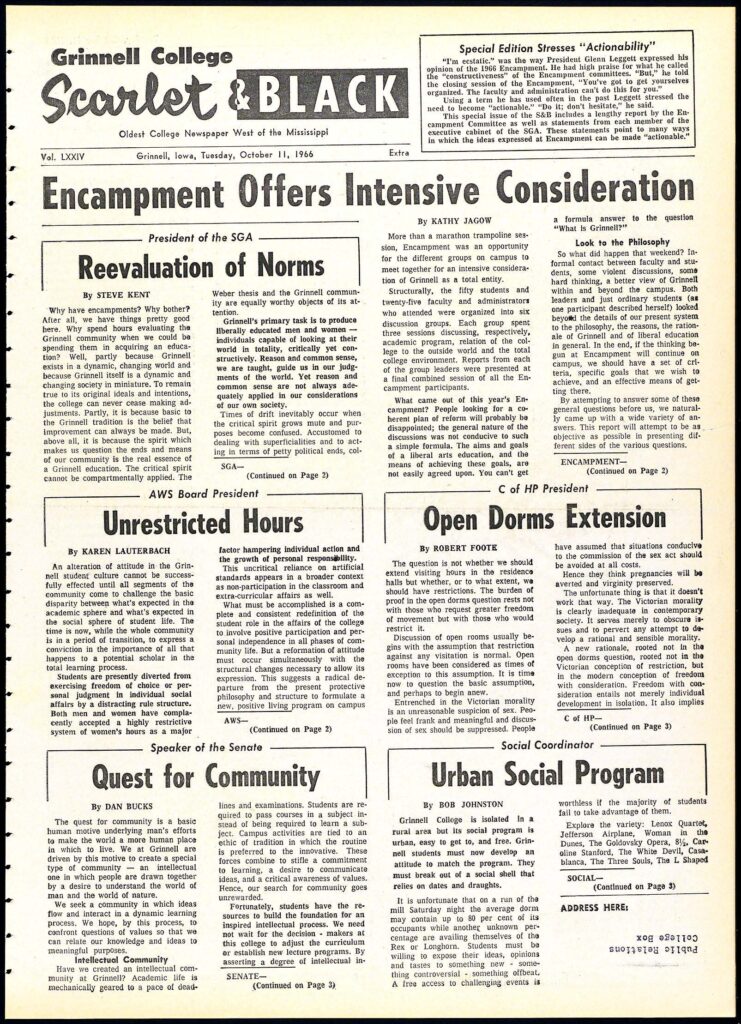
In 1960, the Student Government Association and President Howard Bowen agreed to hold a multi-day retreat, off-campus, that would bring together a select group of students, faculty, and administrators to discuss the “Purposes and Values of a Liberal Arts Education” at Grinnell. This retreat, or “Encampment,” as they called it, became a recurring tradition, in which about 100 members of the campus community would gather at some retreat site in October, each year, to spend a few days informally discussing broader issues of campus culture and curriculum as well as tackling concrete issues, needs, or policies (on a more practical level). The tradition of encampments was seen as one of the more distinctive aspects of campus life and shared governance at Grinnell.

Images: Cyclone Yearbook 1964  and Scarlett & Black special edition, 10/11/66.

encampment in 1964 cyclone yearbook (click here for full sized pdf)

S&B 1966 coverage of encampments at Grinnell (click here for full sized pdf)

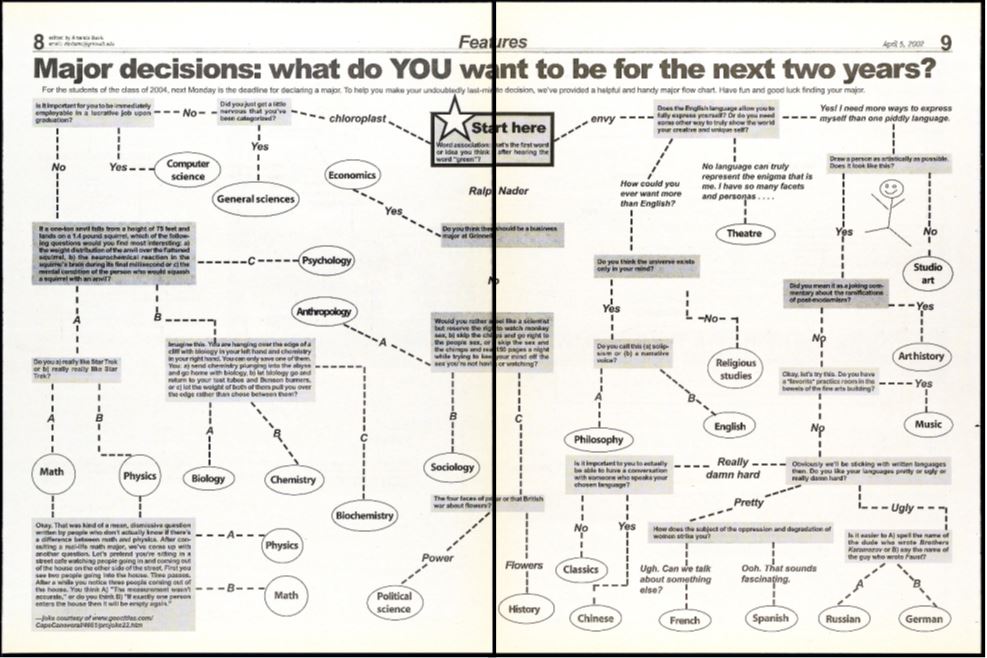
Special October Edition: How to Choose a Major at Grinnell College

how to choose a major (click here for full size pdf)

How to Choose a Major at Grinnell College

Since October is the month when all departments (and many concentrations) host welcome sessions to provide more information for first- and second-year students thinking about their academic futures, I thought it would be appropriate to share the wisdom and insights of the Scarlett & Black editors (from 20 years ago), who created this diagram to guide the process of discernment.  You path to enlightenment begins here…


First Earth Day: April 22, 1970

First Earth Day: April 22, 1970

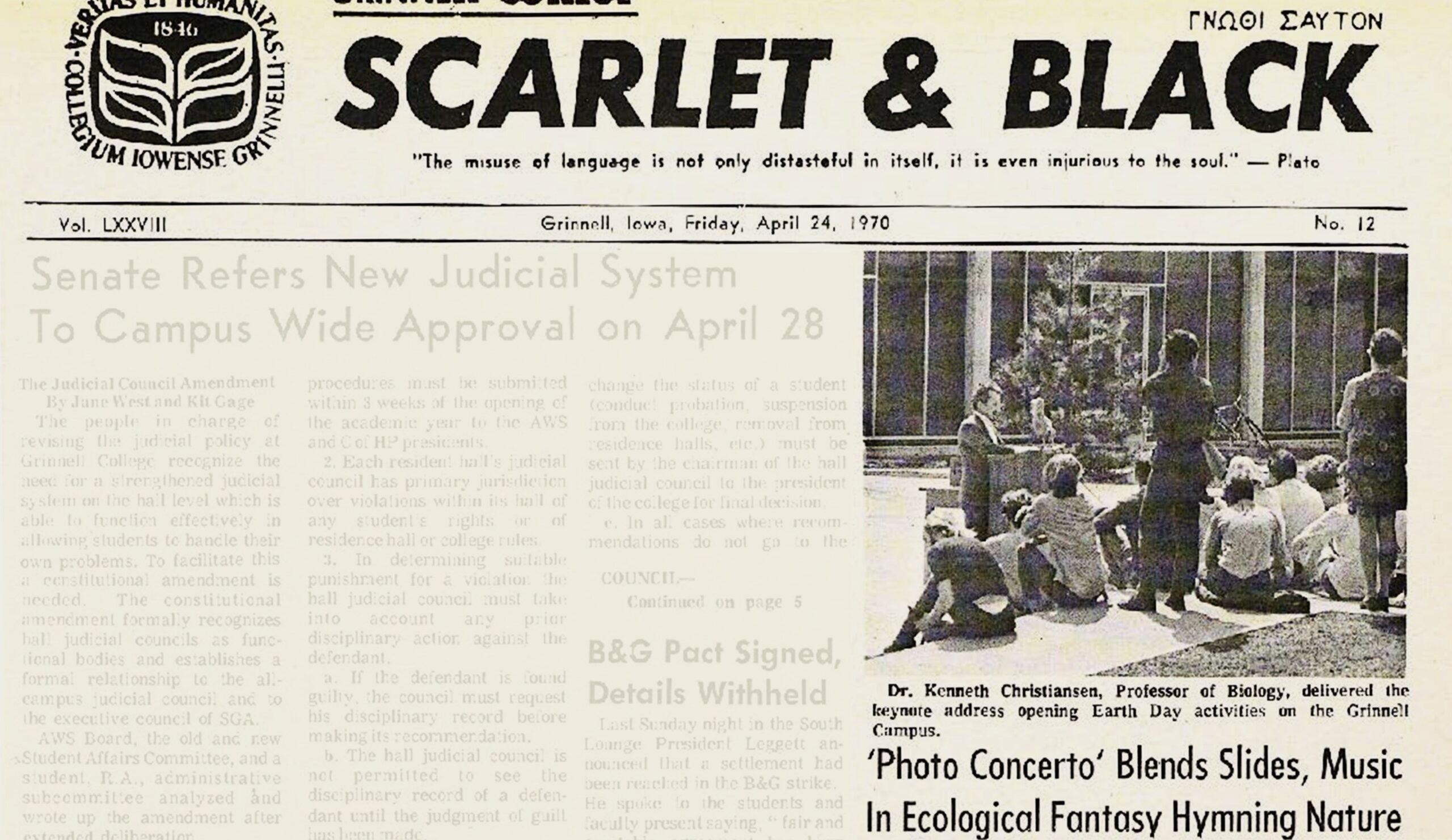
Grinnell College marked the first Earth Day, which began in 1970, with a series of teach-ins, programs, and events, culminating in a campus wide “macro-biotic” dinner, in which students grew, harvested, and cooked all their own organic food. Students and Faculty also created the LEAP program (Local Effluents and Abatement Procedures), which lasted for 3 years, and involved more than 500 students, who enrolled in special classes and collective research projects that studied pollution, energy use, food policy, and recycling on campus and in the local community.

Images:
• S&B cover page, April 24, 1970, showing Prof. Ken Christensen, giving the first of a series of talks and teach-ins that culminated in an address by Paul Erhlich (whose recent book, The Population Bomb [1968] was hugely influential in environmentalist circles).
• Picture of the salad table from the “macro-biotic” dinner to celebrate earth day (Apr. 1970)
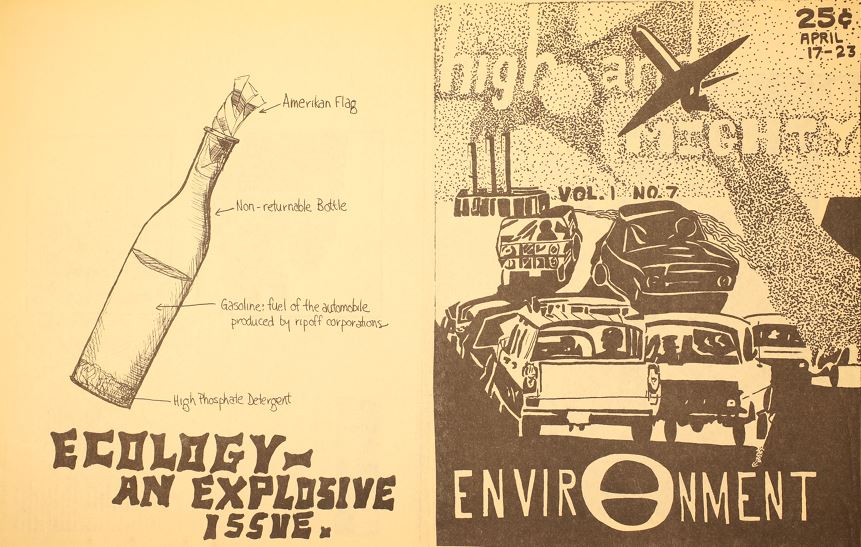
• Earth-day issue of the Grinnell student zine, High and Mighty, April 1970.

Powered by WordPress & Theme by Anders Norén