Tag: 1890s

Alumni Reunion Trivia Question: What were the original colors of Grinnell College?

Grinnell sports teams decided to ditch their original school colors in 1891, in favor of Scarlett and Black, which was seen as more sporting/manly.

Question: What were the original school colors?

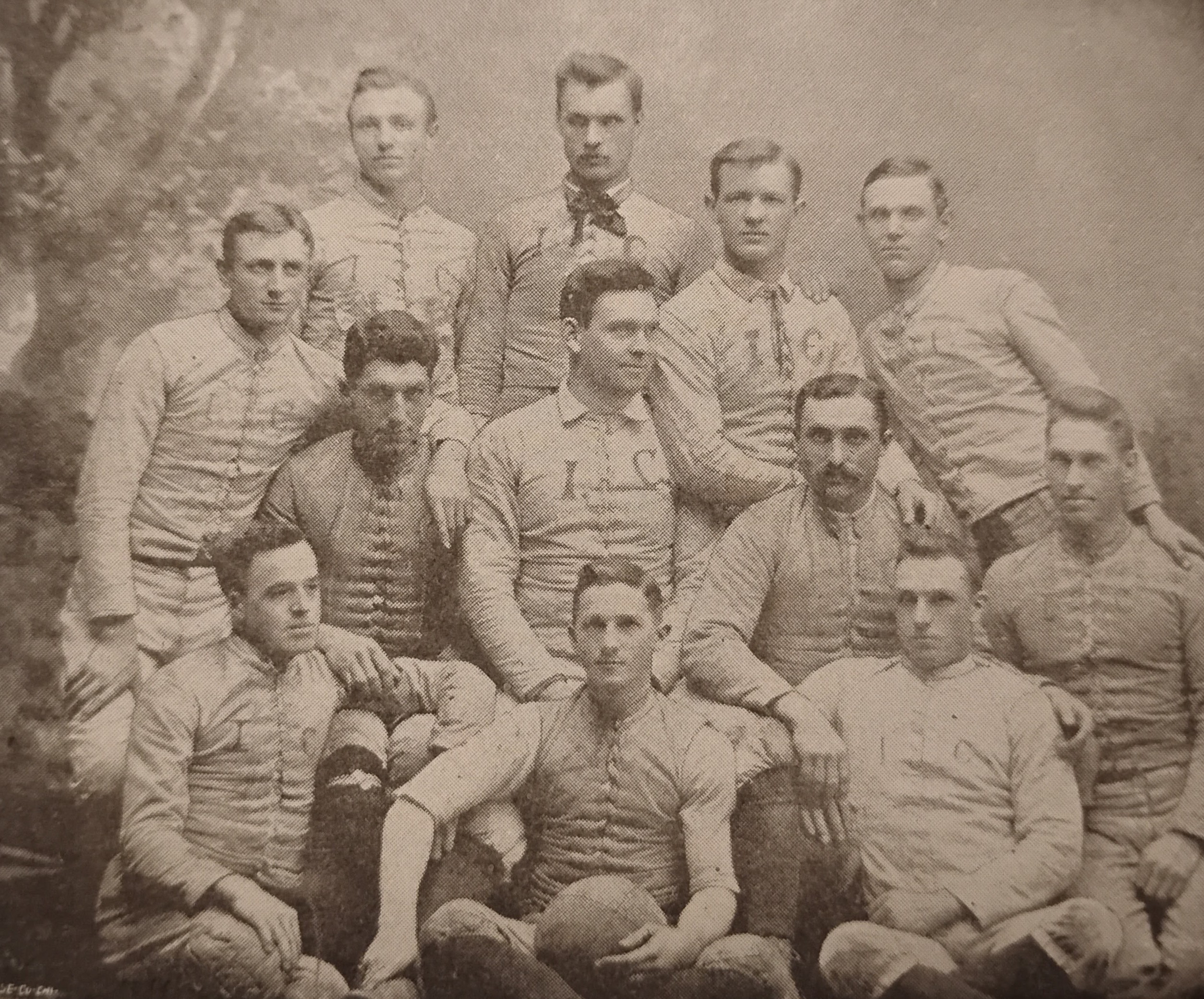
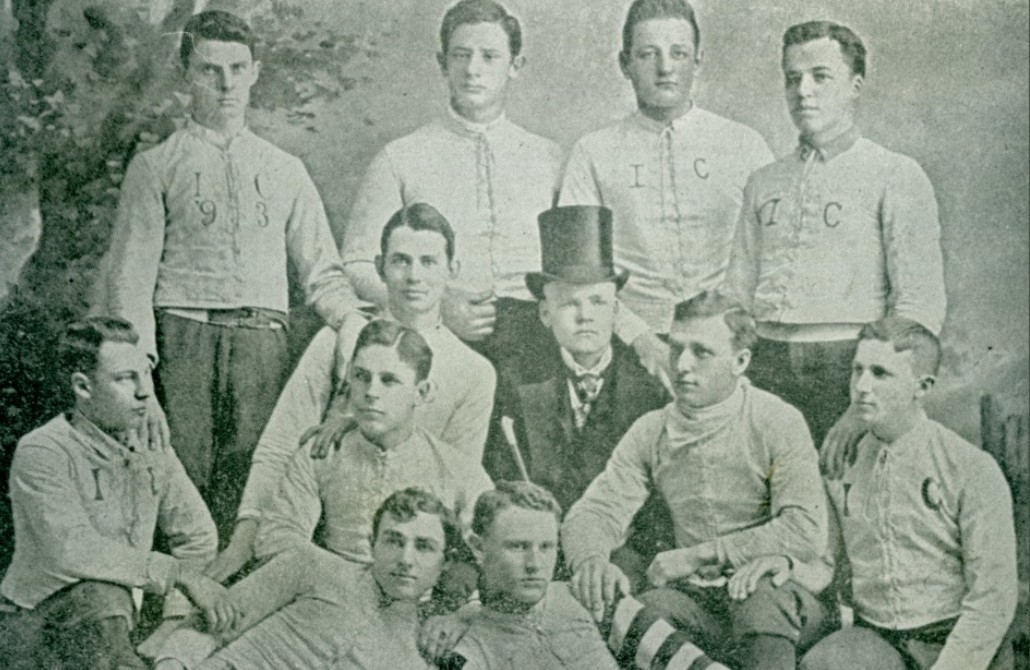
Answer: Pink and Green, as modeled by the football team (the 1889 squad is pictured on top, jaunty headware and all, while the 1890 squad is pictured below them).

Pink was actually quite popular as a school color in the 19th century. In fact, Syracuse University also sported Green and Pink as their school colors, until they abandoned them in favor of blue and orange in the 1890s, as well. Today, there are few schools with these colors, although North High School in Des Moines, still proudly wears pink and green each year. Go Polar Bears!

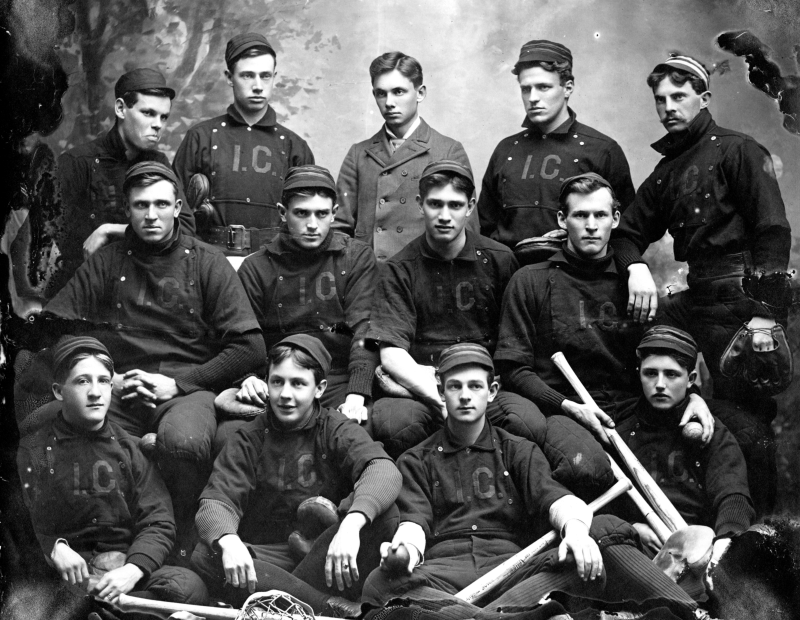
The Men’s Baseball team was actually the first to abandon the school colors, choosing scarlet and black uniforms for their 1891 season. Here they are pictured a couple of years later in those outfits.


Weather Alert: Grinnell’s First System of Weather Warnings (1888)

We have certainly experienced a lot of turbulent weather in the past week or two—with temperatures varying wildly from day-to-day, and severe cold fronts bringing thunderstorms (with the accompanying threat of high winds, hail, or tornados). How did prior generations of Grinnellians deal with this kind of volatile and dangerous weather?

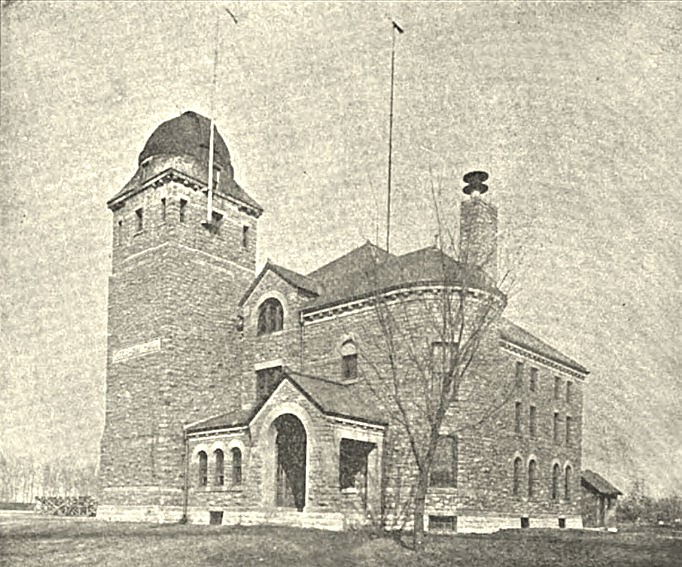
One of the first notable steps towards a public warning system appears to have developed in the spring of 1888, when the college joined the federal government’s network of voluntary weather observatories. Run by the Signal Service, in the Department of War, this program created a network of volunteer observatories throughout the country, which would record a series of meteorological measurements each day, using calibrated instruments provided by the government, and in turn, would receive daily forecasts and weather charts (via telegraph), which would be communicated to the public by flying large, specialized weather flags, atop their buildings. Goodnow Hall served as the first weather observatory, when the college joined this system in the spring of 1888, with Prof Samuel Buck (Mathematics and Astronomy) overseeing this project.

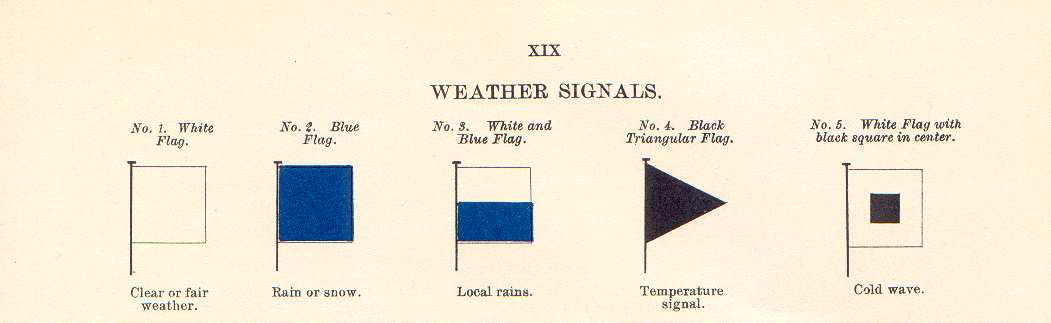
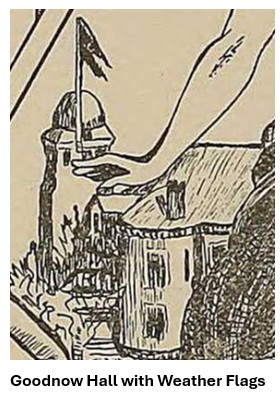
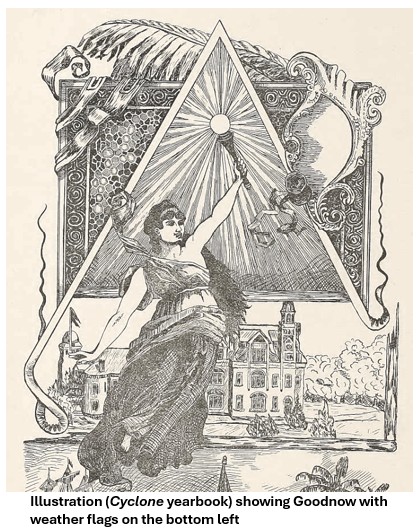
Goodnow, which was built only a few years earlier, in the wake of the devastating tornado of 1882, was designed to serve as the college’s new library and astronomical observatory. To serve as a weather station, two large poles were added to the building—one, was attached to the observatory tower, and served as the flagpole used to fly the 6 large weather flags that an inland station would use (coastal sites, carried a larger number of storm flags particular to maritime conditions), while the second pole was erected in the center of the building’s roofline to carry the sensitive anemometer, which sent electrical signals to a self-recording device (a chronograph) that captured a constant record of wind direction and speed. Pictures & drawings of Goodnow from this period usually include these two features of the building, which disappeared later. And the fluttering weather flags would have been a prominent feature of the local skyline (each flag was more than 6 feet in length, so that they could be seen from far away.

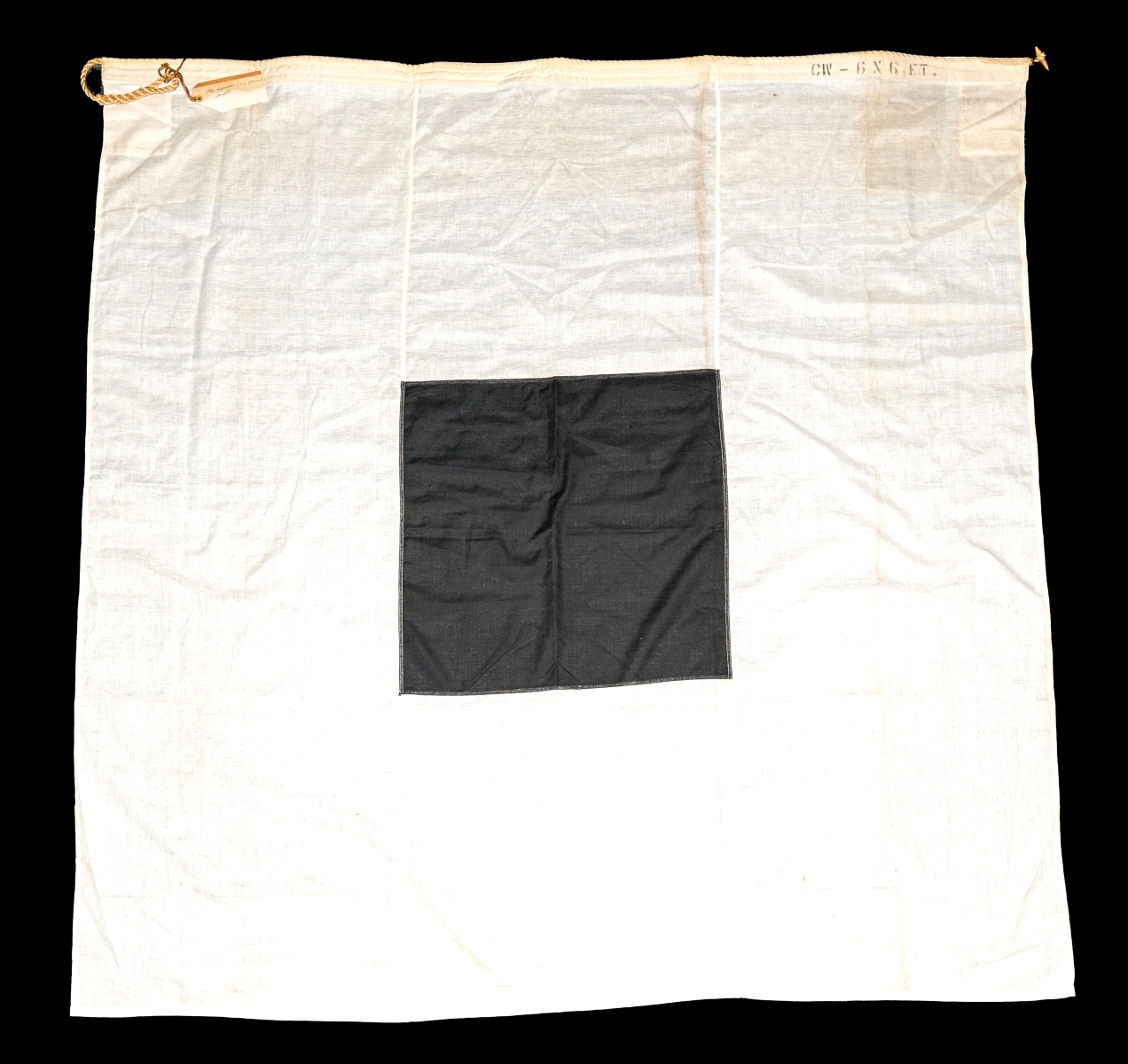
The most prominent and important of the flags was the “Cold Wave” flag (pictured here), that warned of a coming cold front that could lead to dramatic storms throughout the year. The danger that such cold fronts posed were particularly on the mind of Americans in the spring of 1888, when Grinnell joined this forecasting network, because of two, recent, traumatic events. On January 12, 1888, what started out as a very warm and mild day turned into one of the fiercest blizzards in the upper Midwest that struck unexpectedly that afternoon, trapping many school children who were trying to walk home from their rural schoolhouses. It is estimated that nearly 300 people died from exposure in what became known as the  “Children’s Blizzard”; and in March, an equally sudden and ferocious blizzard descended on the Northeast (again leading to a staggering loss of life, and paralyzing much of the region). It seems likely, then, that the timing of Grinnell’s entry into the Signal Service network was driven by these recent events. Throughout the nation, people clamored for better ways to communicate forecasts and warn about impending weather dangers. The flags that flew each day over Goodnow were a visible attempt to address those concerns, and would continue to alert the public until radio broadcasts rendered this system obsolete.

The Ballad of the Squirrels

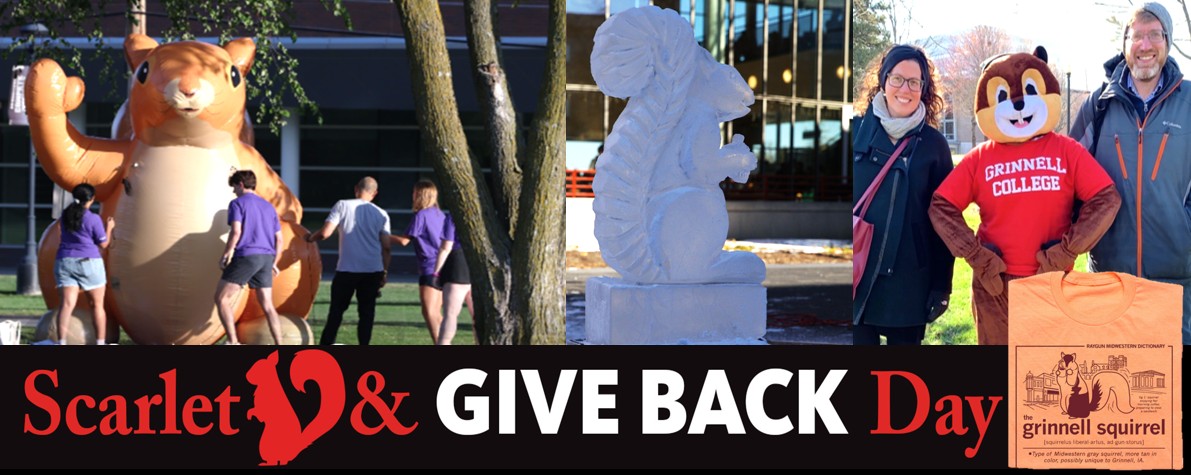
In the past few years, squirrels seem to be everywhere on campus. From the giant inflatable squirrel that welcomed new students in August, to the gleaming squirrel statute carved out of a block of ice in January, these charming rodents have become the unofficial mascot of Grinnell College.

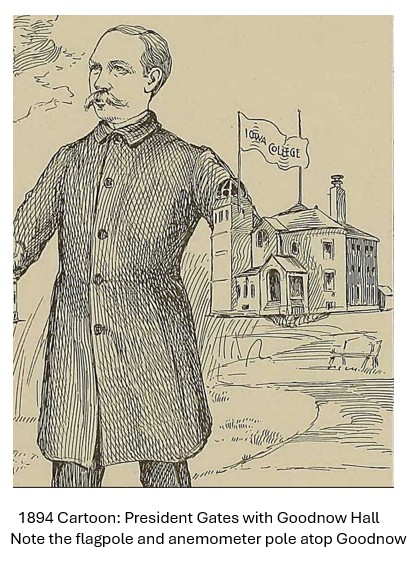
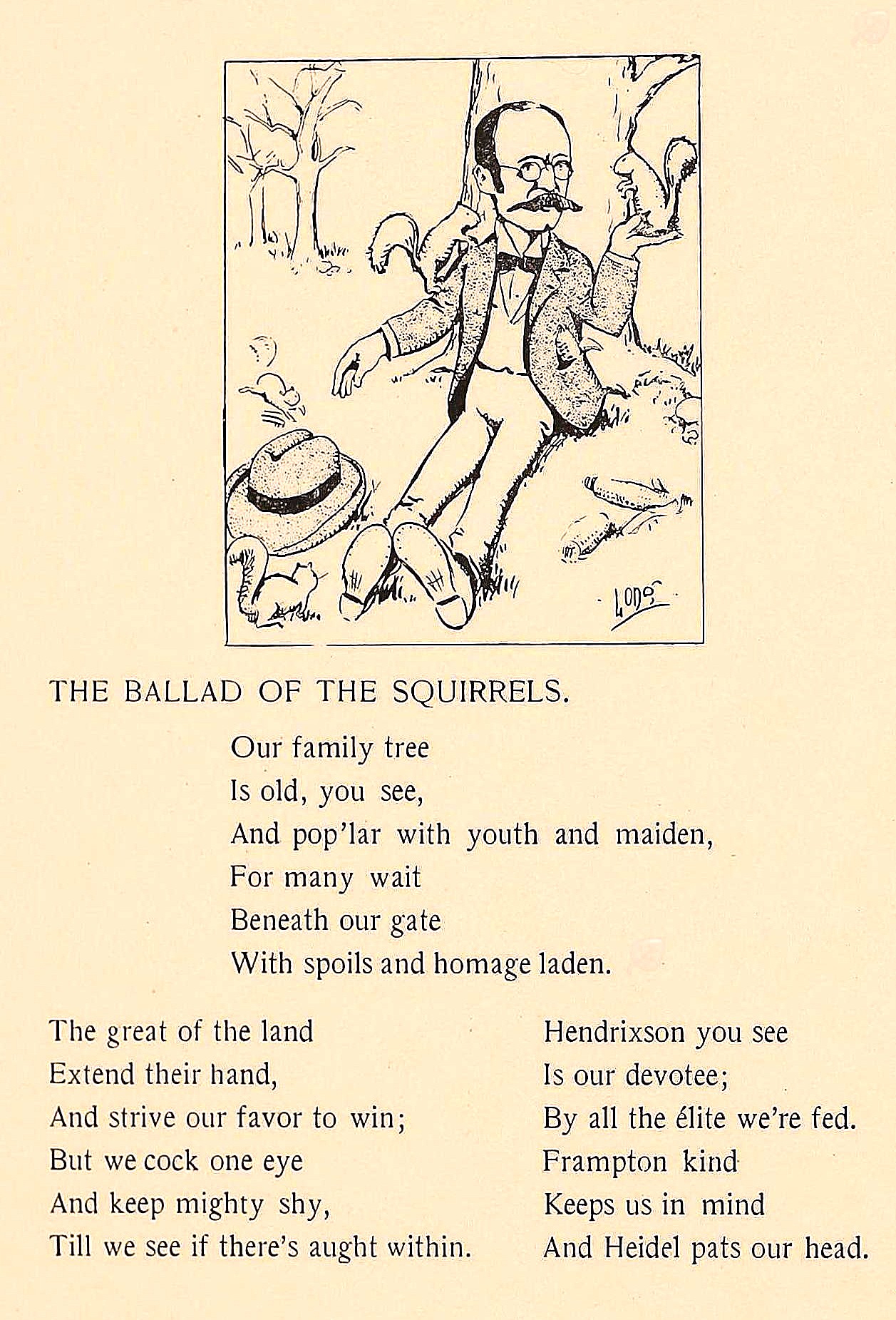
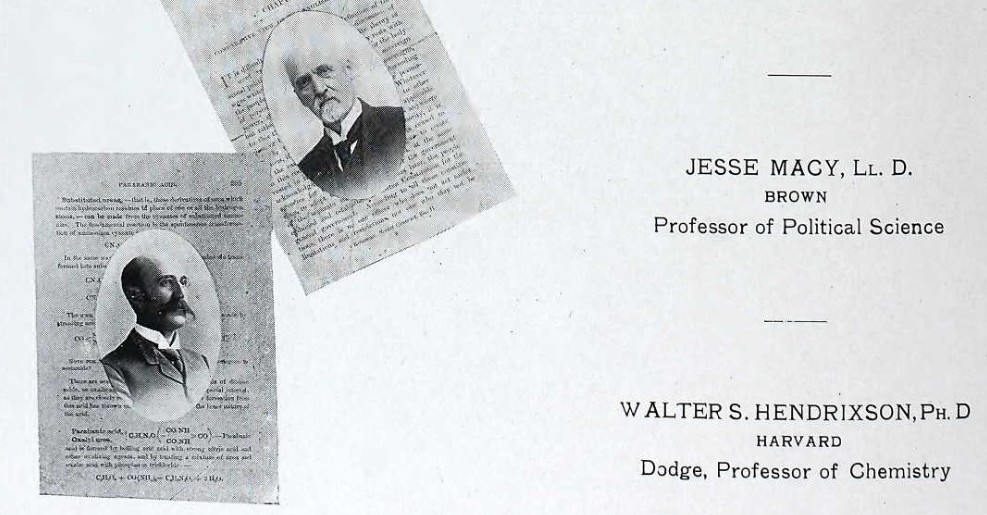
This 1894 cartoon and poem, “The Ballad of the Squirrels,” shows that our love affair with these furry denizens goes back a long way.  The cartoon shows Walter Scott Hendrixson—the Dodge Professor of Chemistry, long-time Grinnell faculty member, and apparently squirrel “devotee”—spending some quality time with campus squirrels. Hendrixson was known to feed them regularly, along with other faculty members (the poem mentions the college organist, John Ross Frampton, and the classics professor, William Arthur Heidel).

This yearbook image shows that the student artist did a good job of capturing Hendrixson’s likeness (particularly his impressive, walrus-like, mustache).

Grinnell’s love affair with squirrels was part of a larger trend in the early 20th century, as college campuses across the country sought to transform their grounds into more park-like environments, and actively encouraged birds and squirrels to become residents, helping mitigate some of the feelings of being isolated from nature that were affecting a generation experiencing rampant urbanization (as well as the disappearance of wildlife & wilderness in rural communities).

The Liberal Arts at Grinnell: The Birth of the Major (1895-1930s)

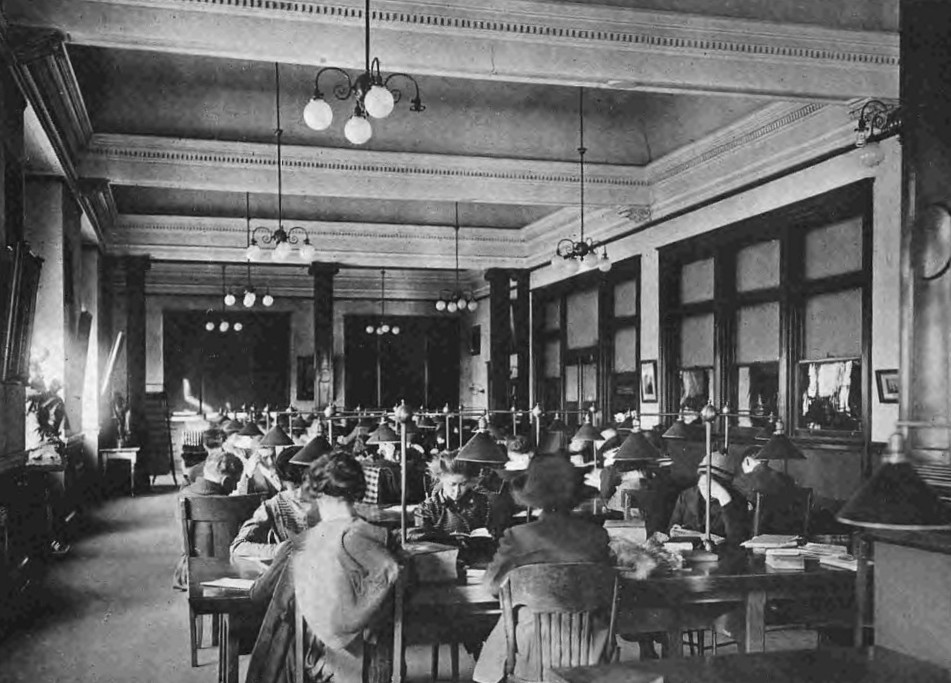
The Reading Room in Carnegie Library (1913)Carnegie Reading Room 1913
In the 1890s, there was heated debate within higher education about the appropriate way to structure the curriculum, with one camp of traditionalists favoring the established path of a carefully defined sequence of courses to be taken at each stage, while new reformers promoted a far more open curriculum that would be almost entirely elective (a trend popularized by many of the new colleges and state universities emerging in the West). Grinnell originally tried to accommodate both philosophies by having a degree track, with a well-defined sequence of courses students had to fulfill each year on their way to a bachelor’s degree, while also having an “Optional Studies” track where students could choose any array of courses they wanted, but would not lead to an actual degree.

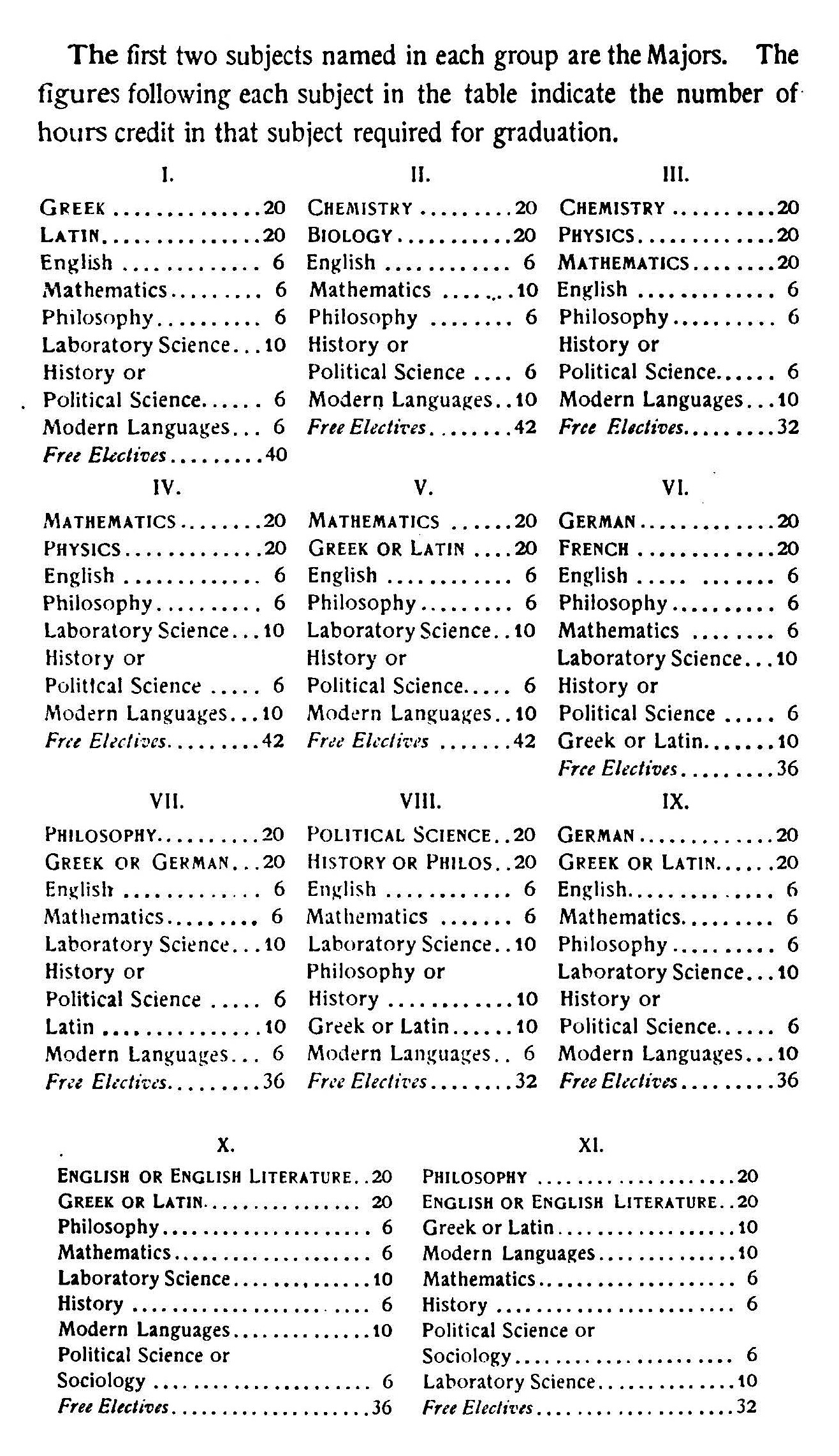
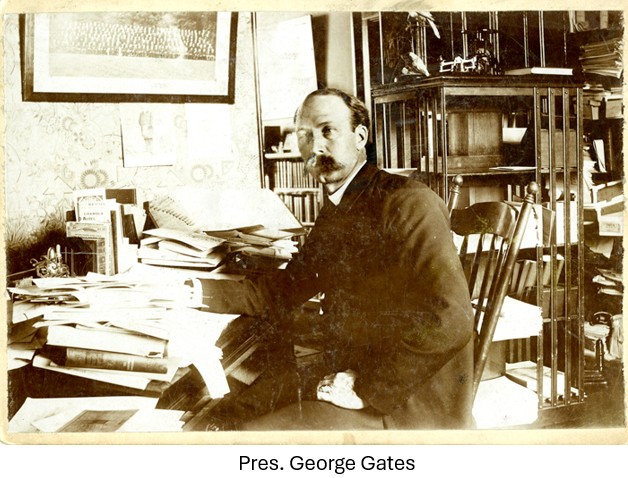
When George Gates became president of the college, in 1887, he began a series of important administrative and curricular reforms that would lead to Grinnell’s adoption of the “Group System” curriculum in 1895. This system, pioneered by the newly created Johns Hopkins’ University, tried to balance the demands of structure and choice, while addressing the mounting problem of how to incorporate new subjects into a fast-changing collegiate environment. For the first time, this system required students to choose a “major”—actually, two complimentary majors—each of which would consist of 20 credits of sequenced course work in those departments. At Grinnell, students could pair these complimentary majors in 9 combinations (increased to 11 in the catalog below), although students could also petition the newly created curriculum committee (yes, we can thank George Gates for creating the first standing committees of the faculty) to approve a new combination. In addition to their two majors (40 credits), students would also choose courses from a variety of required subjects, as specified in the catalog. But note that students could select what course to take in History, for example, or what modern language they would study (as opposed to the older curriculum which spelled out the specific classes a student would take each year).  The end result was a curriculum of roughly thirds (one third of the credits in their major fields, one third in required fields, and one third as open electives).

The college touted the virtues of this compromise, explaining that:

The Group system aims to combine the advantages of the rigid course system with those of the free elective system, while avoiding the dangers of each to maintain a proper balance between educational control on the one side and individual freedom of choice and self-direction on the other…the aim has been to organize each Group that it may afford the opportunity for a well-rounded liberal education, while preventing the waste and dissipation of energy incident to absolutely unlimited election.

To guide students in these choices, the college (for the first time ever) mandated that a faculty member should serve as an individual advisor for students who were majoring in their department.

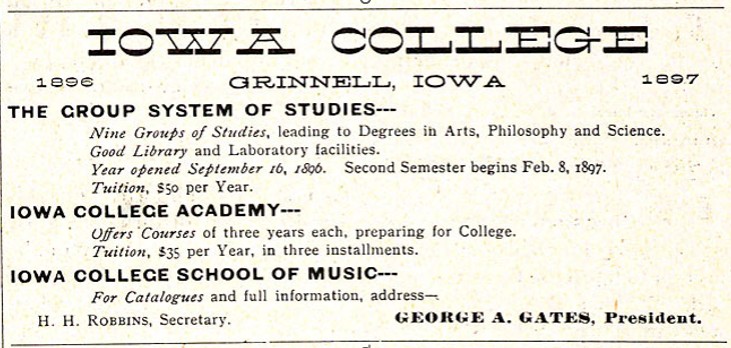
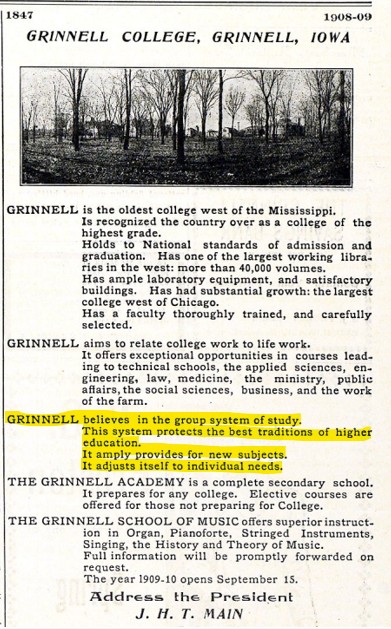
The College’s advertisements from this period (as you can see here), highlighted the group system as a defining feature of Grinnell.  While certain elements would evolve over time—the two majors, for example, became one “major” and one “minor”—the essential framework would remain in place for decades, shaping the institution.


The Liberal Arts Curriculum at Grinnell: c.1870-1895

In light of recent faculty discussions, underscoring the desire for more consistent reflection and conversation about the meaning of a liberal arts education at Grinnell, we’re going to spend some time this spring highlighting how this issue has played out over the college’s history. The early years of Iowa College—both in Davenport and then subsequently in Grinnell—saw very few students attaining a bachelor’s degree, and little structure in terms of the requirement for the B.A. (most of the students were enrolled in the preparatory academy). It was the period after the Civil War, when Grinnell’s first President, George Magoun, took charge that the faculty created an organized curriculum and set of requirements for entering college students, which would hold sway until a series of curricular reforms in the 1890s.
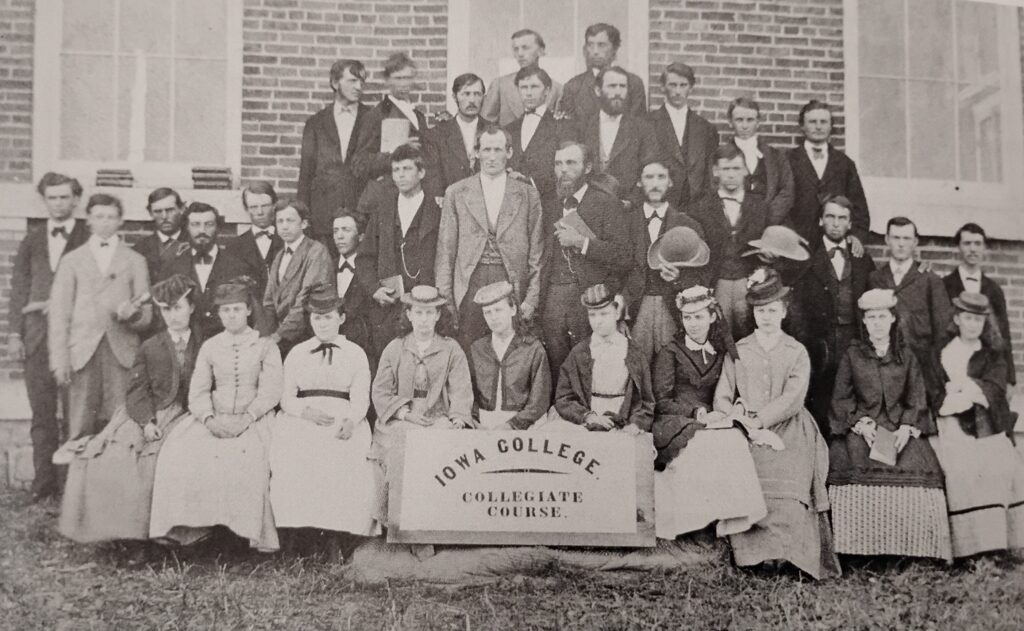
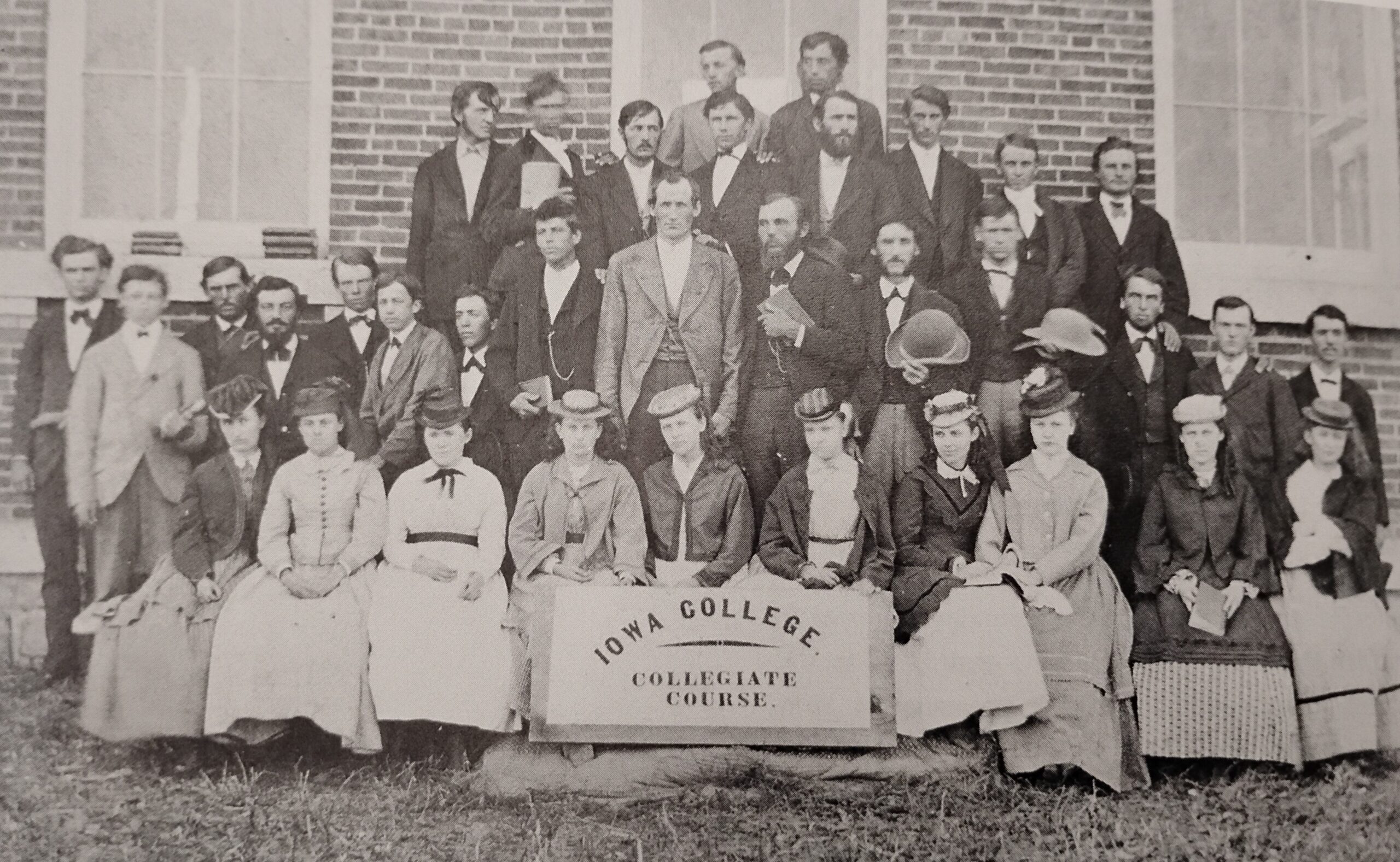
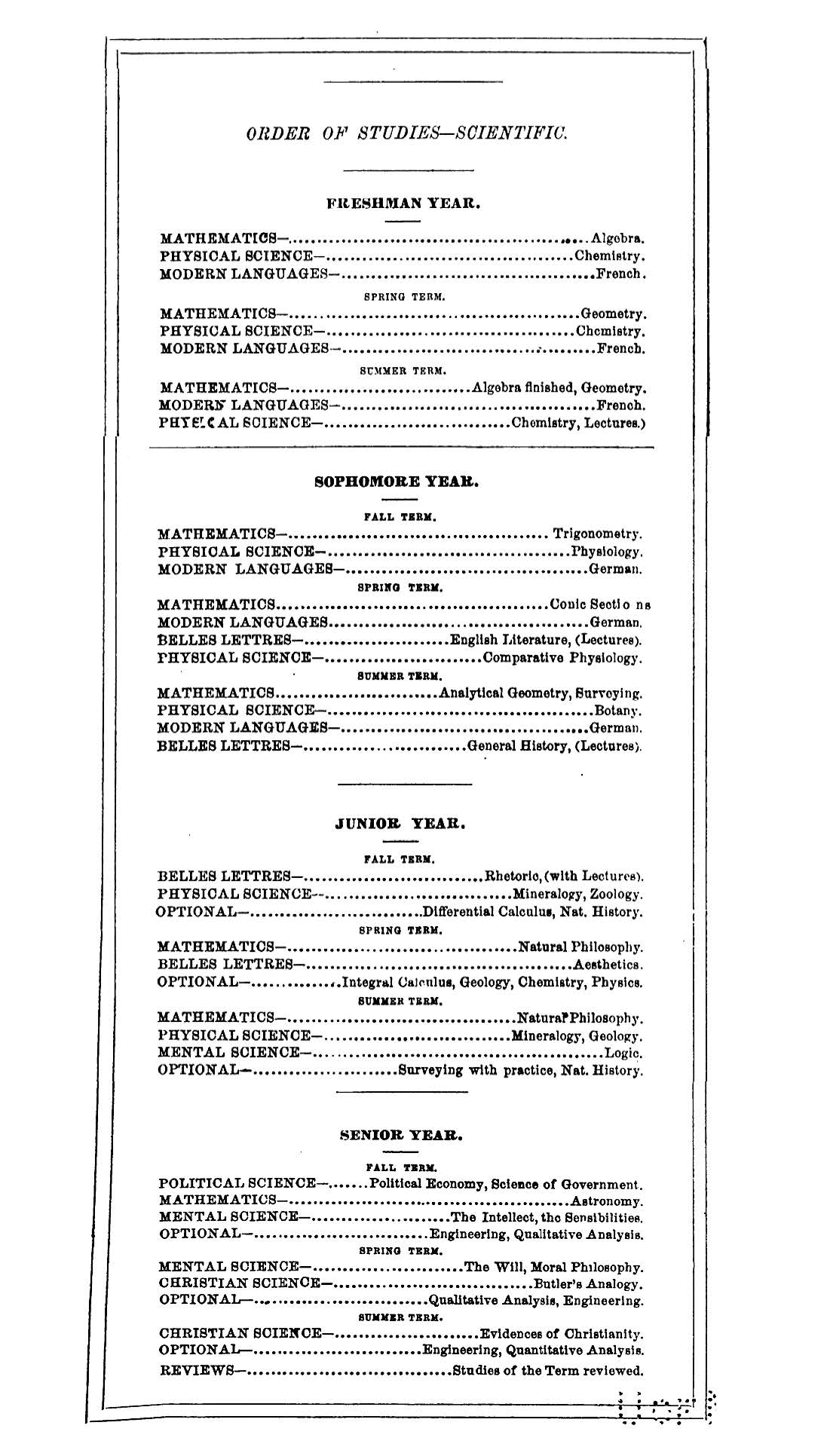
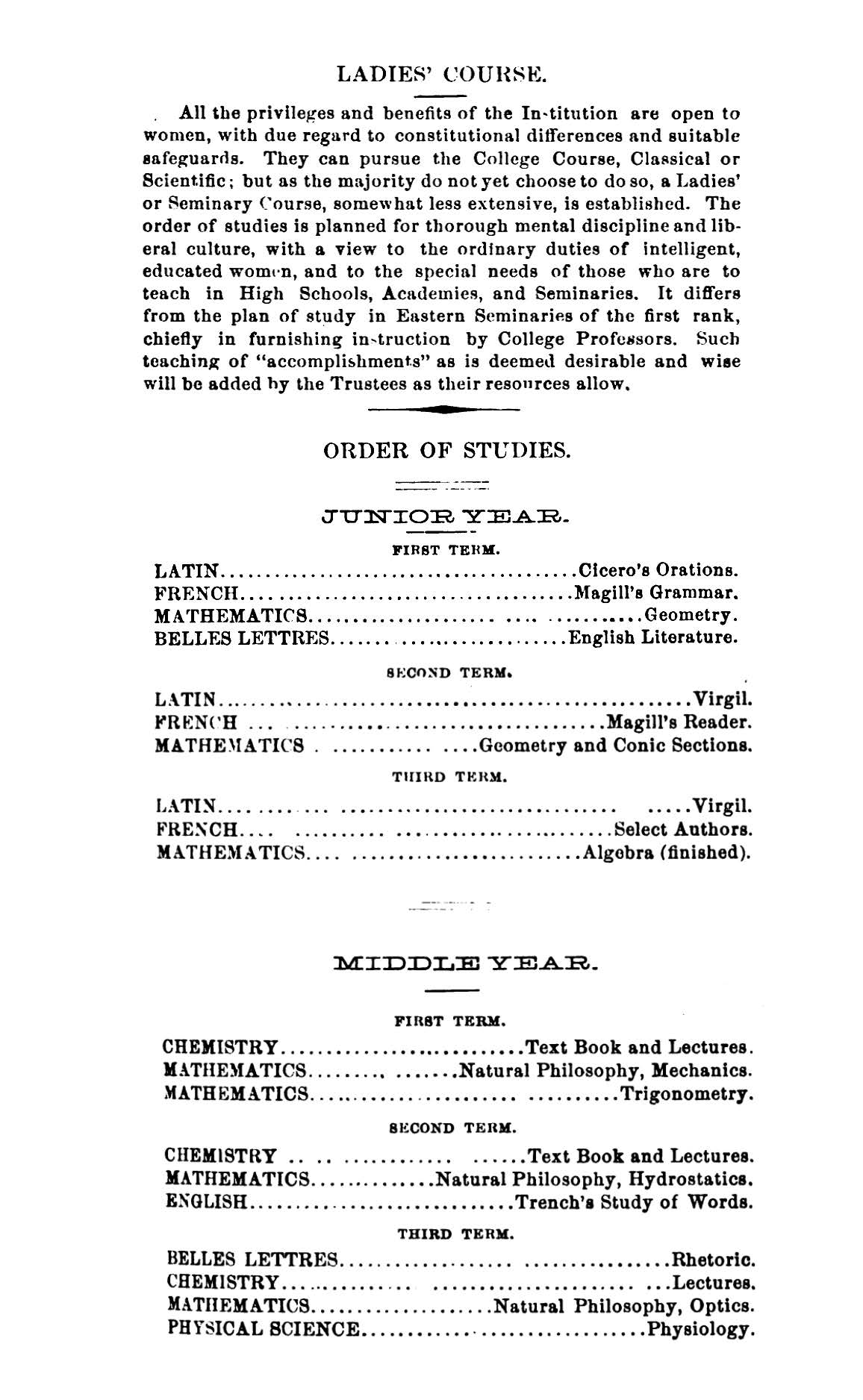
How did Grinnell approach a liberal arts education in 1870 (when the students pictured here, entered the college)?  There were four main “courses,” or tracks, that students could pursue:

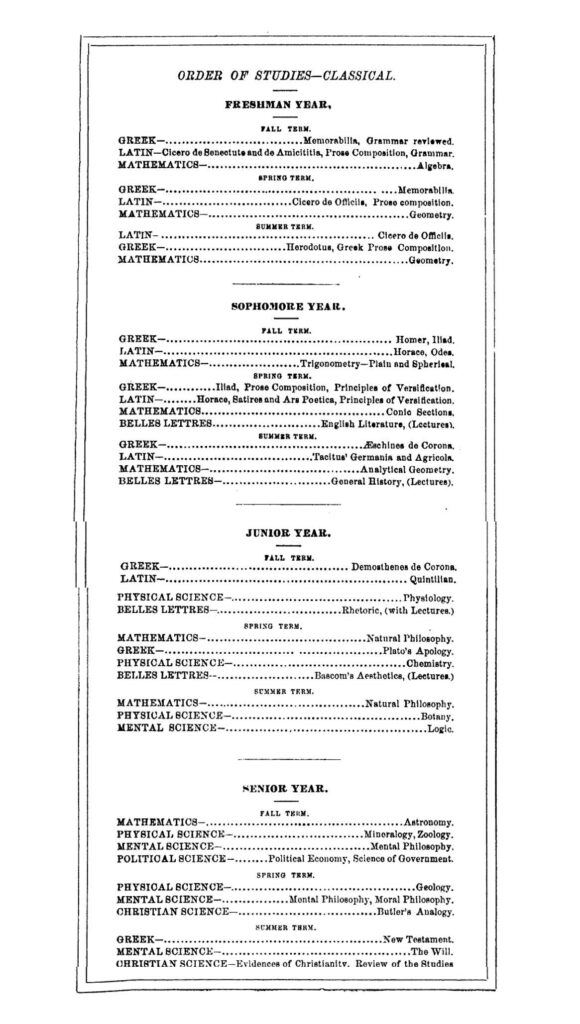
1.) a classical course, leading to the Bachelor’s of Arts (A.B.) degree

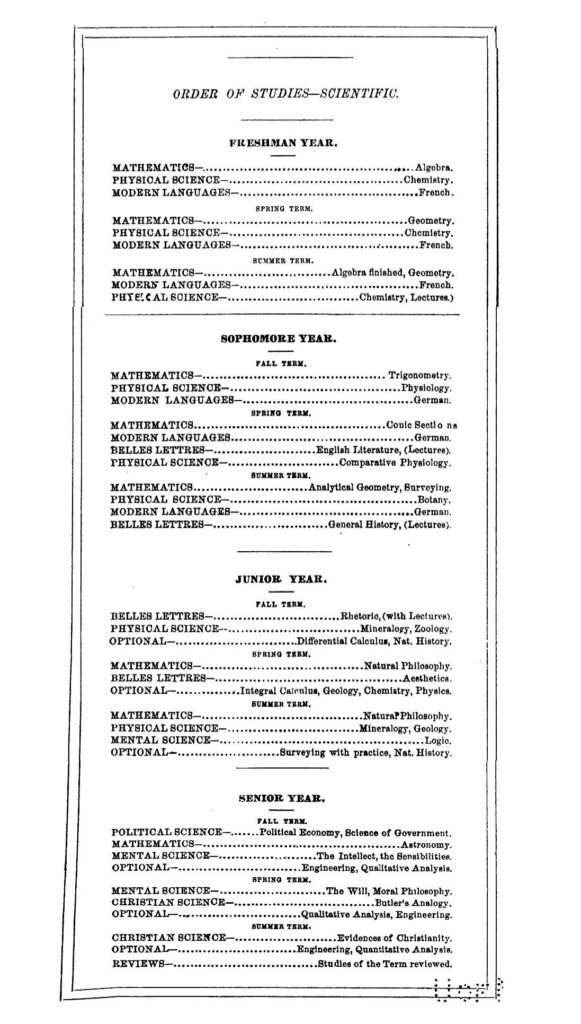
2.) a scientific course, leading to the Bachelor’s of Science (B.S.) degree

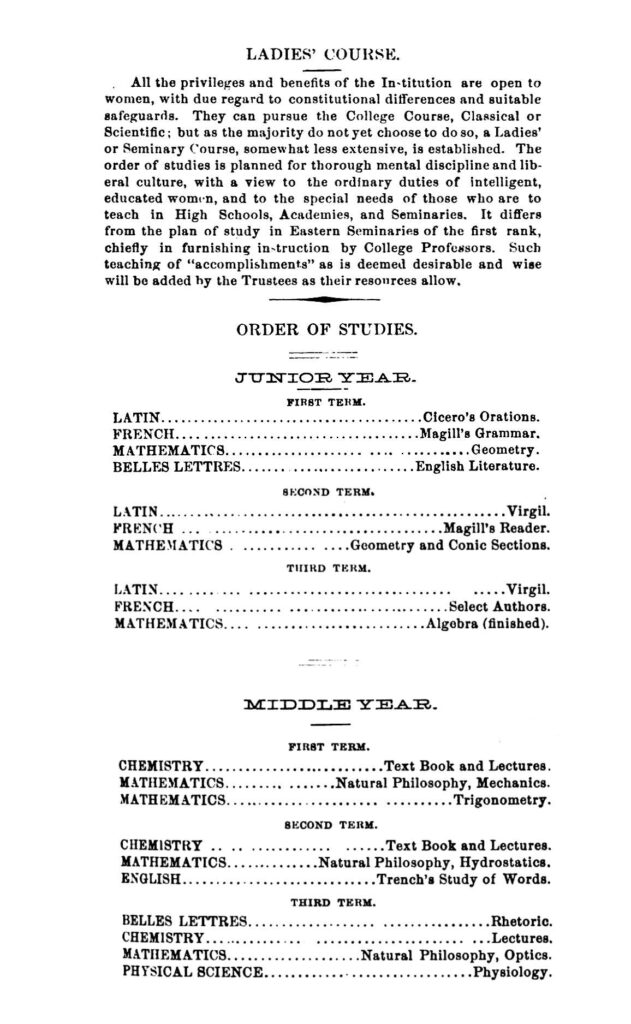
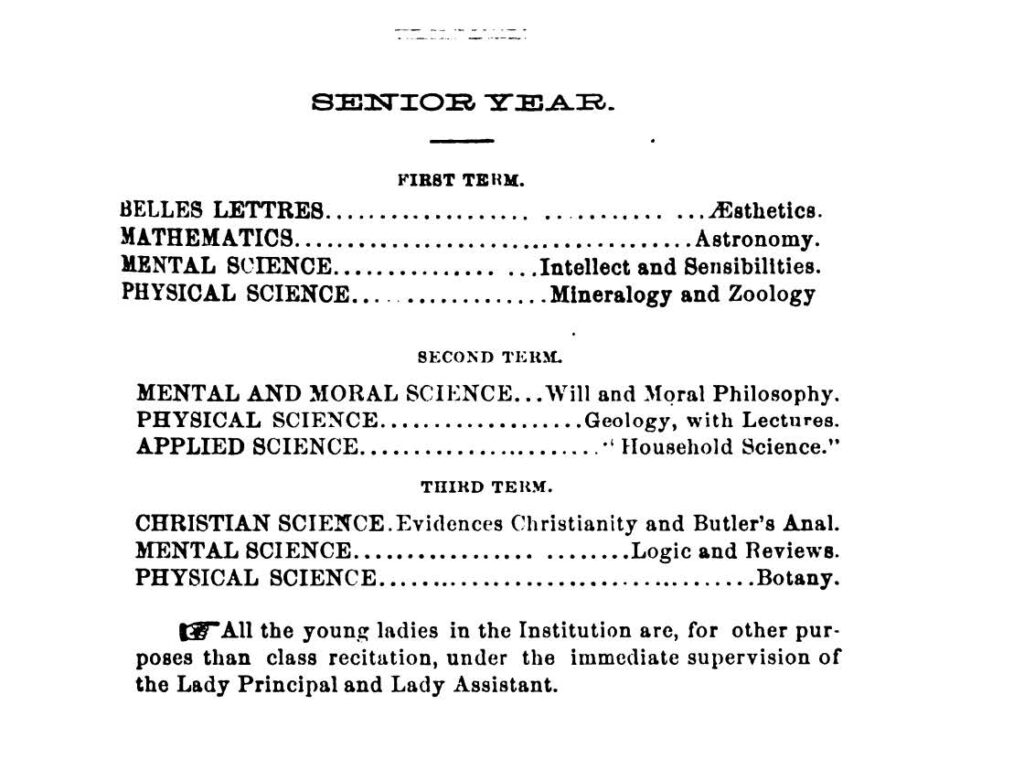
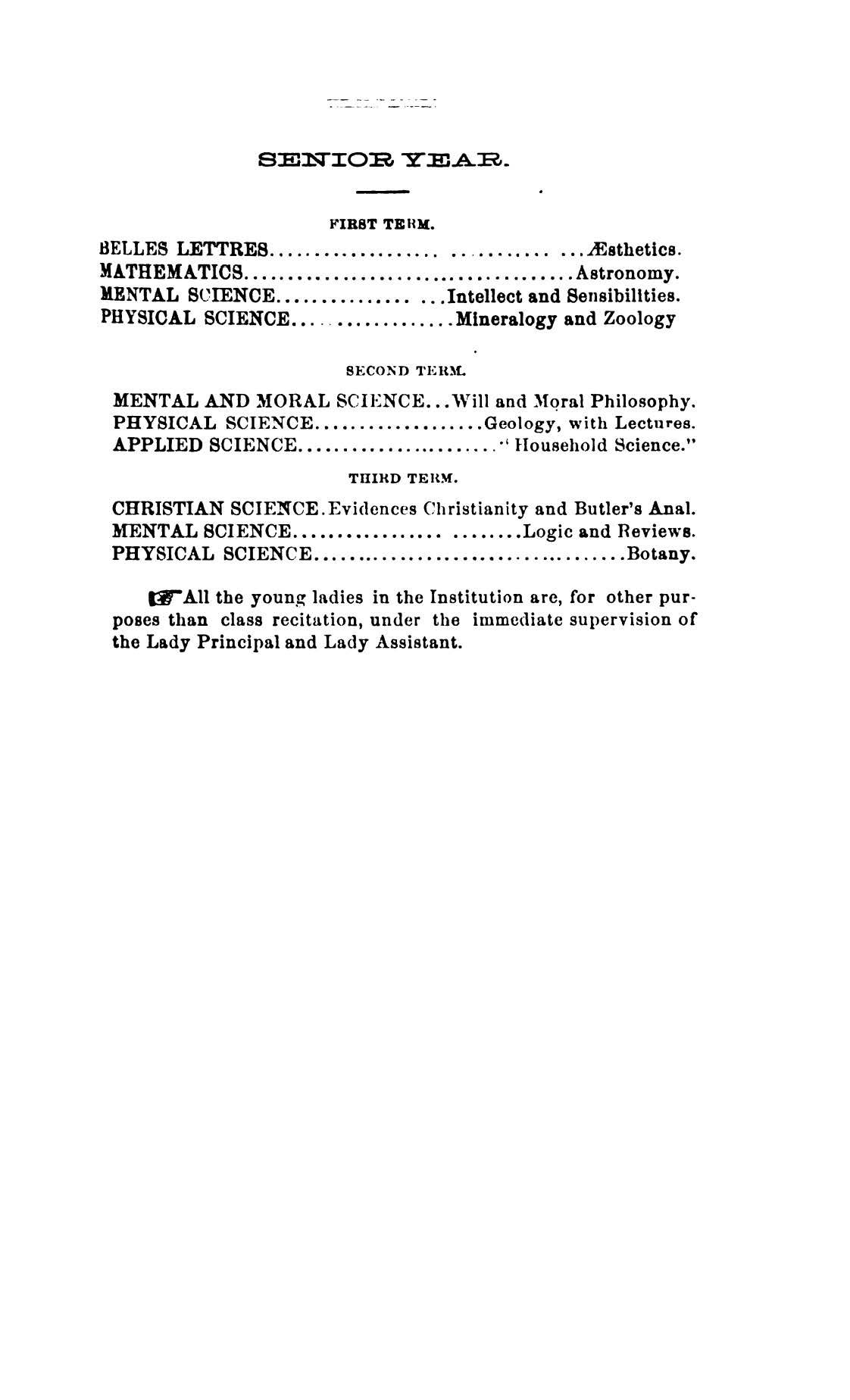
3.) a “Ladies Course,” (explained in the catalog page below) that evolved a decade later into the “Literary” course, and increased from 3 to 4 years. This course, however, led to a diploma rather than a bachelor’s degree.

4.) an “Optional Studies” course, which allowed students to freely choose the classes they wanted to take, but did not lead to a formal diploma or degree.

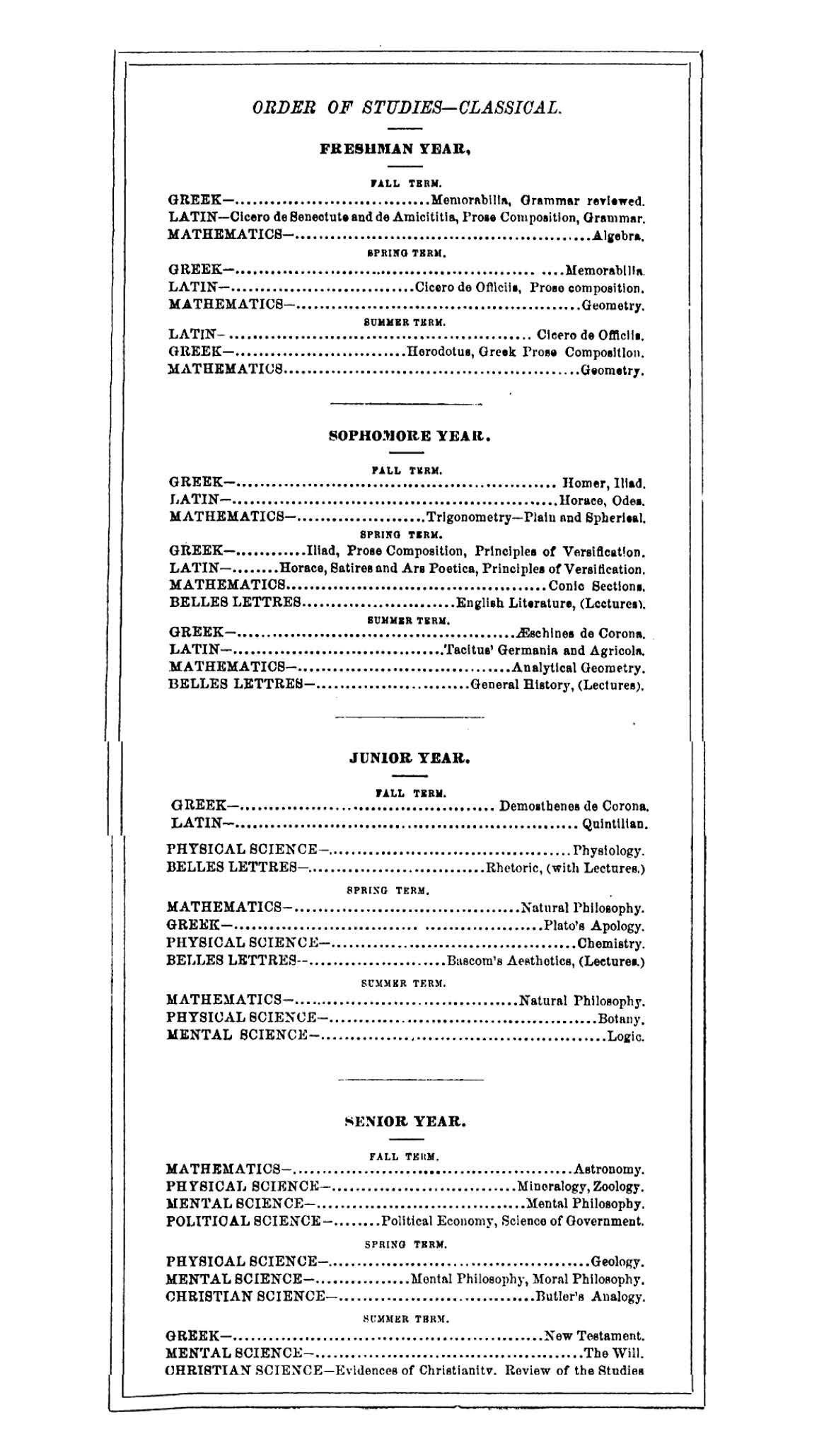
As you will see (below), each of these tracks were pretty rigid in terms of specifying the array and sequence of courses students would take each year.

Printed, here, are the course requirements and sequencing for those three main tracks, established in 1870.  All students were also required to attend religious service each morning (and twice on Sundays) while Men were required to participate in “military drill.”
In 1875, a Conservatory, or School of Music, was also created as a separate institution (although it was under the supervision of the same board of trustees as the college). It initially awarded diplomas, but by 1890, it also offered a Bachelor’s of Music degree to those who completed the full course of study involving musical theory, musical history, musical education, and demonstrated proficiency in one major, and one minor, instrument. It’s also worth noted that, at this time period, Grinnell College continued to run its preparatory Academy as well as a sizable “English or Normal School” that focused on training future school teachers. At times, the Academy and Normal school enrollment was much larger than the number of students in these collegiate tracks.

Carrie Adeline Barbour: Artist, Paleontologist, & Professor


Last week’s post focused on the college’s museum of natural history; or more precisely, the third iteration of this museum, that was assembled after the devastating cyclone of 1882. As the new collection began to come together in Blair Hall, the college hired its first geologist and paleontologist, Erwin H. Barbour, who became the Stone Professor of Natural History, charged with overseeing the museum and related coursework. In addition to his academic training, Erwin had spent several years doing field work out west, serving as assistant paleontologist for the U.S. Geological Survey.

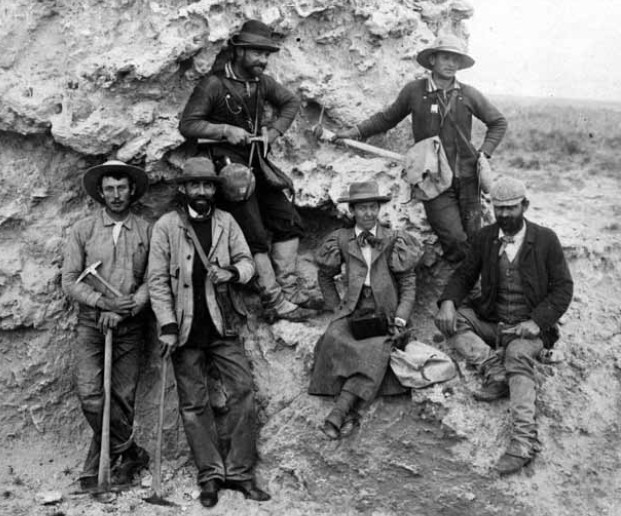
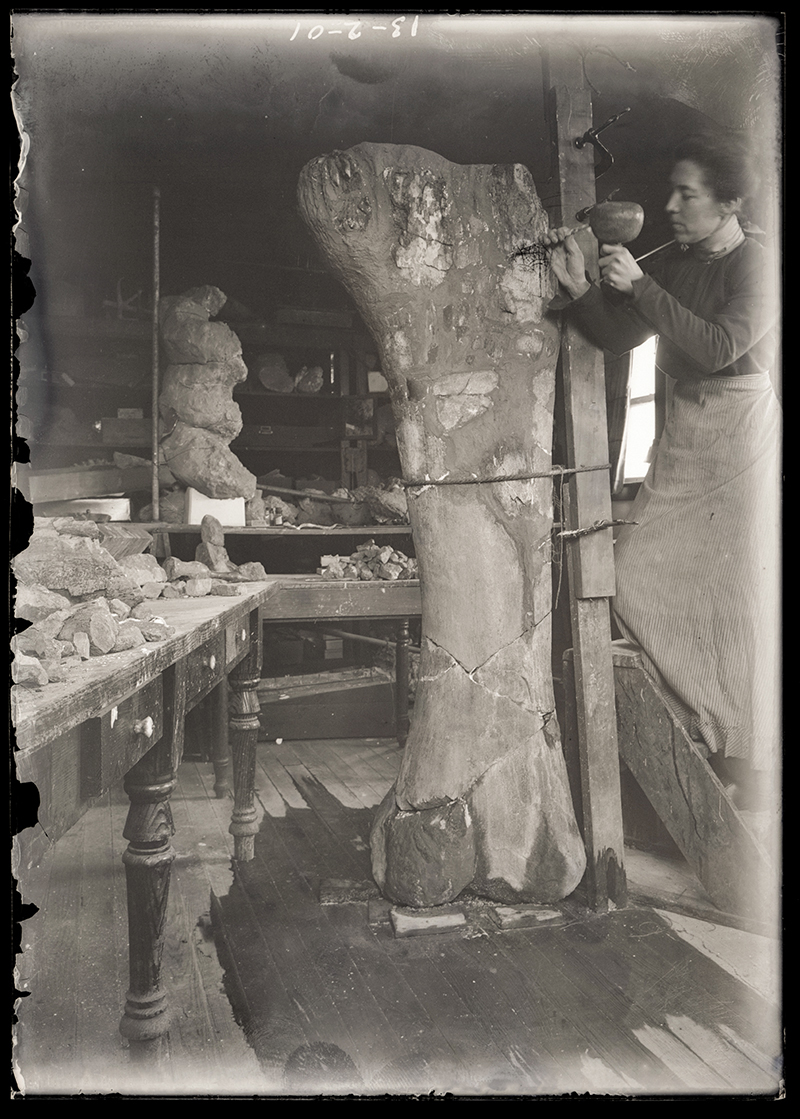
But Erwin Barbour did not come to Grinnell alone. His sister, Carrie Adeline Barbour, also joined the faculty at this time, teaching studio art courses in carving, ceramics, and porcelain painting (which she had studied at Oxford Female College, later absorbed into Miami of Ohio, and at a fine arts school in Cincinnati). Given the close links between art and science that existed in the world of natural history, as well as the tendency for family members to participate in the collective work of science, in an era before paid staff and technicians, it is not surprising to discover that Carrie Barbour became involved in the geological and paleontological work of her brother. Carrie was also personally drawn to the subject, revealing that her mother, Adeline Barbour, had instilled in both of her children a deep love of natural history and collecting specimens.

On the right of the image, Carrie Barbour stands on a short ladder and uses a chisel to work on the dinosaur femur. The femur is fastened to wooden boards, which hold it vertically. In the background are tables and shelves with other artifacts and equipment. Digitized from glass-plate negative.

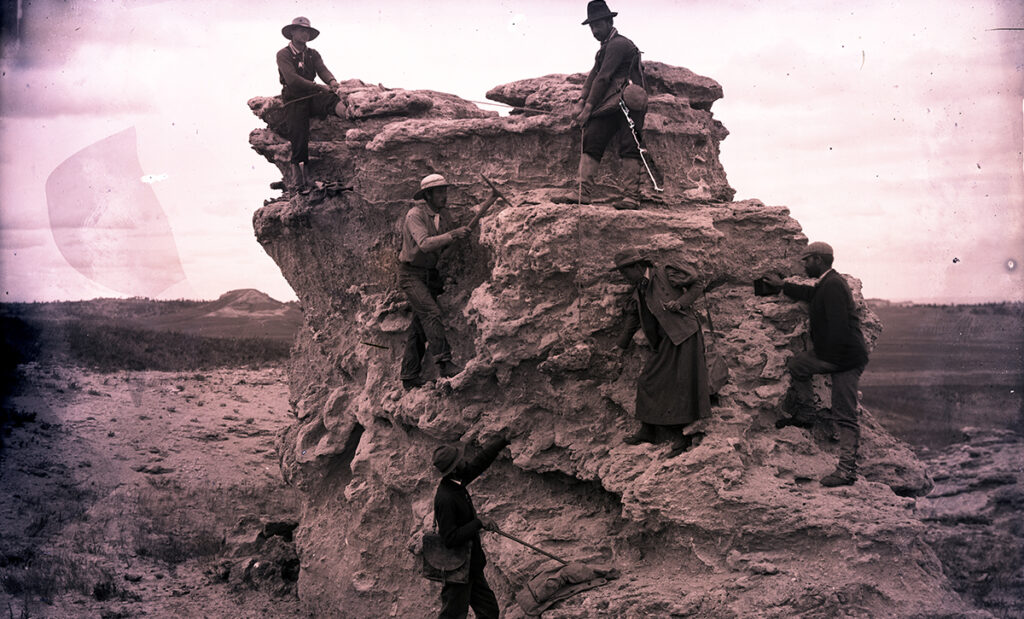
Eventually, Erwin left Grinnell College in 1891 to establish a geology department and museum at the University of Nebraska. Carrie was torn between continuing her career as an art professor, and taking up a position at Nebraska, working with her brother as a full-time paleontologist. “I realized I couldn’t divide my time between the two jobs and accomplish much in either,” she later recalled, “Fossils fascinated me so much I decided to continue a thorough work with them.” Over the next 40 years, Carrie Barbour carved out a remarkable career in paleontology, becoming an assistant curator of the museum, a professor of paleontology, an author of noted scientific papers, and perhaps most unusual for a female scientist at this time, a leader of field expeditions and excavations.

Although Carrie Barbour eventually received recognition, and an academic position of her own, her experience is also part of a larger story about the often-hidden role that wives, sisters, and daughters played in an age when academic work was often a shared, family endeavor while academic publication and credit was limited to the (mostly male) professoriate.


The Social Gospel goes to Summer School

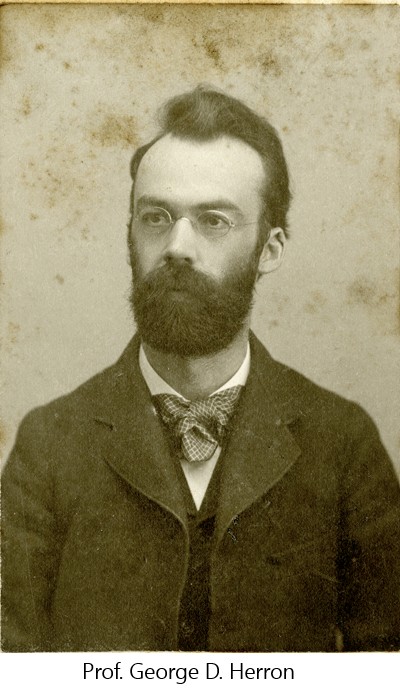
“The usual quiet of the summer vacation was broken this year,” the Scarlet & Black explained in 1894, “by the Summer School…for the systematic study of Christian sociology.” Organized by Prof. George Herron and his department of Applied Christianity, this summer school was meant to help launch the new American Institute of Christian Sociology, that was trying to blend the Social Gospel movement with the emerging fields of Sociology and social work. Intended to be an annual affair, the summer school brought together professors, students and reformers from around the country  to participate in a series of courses, supplemented by free standing lectures. Some of the topics included:

Dr. Coyle: Christ as a Socializer

Dr. Thomas Hall: The Four Laws of the Kingdom

Edward Neally: The Ethics of Jesus in the Legal Profession

Prof. John R. Commons: The Distribution of Wealth

Prof. Richard T. Ely, Private Property: A Social Trust

Josiah Strong: Methods of the New Era

There were also lectures given by Grinnellians: President George Gates, Prof. James Macy, and Prof. Herron.

Grinnell’s First Bicycle Club

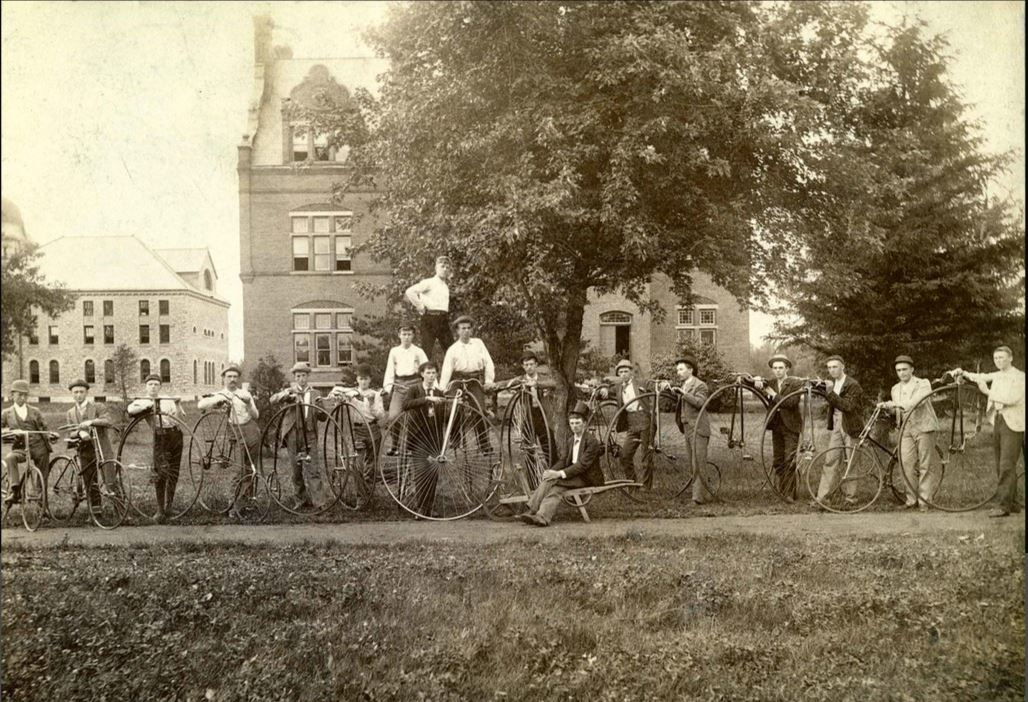
Grinnell College Bicycle Club, 1891.

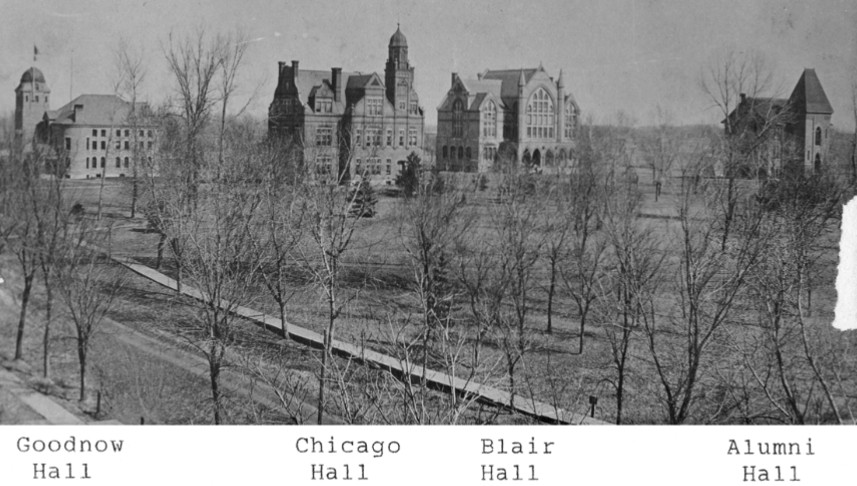
The college’s bicycle club poses in front of Chicago Hall, with Goodnow on the left (you can just make out the original observatory, in the top left, that used to sit atop Goodnow’s Tower, housing the college’s telescope).  Bicycling was all the rage in the 1890s, and was actually incorporated into collegiate track & field competitions for about 30 years.


Powered by WordPress & Theme by Anders Norén