
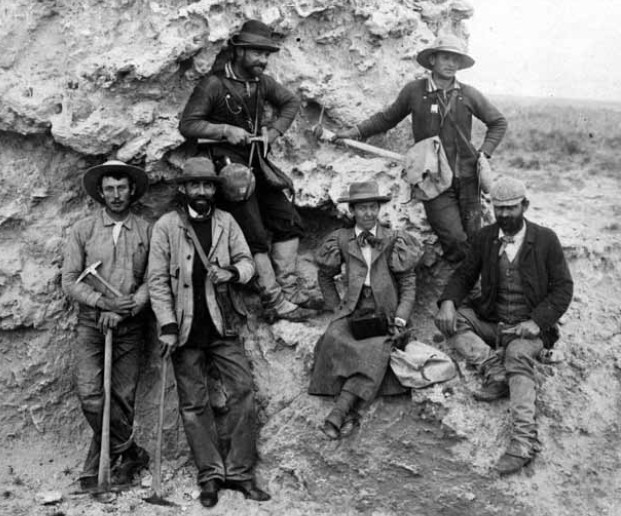
 Last week’s post focused on the college’s museum of natural history; or more precisely, the third iteration of this museum, that was assembled after the devastating cyclone of 1882. As the new collection began to come together in Blair Hall, the college hired its first geologist and paleontologist, Erwin H. Barbour, who became the Stone Professor of Natural History, charged with overseeing the museum and related coursework. In addition to his academic training, Erwin had spent several years doing field work out west, serving as assistant paleontologist for the U.S. Geological Survey.
But Erwin Barbour did not come to Grinnell alone. His sister, Carrie Adeline Barbour, also joined the faculty at this time, teaching studio art courses in carving, ceramics, and porcelain painting (which she had studied at Oxford Female College, later absorbed into Miami of Ohio, and at a fine arts school in Cincinnati). Given the close links between art and science that existed in the world of natural history, as well as the tendency for family members to participate in the collective work of science, in an era before paid staff and technicians, it is not surprising to discover that Carrie Barbour became involved in the geological and paleontological work of her brother. Carrie was also personally drawn to the subject, revealing that her mother, Adeline Barbour, had instilled in both of her children a deep love of natural history and collecting specimens.
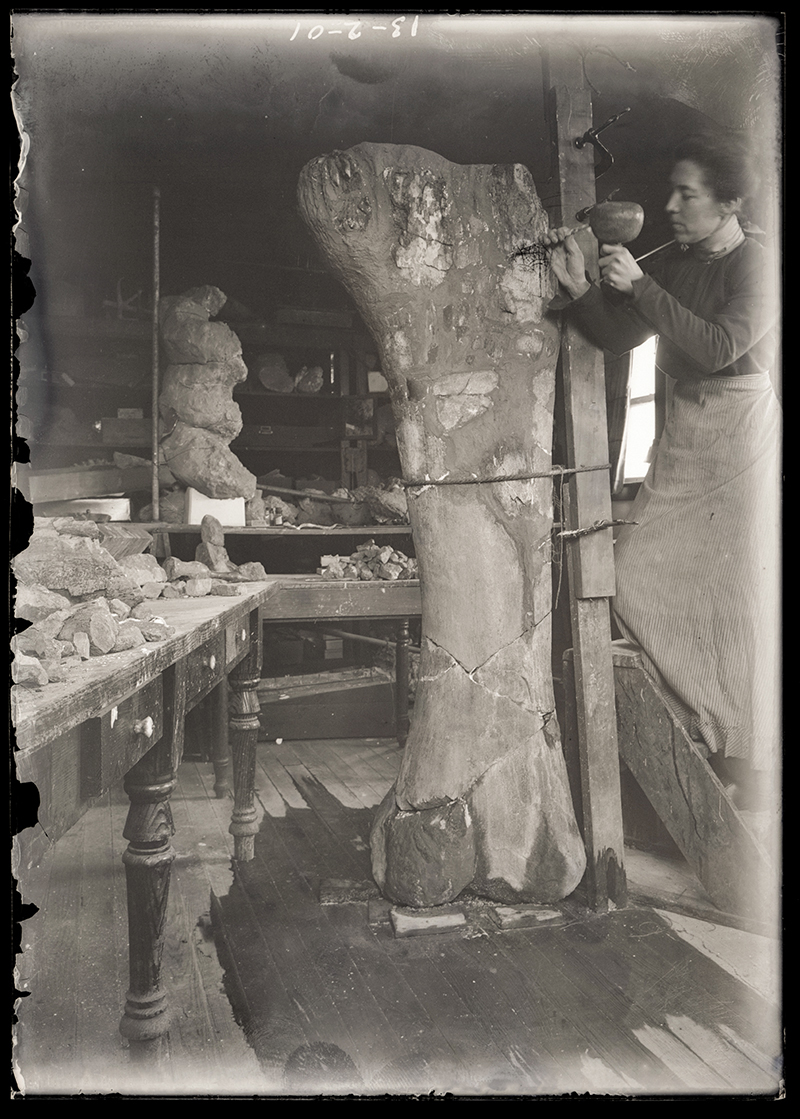
On the right of the image, Carrie Barbour stands on a short ladder and uses a chisel to work on the dinosaur femur. The femur is fastened to wooden boards, which hold it vertically. In the background are tables and shelves with other artifacts and equipment. Digitized from glass-plate negative.
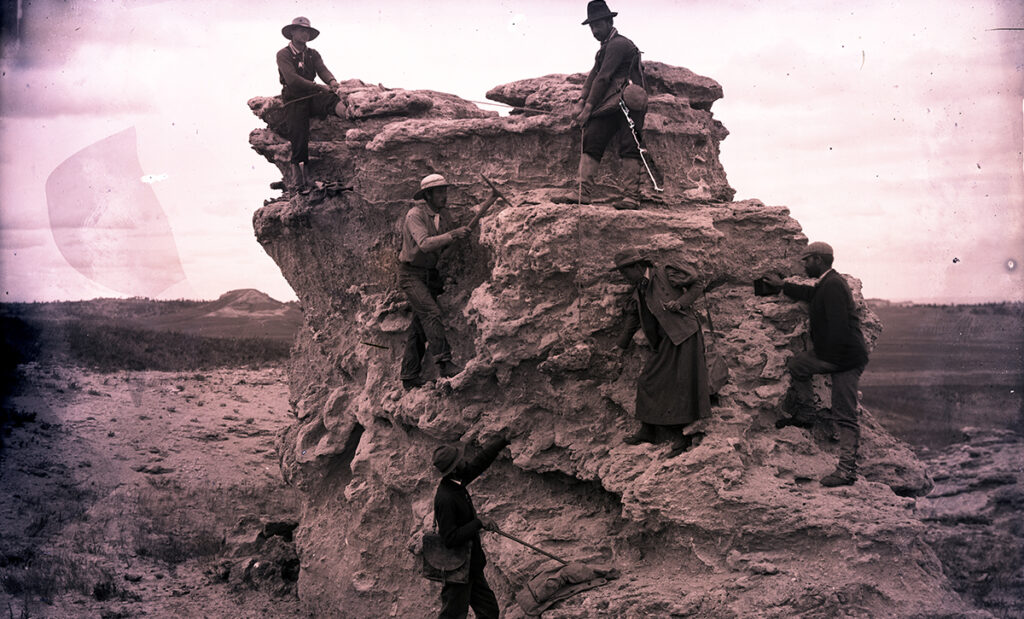
Eventually, Erwin left Grinnell College in 1891 to establish a geology department and museum at the University of Nebraska. Carrie was torn between continuing her career as an art professor, and taking up a position at Nebraska, working with her brother as a full-time paleontologist. “I realized I couldn’t divide my time between the two jobs and accomplish much in either,” she later recalled, “Fossils fascinated me so much I decided to continue a thorough work with them.” Over the next 40 years, Carrie Barbour carved out a remarkable career in paleontology, becoming an assistant curator of the museum, a professor of paleontology, an author of noted scientific papers, and perhaps most unusual for a female scientist at this time, a leader of field expeditions and excavations.
Although Carrie Barbour eventually received recognition, and an academic position of her own, her experience is also part of a larger story about the often-hidden role that wives, sisters, and daughters played in an age when academic work was often a shared, family endeavor while academic publication and credit was limited to the (mostly male) professoriate.
Leave a Reply