
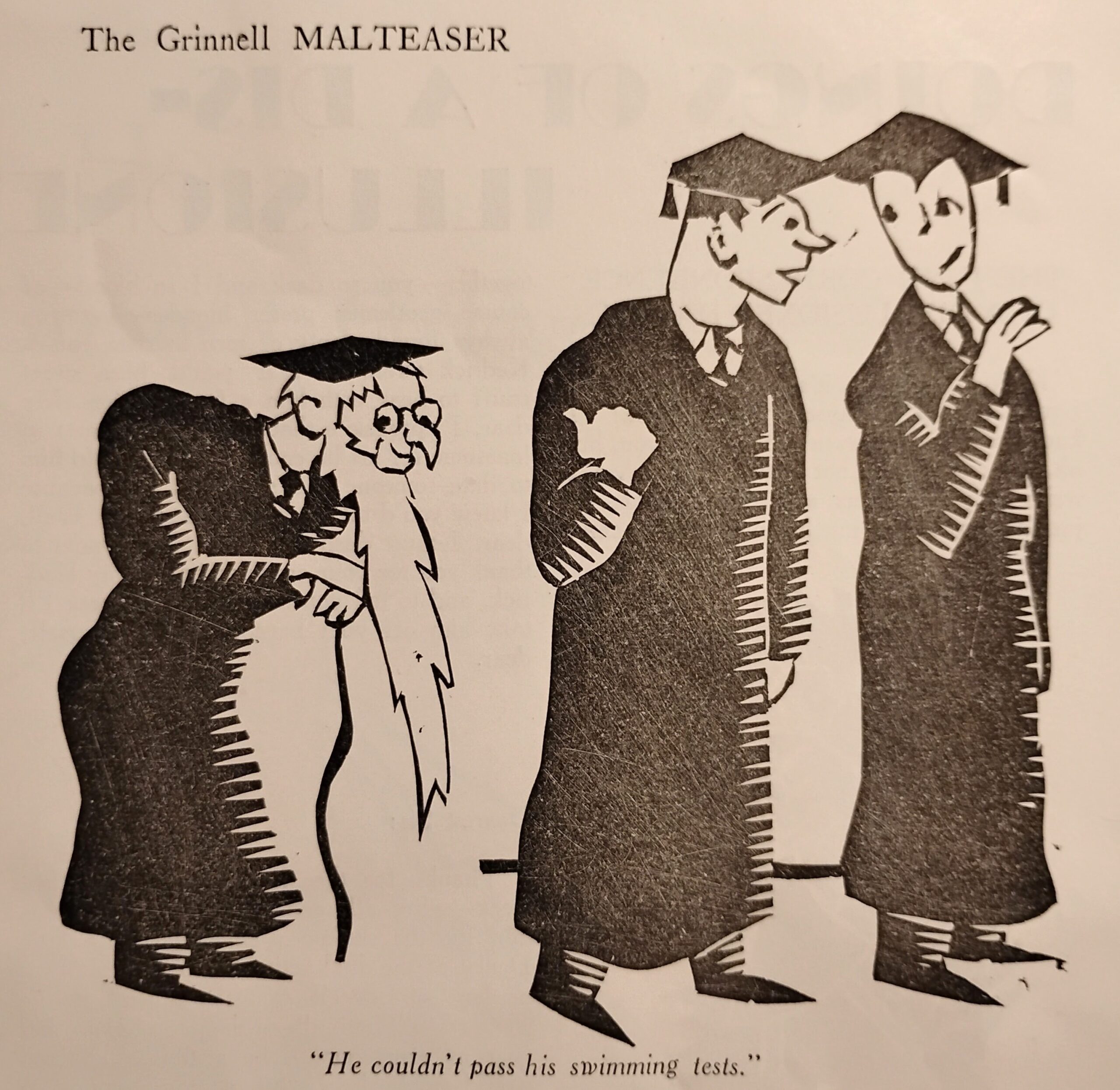
This 1930s cartoon, from a student-run magazine, The Malteaser, pokes fun at one of the relatively new requirements for graduation: passing a swim test. When the college built its first swimming pool, in 1927, it changed its physical education requirements to include a series of mandatory swimming classes, which could be circumvented by passing a swim test, administered at the start of each school year.
Swim tests became widely popular during the 1920s and 1930s, with most colleges and universities adding them to their list of graduation requirements. This trend reflected three inter-connected developments: 1.) the military’s recognition of the importance of teaching swimming to soldiers and sailors (which began at the service academies around the turn of the century, and then rippled outward through ROTC programs at many other colleges in the wake of WWI) 2.) progressive-minded campaigns to teach swimming as a life-saving technique (in an era when drowning was one of the leading causes of accidental death, and when access to pools or swimming instruction was confined to elites) 3.) the rapid expansion of physical education as a serious component of college curricula in the opening decades of the 20th century.
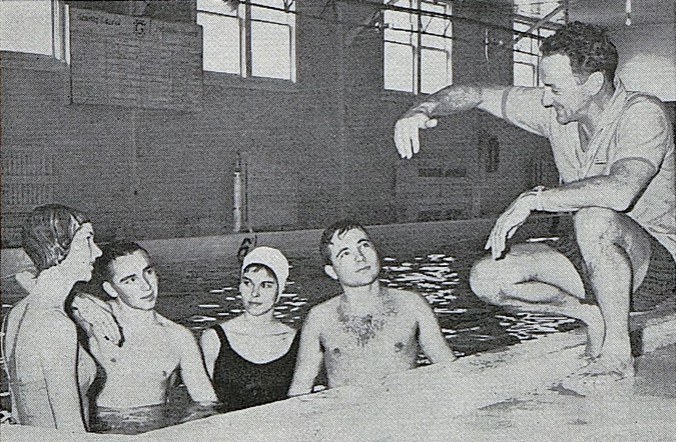 Over the years, the swimming test became one of a number of physical education tests that students had to pass for graduation. In 1961, for example, the college revised its requirements to include multiple physical fitness tests, conditioning tests, a junior “exam” in in a major and a minor sport, and most curious of all, a “dance test” that college women had to pass (in either modern, classical, or folk dance).
All of these required tests were abolished 55 years ago, when in December of 1970, the faculty voted to eliminate all physical education requirements as part of the larger overhaul that led to the open curriculum-tutorial system we have today. Interestingly, it took two faculty votes to settle the matter: the first time, the faculty voted to keep the physical education requirements, which led to some consternation and a second faculty meeting (in which an additional 30 or so faculty attended, helping to push through a majority vote in favor of jettisoning PE requirements).
One beneficiary of the change was Herbie Hancock, who did not receive his Grinnell degree in 1960, because he had not taken the swimming test or completed swim classes. With the change in requirements, the college awarded Hancock his B.A. in 1976, which helps explain why there has always been some confusion around his status (Grinnell lore often links him to other famous alumni, like Gary Cooper, who left before finishing their degrees, while Hancock’s own website, and many other sources, describe him as having received a B.A. from the college).