
Grinnell’s approach to celebrating commencement is a mixture of old and new. Some traditions span the history of the college, while others have changed considerably over the years. It’s illuminating, in fact, to compare this weekend’s commencement festivities (for the class of 2026) with what Grinnell graduates, family, and alumni experienced a hundred years ago, in 1926.
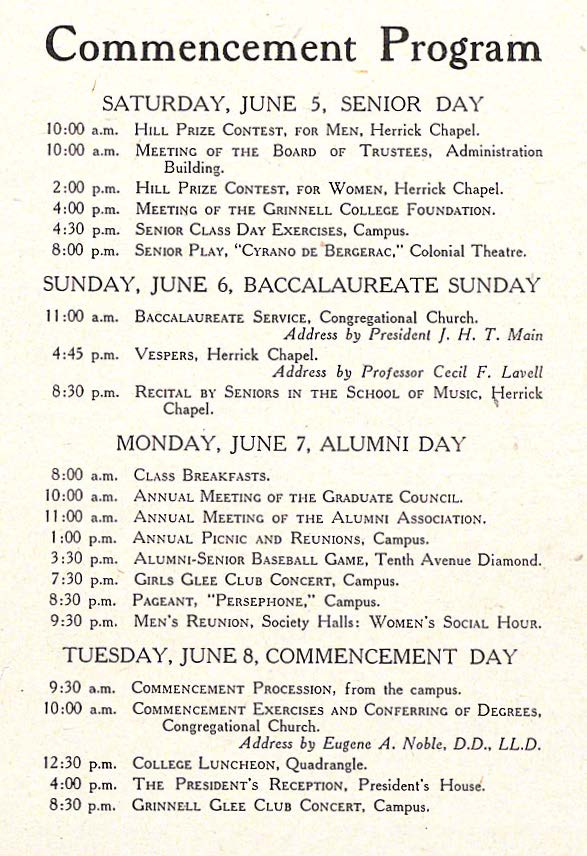 One of the first things you might notice in glancing at the commencement program from 1926 is that graduation was a June affair back then. While Grinnell classes ended by mid-May, exams were followed by an extended “pre-commencement season” devoted to pageants, performances, outings, and events. In 1926, that period included the “All College Revue,” the outdoor pageant Ceres and Persephone, various recitals, and culminated in “Pioneer Day,” replete with sporting events, picnic, band concert, parade, and an evening dance. The Senior class (comprised of 103 graduating students) also held their own special events, such as the senior picnic day at Arbor Lake.
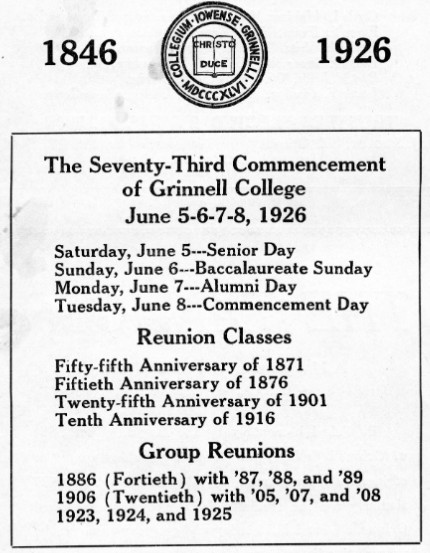 While the graduations ceremonies were the culmination of the four-day festivities in 1926, it’s important to note that alumni reunion was an integral part of the commencement celebrations in this period of Grinnell’s history.Returning alumni attended all of the ceremonies, concerts, recitals, and events (including Baccalaureate and Commencement), while the graduating seniors took an active part in the “Alumni Day” festivities held the day before graduation. Much like today, the alumni reunion was a mix of anniversary classes and clusters (which you can see in this advertisement).
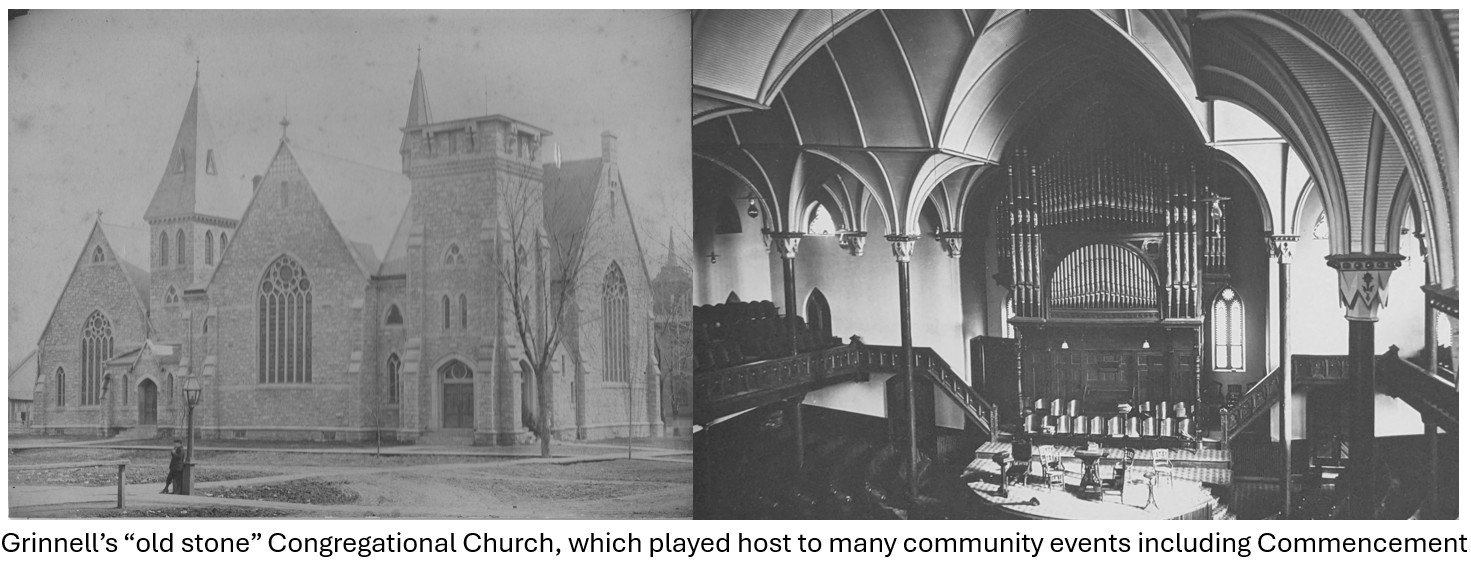
Some other noticeable differences include the larger array of concerts, performances, and competitions that filled the commencement calendar back in 1926. Graduation also took place off-campus, because the Congregational Church (on 4th and Broad St.) was the only space large enough to hold all the students, faculty, family and alumni. This gave rise to a Grinnell tradition that is no longer with us—i.e. the commencement “procession” in which all of the graduates, the faculty, and the trustees processed from Herrick Chapel to the Congregational church, led by honorary Marshalls.
 Looking back, it’s hard to imagine how people had the stamina to make it through this jam-packed calendar of events. At the same time, it also seems like a charming idea to combine graduation and alumni reunion this way, and to create so many meaningful events and performances for the senior class.
Then as now, weather was also an important factor shaping commencement weekend. It was a mixed affair in 1926: good weather for most of the evening events, and for commencement itself, but the alumni picnic had to be moved indoors due to an unexpected dust-storm, which surprised everyone. Never a dull moment in Iowa.
Leave a Reply