
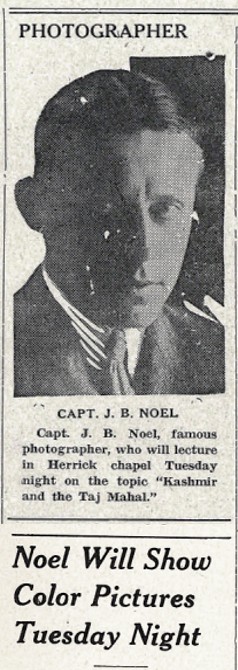
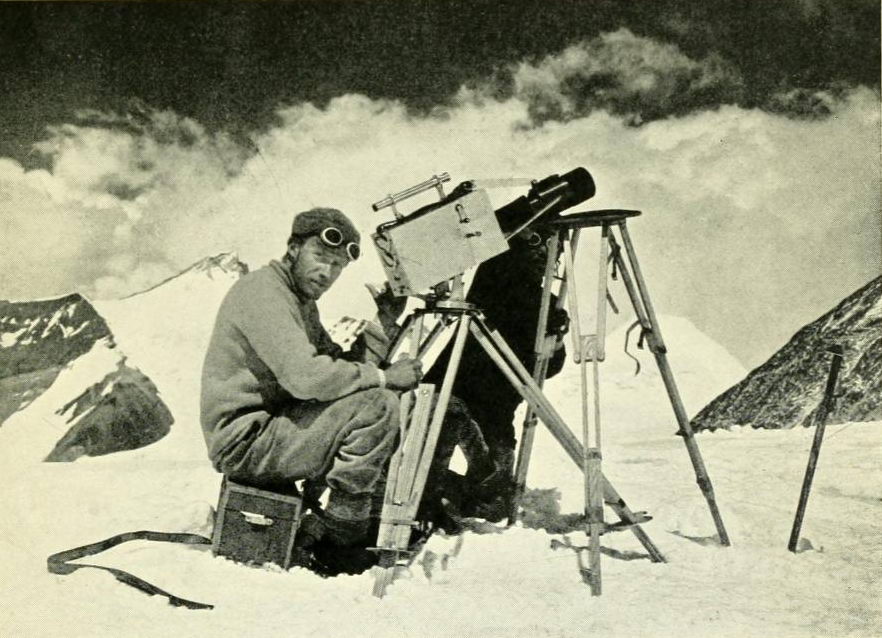
 The use of visual images in talks and lectures became more popular by the 1910s and 1920s, when one encounters increasing references to slides, film, or large illustrations appearing in advertisements for campus events. But Grinnellenians got to see the cutting edge of this technology in 1936, when the famed photographer and cinematographer, Capt. John Baptist Lucius Noel came to Herrick Chapel to present colored slides and films from his travels in South Asia. Noel had been the official photographer on the 1924 British Mount Everest expedition, which ended in tragedy, and a subsequent failed expedition two years later. His work was developed into two films, Climbing Mount Everest (1922) and The Epic of Everest (1924). In the early 1930s, he convinced Harvard University to fund an expedition through portions of Kashmir, Tibet, and Northern India–a trip that was captured in a short film, The Land of Shalimar and a series of photographic slides–both of which formed the basis for his Grinnell lecture, part of a larger North American lecture tour.
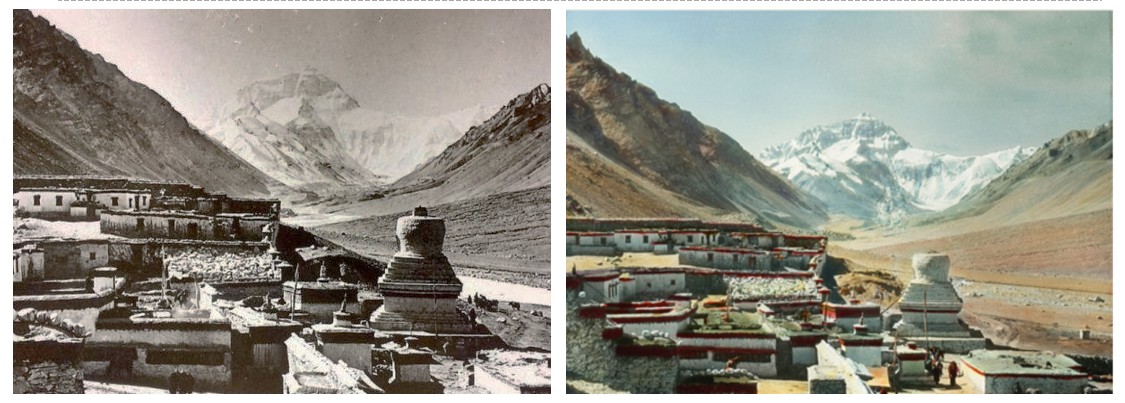
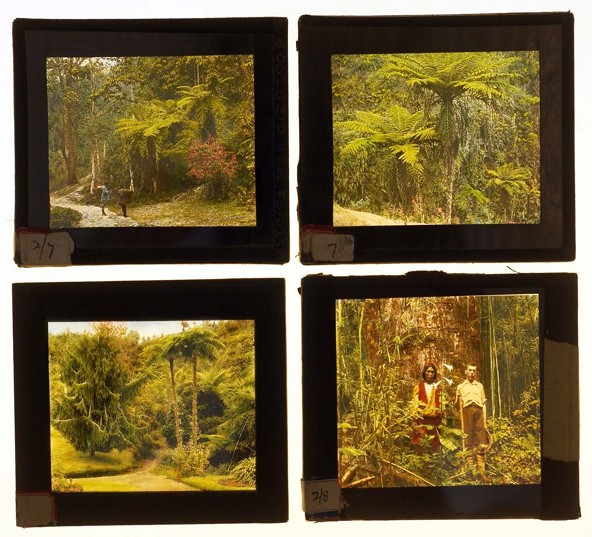
Contemporaries, as well as later scholars, consider Noel an important innovator in the development of new techniques for coloring slides and film. In particular, he developed a “Colour Dissolvograph” which allowed him to enhance the projection of hand tinted glass slides. One reviewer exclaimed: “The method of projection which is special to this particular process merges scene into scene with all the Kaleidoscopic attraction that may rightly be called transformation.” Below is one example of a carefully colored slide that Noel used (the larger collection is preserved at the Royal Geographic Society, although no surviving version of his Dissolvograph exists, sadly).
Leave a Reply