
Note: this is a postscript to the previous week’s topic (about Du Bois’ 1905 lecture at Grinnell).
In the summer of 1904, W.E.B. Du Bois agreed to give a lecture in Grinnell as part of the community’s Y.M.C.A lecture series. The talk would be part of a larger Midwest speaking tour in January and February of 1905, taking Du Bois to various communities in Illinois, Wisconsin, and Iowa.
Yet, the first two months of 1905 proved to be some of the most consequential weeks in Du Bois’ career. Dismayed by the accommodationist stance of Booker T. Washington, and the hard-ball tactics of his “Tuskegee Machine,” Du Bois chose this moment to publicly break with Washington. In January, he published an article, “Debit and Credit” in The Voice of the Negro magazine, accusing Washington of systematically bribing the African-American press to silence his critics. The essay set of a firestorm of controversy, with Du Bois’ receiving numerous letters in February asking for proof or further comment. While travelling to and from Grinnell, for example, Du Bois was drafting letters to Oswald Garrison Villard, the powerful editor of the New York Evening Post, explaining his accusations, while also writing to his friend, William Monroe Trotter (editor of the influential Guardian paper) to provide more concrete evidence to satisfy skeptics. The controversy served as a sort of Rubicon, pushing Du Bois to turn this growing rift into an official break—Du Bois resigned from several Washington-allied organizations in February, such as the “Committee of Twelve” and the Afro-American Council (AAC).
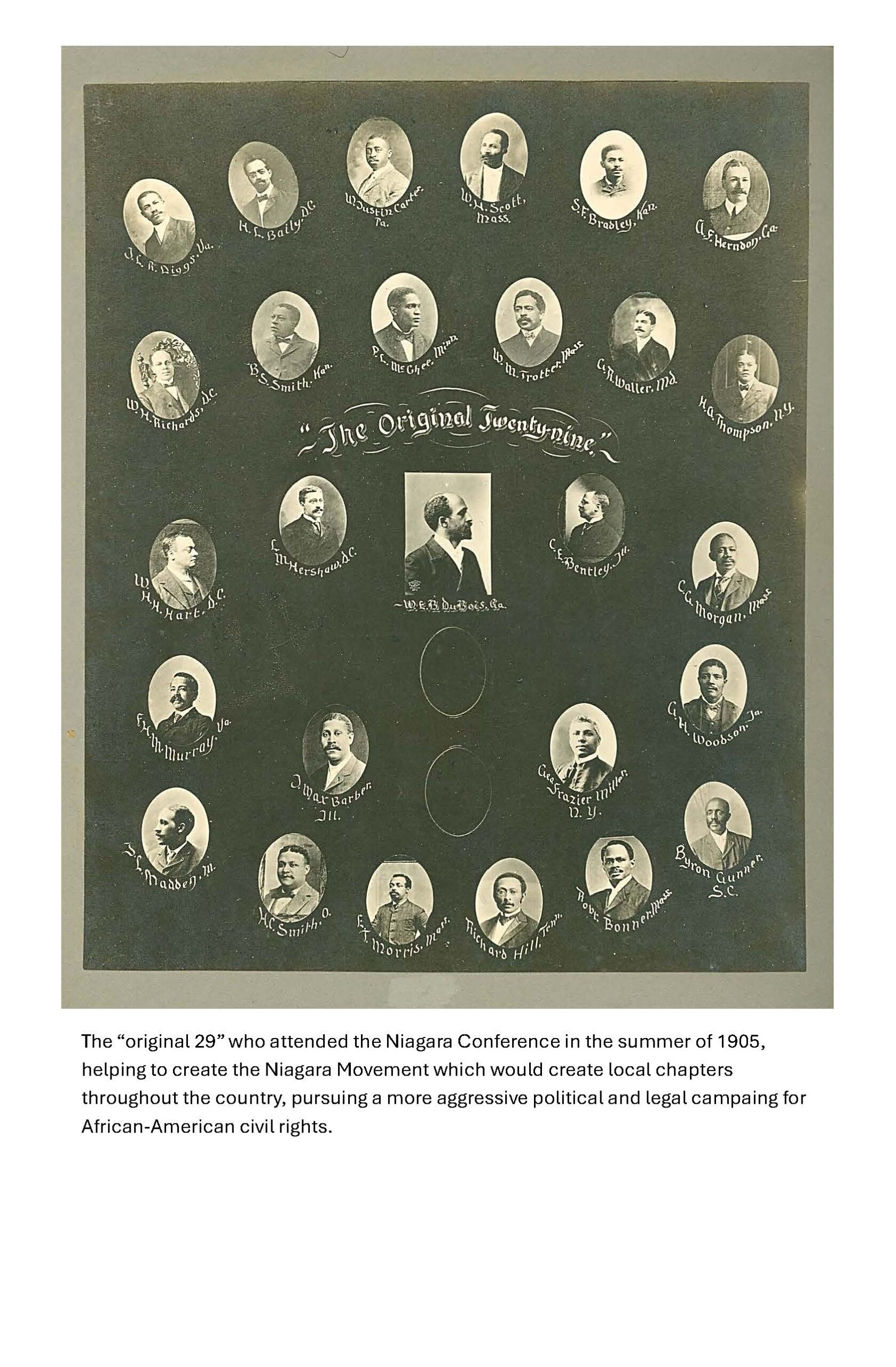 It was during this period—February of 1905—that Du Bois and a few of his close associates held key meetings to launch a new, and more aggressive, civil rights organization, which would culminate in the Niagara Movement (named after the conference, that summer, held near Niagara Falls). Because the Niagara Movement would lay the groundwork for the creation of the NAACP a few years later, historians have long been interested in tracing its origins. We know that one of these meetings was held around February 14th, when Du Bois was in Boston for a week of talks that were nestled between the Wisconsin and Iowa legs of his speaking tour (Du Bois was lecturing in Wisconsin until Feb. 6th, was in Boston from the 8th through the 15th, and then was supposed to start his Iowa tour at Grinnell on Feb. 17th). William Trotter, a leading critic of Booker T. Washington, assembled Du Bois and others for a meeting in his Boston home. Within two days, Du Bois was on a train to Grinnell, but snow prevented him from making the connection in Chicago on Feb 17th. Sometime between Feb 17thand Feb 28th, Du Bois held another meeting in Chicago, coordinated by Charles Edwin Bentley, and a pivotal meeting in Buffalo, at the home of the civil rights leader, Mary Talbert, that developed the final blueprint for the Niagara Movement (that meeting was kept secret, to avoid “spies”, but we know it included Trotter, Du Bois, Bentley, Ida B. Wells, Frederick McGhee and others). From there, Du Bois made an unexpected trip to the twin cities (Feb 26-28), to meet with Frederick McGhee to further develop plans for the summer conference. And then Du Bois boarded a train from St. Paul’s to Grinnell to deliver his rescheduled lecture on March 2.
It appears, then, that the snowstorm and cancellation of Du Bois’ Iowa circuit came at a key moment when he was racing to organize this new political movement (although Grinnell audiences at the colonial theater would have had little clue about all these developments unfolding behind the scenes).
Leave a Reply