Category: 2025-26 Page 2 of 4

The Women’s Edition of the Scarlet & Black

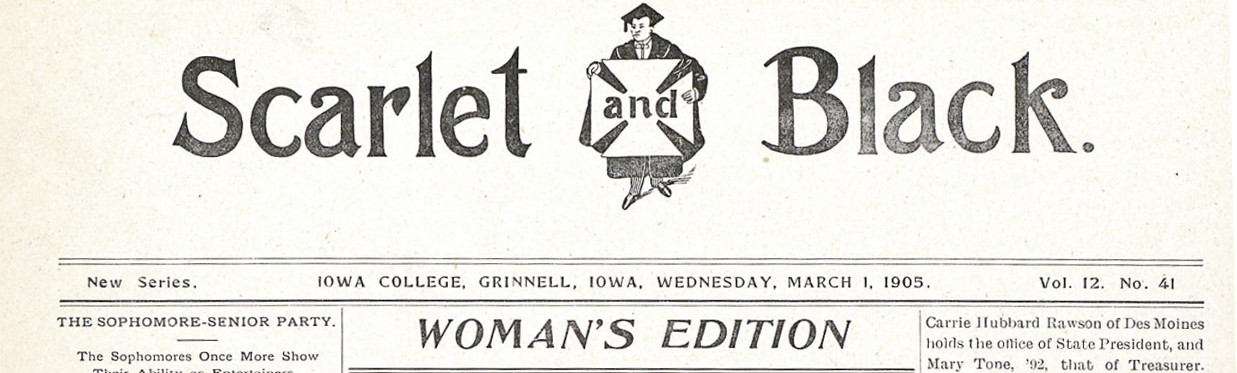
In the spring of 1905, the editorial board of the Scarlet and Black turned over their paper to a special editorial team that would create the paper’s first “Woman’s Edition,” which appeared on March 1st. The all-female team—led by Adah Hopkins ’05 (who would go on to teach Sociology at the college before carving out a trailblazing career in the newly professionalized field of social work)—noted the surprising lack of women in shaping the college’s newspaper. At a time when women outnumbered men at Grinnell (267 to 195), and had such “a prominent share” in the literary clubs and cultural life of the institution, the lack of female input and leadership in the school paper was striking: “for several years the Scarlet and Black has been entirely in the hands of the men of the institution.”
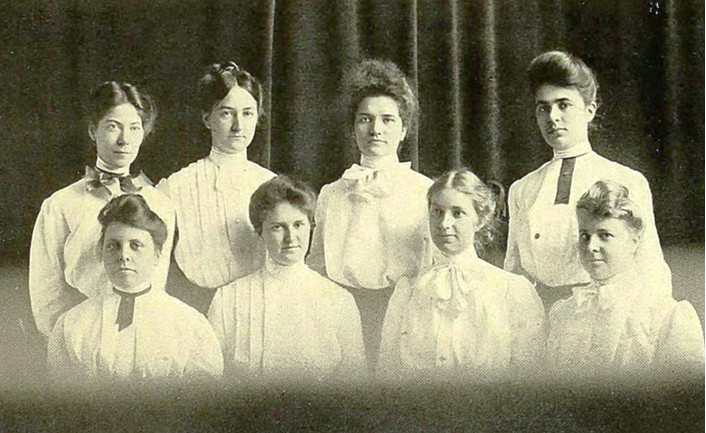
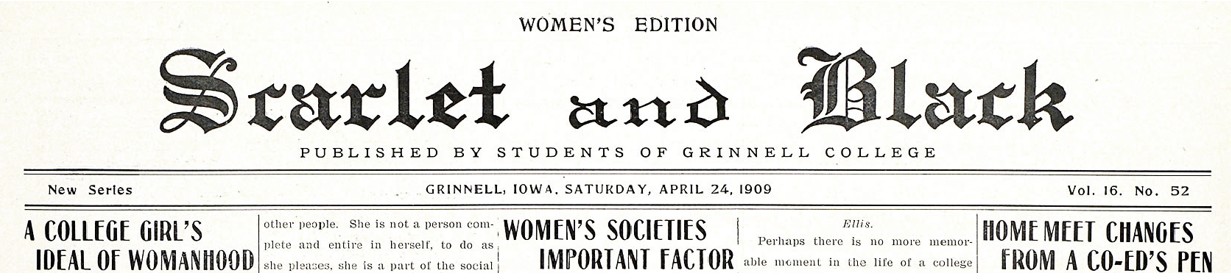
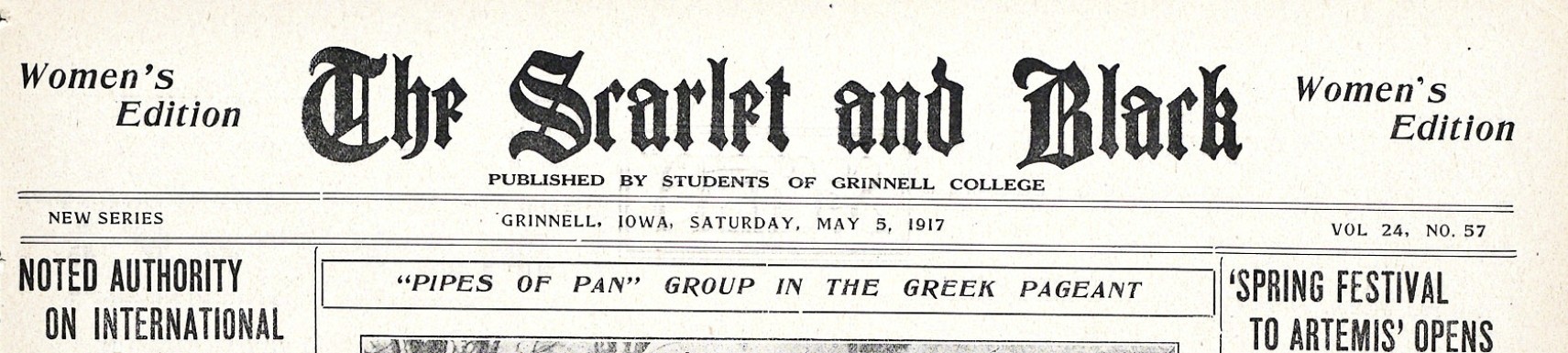
While the first woman’s edition would aim to reflect the interests, perspectives, and voice of women on campus, they also conveyed their hopes “of future appearances some years hence, of Woman’s Editions of forty pages, properly illustrated” that would serve “as a record of the history and conditions of co-ed life at Grinnell.” For a dozen years or so, the S&B carried on this tradition of creating a special women’s edition each year, produced by an all-female team (the spelling changed to women’s, instead of woman’s, and they dropped the title of “editresses”). Over time, these special editions would start to include a growing numbers of letters, sent in by alumnae, expressing their appreciation for these annual issues. But like so many other elements of the Progressive era, this tradition ended in 1917, disrupted by the First World War never to really resume. Still, these editions continue to offer a unique “record of the history and conditions of co-ed life at Grinnell” and are fascinating to explore.
1905 Editorial Statement: 1905 editorial

Alumnae Letters: Alumnae Letter Section
 

Documenting the Glee Club’s “Western Tour” (1909)

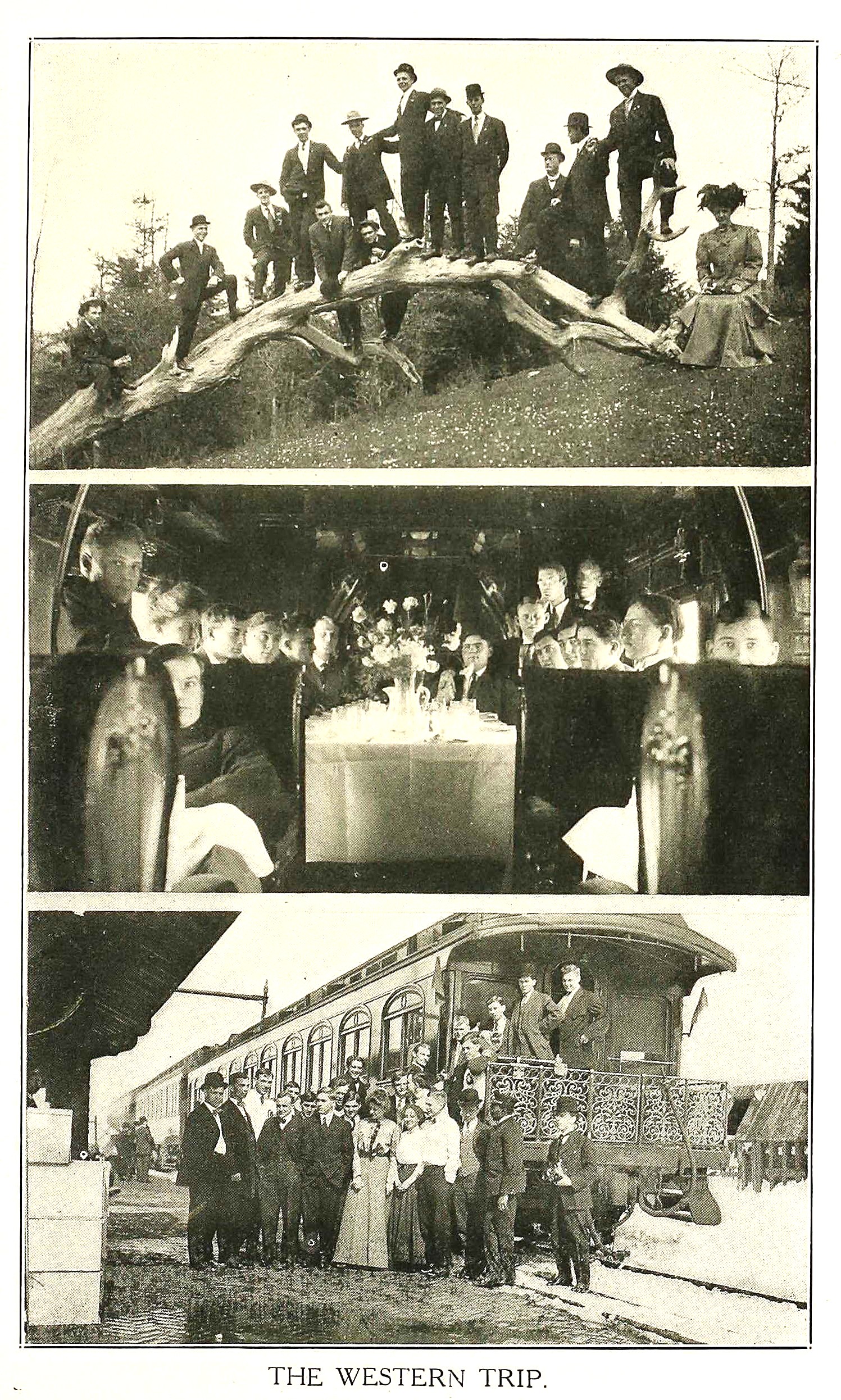
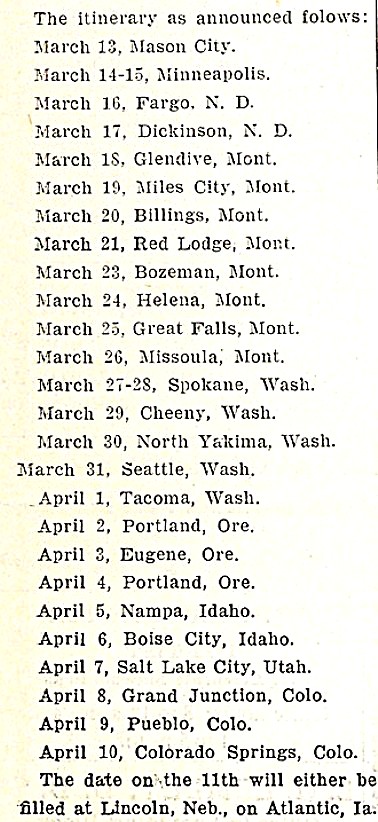
In the spring of 1909, the Men’s glee club spent an entire month touring the Great Plains and Pacific Northwest. It was estimated that they travelled about 5,000 miles, through 11 states; performing 26 “secular” concerts, 6 “sacred” concerts, and a number of informal events at high schools and Y.M.C.A.s, to “an aggregate audience of some fifteen thousand people”—all at a grand cost of five thousand dollars.

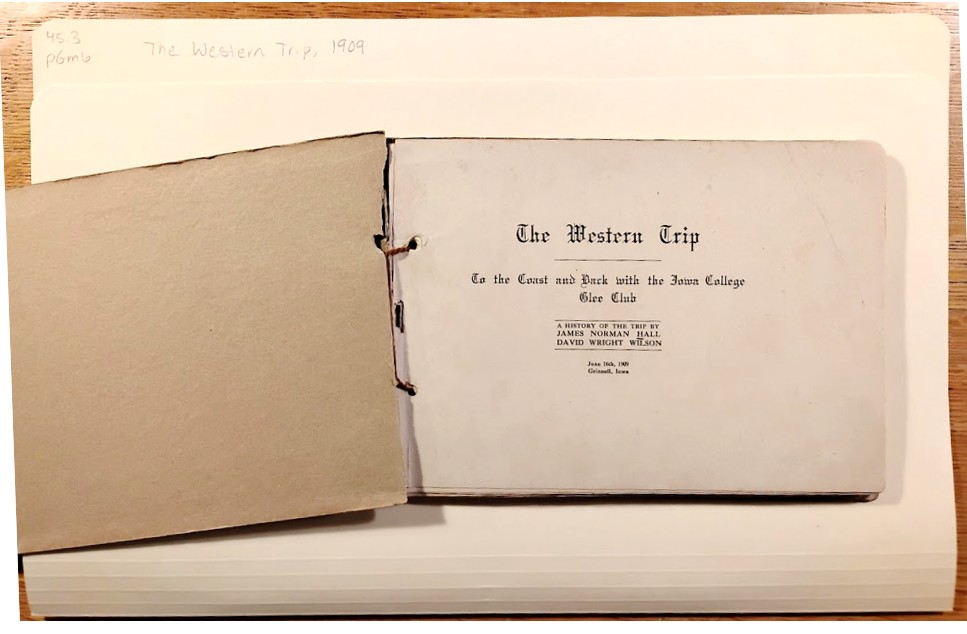
To commemorate this momentous tour, members of the Glee club created a scrap book that recorded each day of the trip, along with pictures and commentary. A local printer published a small run of this work as The Western Trip: To the Coast and Back with the Iowa College Glee Club: A History of the Trip by James Normal Hall and David Wright Wilson (a copy of which is in special collections in Burling Library, for anyone who wants to read about their adventures).


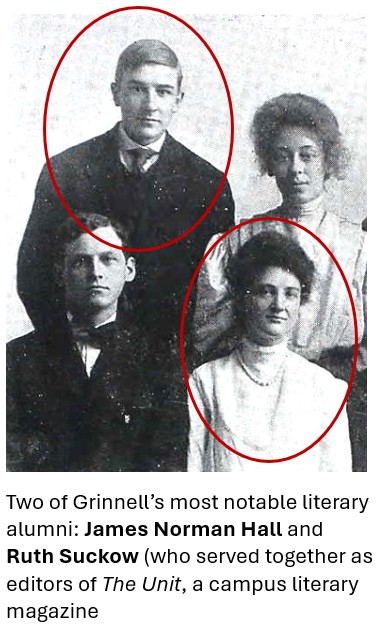
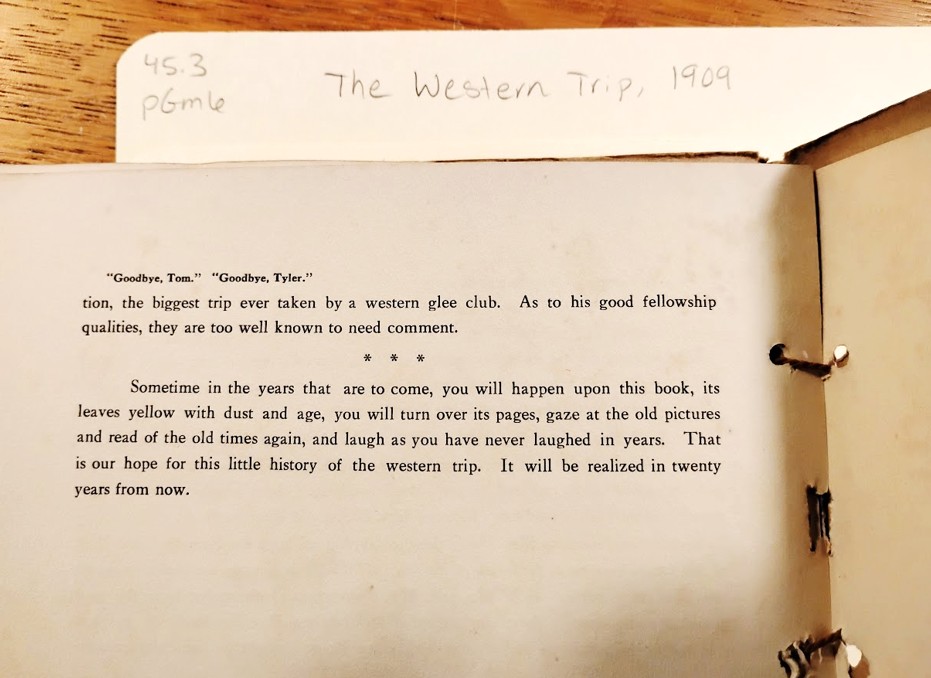
One noteworthy feature of the book is that it represents the first publication of James Norman Hall (class of ’10), who would go on to become a prolific writer and novelist (most known for his Bounty trilogy that began with Mutiny on the Bounty in 1932). It is also interesting to see how the book ends, with a note to future readers who will encounter it’s yellowing pages in decades to come…

Spring Break Travels (1909)

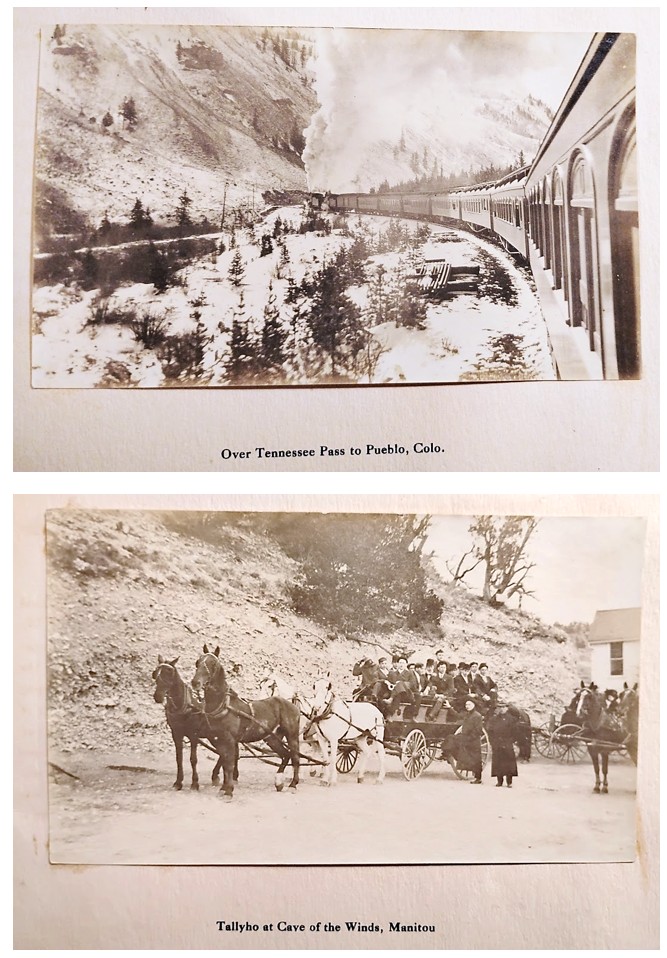
While college Glee Club had a tradition of utilizing the breaks to perform throughout Iowa, or nearby states, the spring of 1909 witnessed something much more ambitious in scope, as the Men’s Glee Club lined up a month’s long, performing tour of the American West.  The club departed from Grinnell in their own “private Pullman car especially fitted for the trip, with all the modern conveniences and comforts.”  At first, the Iowa Central line pulled their private car to Minneapolis, where it joined a larger train on the Great Northern Railroad line, that took them across the Great Plains, and ultimately to Seattle, where they joined the Oregon Line, then the Denver & Rio Grande Line, as they made their way through Idaho, Utah, Colorado, and Nebraska (see the schedule below). From March 13th to April 12th, the Glee Club toured in style.  There was some controversy when they returned, however, since they decided to finance the trip by charging $1 admission to future concerts in Grinnell, generating push-back from local students and townspeople who were not used to paying admission to hear them perform.

The Ballad of the Squirrels

In the past few years, squirrels seem to be everywhere on campus. From the giant inflatable squirrel that welcomed new students in August, to the gleaming squirrel statute carved out of a block of ice in January, these charming rodents have become the unofficial mascot of Grinnell College.

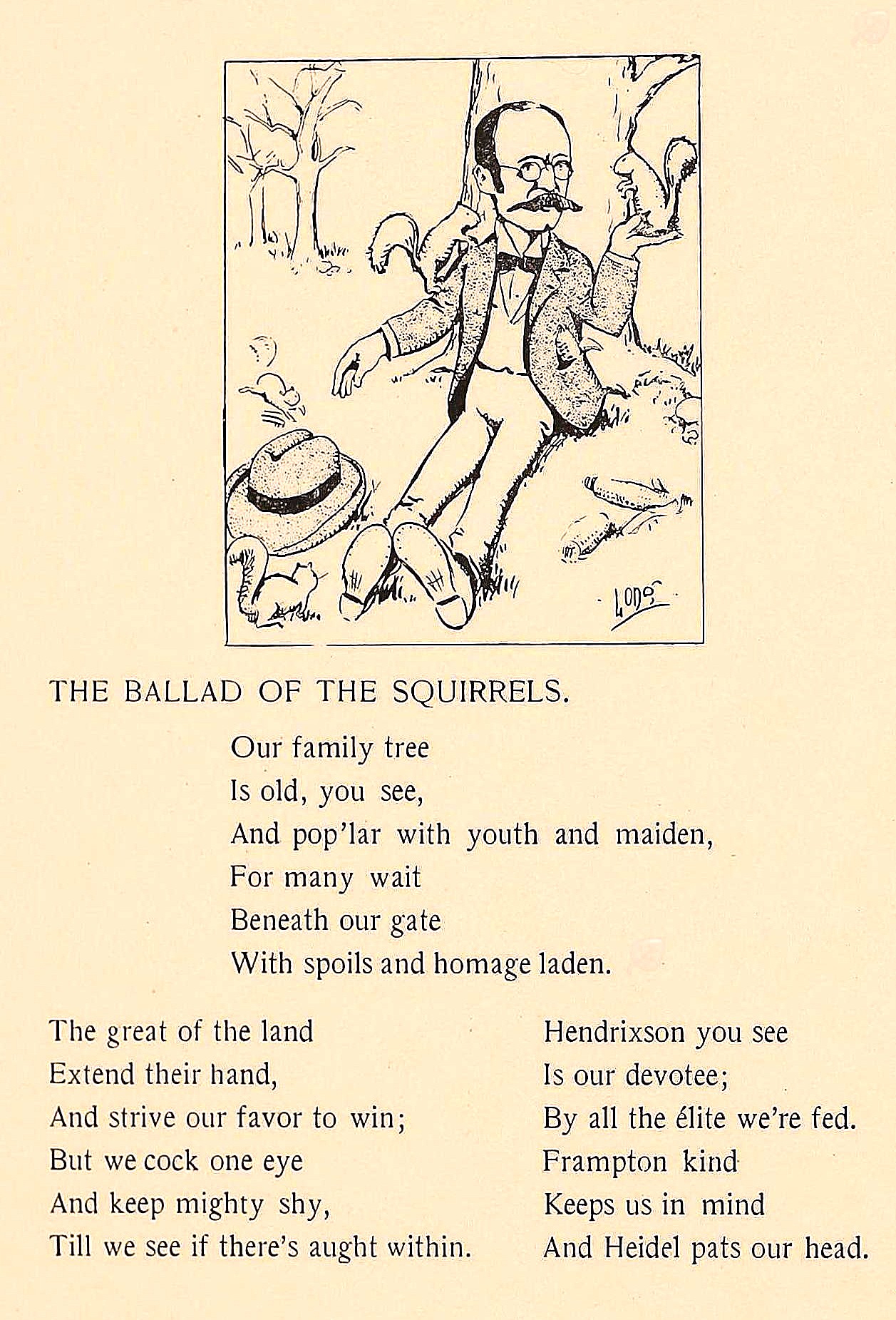
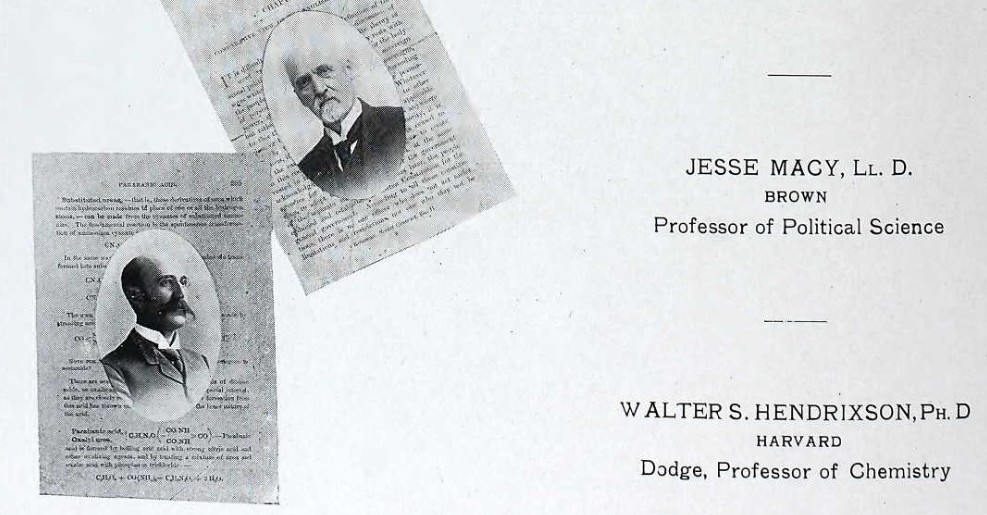
This 1894 cartoon and poem, “The Ballad of the Squirrels,” shows that our love affair with these furry denizens goes back a long way.  The cartoon shows Walter Scott Hendrixson—the Dodge Professor of Chemistry, long-time Grinnell faculty member, and apparently squirrel “devotee”—spending some quality time with campus squirrels. Hendrixson was known to feed them regularly, along with other faculty members (the poem mentions the college organist, John Ross Frampton, and the classics professor, William Arthur Heidel).

This yearbook image shows that the student artist did a good job of capturing Hendrixson’s likeness (particularly his impressive, walrus-like, mustache).

Grinnell’s love affair with squirrels was part of a larger trend in the early 20th century, as college campuses across the country sought to transform their grounds into more park-like environments, and actively encouraged birds and squirrels to become residents, helping mitigate some of the feelings of being isolated from nature that were affecting a generation experiencing rampant urbanization (as well as the disappearance of wildlife & wilderness in rural communities).

A Fateful February: The Busy Agenda of W.E.B. Du Bois in Feb 1905

Note: this is a postscript to the previous week’s topic (about Du Bois’ 1905 lecture at Grinnell).


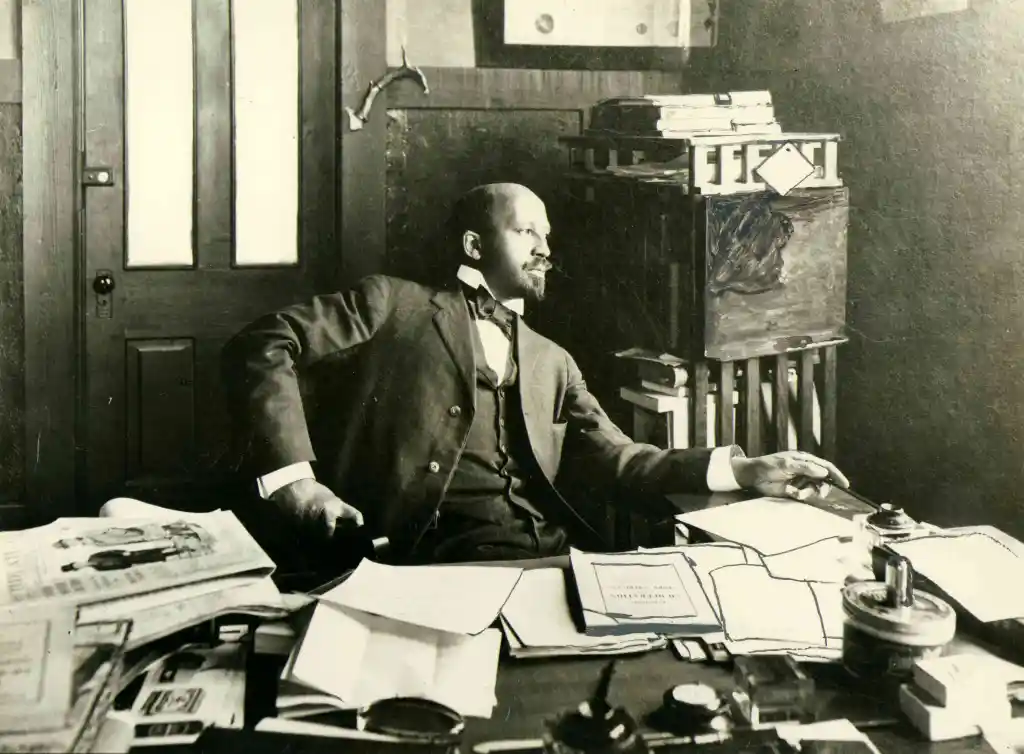
In the summer of 1904, W.E.B. Du Bois agreed to give a lecture in Grinnell as part of the community’s Y.M.C.A lecture series. The talk would be part of a larger Midwest speaking tour in January and February of 1905, taking Du Bois to various communities in Illinois, Wisconsin, and Iowa.

Yet, the first two months of 1905 proved to be some of the most consequential weeks in Du Bois’ career. Dismayed by the accommodationist stance of Booker T. Washington, and the hard-ball tactics of his “Tuskegee Machine,” Du Bois chose this moment to publicly break with Washington. In January, he published an article, “Debit and Credit” in The Voice of the Negro magazine, accusing Washington of systematically bribing the African-American press to silence his critics. The essay set of a firestorm of controversy, with Du Bois’ receiving numerous letters in February asking for proof or further comment. While travelling to and from Grinnell, for example, Du Bois was drafting letters to Oswald Garrison Villard, the powerful editor of the New York Evening Post, explaining his accusations, while also writing to his friend, William Monroe Trotter (editor of the influential Guardian paper) to provide more concrete evidence to satisfy skeptics. The controversy served as a sort of Rubicon, pushing Du Bois to turn this growing rift into an official break—Du Bois resigned from several Washington-allied organizations in February, such as the “Committee of Twelve” and the Afro-American Council (AAC).

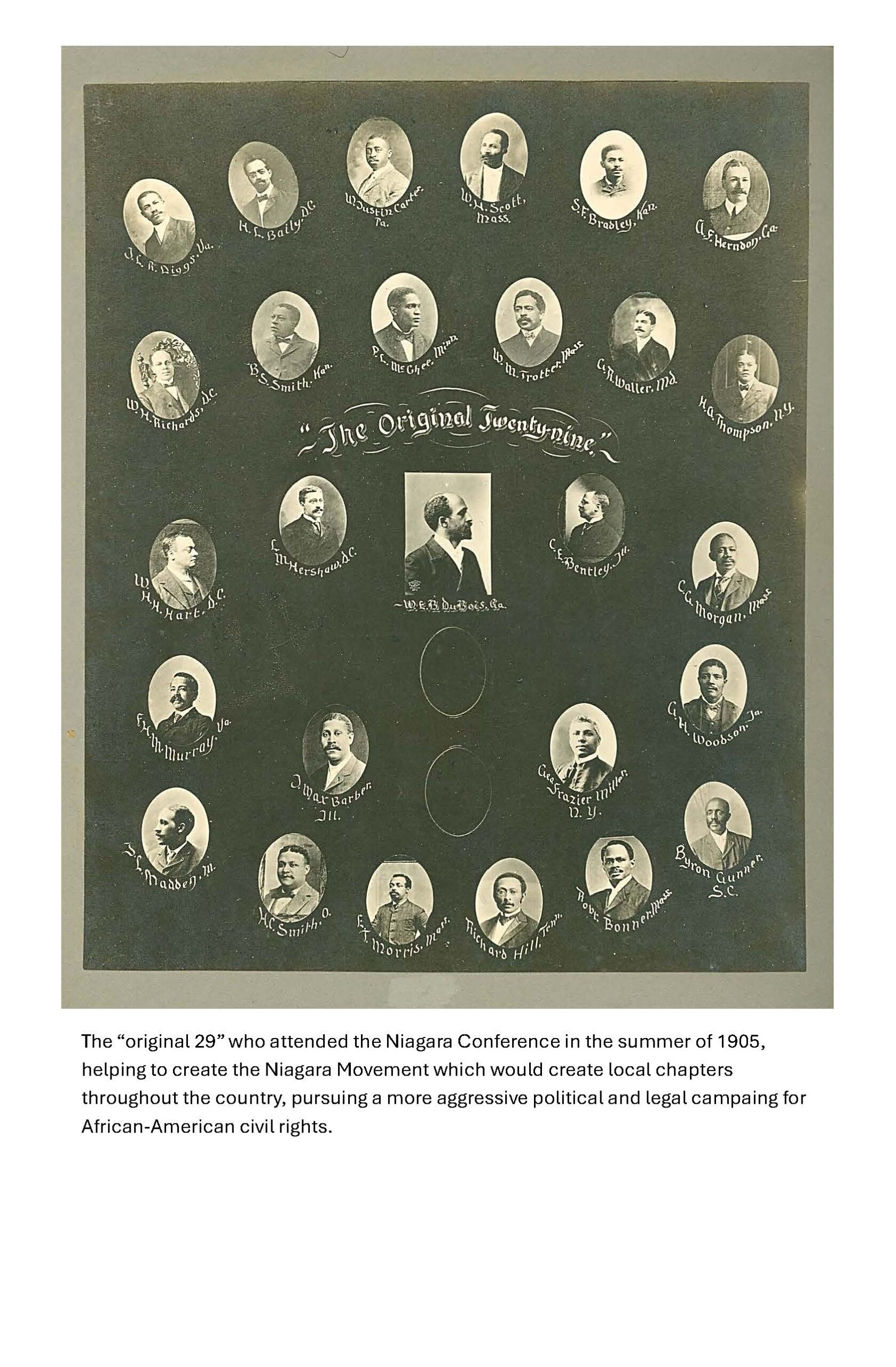
It was during this period—February of 1905—that Du Bois and a few of his close associates held key meetings to launch a new, and more aggressive, civil rights organization, which would culminate in the Niagara Movement (named after the conference, that summer, held near Niagara Falls). Because the Niagara Movement would lay the groundwork for the creation of the NAACP a few years later, historians have long been interested in tracing its origins. We know that one of these meetings was held around February 14th, when Du Bois was in Boston for a week of talks that were nestled between the Wisconsin and Iowa legs of his speaking tour (Du Bois was lecturing in Wisconsin until Feb. 6th, was in Boston from the 8th through the 15th, and then was supposed to start his Iowa tour at Grinnell on Feb. 17th). William Trotter, a leading critic of Booker T. Washington, assembled Du Bois and others for a meeting in his Boston home. Within two days, Du Bois was on a train to Grinnell, but snow prevented him from making the connection in Chicago on Feb 17th.  Sometime between Feb 17thand Feb 28th, Du Bois held another meeting in Chicago, coordinated by Charles Edwin Bentley, and a pivotal meeting in Buffalo, at the home of the civil rights leader, Mary Talbert, that developed the final blueprint for the Niagara Movement (that meeting was kept secret, to avoid “spies”, but we know it included Trotter, Du Bois, Bentley, Ida B. Wells, Frederick McGhee and others).  From there, Du Bois made an unexpected trip to the twin cities (Feb 26-28), to meet with Frederick McGhee to further develop plans for the summer conference.  And then Du Bois boarded a train from St. Paul’s to Grinnell to deliver his rescheduled lecture on March 2.
It appears, then, that the snowstorm and cancellation of Du Bois’ Iowa circuit came at a key moment when he was racing to organize this new political movement (although Grinnell audiences at the colonial theater would have had little clue about all these developments unfolding behind the scenes).

Visualizing The Color Line: W.E.B. Du Bois’ Grinnell Lecture (1905)

In the early 1900s, the Y.M.C.A. lecture series was an important institution in the shared intellectual life of Grinnell, bridging town and gown. Each year, a local committee of the Y.M.C.A. lined up a program of nationally renowned politicians, writers, musicians, orators, theologians, or performers who would appear monthly at the Congregational Church, or the Colonial Theatre (the two largest venues in town).

In February 1905, Grinnellians were looking forward to the next scheduled speaker in the “Y” series, the famed historian, sociologist, and intellectual, W.E.B. Du Bois. In fact, the prior speaker, Senator Robert LaFollete (a lion of progressive politics) had reportedly told the assembled crowd  “Miss anything else this winter, but do not miss hearing Professor Du Bois.” Unfortunately, a Valentine’s Day snowstorm cancelled Du Bois’ train (even back then, winter weather made scheduling visits and speakers a fraught endeavor). But the committee coordinated with Du Bois to reschedule his lecture for Thursday, March 2nd, when he spoke before “one of the largest audiences of the season.”

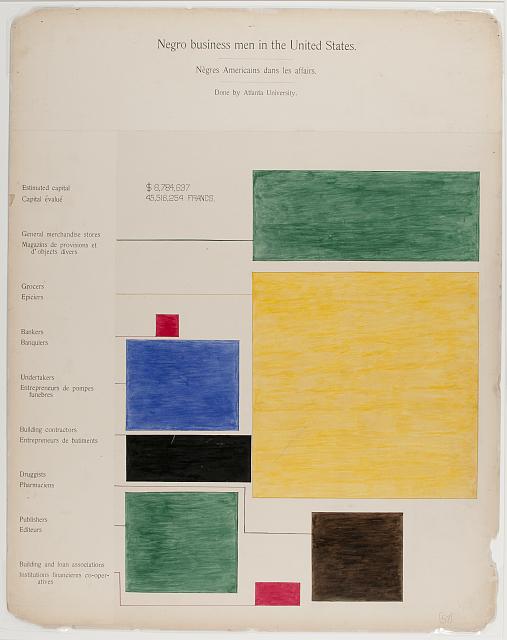
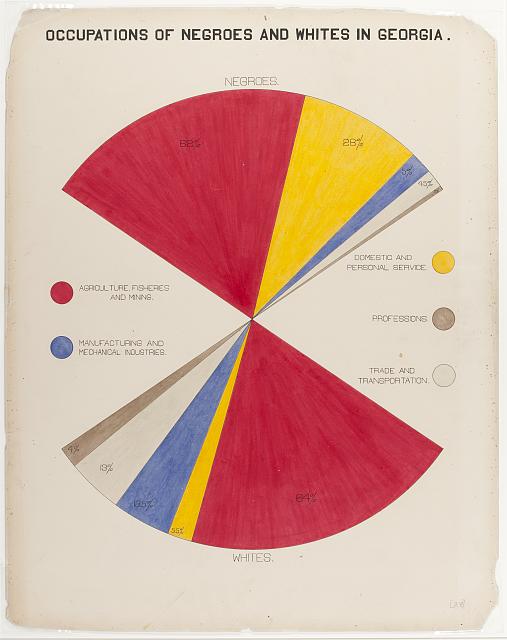
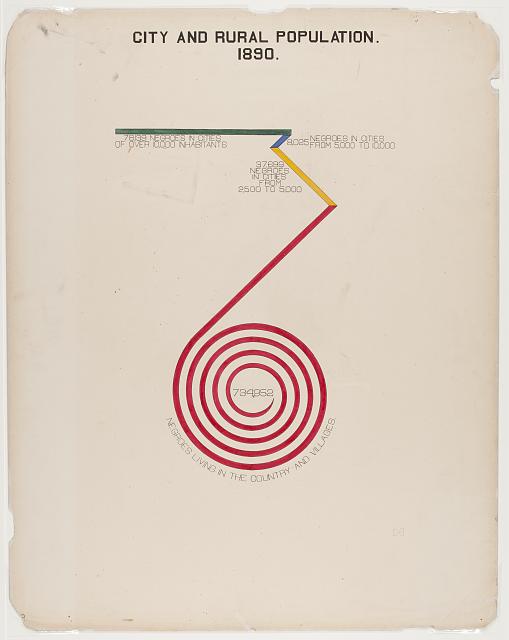
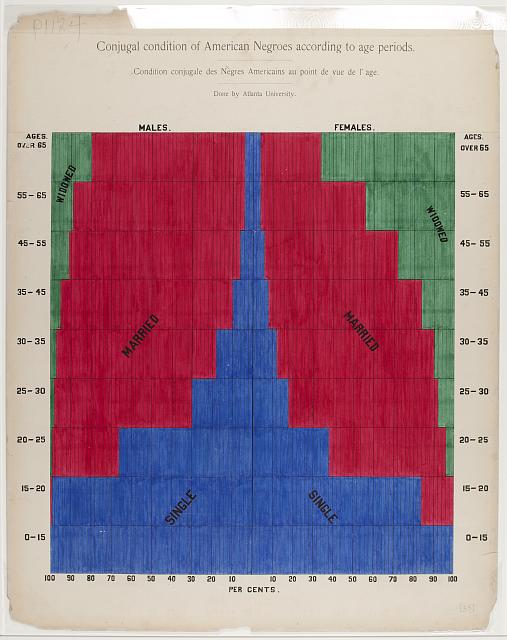
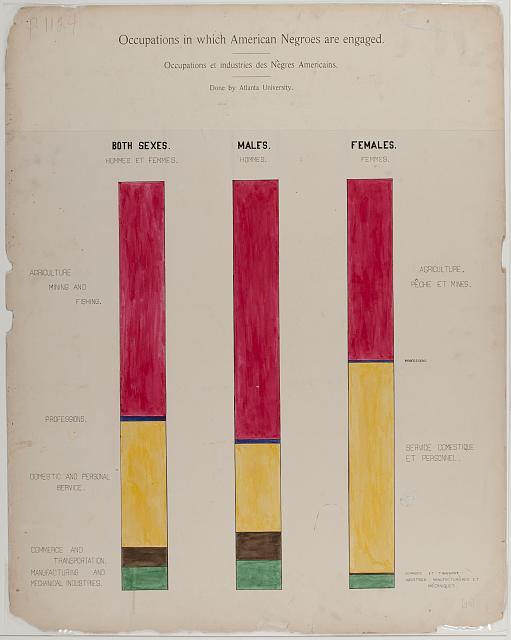
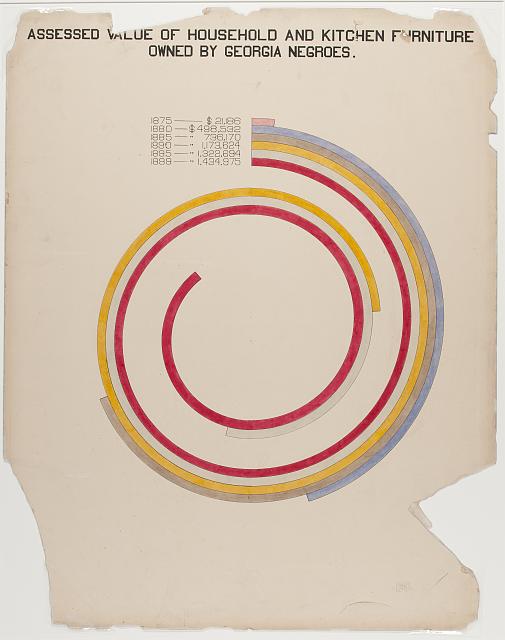
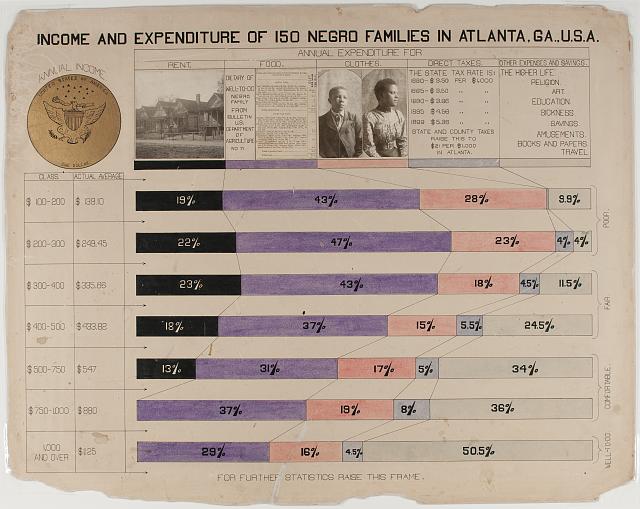
His address, entitled “The South and Its Problems,” focused on the systematic discrimination that African Americans faced in the Jim Crow South, and Du Bois illustrated these systematic consequences through a series of novel “charts…which greatly assisted the audience to a clear understanding of the importance of the problems and the direction recent developments have taken.” These colorful “charts” had been carefully created by Du Bois and his students at his Sociological Laboratory, at Atlanta University, where they creatively experimented with new kinds of data visualizing strategies that turned census data into evocative infographics. Each year, Du Bois and his students focused on a particular theme: in 1905, they were working on the issues surrounding health and medicine; the previous year had focused on crime; and other recent topics included Churches & Religious Life (1903), Work & Labor (1902), Education (1901), Business (1899), and Urban Life (1897).

Just a few years before his Grinnell lecture, Du Bois had showcased 63 of these prints—what he called at the time “data portraits”—at the Paris Exposition. Some of those items, pictured here, were likely featured in his Grinnell lecture at the Colonial Theater.

Today, Du Bois’s work in the field of data visualization has begun to receive much greater attention and recognition from scholars interested in reclaiming these pioneering forms of quantitative advocacy and graphic design. Those interested in seeing more examples can explore the full collection at the library of Congress; the 2023 exhibit at the Cooper Hewitt museum, Deconstructing Power: W.E.B. Du Bois at the World’s Fair; and the interactive website, The Du Boisian Visualization Toolkit.


The Liberal Arts at Grinnell: The Birth of the Major (1895-1930s)

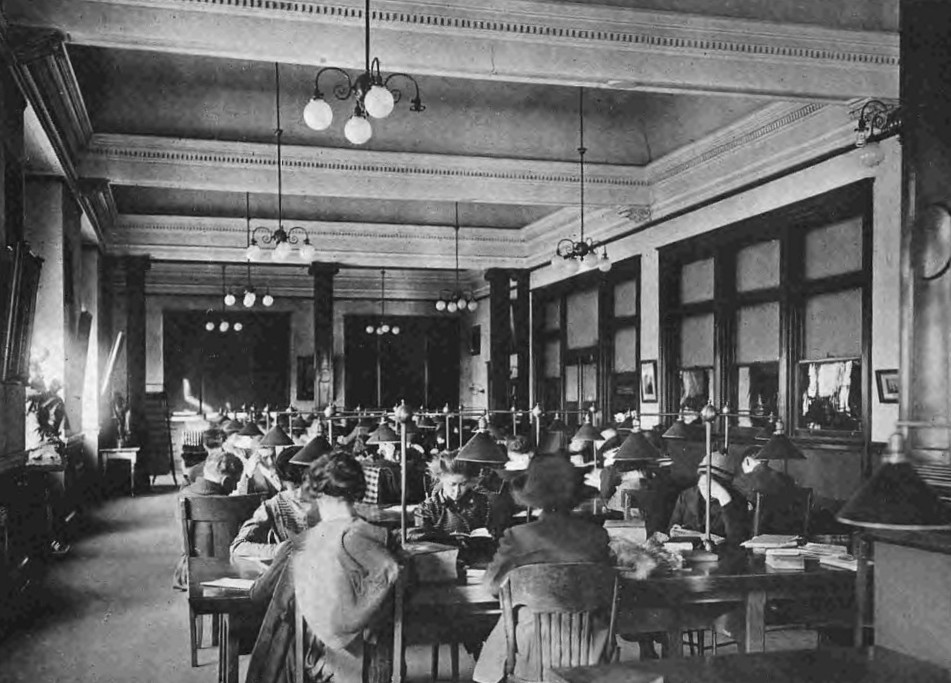
The Reading Room in Carnegie Library (1913)Carnegie Reading Room 1913
In the 1890s, there was heated debate within higher education about the appropriate way to structure the curriculum, with one camp of traditionalists favoring the established path of a carefully defined sequence of courses to be taken at each stage, while new reformers promoted a far more open curriculum that would be almost entirely elective (a trend popularized by many of the new colleges and state universities emerging in the West). Grinnell originally tried to accommodate both philosophies by having a degree track, with a well-defined sequence of courses students had to fulfill each year on their way to a bachelor’s degree, while also having an “Optional Studies” track where students could choose any array of courses they wanted, but would not lead to an actual degree.

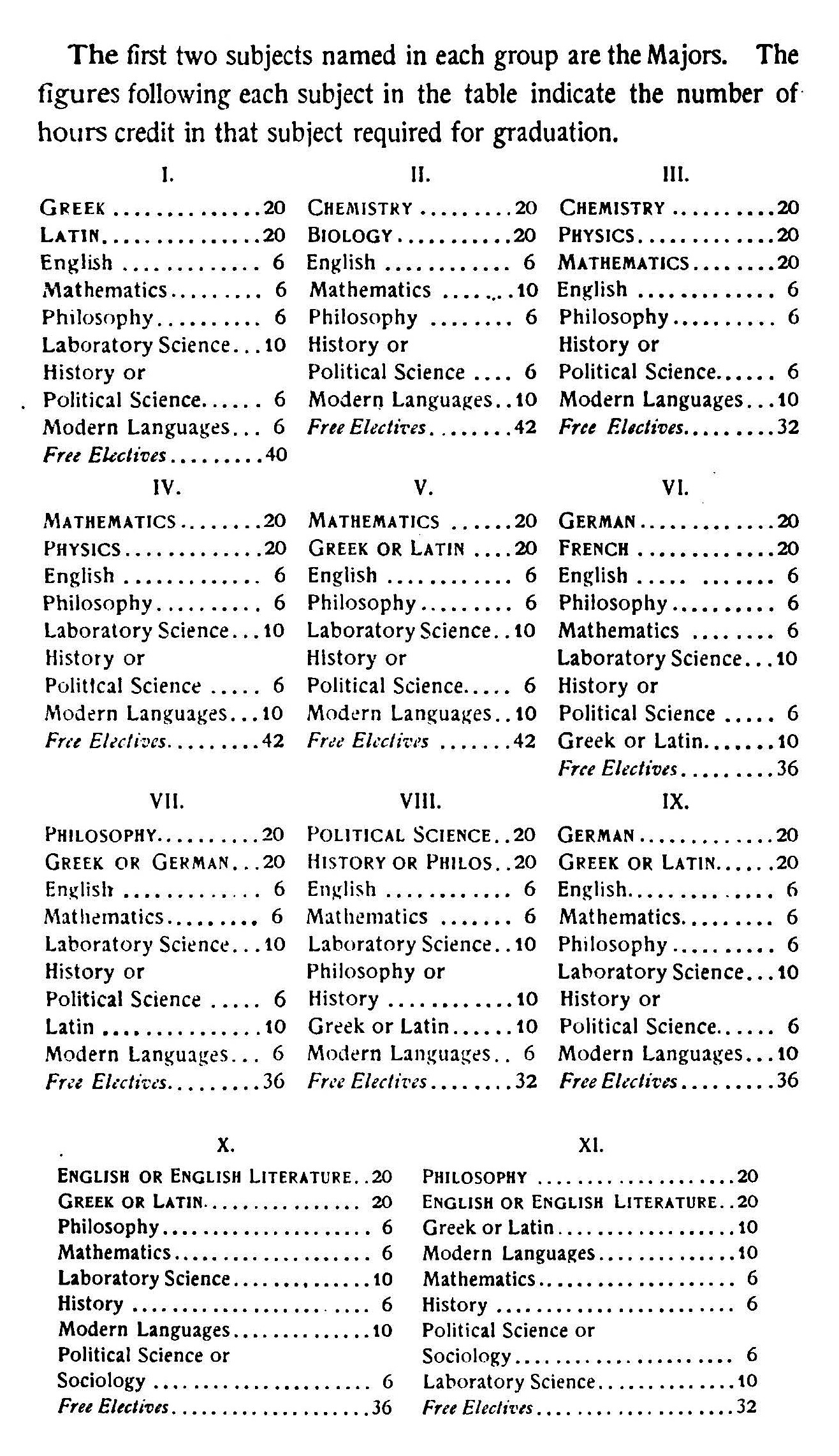
When George Gates became president of the college, in 1887, he began a series of important administrative and curricular reforms that would lead to Grinnell’s adoption of the “Group System” curriculum in 1895. This system, pioneered by the newly created Johns Hopkins’ University, tried to balance the demands of structure and choice, while addressing the mounting problem of how to incorporate new subjects into a fast-changing collegiate environment. For the first time, this system required students to choose a “major”—actually, two complimentary majors—each of which would consist of 20 credits of sequenced course work in those departments. At Grinnell, students could pair these complimentary majors in 9 combinations (increased to 11 in the catalog below), although students could also petition the newly created curriculum committee (yes, we can thank George Gates for creating the first standing committees of the faculty) to approve a new combination. In addition to their two majors (40 credits), students would also choose courses from a variety of required subjects, as specified in the catalog. But note that students could select what course to take in History, for example, or what modern language they would study (as opposed to the older curriculum which spelled out the specific classes a student would take each year).  The end result was a curriculum of roughly thirds (one third of the credits in their major fields, one third in required fields, and one third as open electives).

The college touted the virtues of this compromise, explaining that:

The Group system aims to combine the advantages of the rigid course system with those of the free elective system, while avoiding the dangers of each to maintain a proper balance between educational control on the one side and individual freedom of choice and self-direction on the other…the aim has been to organize each Group that it may afford the opportunity for a well-rounded liberal education, while preventing the waste and dissipation of energy incident to absolutely unlimited election.

To guide students in these choices, the college (for the first time ever) mandated that a faculty member should serve as an individual advisor for students who were majoring in their department.

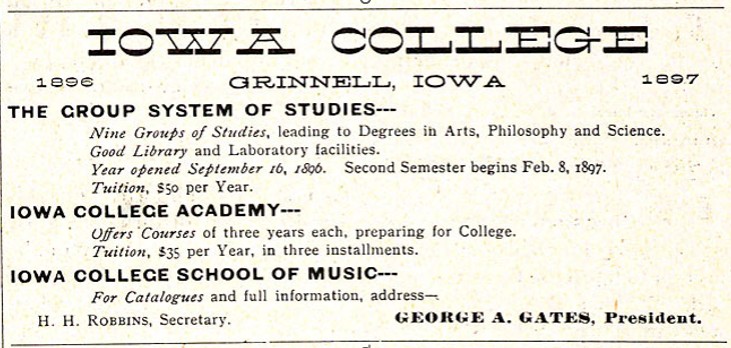
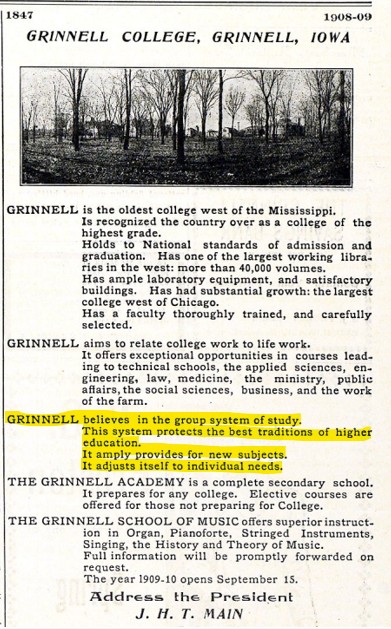
The College’s advertisements from this period (as you can see here), highlighted the group system as a defining feature of Grinnell.  While certain elements would evolve over time—the two majors, for example, became one “major” and one “minor”—the essential framework would remain in place for decades, shaping the institution.


The Liberal Arts Curriculum at Grinnell: c.1870-1895

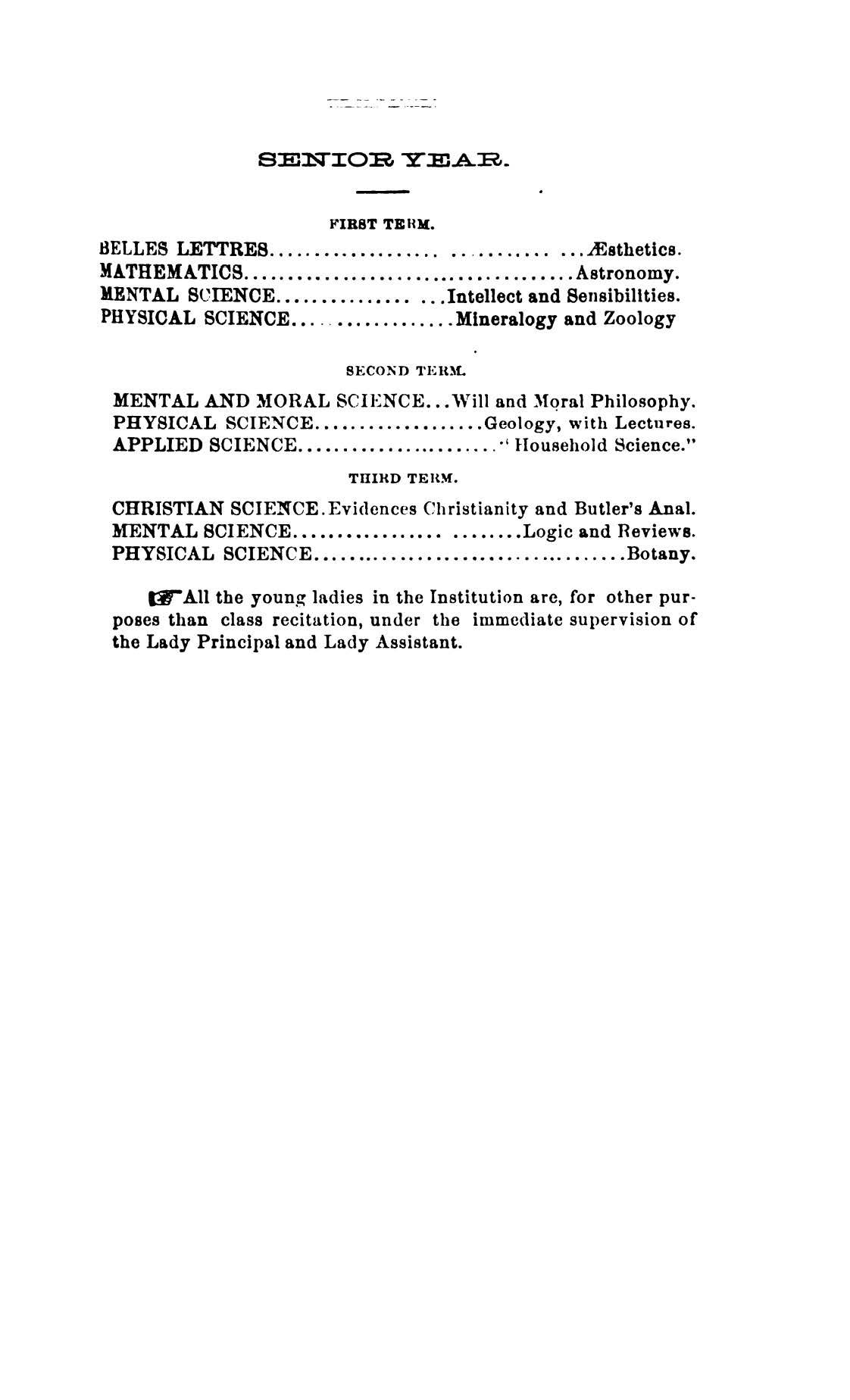
In light of recent faculty discussions, underscoring the desire for more consistent reflection and conversation about the meaning of a liberal arts education at Grinnell, we’re going to spend some time this spring highlighting how this issue has played out over the college’s history. The early years of Iowa College—both in Davenport and then subsequently in Grinnell—saw very few students attaining a bachelor’s degree, and little structure in terms of the requirement for the B.A. (most of the students were enrolled in the preparatory academy). It was the period after the Civil War, when Grinnell’s first President, George Magoun, took charge that the faculty created an organized curriculum and set of requirements for entering college students, which would hold sway until a series of curricular reforms in the 1890s.

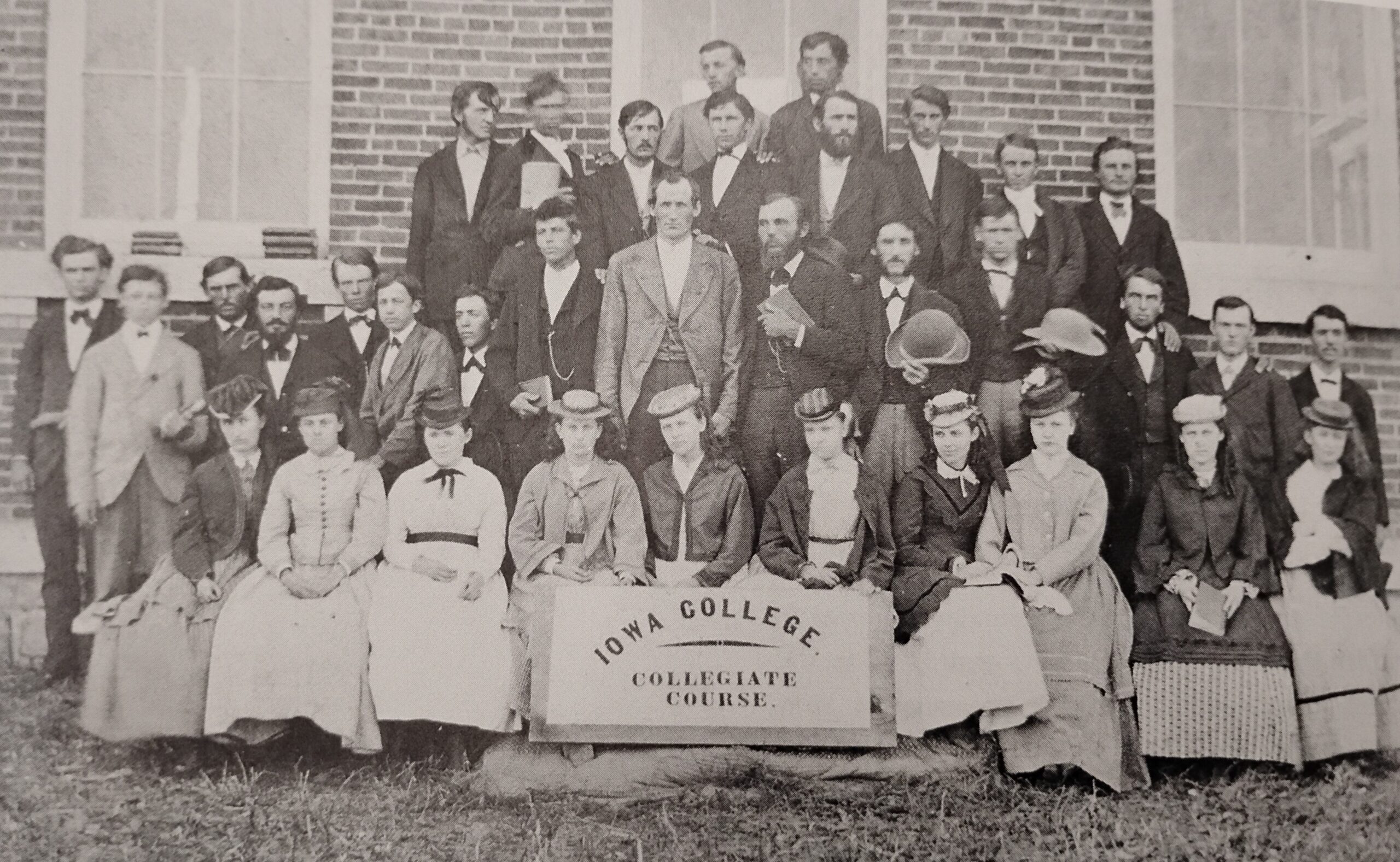
How did Grinnell approach a liberal arts education in 1870 (when the students pictured here, entered the college)?  There were four main “courses,” or tracks, that students could pursue:

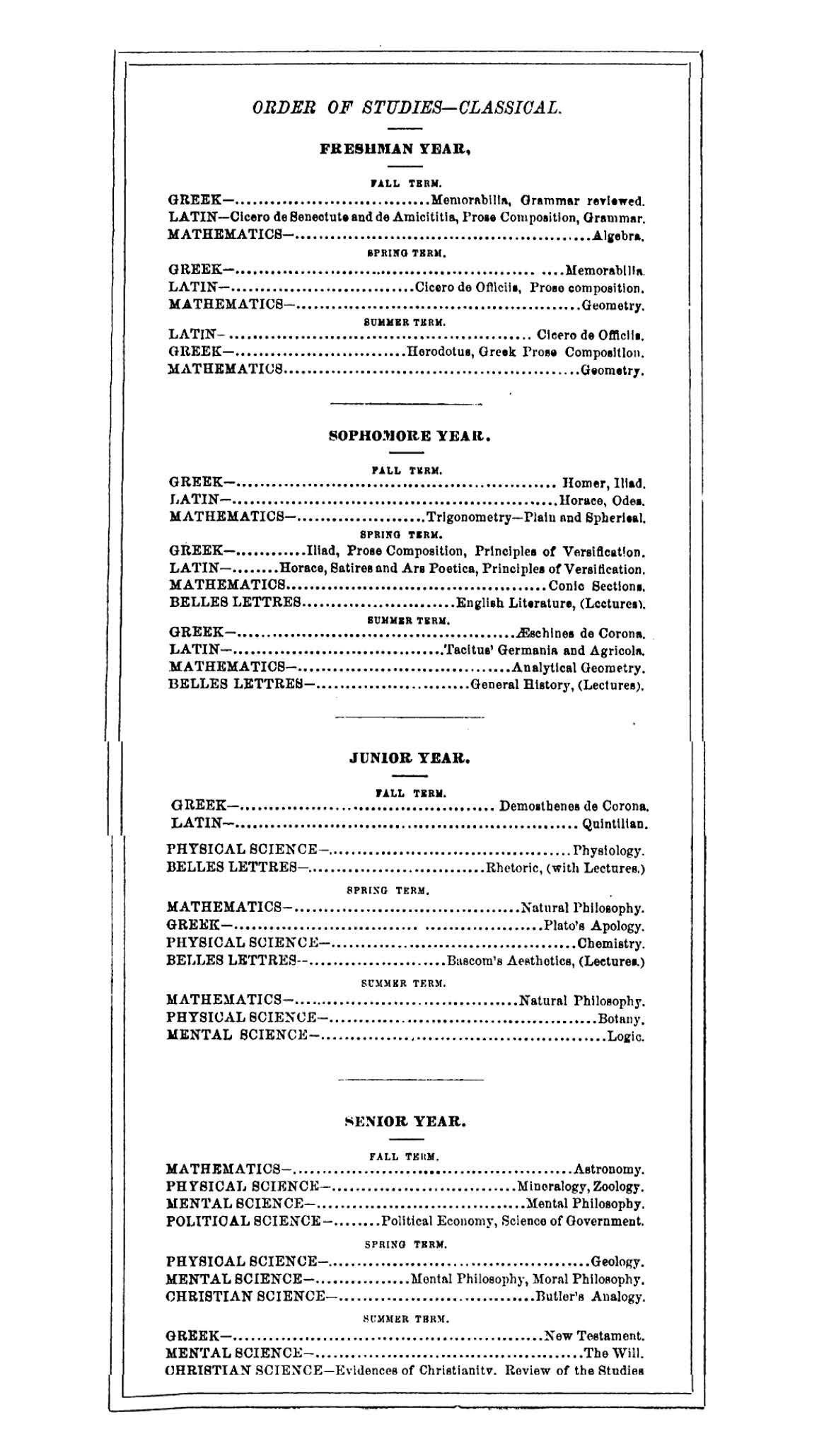
1.) a classical course, leading to the Bachelor’s of Arts (A.B.) degree

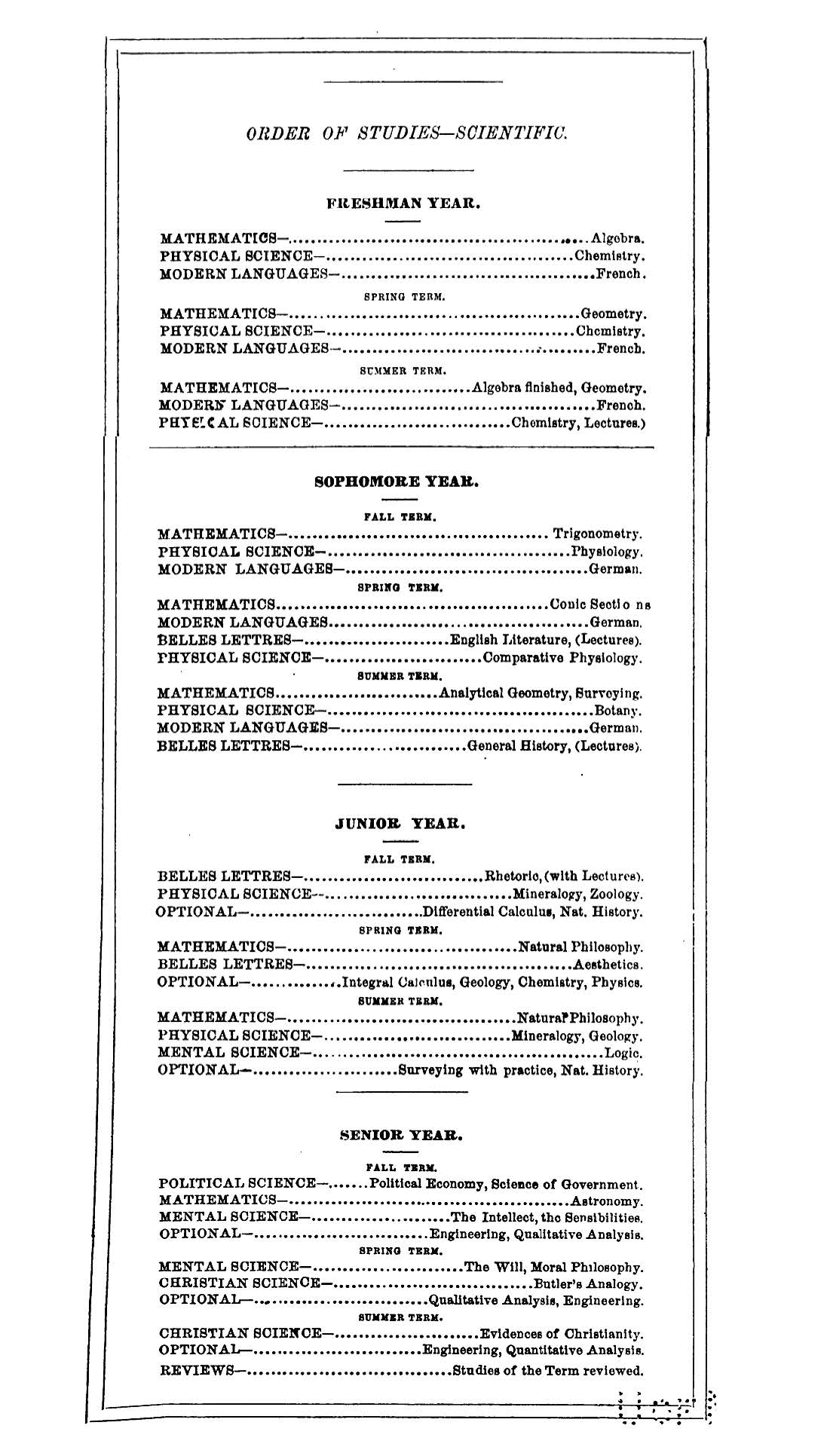
2.) a scientific course, leading to the Bachelor’s of Science (B.S.) degree

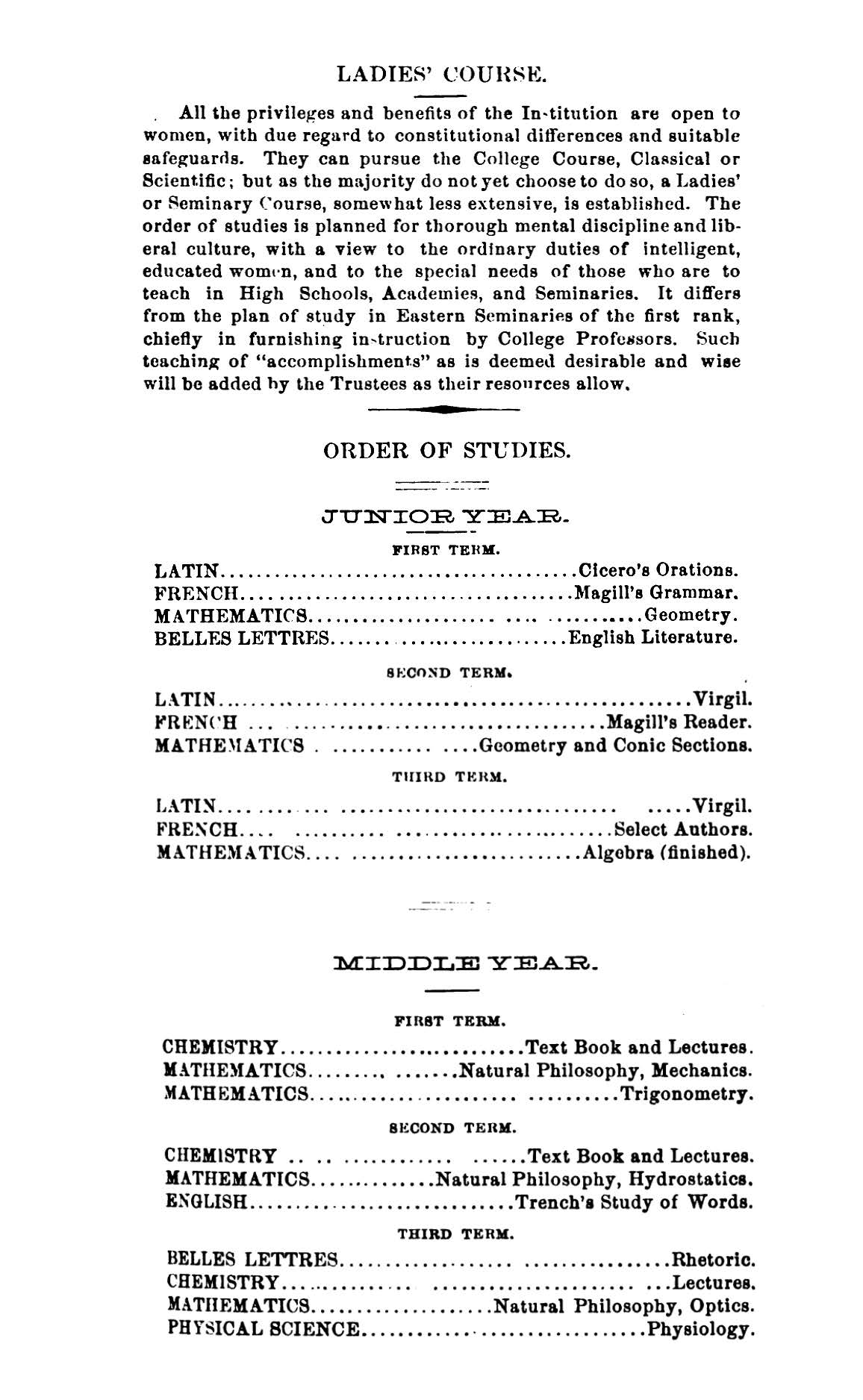
3.) a “Ladies Course,” (explained in the catalog page below) that evolved a decade later into the “Literary” course, and increased from 3 to 4 years. This course, however, led to a diploma rather than a bachelor’s degree.

4.) an “Optional Studies” course, which allowed students to freely choose the classes they wanted to take, but did not lead to a formal diploma or degree.

As you will see (below), each of these tracks were pretty rigid in terms of specifying the array and sequence of courses students would take each year.

Printed, here, are the course requirements and sequencing for those three main tracks, established in 1870.  All students were also required to attend religious service each morning (and twice on Sundays) while Men were required to participate in “military drill.”

In 1875, a Conservatory, or School of Music, was also created as a separate institution (although it was under the supervision of the same board of trustees as the college). It initially awarded diplomas, but by 1890, it also offered a Bachelor’s of Music degree to those who completed the full course of study involving musical theory, musical history, musical education, and demonstrated proficiency in one major, and one minor, instrument. It’s also worth noted that, at this time period, Grinnell College continued to run its preparatory Academy as well as a sizable “English or Normal School” that focused on training future school teachers. At times, the Academy and Normal school enrollment was much larger than the number of students in these collegiate tracks.

Ice Skating at Barber Plaza

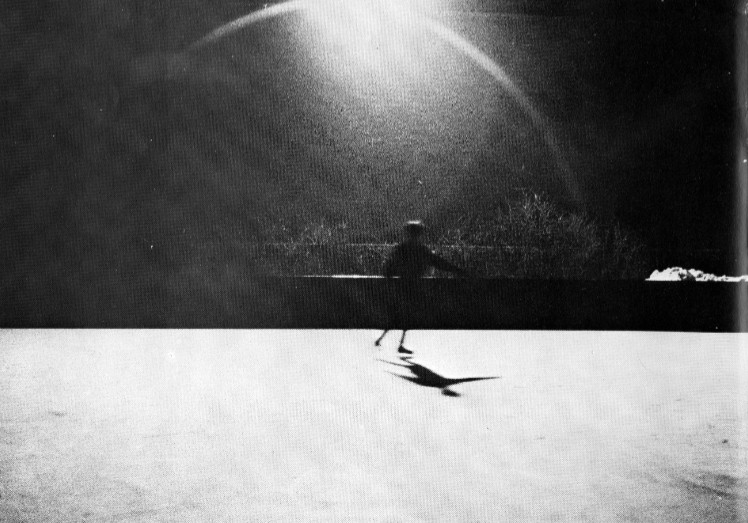
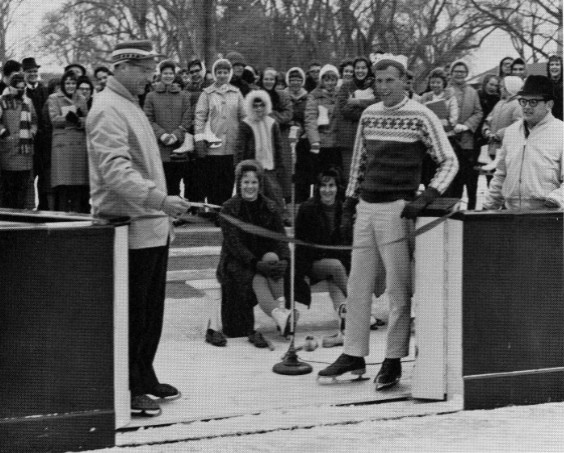
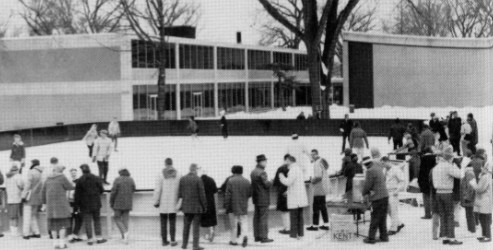
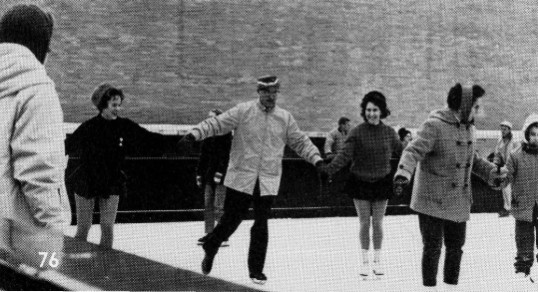
For most of Grinnell’s history, students interested in ice skating took to nearby frozen lakes (such as Arbor Lake in town, or beginning in the 1950s, to the newly created Rock Creek Lake, located seven miles west of the college), while hockey enthusiasts made use of a temporary rink set up each winter for intramural games. But in 1961, a Grinnell alumna and ice-skating enthusiast, Margaret Kyle Barber ’99, donated funds for a more permanent ice-skating rink on campus that would be open from October through March. Named, “Barber Plaza,” and modelled loosely on the ice rink at Rockefeller Center in New York City, this 7,000 square foot rink was constructed to the immediate north-east of the Fine Arts Building, and in fact, used that building’s air-conditioning system to maintain consistently frozen ice on the rink through a network of cooling channels embedded in the plaza’s concrete. During the warmer months—i.e. March through September—the plaza became a useful space for hosting outdoor dances, dinners, concerts, and other events*

At the opening ceremony of Barber Plaza, in January of 1962, President Howard Bowen spoke about the importance of physical exercise and education within a liberal arts college, which was a consistent theme of his presidency which saw a notable expansion in both areas. It also seems as if the 1950s and 1960s represented the peak of “winter culture” on campus, with an impressive range of outdoor activities, programming, and winter sports.


*Having just marked Martin Luther King day, last week, it is worth noting that Barber Plaza served as the site for a large campus gathering on Sunday, April 7th (3 days after King’s assassination in Memphis), in which hundreds gathered to mourn King’s death, to rally in support of the civil right’s movement, and to raise money for the striking sanitation workers in Memphis, TN.

Black Martyrs’ Weekend

In the wake of Martin Luther King’s assassination, on April 4, 1968, the  Concerned Black Students organization (CBS), began planning a “Black Martyrs’ Weekend” that would commemorate the one-year anniversary of Dr. King’s death, the following spring. The first Black Martyrs’ weekend took place from April 3rd to the 6th (1969), and included a range of talks, performances, panels, and lectures honoring those who had died in the struggle for racial justice, while also educating the campus and community, more broadly, about Black culture and the continuing fight for equality. That year’s program included:

  • a talk by the head of the Black Student Party (from San Francisco State)
  • a panel discussion, “In Defense of Black People—The Black Panther Party” (led by members of the Des Mones Black Panther Party)
  • a lecture by Dr. Charles Nichols on “Martin Luther King, Jr. and the present American Mood,”
  • a performance of African dance by members of CBS
  • a concert by The Jackson Five
  • a screening of Martin Luther King’s speech, “Remaining Awake through a Great Revolution.”
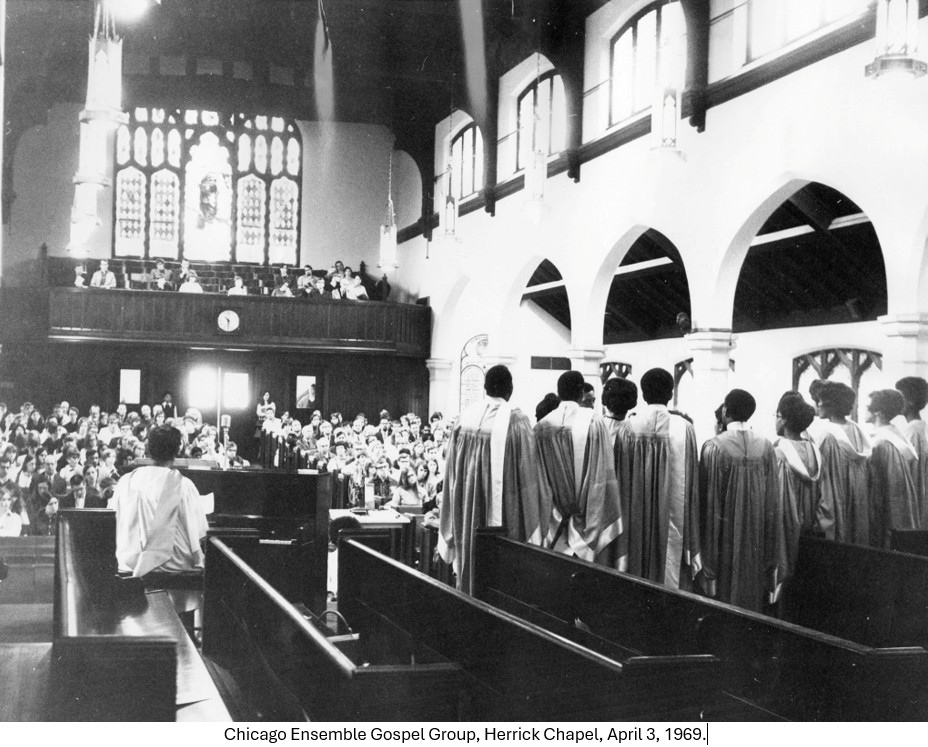
  • a performance by the Chicago Ensemble Gospel Group (pictured here)
  • a sermon by the Father Kwasi Benefee, a black liberation theologian/priest.


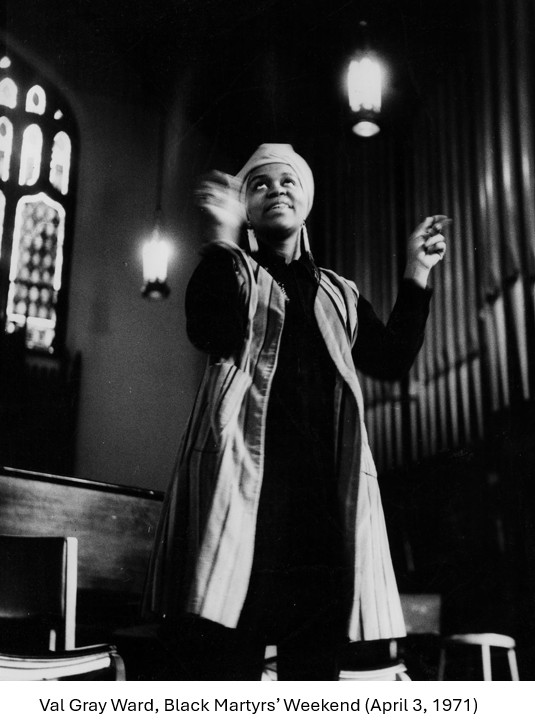
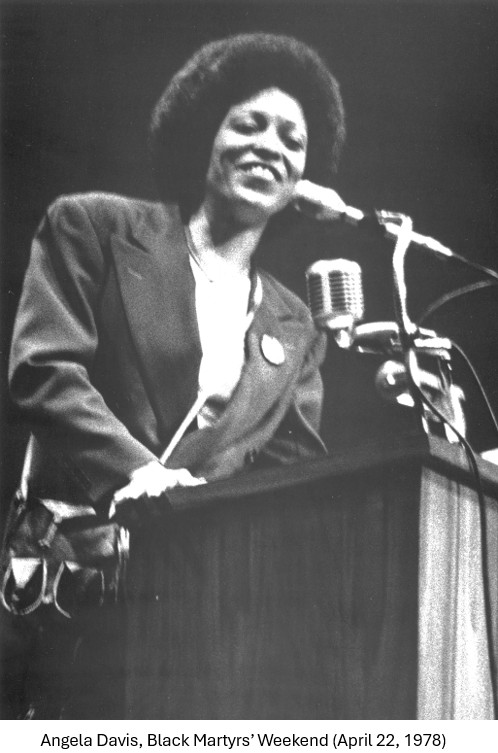
While some events were held in the Forum, many of the talks and performances took place in Herrick Chapel, which would serve as the main site for future iterations of the Black Martyrs’ Weekend that were held throughout the 1970s, and would include many prominent figures like Angela Davis, Gwendolyn Brooks, Dick Gregory, Herbie Hancock, and more.

On today’s campus, the commemoration of Martin Luther King has shifted to January, with the advent of the federal holiday marking MLK Day, in the 1980s. There is something fitting, however, about the fact that this year’s MLK Day speaker, Jamelle Bouie, will delivering his address on “The Civil Rights Movement and the Reconstruction Amendments,” in Herrick Chapel (this Thursday evening). It’s a space, and a pulpit, that has a rich tradition associated with this topic, thanks to the work of the CBS and others who began this process more than fifty years ago.

Page 2 of 4

Powered by WordPress & Theme by Anders Norén