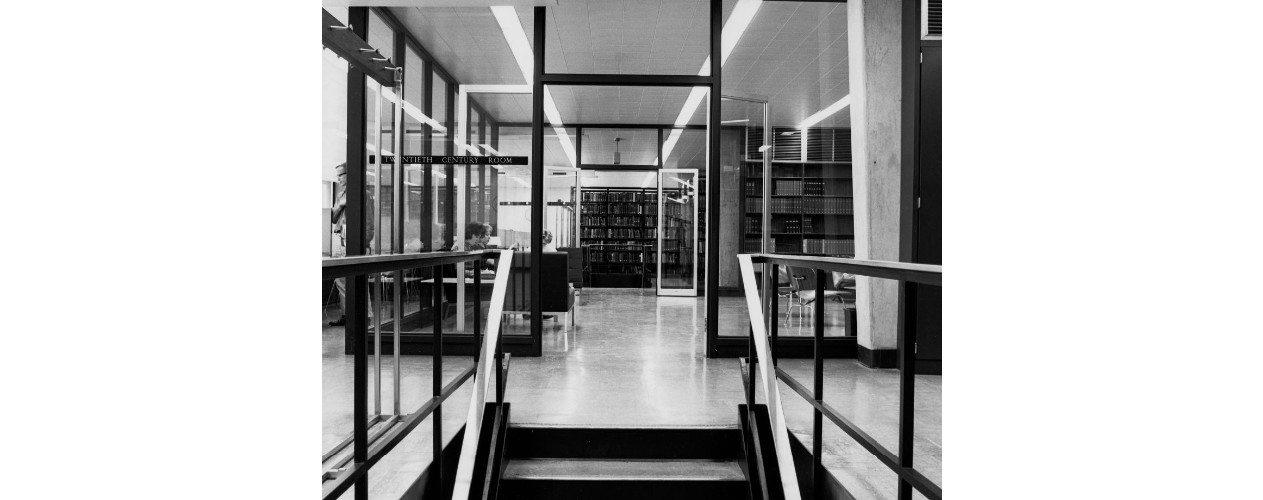
Burling Library’s Twentieth Century Room
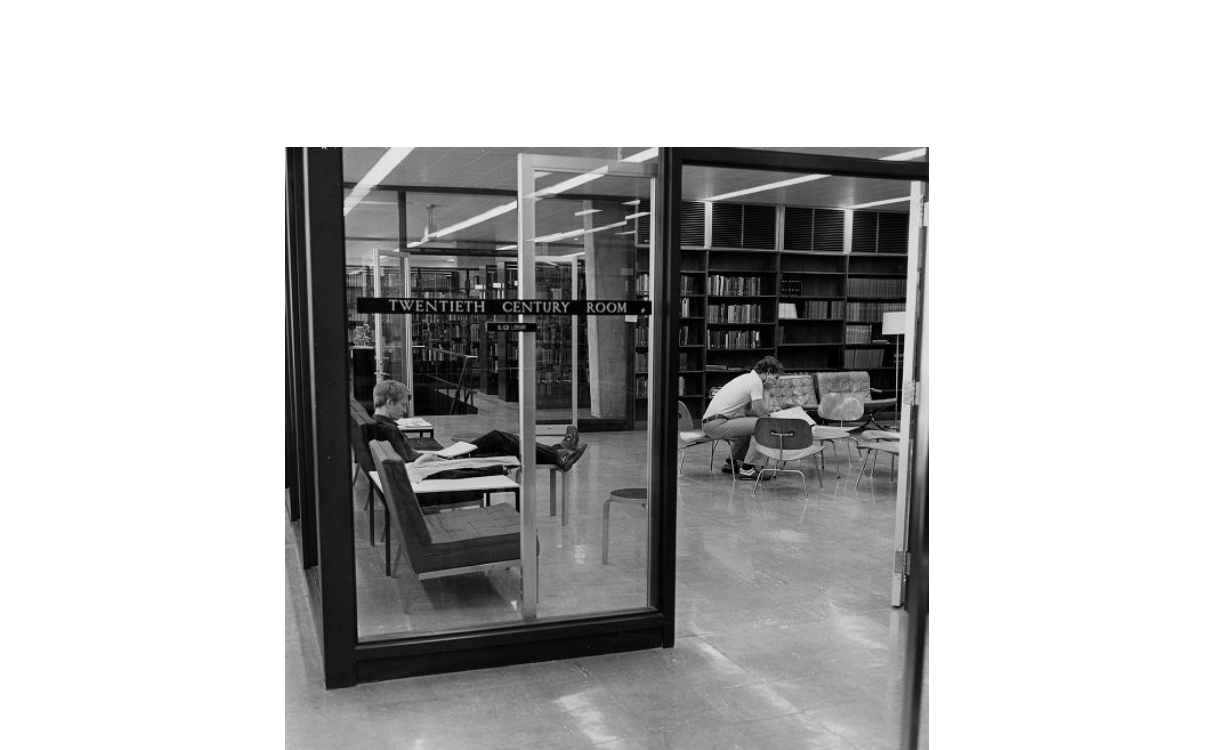
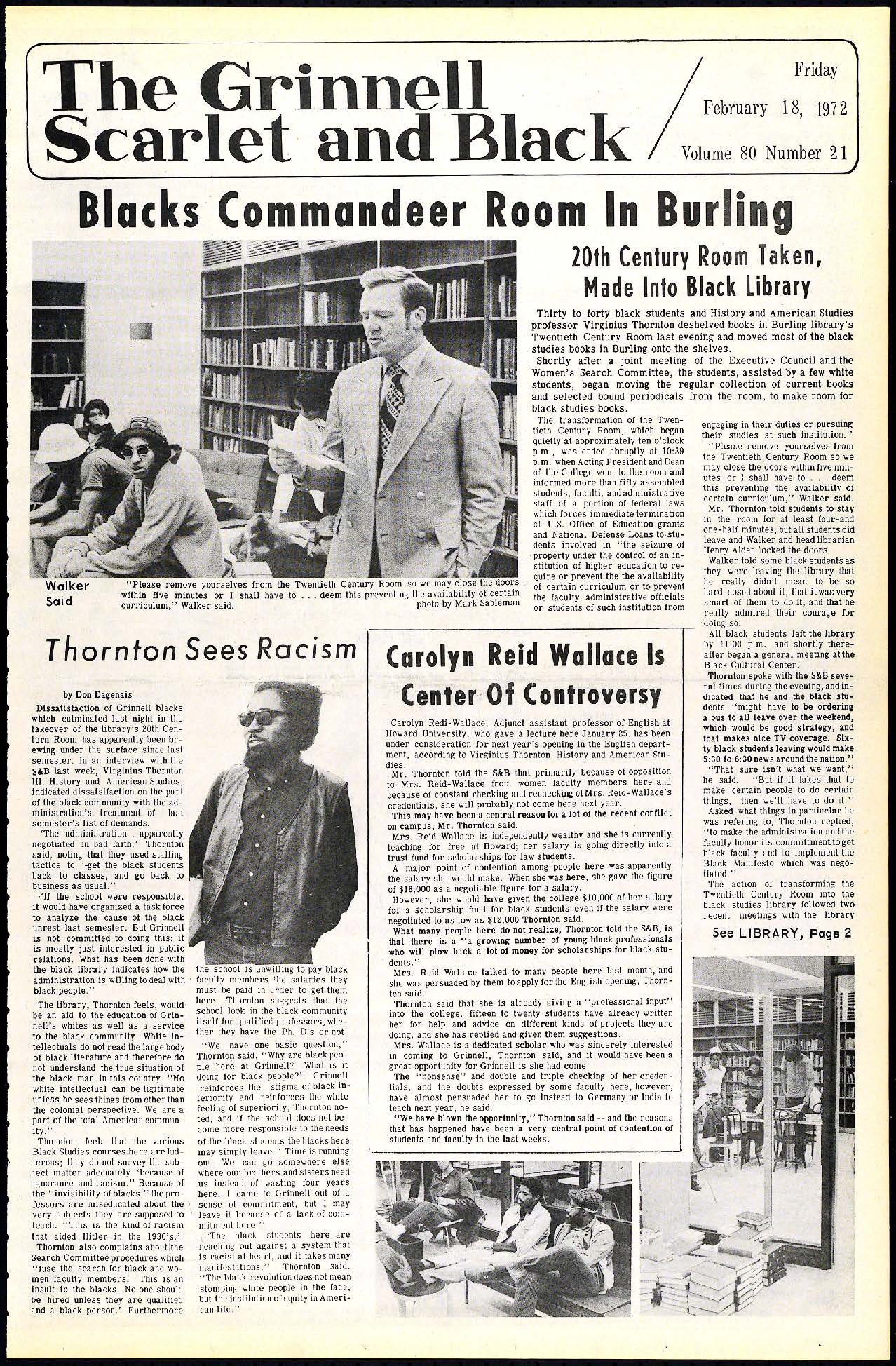
This summer, Burling Library underwent some remodeling and renovations, part of a longer history in which that space has been continually adapted to the changing needs and culture of the college. This week’s images focus on one of the original spaces in Burling—the “Twentieth Century Room”—that was a key part of the initial design in 1958. These two photographs, from 1962, offer a glimpse of the Twentieth Century Room, and the editorial from James Kissane (then Professor of English at the college) in the S&B in 1981 expresses his views about why the room was important and why he regretted its passing.
25 years in the life of a college
The climates of Grinnell
by James Kissane
It’s a shocking reminder of how long I’ve been at Grinnell to realize that Burling Library, which didn’t exist when I started teaching here, is now in need of an overhaul. I’d rather not dwell on the parallels between the present condition of Burling and my own possible need of repair; it’s more interesting to reflect on the changes in store for the library as they symbolize the differences one feels between what the College was like in the late 1950’s and how it is today.
Burling was an important expression of a new era at Grinnell. The College had been visited by a new academic climate, one I should label a climate of standards. I don’t mean excellence had not been a goal at the .College all along, but in the late ’50’s and early ’60’s we embraced the word “Excellence” did not provoke cynicism from the faculty nor fiscal conservatism from the trustees.
The feature of Burling that best reflected that climate was the study lounge in the mezzanine called “The Twentieth Century Room.” The idea was to fill the handsome shelves lining its walls with the greatest books written in our own century. The furniture chosen for this room was a collection of pieces representing the most distinguished styles of the twentieth century. The effect was a rather museum-like but nonetheless pleasing and altogether impressive “anthology” of modern design: work by Eames, Saarinen, Mies van der Rohe, and other masters of the art.
To create a space containing the most important modern books and appoint it with the most elegant modern furniture must figure to many today as a curious and pretentious extravagance; at the time it seemed to the College an appropriate way of putting the best in front of its students. The room was certainly comfortable, but its utility was not the point so much as its class. The aim was inspiration and perhaps a bit of earnest flattery.
This spring, by contrast, as plans for Burling’s renovation advance, carpenters have created a mock-up of portions of a “study tower” that will consist of a complex of carrels perfectly suited to the study habits of Grinnell’s students. They have been urged to try out these mock-ups, and student reactions and suggestions will be reflected in the final designs of the furnishings and spaces of this study tower. Such canvassing of student preferences would not have occurred to the architects and planners of the Twentieth Century Rooni; to do so would have contradicted the assumption that those preferences were more to be influenced by the College environment then vice versa. The study tower, however, will (assuming the students’ “input” has been effective) reflect their tastes and should of course be enormously popular, at least so long as those tastes remain in force.
I take the study tower to be symptomatic of the institutional climate we have been passing through, a climate not of standards but of services. As I see it, the institutional authority the administration and the faculty relinquished during the mid-’60’s and early 70’s has been reasserted, but in different ways and on a different basis. The. College is now modest in its profession of insight and conviction regarding what constitutes liberal learning; instead it professes practical expertise and promises to purvey services that will stand its students in good stead. Given the current competition among private colleges for qualified students and also the relatively grim prospects facing many liberal arts graduates, it is hardly surprising that a college less prestigious and less favorably situated than, say, Harvard should make its appeal to students through an increasing array of services.
I presume I needn’t particularize Grinnell’s considerable involvement in providing services to its students in such diverse, areas as career and personal counseling, academic advising, off-campus apprenticeships, and remedial writing and reading. We do not merely aim to please; we are now experts at what pleases. This spring our preoccupation with services reached its acme with the initiation of a shuttle to the liquor store.
No doubt it’s an attractive quality in a college to be gracious and obliging to its students. But making provision for students is not the same as educating them. A climate of services leads students to think of themselves as clients or customers. They will expect, therefore, to have their tastes and values catered to rather than challenged, enriched, or refined. To encourage students in the habits of wary customers, whose only measure of educational value is what they are sure they can use, may stifle their intellectual curiosity and impede their maturity.
The renovations planned for Burling Library will, I’m sure, be a welcome improvement; nor do I object strongly to study spaces designed by consensus. But I persist in thinking that the notion behind the original Twentieth Century Room remains truer to the essential idea of a college like ours. We all need to live in the presence of ideas and forms and other human creations considerably grander than what we could have imagined for ourselves; we need to be confronted by purposes larger and finer than our own. It’s acknowledging this need that makes us educable; and it’s stimulating and answering this need that gives a college, however its climate changes, a task to perform.




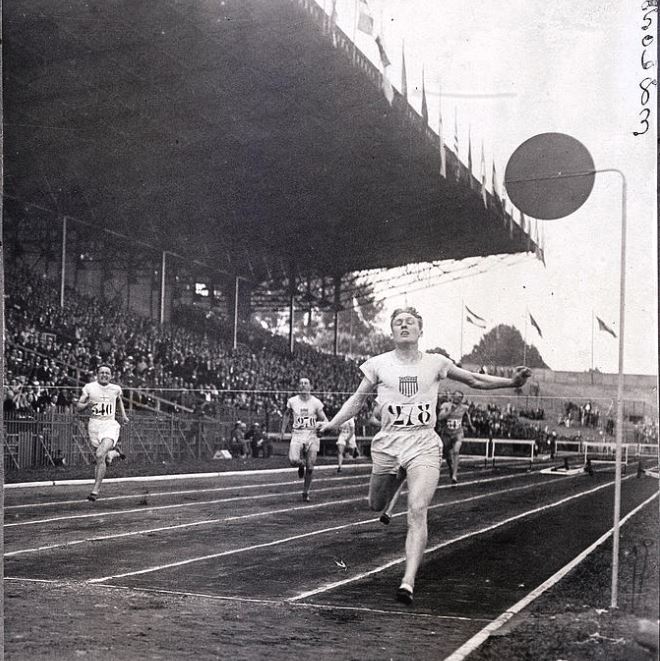
 F. Morgan Taylor was one of Grinnell’s most decorated athletes of the 20th century. In the summer of 1924, while a student at Grinnell, Taylor won the U.S. Olympic trials for the 440-yard hurdle, setting a world record time of 52.6 seconds in the process (because a hurdle was knocked down, it did not count as an official world record). At the Paris games, Morgan again came in under 53 seconds, winning a gold medal (pictured here). In all, Morgan won four collegiate (AAU) titles, and two more Olympic bronze medals in 1928 and 1932 (loosing out to the famed British hurdler, Lord Burghley, who was fictionally immortalized in the film, Chariots of Fire). Morgan was widely respected by his colleagues and was elected as the captain of the U.S. track and field team for the 1932 Olympics (Los Angeles) as well as the official flag bearer for team U.S.A (pictured here) one of the highest honors in Olympic sports.